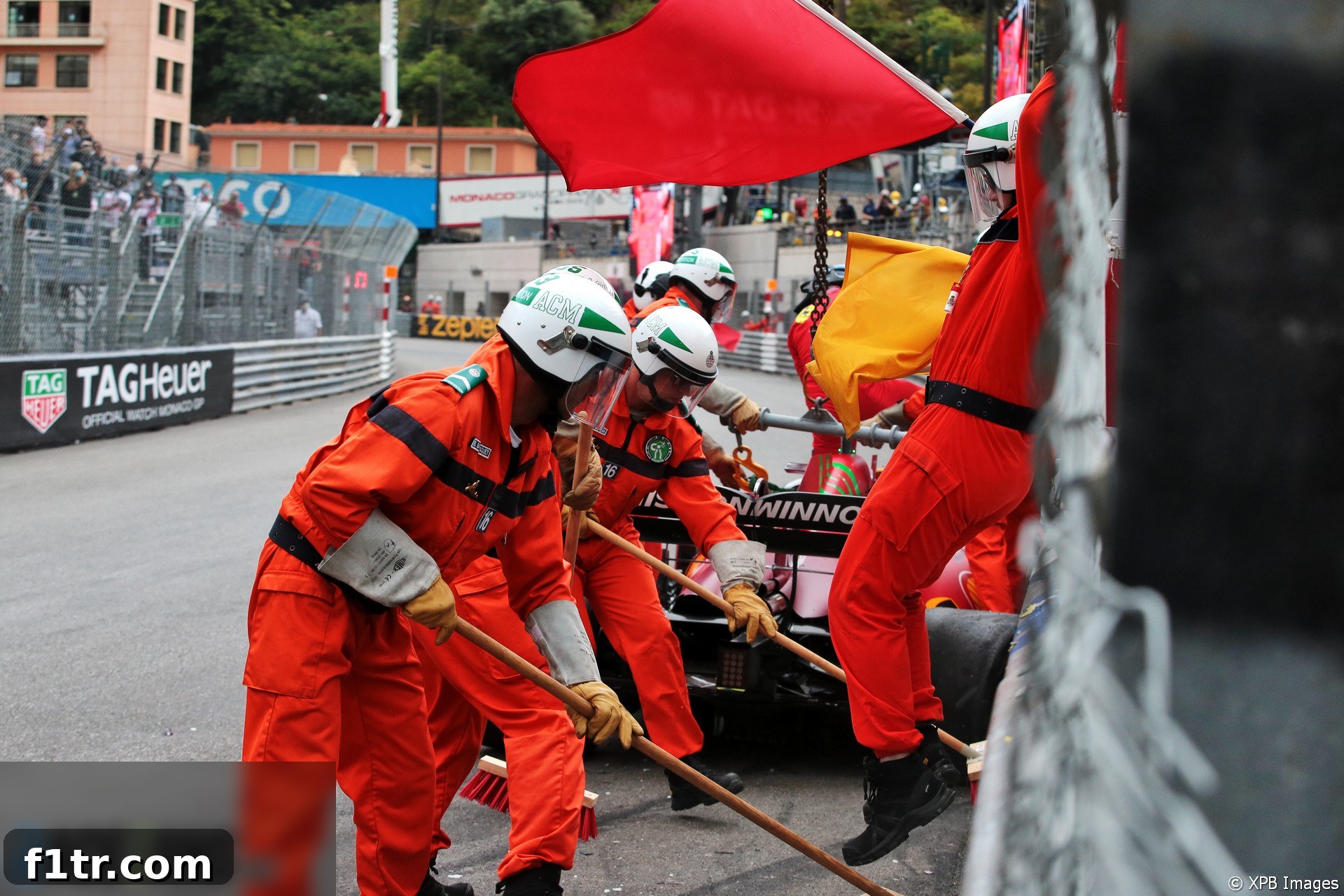
The roar of the crowd and the frantic energy of the Monaco Grand Prix qualifying session were punctuated by a dramatic crash involving local hero Charles Leclerc. Securing pole position in a spectacular fashion, Leclerc pushed his Ferrari to the absolute limit, only to clip the barriers at the challenging Swimming Pool complex. The subsequent red flags, while confirming his provisional pole, also sparked a familiar and often contentious debate within the Formula 1 paddock and media circles. Whispers of “Schumacher 2006” and “Rosberg 2014” immediately began to circulate, invoking memories of past controversies surrounding qualifying incidents in the principality.
Advert | Become a Supporter & go ad-free
The parallel to Michael Schumacher’s infamous 2006 incident at Rascasse remains etched in F1 lore. In a move widely perceived as deliberate, the seven-time world champion executed a broadside parking maneuver that effectively blocked the track, preventing arch-rival Fernando Alonso and others from improving their times in the dying moments of qualifying. This controversial act, which some dubbed ‘Rascassegate’, led to a marathon stewards’ inquiry. Ultimately, Schumacher was relegated to the back of the grid, a severe penalty that underlined the FIA’s disapproval of actions that could manipulate qualifying outcomes. The incident raised profound questions about sportsmanship and the very integrity of competition at the highest level.
Fast forward to 2014, and a different Mercedes driver found himself under scrutiny. Nico Rosberg, having set the fastest time in Q3, locked up his wheels at Mirabeau, triggering yellow flags that thwarted teammate Lewis Hamilton’s final attempt at pole position. The crucial difference here was the lack of visible damage to Rosberg’s Mercedes, which fuelled paddock suspicions regarding the intentionality of the lock-up. Despite the raised eyebrows and intense speculation, Rosberg emerged unscathed from the stewards’ review, retaining his pole position. This incident, while less clear-cut than Schumacher’s, further cemented the perception that certain drivers might employ strategic mishaps to their advantage in the unique environment of Monaco.
The immediate comparison of Leclerc’s crash to these prior incidents, however, quickly dissolved upon closer inspection. Leclerc’s accident was far from subtle; it was a brutal encounter with the unforgiving Monaco barriers. Not only did the Monegasque driver rip off the Ferrari’s right front wheel upon impact at the corner entry, but the subsequent force from the rear wheel hitting the barrier sent severe shockwaves through the transmission all the way to the left hub. This extensive damage proved critical, ultimately forcing his retirement from his home Grand Prix during the reconnaissance lap. The sheer violence and debilitating nature of the crash provided a stark contrast to the less damaging incidents of Schumacher and Rosberg, suggesting a genuine driving error rather than a calculated maneuver.
Does the catastrophic outcome of Leclerc’s crash truly sound like a driver engineering an incident to deny Max Verstappen pole position, a position the Red Bull driver would effectively inherit once the Ferrari was wheeled into the pits and garage? For an unequivocal example of a deliberate crash, one need only recall Nelson Piquet Jnr’s ‘Crashgate’ incident in Singapore 2008. Piquet Jnr intentionally crashed his Renault to trigger a Safety Car, a premeditated act designed to benefit his teammate Fernando Alonso. The damage inflicted on Piquet Jnr’s car, while significant, was part of a nefarious plan, a stark difference from Leclerc’s genuine oversteer and subsequent heavy impact.
Indeed, investigations by the FIA after Leclerc’s incident confirmed the absence of any suspicious intent. A source close to the FIA revealed that there was no discernible difference in Leclerc’s throttle or steering inputs between his qualifying lap and his previous attempts, save for a marginal one or two inches further to the right as he entered the Swimming Pool section. This tiny deviation, amplified by the unforgiving nature of the Monaco circuit, proved to be the difference between a triumphant pole position lap and a race-ending collision. It was a precise, expensive misjudgment, not a calculated act of gamesmanship.
The subsequent outcry after qualifying, therefore, appears to have been not only misguided but also fueled by historical precedents that did not accurately reflect the circumstances of Leclerc’s crash. This debate inevitably raised a critical question for Formula 1: Should the regulations be altered to penalize a driver who, while pushing to the absolute limit in the closing stages of qualifying, makes an error and crashes in the process? During his post-race debrief, FIA race director Michael Masi acknowledged the ongoing discussion, admitting that F1 could indeed consider adopting a regulation similar to those applied in IndyCar and other prominent motorsport championships around the globe.
Advert | Become a RaceFans supporter andgo ad-free
“I am well aware of the IndyCar rule, which is also implemented across a number of other FIA international series and various domestic championships globally,” Masi stated. “We are committed to reviewing it thoroughly, in collaboration with all key stakeholders, to determine its suitability or otherwise for Formula 1.” This statement opened the door to a potentially significant shift in how F1 approaches qualifying incidents, prompting a deeper dive into the specifics of these alternative regulations.
So, what exactly do the IndyCar regulations stipulate regarding such incidents that trigger a red flag? Article 8.3.9 of the IndyCar rulebook explicitly states: “If a car causes a red condition in any segment, the car’s best two timed laps of the segment shall be disallowed, the car may not continue in the segment, and the car shall not advance to the next segment.” This rule is designed to prevent drivers from deliberately, or even accidentally, gaining an unfair advantage by causing a session stoppage. It’s a swift and decisive penalty, ensuring that the driver who brings out the red flag suffers a direct and immediate consequence for disrupting the session.
Under the stringent framework of IndyCar rules, had they been applied to Formula 1, drivers like Leclerc, Schumacher, and Rosberg would all have forfeited their pole positions for causing red flags. More broadly, any driver who inadvertently strays beyond the absolute limits at any circuit during any qualifying session – the ultimate test of speed and precision in a Grand Prix weekend – would be penalized by having their two best laps scrapped. This universal application aims to maintain fairness and discourage any perception of tactical errors, regardless of intent. The implications for F1, a series renowned for its high stakes and individual driver heroics, would be profound.
Considering the unique circumstances of Monaco, this entire discussion about a potential rule overhaul largely stems from a relatively small number of high-profile incidents – three over 15 years, with only one of them conclusively deemed deliberate. Is such a significant regulatory change truly warranted for such isolated occurrences, particularly given the specific, unforgiving nature of the Monaco street circuit? This is a question that requires careful consideration of F1’s core values and identity.
The undeniable truth is that the Monaco street circuit presents the single greatest challenge to driver precision and car control in all of motorsport. Devoid of the expansive run-off areas common at modern purpose-built tracks, save for the occasional coincidental space provided by the urban landscape, accidents are an inherent and inevitable part of the Monaco experience. Drivers are compelled to push their machines and their own abilities to the absolute ragged edge, often venturing beyond it. This commitment to pushing the limit, however, is surely the very essence of Formula 1. It is what captivates fans, what defines legends, and what makes the sport so thrilling. To introduce a draconian penalty for such incidents would inevitably breed caution, forcing drivers to hold back, denying spectators the breathtaking spectacle of cars dancing millimeters from the barriers, operating at the zenith of human and mechanical performance.
Formula 1 has a well-documented history of implementing knee-jerk rule changes, often in response to specific incidents or perceived injustices. All too frequently, these hurried alterations lead to unforeseen and unintended consequences, which then manifest themselves in other areas of the sport, demanding yet another round of complex rule modifications, creating a perpetual cycle of regulatory adjustments. Leclerc’s incident in Monaco was undoubtedly extremely costly, both for himself personally and for the Scuderia Ferrari team. It resulted in a missed opportunity for a home victory and significant repair bills. You can be absolutely certain that both the driver and the team have learned an invaluable lesson from this experience. In the unforgiving world of top-tier motorsport, experience often proves to be the most effective teacher, far more so than an arbitrary, ad hoc rule change imported from a vastly different racing series with its own unique characteristics and philosophy.
Hopefully, Michael Masi and the decision-makers within Formula 1 will conclude that the IndyCar regulation, while effective in its own context, is ultimately “not suitable” for the broader landscape and unique spirit of F1. The essence of Formula 1 lies in daring, in pushing boundaries, and in the raw, unadulterated talent of its drivers navigating the most challenging circuits. Penalizing genuine errors that occur at the absolute limit risks diluting this core appeal. The current system, with its inherent risks and consequences – like Leclerc’s race-ending damage – provides its own powerful deterrent and learning mechanism, preserving the integrity and excitement that fans worldwide cherish.
Advert | Become a RaceFans supporter andgo ad-free
News Focus
- No happy ending for Ricciardo’s made-for-Netflix redemption arc
- No ‘two alphas’ for Red Bull as team forms its longest-running driver line-up
- Will Mercedes come to the rescue of Ocon’s career a third time?
- How the midfield’s hottest team mate rivalry boiled over
- Petty officialdom or deserved decisions? Five drivers stripped of wins in 2024
Browse all News Focus articles