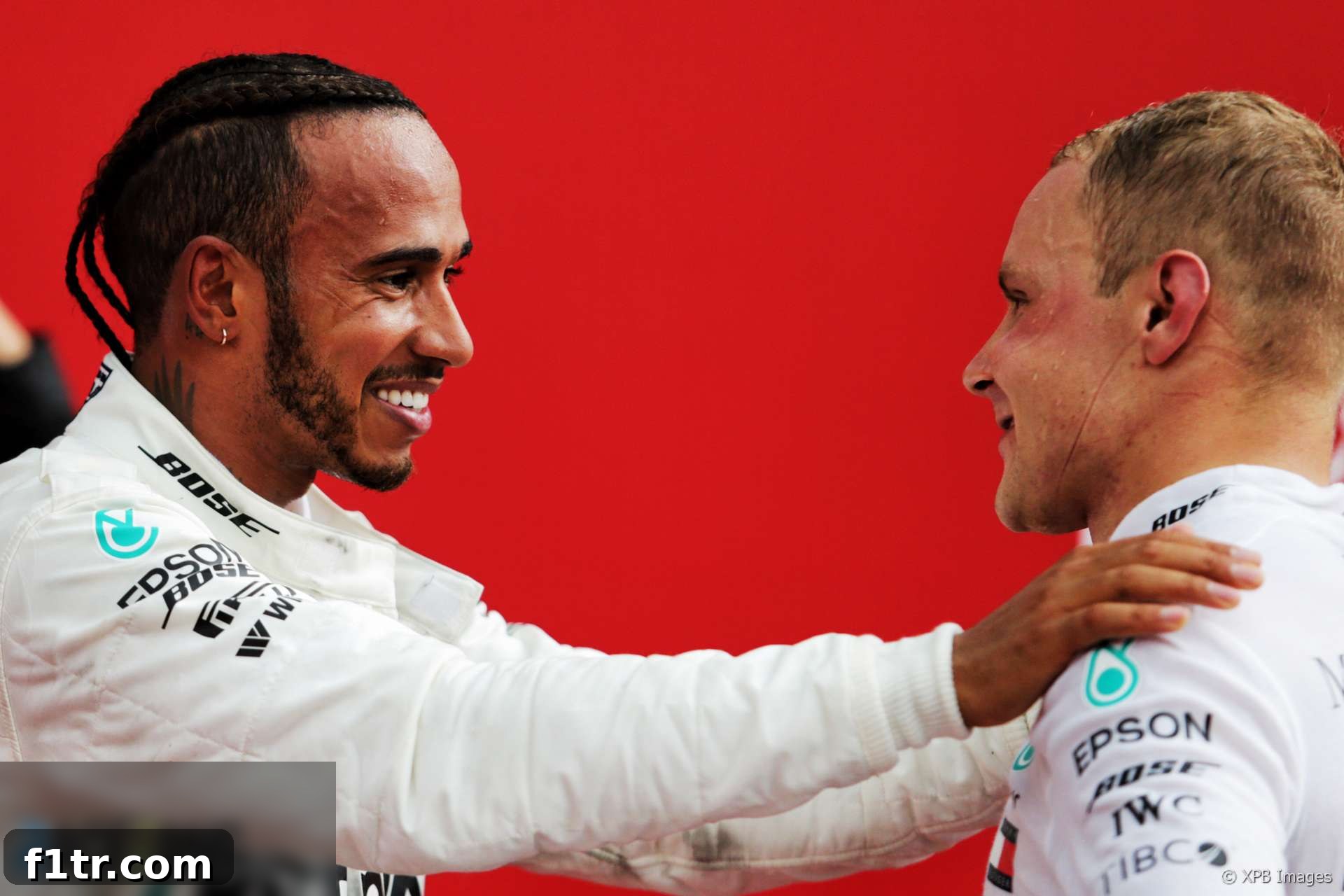
The aftermath of the German Grand Prix often brings with it discussions of strategic brilliance, driver heroics, and occasionally, the contentious subject of team orders. In a race laden with drama and fluctuating fortunes, Mercedes team principal Toto Wolff found himself at the center of such a debate. Following a crucial “hold position” directive issued to his drivers, Wolff vehemently defended the team’s decision, asserting that the order would have been identical regardless of which Mercedes driver was leading at the time. This strategic call, which saw Valtteri Bottas maintain his second-place position behind Lewis Hamilton in the closing stages of the race, was pivotal for the Silver Arrows, allowing them to secure a vital one-two finish.
Wolff’s explanation aimed to dispel any notions of favoritism towards Hamilton, who was Mercedes’ leading contender in the 2018 Formula 1 championship battle. The Austrian team boss emphasized that the paramount objective was to maximize the team’s points haul, especially after suffering a period of what he described as “bad luck” in previous races. This desire to recover lost ground and solidify their standing in the constructors’ championship superseded individual driver aspirations in that specific moment. The delicate balance between allowing drivers to race freely and intervening for the greater good of the team is a perennial challenge in Formula 1, and the German Grand Prix served as a stark reminder of these high-stakes decisions.
Understanding Mercedes’ Strategic Imperative
The “hold position” order, while seemingly straightforward, carries immense weight in the hyper-competitive environment of Formula 1. For Mercedes, the decision to freeze the running order was not, according to Wolff, about elevating one driver’s championship ambitions over another’s. Instead, it was a calculated move to ensure the team brought home the maximum possible points. “No, absolutely not,” Wolff stated definitively when asked if the order was given to ensure Hamilton, as the championship leader, scored more points. He elaborated, “If it would have been the other way around with Valtteri in the lead and Lewis second, we would have made the same call. Identical call. It was about bringing it home; we respected who was in the front.”
This statement underscores a fundamental principle often cited by top F1 teams: prioritizing the collective over the individual when the stakes are high. The 2018 season was a fiercely contested battle, with Ferrari and Sebastian Vettel posing a significant threat to Mercedes’ dominance. Every point mattered, and a one-two finish provided a substantial boost, not only in terms of championship points but also in demonstrating the team’s capability and control under pressure. Wolff further clarified that the team’s priority was “to score the one-two in order to recover some of the points that we lost to bad luck,” suggesting a broader strategic perspective that transcends the immediate race outcome for individual drivers.
The Fine Line Between Team Strategy and Driver Fairness
The decision to impose team orders invariably ignites debate among fans, pundits, and even within the racing fraternity itself. Many argue that such interventions detract from the purity of competition, denying spectators the spectacle of uninhibited racing. However, from a team management standpoint, especially in a championship fight, these calls are often deemed a necessary evil. Wolff articulated this internal struggle, highlighting the tension between optimizing results and maintaining fairness for both drivers. He pointed out that while racing is paramount, there comes a point in the season – typically the final third or quarter – where championship implications might necessitate such an “uncomfortable call.”
Crucially, Wolff stressed that the 2018 season was “much too early” for championship considerations to dictate team orders directly based on driver standings. The German Grand Prix decision, he maintained, was solely for securing the one-two. This distinction is vital for a team aiming to foster internal harmony and ensure both drivers feel they have an equal opportunity to compete and win. The challenge lies in convincing both drivers, and the wider public, that such decisions are made impartially and solely for the team’s benefit, rather than an endorsement of one driver over the other.
Ferrari’s Parallel Predicament: A Universal Challenge
Interestingly, Mercedes was not the only top team grappling with team orders during the same race weekend. Ferrari also found themselves in a similar strategic bind, instructing Kimi Raikkonen to allow Sebastian Vettel to pass at a certain stage of the German Grand Prix. Wolff acknowledged this as “also a very difficult call” for Mercedes’ rivals, demonstrating an understanding of the complex pressures that lead to such decisions. He empathized with Ferrari’s situation, recognizing the dual objectives of maximizing results while giving both drivers a fair chance.
Wolff reflected on Ferrari’s context, noting Raikkonen’s perceived “unlucky” run in earlier races where strategy had not favored him. “On one side, we want to optimise the result, and that is what you need to do, but on the other side, you need to give both drivers a chance to win the race,” Wolff commented. “Kimi was unlucky in a few races at the beginning of the season where the strategy went against him, and I think Ferrari struggled to come up with the right call there. It’s understandable.” This insight from a direct competitor highlights the universality of these strategic dilemmas in Formula 1, where every team principal must navigate the delicate balance between individual driver ambitions and the overarching goals of the constructor’s championship.
The 2018 F1 Season: A Crucible of Competition
The 2018 Formula 1 season stands out as a particularly intense period in recent memory, characterized by a fierce championship battle between Mercedes and Ferrari. Lewis Hamilton and Sebastian Vettel were locked in a captivating duel, with both teams pushing the boundaries of performance and strategy. The German Grand Prix, held at Hockenheim, was a pivotal moment in this championship narrative. The race was unpredictable, with changing weather conditions adding another layer of complexity to strategy calls. Hamilton started from an uncharacteristically low position after qualifying but capitalized on the chaotic race conditions and a strategic masterstroke by his team to surge through the field and ultimately win. Valtteri Bottas, who had shown strong pace throughout the weekend, was a strong contender for the win himself, making the “hold position” order all the more significant and contentious.
In this high-stakes environment, where every point could swing the momentum of the championship, team orders, while unpopular with purists, become a calculated risk. A one-two finish not only delivers a substantial points haul but also sends a powerful message of team unity and strategic prowess. For Mercedes, securing this result at their home race, especially after a challenging start to the weekend for Hamilton, was a profound statement. It underscored their unwavering focus on the constructors’ title and their ability to execute under pressure, even if it meant making difficult decisions that would inevitably spark debate.
The Enduring Debate on Sporting Integrity vs. Team Objectives
Team orders have been a recurring and often controversial element throughout the history of Formula 1. From the infamous “multi-21” incident at Red Bull to various instances across different eras, the conflict between pure sporting competition and team objectives is a constant source of tension. Teams argue that their primary responsibility is to their shareholders, sponsors, and ultimately, to win championships. This often necessitates strategic interventions that might not always align with the romantic ideal of two drivers fighting tooth and nail until the very last lap.
However, the impact on driver morale and fan perception cannot be understated. Drivers, by nature, are fiercely competitive individuals, and being asked to yield a position to a teammate can be a significant psychological blow. Fans, too, often feel short-changed, yearning for unadulterated racing. The challenge for team principals like Toto Wolff is to manage these expectations and ensure that while strategic decisions are made for the collective good, they do not irrevocably damage internal relationships or alienate the fan base. The German Grand Prix team order served as yet another chapter in this ongoing, complex narrative, highlighting the strategic imperatives that often dictate the ultimate outcomes in the thrilling world of Formula 1 racing.