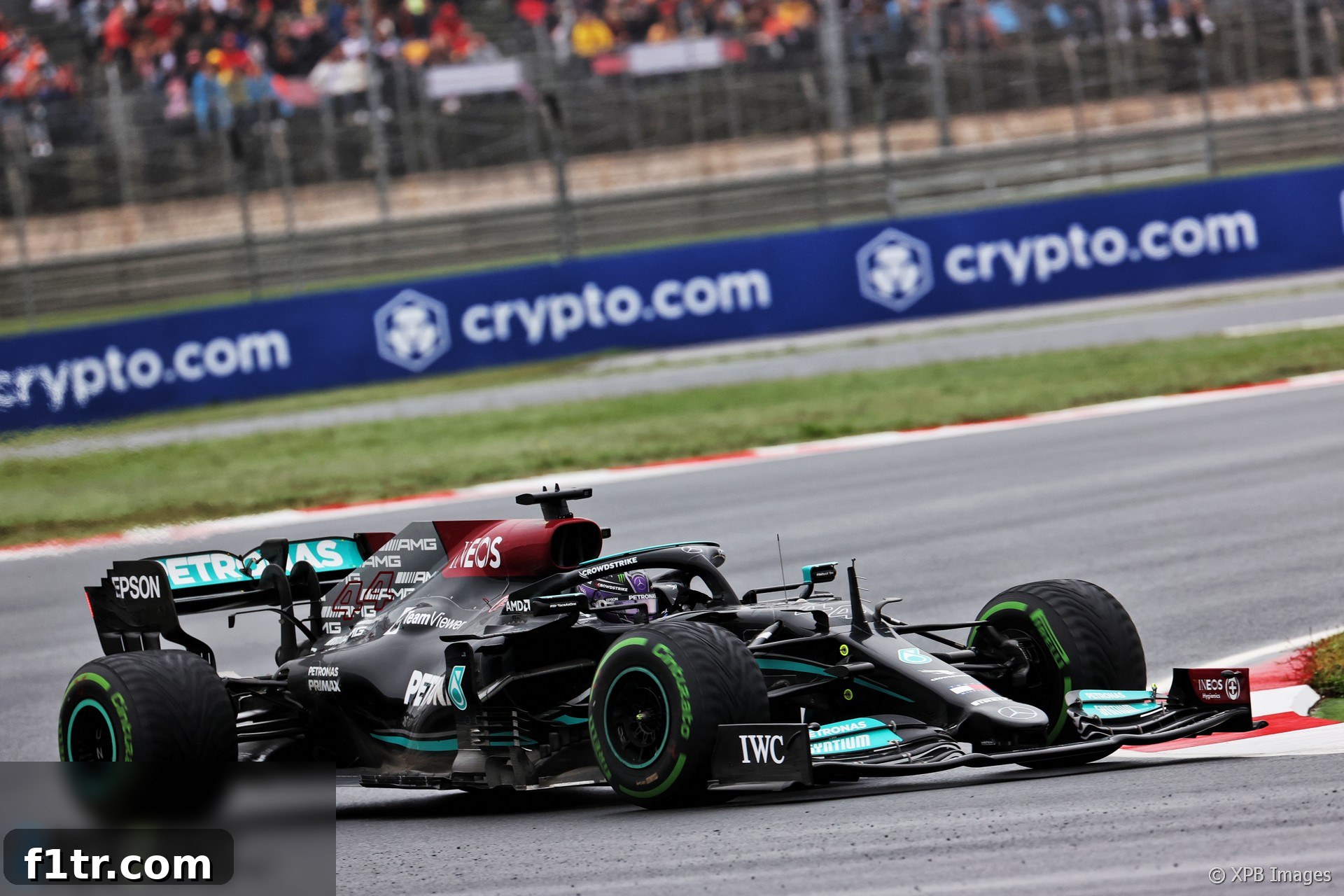
In the high-stakes world of Formula 1, every strategic decision can mean the difference between victory and defeat, or in the case of a championship contender, vital points. The 2021 Turkish Grand Prix at Istanbul Park presented just such a scenario, turning a seemingly straightforward race into a masterclass of strategic dilemmas, particularly for Mercedes and their star driver, Lewis Hamilton. Emerging from a challenging Sunday, Hamilton openly voiced his belief that his team made the wrong call regarding his tyre change during the race’s crucial closing stages, a decision that ultimately cost him valuable track position and championship points.
The Istanbul Park circuit was a theatre of constantly evolving conditions. A persistently damp track, having been wet throughout the day, slowly began to dry as the race progressed. This presented a unique strategic challenge: how long could drivers make their intermediate tyres last, and when was the optimal time to switch? Most drivers began their race on intermediate tyres, meticulously managing them to extend their lifespan, knowing that a premature switch to slicks would be catastrophic, while an overdue change could lead to significant performance drop-off.
Advert | Become a Supporter & go ad-free
Hamilton’s race had been a testament to his exceptional skill and determination. Starting from a challenging 11th position on the grid due to an engine penalty, he executed a brilliant opening stint, carving his way through the field with surgical precision. By the early stages, he had climbed to a remarkable fifth place. As drivers ahead of him began to make their anticipated pit stops around lap 36, Hamilton found himself elevated further, reaching third position. His intermediate tyres, despite the laps accumulated, felt good to him, providing adequate grip and consistent lap times. This confidence led him to turn down an initial request from the Mercedes pit wall to come in, preferring to stay out and assess the track conditions further.
The decision to refuse the first pit call was rooted in Hamilton’s exceptional feel for the car and tyres, a trait that has often served him well throughout his illustrious career. He believed his current set of intermediate tyres still had life and offered a competitive edge on the slowly drying track. Pushing the boundaries of tyre wear is a calculated risk, and Hamilton, in that moment, felt the risk was manageable and the reward of track position too great to relinquish. However, as the final laps loomed, the strategic calculus shifted, and the dilemma intensified. The track, while drying, wasn’t yet fully ready for slick tyres, leaving intermediates as the only viable option, but their performance window was closing rapidly.
As the race edged towards its conclusion, the Mercedes strategy team revisited their call. The urgency was palpable. They warned Hamilton that if he continued on his highly worn intermediates, he would soon fall out of the pit stop window where he could make a change and still emerge ahead of Pierre Gasly, who was running in sixth. This was the critical juncture. The risk of losing a valuable championship position, coupled with the uncertainty of how much longer his rapidly degrading tyres could perform safely and competitively, forced Hamilton’s hand. Reluctantly, he conceded and brought his Mercedes W12 into the pits for a fresh set of intermediate tyres.
Upon rejoining the track, Hamilton was indeed ahead of Gasly, securing what seemed like a tactical success. However, the fresh intermediates immediately presented a new challenge: graining. Graining occurs when the tyre surface heats up too quickly or isn’t worked hard enough, causing small pieces of rubber to tear off and re-attach to the tyre, creating a rough, uneven surface that severely reduces grip and performance. On a drying track, with less water to cool them, and a short number of laps remaining, the new tyres struggled to get into their optimal operating window. Hamilton’s pace suffered dramatically, turning a once-promising charge into a desperate struggle to hold position.
In the aftermath of the race, the questions were immediate and poignant. Could Hamilton have made it to the end without pitting at all? His response was telling: “Well, Ocon’s did, I heard, so I assume they probably could.” Esteban Ocon, driving for Alpine, famously completed the entire Turkish Grand Prix without a single pit stop, a rare and remarkable feat on intermediate tyres, proving that a one-stop strategy was indeed possible. This added a layer of frustration to Hamilton’s post-race analysis, highlighting the road not taken. While Ocon’s performance demonstrated the possibility, Hamilton admitted he harboured doubts about his own tyres’ longevity when he eventually pitted.
“The tyres are bald so you don’t know how far they’re going to go,” he elaborated to Sky Sports. “So there’s definitely the worry of the life of the tyre.” The risk of a tyre failure, or simply a catastrophic loss of performance that would leave him vulnerable to all competitors, was a genuine concern. Despite the appearance of their wear, Hamilton’s performance had still been strong prior to the pit stop. “But also, I wasn’t really that fast at the end there. I was struggling, had low grip. Not really sure why. But then all of a sudden I’d have not such bad pace. But I was losing performance to the guys behind.” This fluctuating performance, a characteristic of intermediates pushed to their limit on a drying track, further complicated the strategic picture.
Reflecting on the entirety of the strategic conundrum, Hamilton articulated a clear alternative path that, with the benefit of hindsight, would have been preferable. “Probably in hindsight, I should have either stayed out or come in much earlier. Because when you come in with eight laps to go, you don’t have time to go through the graining phase of that [intermediate] tyre on a drying track.” This analysis hits on a fundamental aspect of tyre management: new tyres, especially intermediates on a marginal track, often require a few laps to “bed in” and shed the initial graining phase before reaching optimal performance. With only a handful of laps remaining, there was simply no opportunity for the fresh tyres to recover.
The consequence of this late pit stop and the subsequent graining was immediate and painful. “So then I went through this whole sliding phase where I nearly lost more positions. So it’s frustrating, but it is what it is.” What started as a promising recovery drive, climbing from 11th to contention for a podium, ended in a hard-fought, yet disappointing, fifth place. While still a strong result given his starting position, it felt like a missed opportunity for more points in a fiercely contested championship battle. The Turkish Grand Prix served as a stark reminder of the razor-thin margins in Formula 1 strategy, where driver instinct, team data, and unpredictable track conditions converge to create make-or-break decisions that are only truly clear in the rearview mirror.
Advert | Become a RaceFans supporter andgo ad-free
2021 Turkish Grand Prix
- Fifth place was possible from back row without slow pit stop – Sainz
- Giovinazzi ignoring position swap order was “not ideal”, admit team
- Bottas becomes 35th Formula 1 driver to reach 10 race wins
- Medical Car driver van der Merwe likely to miss further races due to Covid-19 rules
- Drivers to ask Masi why Alonso and Norris went unpunished for “very clear” incidents
Browse all 2021 Turkish Grand Prix articles