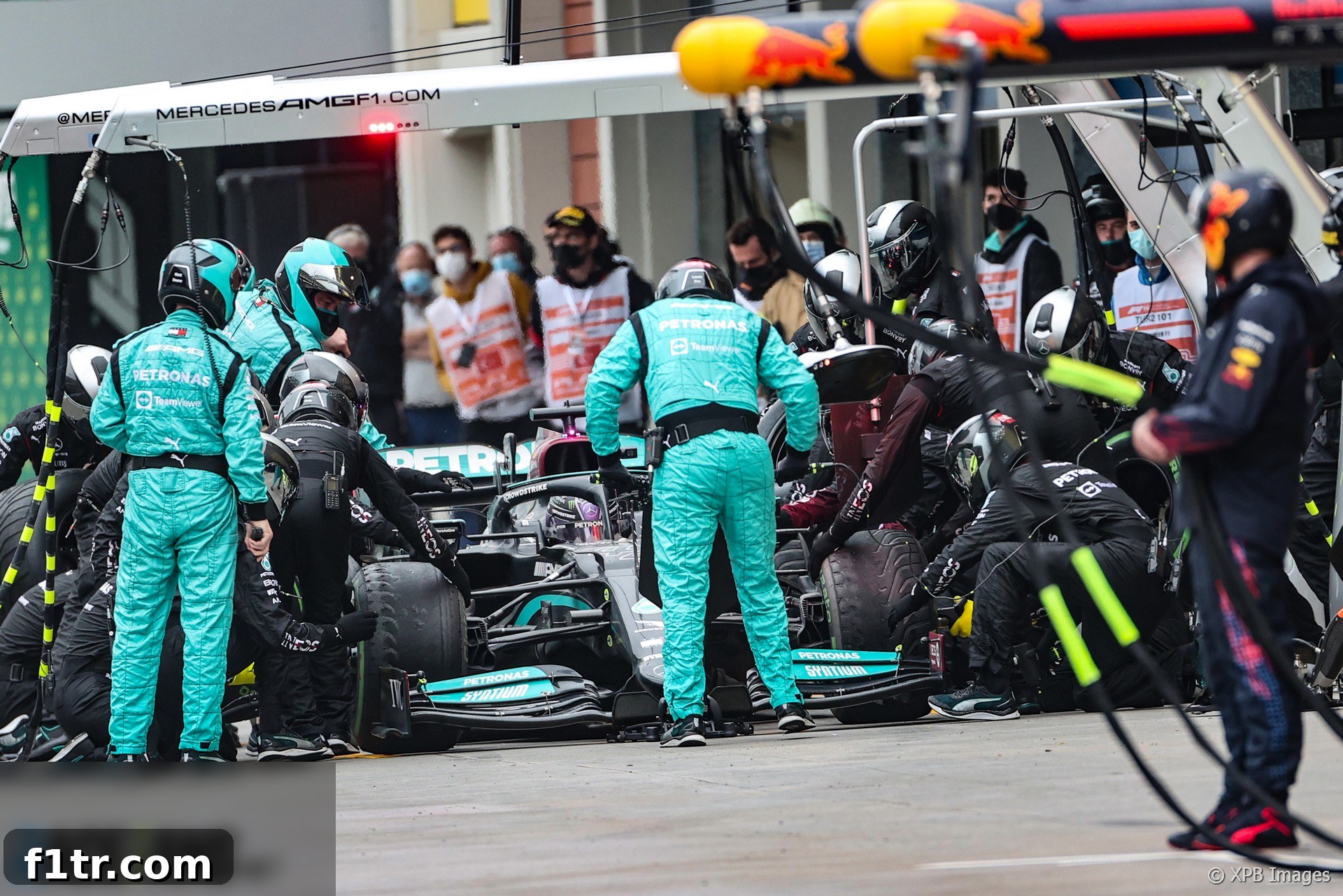
In a high-stakes moment at the Turkish Grand Prix, the Mercedes-AMG Petronas Formula 1 team has openly acknowledged that a revised pit stop strategy for Lewis Hamilton could have yielded a more favourable outcome than his eventual fifth-place finish. This candid revelation from team principal Toto Wolff underscores the razor-thin margins and immense pressure inherent in top-tier motorsport, particularly when navigating the unpredictable conditions of a wet race. The strategic decisions made under immense pressure at Istanbul Park became a significant talking point, highlighting the delicate balance between driver instinct and team data in the heat of a championship battle.
The 2021 Turkish Grand Prix proved to be a pivotal race in the fiercely contested championship duel between Lewis Hamilton and Max Verstappen. Starting from 11th on the grid due to an engine penalty, Hamilton embarked on an impressive charge through the field. The damp and constantly evolving conditions at Istanbul Park meant all cars started on intermediate tyres, and for a significant portion of the race, Hamilton demonstrated exceptional pace and masterful car control, climbing as high as third position, a remarkable feat given his starting disadvantage.
The critical juncture arrived as several of Hamilton’s key rivals, including championship contender Max Verstappen and Sergio Perez, opted for fresh sets of intermediate tyres. Mercedes, contemplating a similar move, engaged in a real-time strategic debate with Hamilton. Ultimately, Hamilton decided to extend his stint on the original set of intermediates, a high-stakes decision rooted in the hope that the track would dry sufficiently to allow for a direct switch to slick tyres. This would eliminate an additional pit stop, potentially saving valuable track time and securing a strategic advantage over his competitors.
Speaking after the race, Toto Wolff elaborated on the complex decision-making process that unfolded in the Mercedes pit wall. “In the car it’s always very difficult to assess your position in the race,” Wolff stated, highlighting the limited perspective a driver has compared to the comprehensive data available to the team. He outlined two primary strategic avenues available to them at that crucial point, each with its own set of risks and potential rewards, underscoring the constant gamble involved in Formula 1 race strategy.
The first option involved a more conservative approach: pitting Hamilton around the same time as Verstappen and Perez. This would have meant fighting for track position immediately after the stop, likely emerging behind Perez and battling for P3 or P4 on fresh, optimally performing intermediate tyres. It was a known quantity, a safer bet in terms of tyre life and immediate performance, minimizing the risk of a significant performance drop-off later in the stint.
The second, more audacious option, was to attempt an extended run on the initial set of intermediate tyres. This strategy carried the inherent risk of severe tyre degradation but offered the potential reward of either a transition to dry tyres if the track dried sufficiently, or simply reaching the end of the race without any further stops. “So there was two possible options that sounded quite good,” Wolff reflected, illustrating the profound dilemma faced by the strategists, weighing immediate performance against long-term strategic gain in unpredictable conditions.
Initially, Hamilton’s decision to stay out appeared to pay dividends. His pace remained strong, and he continued to hold a competitive position, expertly managing his tyres. However, as the laps ticked by and the track failed to dry enough for slick tyres, the performance of his intermediate tyres began to wane considerably. The once-grippy rubber started to lose its effectiveness, leading to a noticeable drop in lap times and increasing vulnerability to those on fresher tyres. This deterioration put Hamilton at increasing risk of losing positions, not only to those ahead but also to the rapidly closing cars behind him.
The Mercedes team became increasingly concerned as they observed Hamilton’s lap times progressively fall off, losing multiple seconds per lap compared to rivals on fresher rubber. The strategic gamble of going long was starting to visibly backfire, and the risk of significant time loss and a drastic drop in positions became too great to ignore. The spectre of losing a crucial championship point to a determined rival like Pierre Gasly, who was rapidly closing the gap, loomed large and demanded immediate action to prevent further setbacks.
“Unfortunately the pace just dropped off much quicker than we would have needed in order to stay third or even fourth or even fifth,” Wolff explained, articulating the growing frustration and strategic reassessment within the team. The window of opportunity to pit without significant losses was rapidly closing. It was at this point, with just eight laps remaining in the race, that Mercedes made the decisive call to bring Hamilton in for a fresh set of intermediate tyres. The objective was no longer to optimize for a higher finish but to consolidate his current position and mitigate further damage, ensuring he secured at least fifth place.
The late pit stop saw Hamilton drop from a potential third or fourth place to fifth, where he ultimately finished after a somewhat deflating end to what had been an incredible recovery drive. In the immediate aftermath, the wisdom of the decision was subject to intense scrutiny. Wolff, with the benefit of hindsight and complete race data, was candid in his assessment. “So in hindsight now, I would have pitted ten laps earlier and fought it out on track, probably finished third or fourth. It was much more to gain from the other more dynamic variant,” he admitted, acknowledging the costly strategic error.
This “five-point swing” – the difference between a hypothetical third or fourth place and the actual fifth – was far from insignificant in a championship fight as relentlessly tight as the 2021 Formula 1 season. Every point carried immense weight, and the lost opportunity at Istanbul Park was a tough pill for the team and Hamilton to swallow, potentially impacting the final standings. While Valtteri Bottas delivered a stellar performance to win the race for Mercedes, securing maximum points and an extra point for the fastest lap, Hamilton’s result felt like a crucial missed chance for an even stronger team showing and a potentially decisive boost in his title bid.
Wolff acknowledged that a fifth-place finish from 11th on the grid in a “normal dry race” would have been a commendable result, perhaps even the best-case scenario. However, the damp and evolving conditions of the Turkish Grand Prix presented a unique opportunity for Hamilton to climb even higher, potentially securing a podium finish that could have been vital for his championship aspirations. “Today best case with every decision, with the hindsight of the end result or with the information we have at the end, probably third would have been the best we could have achieved,” Wolff stated, emphasizing the strategic miscalculation in not seizing the full potential of the conditions.
Despite the disappointment surrounding Hamilton’s strategy and the lost points, the team principal chose to adopt a pragmatic perspective, focusing on the broader picture of the championship. “But I think we need to walk away from here and say that was damage limitation for this weekend,” Wolff concluded. This viewpoint highlights the cut-throat nature of Formula 1, where even a slight strategic misstep can have significant repercussions. Mercedes, while critical of their own decision-making process, also recognized the strong performance of Valtteri Bottas, which prevented a complete loss of momentum in the Constructors’ Championship and kept their title hopes alive.
The 2021 Turkish Grand Prix served as a stark reminder of the complexities of race strategy, particularly in variable weather conditions. The interplay between driver instinct, real-time data analysis, and the inherent unpredictability of tyre performance creates a dynamic environment where optimal decisions are often only clear in retrospect. For Lewis Hamilton and the Mercedes-AMG Petronas F1 Team, it was a valuable, albeit costly, lesson in a championship season where every strategic choice carried immense weight and every point could prove decisive in the ultimate outcome of the Formula 1 World Championship.
2021 Turkish Grand Prix Further Insights
- Fifth place was possible from back row without slow pit stop – Sainz
- Giovinazzi ignoring position swap order was “not ideal”, admit team
- Bottas becomes 35th Formula 1 driver to reach 10 race wins
- Medical Car driver van der Merwe likely to miss further races due to Covid-19 rules
- Drivers to ask Masi why Alonso and Norris went unpunished for “very clear” incidents
Browse all 2021 Turkish Grand Prix articles