Max Verstappen found himself pondering a critical strategic decision made by his Red Bull Racing team at the Azerbaijan Grand Prix. The reigning world champion questioned whether his squad could have anticipated the imminent deployment of the Safety Car, thereby avoiding a costly pit stop from the lead that ultimately deprived him of victory. This pivotal moment has sparked considerable debate, highlighting the razor-thin margins and immense pressure inherent in Formula 1 strategy.
Advert | Become a Supporter & go ad-free
The incident unfolded dramatically when his teammate, Sergio Perez, was able to pit under the Safety Car conditions. This allowed Perez to complete his mandatory stop with significantly less time loss, emerging in the lead and cruising to a memorable win on the challenging Baku City Circuit. Verstappen, naturally, felt that a closer examination of the events leading up to the Safety Car was warranted.
The Inciting Incident: De Vries’ Costly Error and the Strategic Window
The catalyst for the Safety Car was the unfortunate retirement of AlphaTauri driver Nyck de Vries. De Vries’ race came to an abrupt end when he made contact with the barrier at Turn 5. This seemingly innocuous touch caused terminal damage to his front-left track rod, leaving his car stranded and immobile on the track. The location of the incident, a relatively narrow section of the circuit, compounded the potential for danger and disruption, making a Safety Car intervention highly probable.
At the precise moment De Vries made contact with the barrier, Verstappen was navigating the fast Turn 13 left-hander. As he accelerated out of Turn 16 and began the long sprint towards the start-finish line, he received the call from his pit wall to box. This critical window, from De Vries’ impact to Verstappen committing to the pit lane entrance, gave the Red Bull strategists a mere 25 seconds at most. Within this incredibly tight timeframe, they needed to assess the severity of De Vries’ situation, determine if his AlphaTauri was immovable, and predict the likelihood of a Safety Car. A decision to stay out, given the unfolding circumstances, might have yielded a different outcome.
Verstappen’s Frustration and Red Bull’s Real-Time Challenge
Post-race, Verstappen voiced his thoughts on the decision-making process, highlighting the frustration of losing a winning position to an unforeseen event. “I saw that there was a car stopped, I thought he maybe just locked up,” said Verstappen. “In hindsight, I mean I can’t see that, but it’s something to review. Clearly you could see there was one wheel damaged and it looked like he was not going to drive that anyway back to the pits, even if he would have reversed. So it’s something to look at because, of course, that then did hurt my race after that.” His comments reflect a champion’s natural desire to optimize every possible scenario, especially when a victory slips away due to external factors that, in retrospect, might have been anticipated.
Adding another layer of complexity, Verstappen was already under considerable pressure from his teammate. As the lap commenced, Sergio Perez had closed the gap, entering DRS range for the first time on lap nine. Verstappen had been struggling with his tyres, communicating his difficulties over team radio moments before the pit call. There was no direct discussion of De Vries’ stoppage on Verstappen’s radio during the lap he was called in, indicating that the team’s primary focus was on managing his tyre degradation and the immediate threat from Perez.
| Speaker | Message |
|---|---|
| Lambiase | 0.9 and DRS. Things are starting to move already. |
| Verstappen | I just struggle a lot in two and three. |
| Lambiase | Okay understood. |
| Lambiase | You’re currently torque six, Max. Baseline is.. |
| Verstappen | Yeah, mate, I’m sliding. |
| Lambiase | Understood. |
| Lambiase | Okay box and pit confirm, Max. Box, pit confirm. |
This radio exchange paints a vivid picture of the immediate concerns on the Red Bull pit wall. Verstappen’s complaints about sliding and struggling with grip, coupled with Perez being within DRS range, underscore the strategic imperative Red Bull faced. They needed to react to the on-track situation, and a pit stop seemed like the logical next step to address Verstappen’s tyre wear and maintain track position against Perez, assuming normal race conditions. The data coming in from the car and the evolving race situation dictated their primary response.
Red Bull’s Strategic Insights and The “Double Stop” Consideration
Red Bull team principal Christian Horner later shed light on the intricate decision-making process within the team. He revealed that while the strategists were contemplating bringing Verstappen in, they also weighed the possibility of a simultaneous double pit stop for both cars. Such a maneuver is incredibly complex, requiring precise timing, flawless execution from the pit crew, and minimal risk of impeding one another. This illustrates the high-pressure environment where multiple scenarios must be evaluated almost instantaneously.
Crucially, there was no indication that Perez was experiencing the same level of tyre degradation as Verstappen. This difference in tyre performance was a key factor in Red Bull’s decision to keep Perez out longer. While Verstappen headed into the pits, Perez received clear instructions: he was twice told, “your windows are open,” a coded message signaling that he should be prepared to pit at a moment’s notice if a Safety Car or Virtual Safety Car was deployed. This highlights Red Bull’s awareness of the potential for a safety car, even if they couldn’t confirm its certainty. They were actively preparing for such an eventuality, showcasing a proactive strategic mindset.
Advert | Become a RaceFans supporter andgo ad-free
Horner elaborated on the multi-layered process that leads to such high-stakes decisions. “As a collective it comes up the chain, the strategists make the recommendation, the team manager’s controlling the pit stop and obviously looking at the circuit in terms of whether it’s a yellow or not and the probability of a Safety Car,” he explained. “The race engineer is obviously looking at it as well. So we have a process, at one stage we were talking about gearing up for a double stop.” This intricate system involves constant communication and analysis from various departments—strategy, race engineering, and team management—all under immense time pressure and with incomplete real-time information.
A crucial factor in Red Bull’s immediate decision was the initial lack of clear information from the world feed, which is often a primary source of visual data for pit walls. As Horner pointed out, the first footage of De Vries’ car was ambiguous. “There was a quick shot of him and it was just a black set of lines,” said Horner. “It looked like he outbraked himself, gone straight on, hadn’t hit the barrier. Usually if you see it in a barrier, it’s a Safety Car. But there was no sign of him having hit the barrier and so it was only subsequently, I think on the replays, that you were able to see a track rod that was broken.” This illustrates the profound challenge of making split-second strategic calls based on incomplete or even misleading visual information, which is a common occurrence in the fast-paced world of Formula 1. The broken track rod, the undeniable sign of an irreparable issue, only became apparent on later replays, by which time Verstappen was already committed to his pit stop.
Despite the initial ambiguity from the world feed, there were two key clues that De Vries’ stoppage was highly likely to trigger a Safety Car, one of which was discernible from the race broadcast. The first was the precise location of his AlphaTauri: drivers rarely pull off at Turn 6 unless their car is genuinely incapacitated, given the relatively low approach speed from Turn 5. An experienced strategist would immediately flag this as an unusual and potentially problematic parking spot, indicating a higher probability of a safety intervention. The second, and perhaps most definitive, clue was available to anyone watching the live onboard stream from De Vries’ car. This perspective would have clearly shown his front wheels pointing in opposite directions after the impact with the Turn 5 barrier, an unmistakable sign that his race was definitively over and the car was undrivable.
However, the challenge lies in the rapid assimilation and verification of such information. Any Red Bull team member who spotted these crucial signs had an extremely limited window—mere seconds—to cross-reference them, confirm their implications, and escalate the information up the chain to the decision-makers on the pit wall. While Verstappen is correct that it eventually became clear De Vries would not be driving away, the critical period for an immediate strategic pivot was fleeting. The pressure to make the correct call in real-time, with imperfect data, underscores the complexity and high-stakes nature of F1 strategy, where every fraction of a second can alter the course of a Grand Prix.
Advert | Become a Supporter & go ad-free
The Aftermath: A Mixed Result and Missed Opportunities
While the outcome was certainly not a disaster for Red Bull – securing a dominant one-two finish in the Grand Prix – it undeniably represented a significant blow for Max Verstappen. The incident effectively gifted his teammate, Sergio Perez, a crucial advantage and, ultimately, the race victory. It also denied racing fans the tantalizing prospect of a genuine, wheel-to-wheel battle between the two Red Bull drivers for the win, a contest that Perez had shown he had the pace to deliver throughout the weekend.
Beyond the immediate strategic fallout, Red Bull’s pace, while superior, wasn’t quite enough to claim the fastest lap of the race. This honor fell to George Russell of the Mercedes-AMG Petronas F1 Team, who capitalised on the late stages of the race. Russell made an opportunistic pit stop for a set of fresh, softer compound tyres on the final lap, seizing the extra point for fastest lap by a significant 0.862 seconds over Verstappen. Verstappen’s best time, by contrast, was set on a set of hard tyres that had endured a remarkable 41 laps, a testament to their durability but not their ultimate pace for a single flying lap attempt.
Russell wasn’t the only driver to employ this ‘free pit stop’ strategy. Esteban Ocon of Alpine also made a late stop, having remarkably completed 50 of the 51 laps on a single set of hard tyres. Haas driver Nico Hulkenberg attempted a similar long-stint strategy, with both drivers starting from the pit lane. Their hope was that a late Safety Car or, in the most ideal scenario, a red flag, would allow them a cheap pit stop for fresh rubber and potentially rescue their race from the back of the grid. “I think we need to pit, the tyres are fucked,” Hulkenberg famously told his team late in the race. His race engineer, Gary Gannon, responded with a clear instruction: “Just hang in there. Just try to stay out. The only chance is if we get some kind of Safety Car or a red.” Unfortunately for them, no such salvation arrived, highlighting the high-risk, high-reward nature of this particular gamble.
This widespread adoption of the late ‘free pit stop’ strategy further underscores how pivotal safety car timings can be, not just for the race leaders but for every position on the grid. It’s a gamble that often pays off, showcasing the strategic depth and risk assessment that defines modern Formula 1, where teams are constantly evaluating the probabilities of such race-altering events.
Detailed Race Data Analysis from Azerbaijan Grand Prix
To provide a comprehensive understanding of the 2023 Azerbaijan Grand Prix, we delve into various performance metrics and strategic decisions made by the teams and drivers throughout the event.
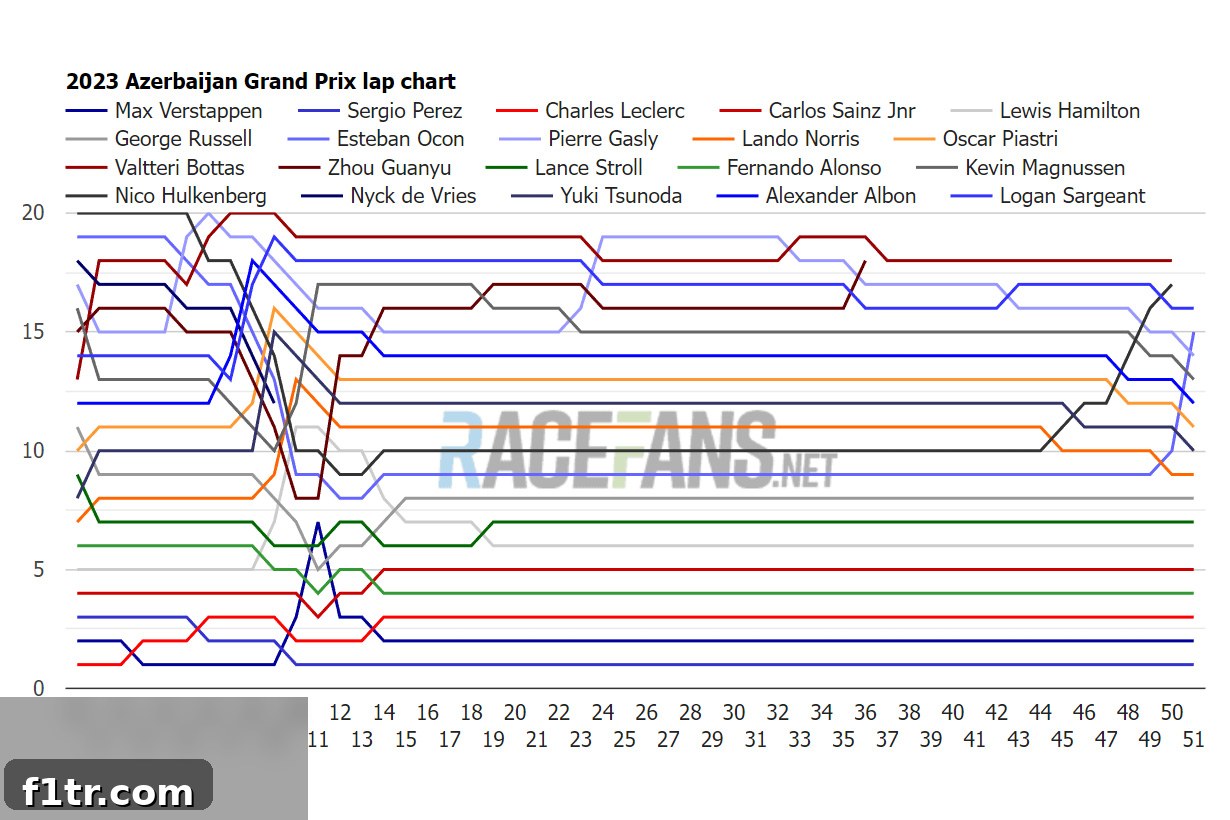
2023 Azerbaijan Grand Prix Lap Chart
The positions of each driver on every lap. Click name to highlight, right-click to reset. Toggle drivers using controls below:
2023 Azerbaijan Grand Prix Race Chart
The gaps between each driver on every lap compared to the leader’s average lap time. Very large gaps omitted. Scroll to zoom, drag to pan and right-click to reset. Toggle drivers using controls below:
2023 Azerbaijan Grand Prix Lap Times
All the lap times by the drivers (in seconds, very slow laps excluded). Scroll to zoom, drag to pan and toggle drivers using the control below:
Advert | Become a RaceFans supporter andgo ad-free
2023 Azerbaijan Grand Prix Fastest Laps
Each driver’s fastest lap times, showcasing individual performance peaks throughout the Grand Prix:
| Rank | No. | Driver | Car | Lap time | Gap | Average speed (kph) | Lap no. |
|---|---|---|---|---|---|---|---|
| 1 | 63 | George Russell | Mercedes | 1’43.370 | 209.06 | 51 | |
| 2 | 1 | Max Verstappen | Red Bull | 1’44.232 | 0.862 | 207.33 | 51 |
| 3 | 14 | Fernando Alonso | Aston Martin-Mercedes | 1’44.241 | 0.871 | 207.32 | 49 |
| 4 | 16 | Charles Leclerc | Ferrari | 1’44.561 | 1.191 | 206.68 | 49 |
| 5 | 11 | Sergio Perez | Red Bull | 1’44.589 | 1.219 | 206.63 | 50 |
| 6 | 55 | Carlos Sainz Jnr | Ferrari | 1’45.175 | 1.805 | 205.47 | 48 |
| 7 | 44 | Lewis Hamilton | Mercedes | 1’45.346 | 1.976 | 205.14 | 48 |
| 8 | 10 | Pierre Gasly | Alpine-Renault | 1’45.540 | 2.170 | 204.76 | 47 |
| 9 | 18 | Lance Stroll | Aston Martin-Mercedes | 1’45.627 | 2.257 | 204.6 | 45 |
| 10 | 81 | Oscar Piastri | McLaren-Mercedes | 1’45.631 | 2.261 | 204.59 | 51 |
| 11 | 22 | Yuki Tsunoda | AlphaTauri-Red Bull | 1’45.727 | 2.357 | 204.4 | 51 |
| 12 | 4 | Lando Norris | McLaren-Mercedes | 1’45.738 | 2.368 | 204.38 | 49 |
| 13 | 20 | Kevin Magnussen | Haas-Ferrari | 1’45.850 | 2.480 | 204.16 | 51 |
| 14 | 31 | Esteban Ocon | Alpine-Renault | 1’45.908 | 2.538 | 204.05 | 49 |
| 15 | 23 | Alexander Albon | Williams-Mercedes | 1’45.925 | 2.555 | 204.02 | 51 |
| 16 | 77 | Valtteri Bottas | Alfa Romeo-Ferrari | 1’46.304 | 2.934 | 203.29 | 36 |
| 17 | 2 | Logan Sargeant | Williams-Mercedes | 1’46.501 | 3.131 | 202.92 | 49 |
| 18 | 27 | Nico Hulkenberg | Haas-Ferrari | 1’46.731 | 3.361 | 202.48 | 34 |
| 19 | 24 | Zhou Guanyu | Alfa Romeo-Ferrari | 1’47.553 | 4.183 | 200.93 | 31 |
| 20 | 21 | Nyck de Vries | AlphaTauri-Red Bull | 1’48.781 | 5.411 | 198.66 | 4 |
2023 Azerbaijan Grand Prix Tyre Strategies
An overview of the different tyre compounds and pit stop strategies employed by each driver throughout the race, highlighting the varying approaches to managing tyre wear and seeking optimal performance:
Advert | Become a RaceFans supporter andgo ad-free
2023 Azerbaijan Grand Prix Pit Stop Times
A detailed breakdown of how long each driver spent in the pit lane for their stops, a crucial measure of team efficiency and operational precision:
| Rank | No. | Driver | Team | Complete stop time (s) | Gap to best (s) | Stop no. | Lap no. |
|---|---|---|---|---|---|---|---|
| 1 | 10 | Pierre Gasly | Alpine | 20.235 | 1 | 5 | |
| 2 | 44 | Lewis Hamilton | Mercedes | 20.324 | 0.089 | 1 | 9 |
| 3 | 4 | Lando Norris | McLaren | 20.346 | 0.111 | 1 | 9 |
| 4 | 31 | Esteban Ocon | Alpine | 20.367 | 0.132 | 1 | 50 |
| 5 | 11 | Sergio Perez | Red Bull | 20.389 | 0.154 | 1 | 11 |
| 6 | 63 | George Russell | Mercedes | 20.459 | 0.224 | 1 | 11 |
| 7 | 22 | Yuki Tsunoda | AlphaTauri | 20.497 | 0.262 | 1 | 8 |
| 8 | 1 | Max Verstappen | Red Bull | 20.707 | 0.472 | 1 | 10 |
| 9 | 81 | Oscar Piastri | McLaren | 20.902 | 0.667 | 1 | 8 |
| 10 | 77 | Valtteri Bottas | Alfa Romeo | 20.967 | 0.732 | 1 | 6 |
| 11 | 77 | Valtteri Bottas | Alfa Romeo | 21.012 | 0.777 | 3 | 34 |
| 12 | 2 | Logan Sargeant | Williams | 21.015 | 0.78 | 1 | 8 |
| 13 | 23 | Alexander Albon | Williams | 21.103 | 0.868 | 1 | 7 |
| 14 | 16 | Charles Leclerc | Ferrari | 21.126 | 0.891 | 1 | 11 |
| 15 | 10 | Pierre Gasly | Alpine | 21.169 | 0.934 | 2 | 23 |
| 16 | 63 | George Russell | Mercedes | 21.389 | 1.154 | 2 | 49 |
| 17 | 55 | Carlos Sainz Jnr | Ferrari | 21.97 | 1.735 | 1 | 11 |
| 18 | 24 | Zhou Guanyu | Alfa Romeo | 22.247 | 2.012 | 1 | 11 |
| 19 | 77 | Valtteri Bottas | Alfa Romeo | 22.354 | 2.119 | 2 | 12 |
| 20 | 14 | Fernando Alonso | Aston Martin | 23.148 | 2.913 | 1 | 11 |
| 21 | 18 | Lance Stroll | Aston Martin | 23.161 | 2.926 | 1 | 11 |
| 22 | 27 | Nico Hulkenberg | Haas | 24.748 | 4.513 | 1 | 49 |
| 23 | 20 | Kevin Magnussen | Haas | 30.951 | 10.716 | 1 | 10 |
Bringing the F1 News Directly from the Source
RaceFans remains committed to delivering insightful news and analysis directly from the heart of Formula 1. Our unique approach allows readers to gain perspectives straight from the key players, teams, and strategists within the sport. This independent journalism is made possible, in part, by the invaluable support of our dedicated RaceFans Supporters.
By contributing a modest £1 per month or £12 per year (or its equivalent in other currencies), you play a crucial role in helping us cover the essential costs associated with producing high-quality, original journalism. These contributions directly fund vital activities such as travel to race events, in-depth writing and research, content creation, website hosting, maintaining contact with F1 personnel, and continuous platform development.
For over a decade, our readers have proudly supported our mission. If you appreciate our independent coverage and the unique insights we provide, please consider joining our community of RaceFans Supporters today. As an added benefit, all our Supporters enjoy an entirely ad-free browsing experience across the site. You can sign up or learn more about the program via the links below:
- Become a RaceFans Supporter
- RaceFans Supporter FAQ
Advert | Become a RaceFans supporter andgo ad-free
More from the 2023 Azerbaijan Grand Prix
Stay informed with further analysis and news surrounding the thrilling 2023 Azerbaijan Grand Prix:
- Aston Martin radio messages reveal how “older brother” Alonso helps Stroll
- How slashing practice to a single hour in Baku tripped up F1 teams
- Bottas: “Rapid improvement needed” at Alfa Romeo
- Red Bull could become first team to score 1,000 points in a season
- Aston Martin hoping DRS fix works in Miami after Stroll manages fault in race
Browse all 2023 Azerbaijan Grand Prix articles