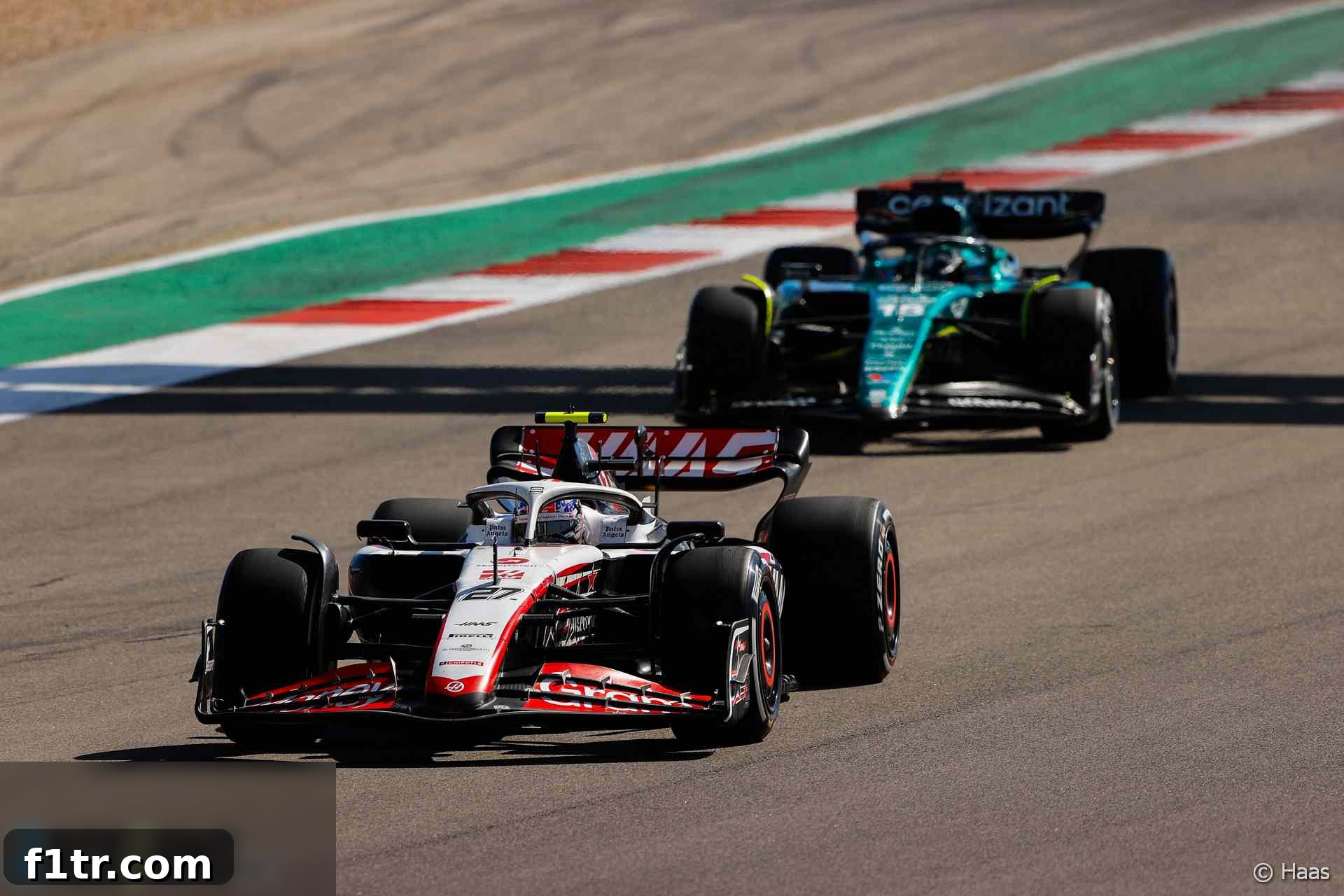
Haas F1 Team has formally requested that the Fédération Internationale de l’Automobile (FIA) re-examines the results of the 2023 United States Grand Prix, which concluded just over two weeks ago. This pivotal move by the American outfit highlights persistent controversies surrounding track limits enforcement in Formula 1 and could potentially alter the final standings of the race held at the Circuit of the Americas (COTA) in Austin, Texas.
Advert | Become a Supporter & go ad-free
The core of Haas’s submission is believed to hinge on the allegation that race stewards overlooked several instances of track limit infringements by various competitors during the high-stakes race. If proven, such oversights could have a direct impact on the final classifications, particularly affecting points-paying positions which are crucial for teams battling in the competitive mid-field of the Constructors’ Championship.
For the review process to formally commence, the initial step requires the race stewards to agree upon a time to reconvene for a preliminary hearing. A formal summons will be issued to all relevant parties. During this initial hearing, the critical determination will be whether Haas has successfully presented “significant and relevant new evidence” that was not available or considered during the original race adjudication. This prerequisite is fundamental to prevent frivolous appeals and ensures that reviews are only undertaken when genuine new information comes to light.
Teams participating in Formula 1 are granted a strict 14-day window following a Grand Prix to lodge a request for a review of the results. Haas submitted their request precisely on the 13th day after the United States Grand Prix, demonstrating strategic timing to gather necessary information while adhering to the tight regulatory deadlines set by the FIA’s International Sporting Code. This adherence to procedure underscores the seriousness with which Haas is pursuing this matter.
This isn’t the first time the FIA has faced a call for review concerning track limits this season. Earlier in 2023, Aston Martin successfully triggered a review of the Austrian Grand Prix results. In that instance, Aston Martin provided compelling evidence demonstrating that race stewards had indeed failed to account for all track limits violations during the Spielberg race. The subsequent re-evaluation led to significant penalties for several drivers and altered the final points distribution, setting a clear precedent for how such reviews can lead to concrete changes.
For Haas, the stakes are considerable. Their driver, Nico Hülkenberg, finished the Austin race in 11th position, agonizingly close to scoring points. He was less than two seconds behind Williams’ Logan Sargeant, who secured the final point for 10th place, and under four seconds adrift of Alexander Albon, who finished ninth. Any post-race adjustments could potentially elevate Hülkenberg into a points-scoring position, a vital outcome for Haas as they strive to improve their standing in the Constructors’ Championship and secure valuable prize money.
Alexander Albon, mentioned above, was notably issued a five-second time penalty during the United States Grand Prix for multiple track limits breaches. Following the race, the stewards acknowledged that they had considered whether Albon might have committed additional infringements beyond those for which he was penalized. However, they concluded that it was impossible to ascertain with certainty due to a perceived “lack of conclusive evidence” available to them at the time. This statement by the stewards themselves inadvertently bolsters Haas’s argument, suggesting that comprehensive monitoring of track limits was indeed a challenge during the event.
The 2023 United States Grand Prix was characterized by widespread issues concerning track limits. An astonishing total of 35 lap times were deleted during the race due to drivers exceeding track boundaries at eight different corners around the Circuit of the Americas. The scale of these deletions alone points to a systemic problem in enforcement or driver compliance. Post-race, several drivers voiced their frustrations and confusion, claiming that the FIA’s ability to monitor adherence to track limits across all sections of the demanding circuit was inconsistent or, in some areas, entirely lacking.
Adding a dramatic layer to the controversy, Lando Norris, who delivered an impressive performance to finish second in the race, openly admitted to deliberately going off track at Turn 6. His candid explanation was that he believed the FIA officials were incapable of accurately judging whether drivers had stayed within the designated white lines at that particular corner. Such an admission from a leading driver casts a long shadow over the efficacy and fairness of track limits policing, raising critical questions about the integrity of the racing and the consistency of penalties.
This is not the first time Haas has found itself embroiled in a post-race review concerning the United States Grand Prix. Just last year, in the 2022 edition of the same race, Haas lodged a protest against the outcome. Their grievance focused on what they perceived as the stewards’ failure to take appropriate action regarding a loose wing mirror on Fernando Alonso’s Alpine car. Initially, Haas’s protest was upheld by the stewards, leading to a penalty for Alonso. However, this decision was subsequently overturned after Alpine successfully argued that Haas had failed to submit their protest within the strict deadline stipulated by the regulations. This past event demonstrates Haas’s ongoing commitment to scrutinizing race results and challenging perceived regulatory oversights, even when their efforts are met with procedural hurdles.
The current request for review from Haas regarding the 2023 US Grand Prix serves as a stark reminder of the ongoing challenges in uniformly enforcing track limits across all Formula 1 circuits. The difficulty in consistent application of penalties, coupled with driver complaints and the precedent set by the Austrian Grand Prix, places the FIA under considerable pressure. The outcome of Haas’s review could have significant ramifications, not only for the 2023 Constructors’ Championship standings but also for future interpretations and enforcement of one of Formula 1’s most contentious sporting regulations. The motorsport world now awaits the stewards’ decision, which will determine whether new evidence is sufficient to revisit and potentially revise the results of a thrilling yet controversial race.
Advert | Become a RaceFans supporter andgo ad-free
2023 United States Grand Prix Coverage
- US GP Was Mercedes’ Best Race of 2023 Despite Disqualification – Wolff
- Singapore and Austin Retirements Cost Me Top 10 Championship Place – Ocon
- United States Grand Prix Result Unchanged as FIA Rejects Haas’ Call For Review
- Sargeant Admits He’s ‘Struggled to Use All The Downforce At Times’ In F1
- Mercedes’ Brazilian GP Set-Up Was “Conservative” After US GP Disqualification
Browse All 2023 United States Grand Prix Articles