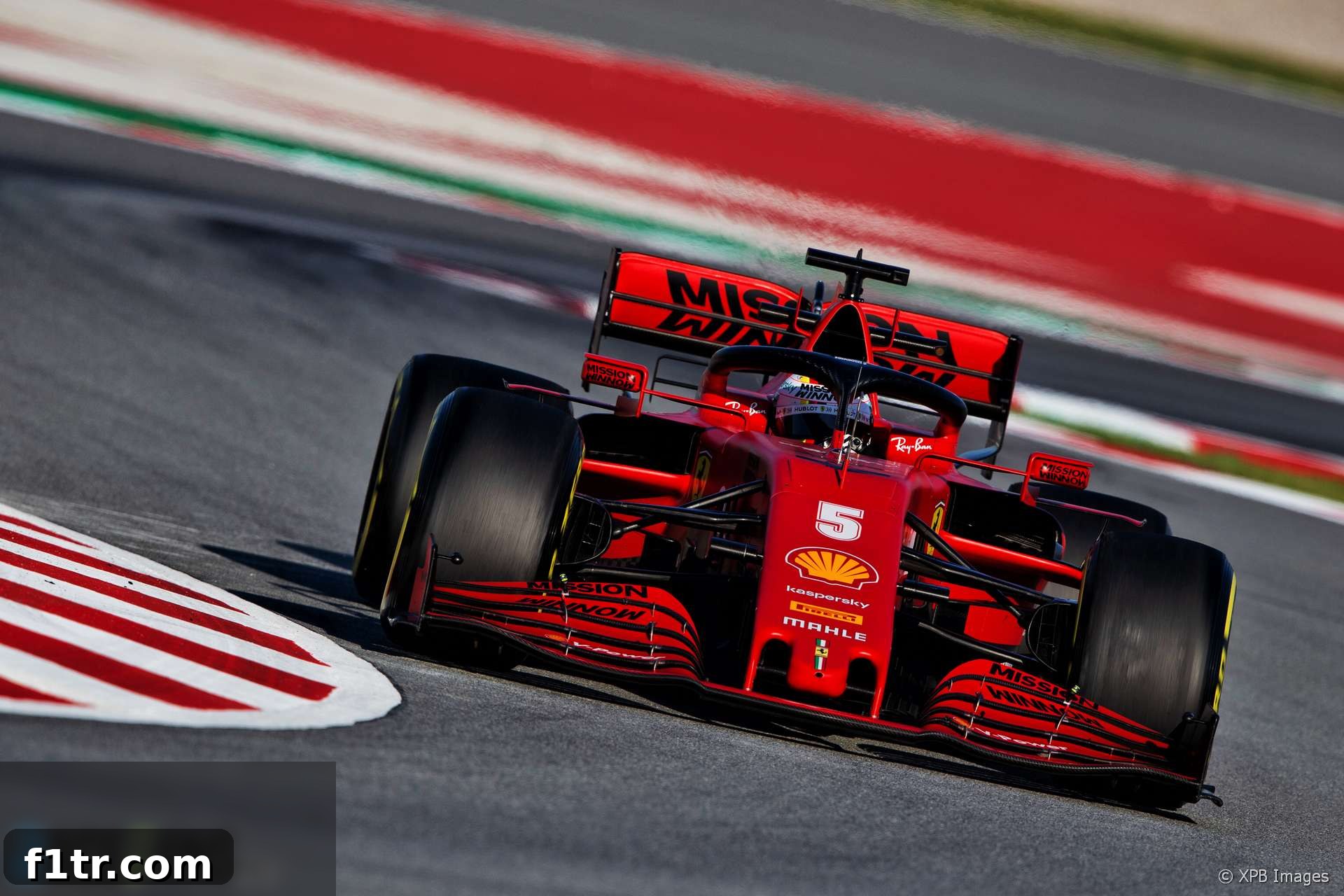
Sebastian Vettel on Ferrari SF1000: Promising Steps Forward in Downforce
Sebastian Vettel, the revered four-time Formula 1 World Champion, recently offered his initial assessment of Ferrari’s highly anticipated new challenger, the SF1000. After his inaugural half-day of testing, Vettel conveyed a sense of cautious optimism, indicating that the Scuderia has indeed made tangible progress in addressing a critical area of focus: enhancing the car’s downforce. This improvement marks a significant milestone for the Italian team, which had explicitly targeted maximum downforce levels during the design and development phase of their 2020 contender.
During the unveiling of the SF1000, team principal Mattia Binotto articulated the team’s ambitious objective: to “maximise the downforce level” of the new car. Vettel’s early feedback corroborates this strategic direction, affirming that a noticeable increase in downforce has been achieved. While the German driver remained pragmatic about the ultimate sufficiency of these gains, he unequivocally stated, “it’s definitely a step up from last last year.” This positive reinforcement from the cockpit provides an encouraging start to Ferrari’s pre-season preparations, signalling a potentially more competitive platform for the upcoming Formula 1 season.
The Intricate Dance: Downforce Versus Drag
While the initial downforce gains are a welcome development, Vettel quickly tempered expectations by highlighting the perennial challenge in Formula 1 aerodynamics: the delicate balance between downforce and drag. It remains premature, he noted, to definitively ascertain whether Ferrari has managed to secure these aerodynamic advantages without incurring an undue penalty in terms of increased drag, which can significantly impede top-end speed on straights. “It’s hard to tell,” Vettel conceded, underscoring the complexity of F1 car performance.
He further elaborated on this critical trade-off: “Obviously, downforce does come with drag. You try to find downforce with as little drag as possible, which I think we found as well.” This statement suggests that while the team has successfully generated more grip-enhancing downforce, they have also, to some extent, mitigated the adverse effects of drag. However, the true efficacy of this balance can only be fully evaluated through extensive testing across various track conditions and configurations. Vettel’s prudence reflects the comprehensive data analysis that follows every test run, where engineers meticulously scrutinize telemetry to correlate driver feedback with empirical performance metrics.
The nuances of aerodynamic efficiency are not simply about raw numbers; they involve how the car behaves under different loads, speeds, and cornering scenarios. The ability to generate high downforce for cornering stability while simultaneously maintaining competitive straight-line speed is often the differentiating factor between championship contenders and the rest of the field. For Ferrari, a team that sometimes struggled with outright speed on specific tracks in previous seasons, finding this optimal balance is paramount to challenging for the constructors’ and drivers’ titles.
SF1000: An “Extreme Development” Forged from Experience
The SF1000 has been characterized by Scuderia Ferrari as an “extreme development” of its predecessor, the SF90, a car that, despite its three race victories, exhibited certain weaknesses throughout the 2019 season. This “extreme development” philosophy implies a significant evolution rather than a revolutionary design, focusing on refining and optimizing existing concepts to unlock greater performance potential. Such an approach often involves pushing the boundaries of aerodynamic design, chassis stiffness, and suspension kinematics, all while integrating the power unit seamlessly into the overall package.
Vettel, with his vast experience and innate feel for F1 machinery, quickly discerned the car’s inherent characteristics. “I had some laps and you feel very quickly the characteristic of the car,” he explained. His initial assessment points to improvements in certain areas, while other aspects retain similarities to the previous year’s car. This blend of familiarity and novelty is typical in F1 car progression, where successful elements are retained and enhanced, while problematic areas undergo radical revision.
The SF1000 moniker itself is a tribute to Ferrari’s impending 1000th Grand Prix start, a monumental achievement that underscores the team’s rich heritage and enduring presence in Formula 1. This significant milestone undoubtedly adds an extra layer of motivation for the team to deliver a highly competitive car capable of challenging at the front. The design team, led by technical director Simone Resta and guided by team principal Mattia Binotto, aimed to push the envelope on all fronts, learning from the lessons of the SF90, particularly its varying performance across different circuit types. The extreme development likely includes detailed work on flow structures around the front wing, bargeboards, floor, and rear diffuser, aiming to create a more consistent and potent aerodynamic platform.
The Crucial Role of Pre-Season Testing
Sebastian Vettel’s early laps represent just the tip of the iceberg in the arduous and meticulously planned pre-season testing regimen. These initial sessions are invaluable for gathering foundational data and validating theoretical models developed in the factory’s wind tunnel and computational fluid dynamics (CFD) simulations. “I think it’s still very early days,” Vettel reiterated, emphasizing the extensive work that lies ahead for the team.
The testing schedule is packed with objectives, ranging from understanding the car’s fundamental behaviour to optimizing its response to various setup changes. “We’ve plenty of stuff on the list still to go through for the next four days to try and see what the car’s doing, how it will respond to certain set-ups and windows where we use the car,” Vettel detailed. This methodical approach ensures that engineers and drivers systematically explore the SF1000’s performance envelope, identifying its strengths, pinpointing areas for improvement, and fine-tuning its interaction with different tyre compounds.
Beyond pure performance, reliability is another cornerstone of pre-season testing. Putting hundreds of kilometres on the new chassis, engine, and gearbox helps to uncover potential weaknesses and ensure that all components can withstand the rigours of a full Grand Prix weekend. Driver feedback, combined with extensive sensor data, guides the development trajectory, allowing the team to make informed decisions about aerodynamic packages, suspension settings, and power unit mapping. The aim is to create a robust, predictable, and ultimately fast race car. Every minor adjustment to wing angles, ride height, or suspension stiffness can have a profound impact, and it’s during these early tests that the team begins to understand these complex interdependencies.
Ferrari’s 2020 Ambitions and The Road Ahead
Ferrari entered the 2020 season with a clear mandate: to challenge for the championship titles after a 2019 campaign that saw them finish second in the Constructors’ Championship, but often lagging behind Mercedes in overall pace. The SF1000 is a testament to this ambition, designed with a specific performance direction in mind. “Obviously we had a clear plan of what we want to achieve with this year’s car and I think it is going in that direction,” Vettel confirmed, indicating that the car’s initial on-track behaviour aligns with the team’s developmental objectives.
However, the journey from a promising test car to a race-winning machine is long and arduous. “But now I think it’s up to us to really explore the car back to front and see how it responds on track,” he concluded. This exploration involves not only pushing the car to its absolute limits but also understanding its behaviour in marginal conditions, during long runs, and under pressure. The insights gained from these early testing phases will be crucial for the continuous development cycle that characterizes Formula 1, as teams constantly introduce upgrades throughout the season.
The battle for supremacy in Formula 1 is not just about raw speed; it’s also about consistency, reliability, and the ability to adapt to diverse circuit characteristics. For Ferrari, the SF1000 represents an opportunity to build on its strengths, rectify past shortcomings, and provide both Sebastian Vettel and Charles Leclerc with a machine capable of delivering thrilling performances and, crucially, securing vital championship points. The initial positive feedback on downforce is a promising start, setting the stage for an intriguing season as the Scuderia aims to reclaim its spot at the pinnacle of motorsport.
2020 F1 Season & Related Articles
- Grosjean to make F1 test return tomorrow for first time since Bahrain horror crash
- Pictures: Wrecked chassis from Grosjean’s Bahrain fireball crash to go on display
- Bottas vs Rosberg: Hamilton’s Mercedes team mates compared after 78 races each
- F1 revenues fell by $877 million in Covid-struck 2020 season
- Hamilton and Mercedes finally announce new deal for 2021 season
Browse all 2020 F1 season articles