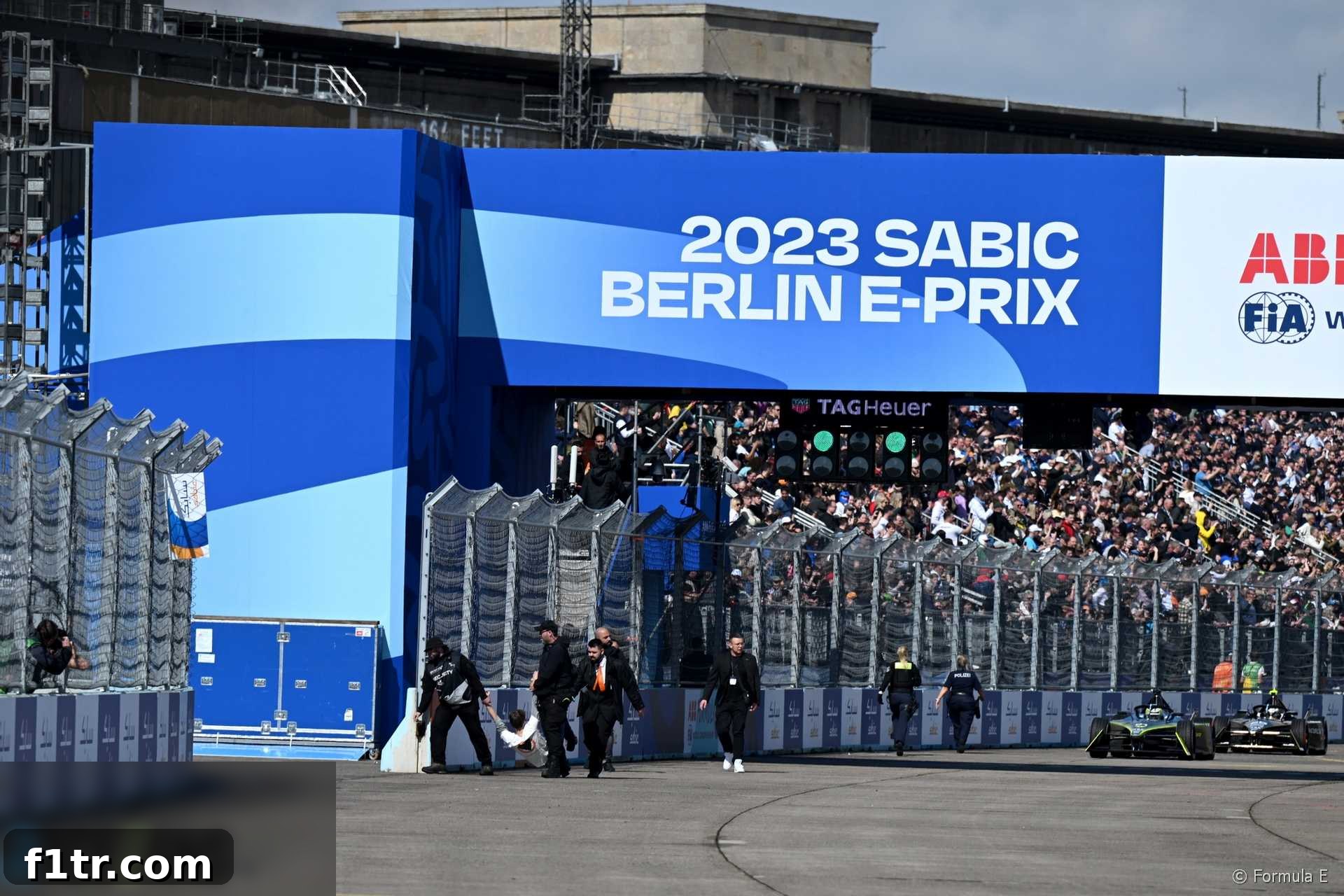
In a dramatic turn of events that momentarily halted the adrenaline-fueled excitement of the Berlin Formula E Eprix, a climate activist group claimed responsibility for storming the race grid on Sunday. The incident, which occurred just moments before the start of the second race of the weekend, thrust the electric motorsport series into the spotlight not for its cutting-edge technology or thrilling competition, but for an urgent message about climate change.
Advert | Become a Supporter & go ad-free
Climate Activists Disrupt Berlin Formula E Race
The serene atmosphere at the Berlin Templehof Airport circuit was shattered as approximately five individuals from the German activist group, Letzte Generation (Last Generation), bypassed security measures and climbed the debris fence lining the main straight. This occurred while the advanced electric single-seaters were meticulously settling into their designated final grid slots, preparing for the customary standing start. Each protester donned white t-shirts emblazoned with distinct logos and slogans, a clear visual declaration of their purpose. Their intent was to sit directly on the track, positioned precariously in front of several high-performance vehicles already lined up for the commencement of the race, effectively obstructing the event.
The swift and coordinated intervention by security personnel was immediate. Marshals and event staff rapidly converged on the scene, physically removing the protestors from the hazardous live track environment. Following their apprehension on the circuit, the individuals were promptly handed over to local police authorities and subsequently arrested. The disruption caused a significant delay, pushing back the scheduled start of the race by over six minutes, a considerable period in the fast-paced world of motorsport. Despite the unexpected interruption, the race eventually commenced with a traditional grid start, as originally planned, albeit with a palpable tension lingering from the preceding events.
Letzte Generation: Unpacking the Activist Group Behind the Protest
The group claiming responsibility for the audacious grid invasion is Letzte Generation, or “Last Generation” in English. They define themselves on their Mastodon page as a dedicated collective of “climate justice activists.” This protest was not an isolated act but part of a broader series of coordinated activities undertaken by the group across the German capital city over the weekend. Their overarching objective is to amplify their urgent call for the German government to enact more robust and decisive measures to safeguard its citizens from the escalating and pervasive impacts of climate change. Their tactics often involve highly visible and disruptive actions designed to capture public and media attention, forcing conversations about climate inaction into mainstream discourse.
A compelling video circulated by Letzte Generation on social media platforms vividly captured the intense moments when the activists scaled the catch fencing to gain unauthorized access to the circuit. This footage served as both evidence of their actions and a powerful public statement, spreading their message far beyond the confines of the racetrack itself. The group’s social media post regarding the incident was direct and uncompromising: “We are at the @eFORMELde [sic] racetrack to sound the alarm. It’s time to slow down. Because we’re on the highway to climate hell with our foot on the accelerator.” This potent analogy encapsulates their belief that society is hurtling towards an environmental catastrophe, driven by unchecked fossil fuel consumption and insufficient governmental action.
The choice of a Formula E event as a target for such a protest is particularly noteworthy and perhaps strategically calculated. Formula E prides itself on being the world’s only FIA-accredited world championship that exclusively utilizes all-electric power. Its cars produce zero tailpipe emissions during racing, positioning the series as a vanguard for sustainable motorsport and a platform for demonstrating advanced electric vehicle technology. This inherent “green” credential of Formula E could lead some to question the logic behind targeting an event that seemingly aligns with environmental goals. However, from the perspective of groups like Letzte Generation, the focus might be less on the specific environmental merits of the sport itself and more on using any high-profile global stage to highlight the broader, systemic failures in addressing climate change. Their message, “It’s time to slow down… we’re on the highway to climate hell,” suggests a critique that even incremental green innovations within an unsustainable system are not enough to avert disaster.
A Growing Trend: Climate Protests in High-Profile Sporting Events
The incident at the Berlin Eprix is far from an isolated event; it represents the latest in a burgeoning series of climate change-related protests that have increasingly targeted high-profile sporting events worldwide. These demonstrations, often characterized by direct action and significant disruption, are designed to maximize media exposure and force uncomfortable conversations about climate policy into the public consciousness. Motorsport, with its global reach and often substantial environmental footprint (even electric series require significant logistics and energy), has become a frequent target.
A notable precursor to the Berlin protest occurred last year at the British Grand Prix, where a group of activists from “Just Stop Oil” breached the circuit shortly after the start of the race. While their disruption on the Wellington Straight was significant, the race had already been red-flagged due to a severe accident involving Zhou Guanyu at the first corner, inadvertently mitigating some of the immediate danger posed by their presence on track. The Silverstone protestors, like those in Berlin, sought to use the grand stage of Formula 1 to draw attention to their demands for an end to new fossil fuel projects. The consequences for the Just Stop Oil activists were severe; they were subsequently convicted of causing a public nuisance, receiving a combination of suspended prison sentences and community orders, signaling a firm legal stance against such disruptive actions.
Beyond motorsport, climate activists have broadened their scope, targeting other major international sporting events. Tennis tournaments like Wimbledon have seen activists disrupt play by scattering orange confetti or invading courts. Similarly, snooker championships have been interrupted by protestors attempting to glue themselves to tables. These diverse tactics, employed across different sports, underscore a strategic approach: leverage moments of peak global viewership and public interest to deliver an urgent message. The motivations are consistent – to pressure governments and corporations into faster, more aggressive climate action, often arguing that existing measures are insufficient or too slow.
The effectiveness of such protests remains a subject of intense debate. While they undeniably generate headlines and spark discussion, they often divide public opinion, with some sympathizing with the cause but condemning the disruptive methods, particularly when they pose safety risks or inconvenience innocent spectators and participants. Sporting organizations, meanwhile, face a delicate balancing act: upholding freedom of speech while ensuring the safety of their events and maintaining their integrity. This necessitates enhanced security measures, contingency planning, and often, public statements that acknowledge environmental concerns while condemning illegal intrusions.
Formula E’s Paradox: Green Motorsport Under Scrutiny
The targeting of Formula E by climate activists presents a unique paradox. Unlike its internal combustion engine counterparts, Formula E is fundamentally built upon principles of sustainability and innovation in electric mobility. As mentioned, it is the only FIA-accredited world championship operating solely on electric power, producing zero emissions directly from its racing vehicles. The series actively promotes electric vehicle adoption, sustainable technologies, and smart city solutions. Its race calendar is meticulously designed to minimize its carbon footprint, featuring city-center races to promote public transport and reduce travel emissions for fans. Formula E vehicles run on 100% certified renewable energy, and the championship adheres to a strict sustainability roadmap, aiming for net-zero carbon from its inception. Therefore, for activists to target such a series might seem counterintuitive to some.
However, the activists’ perspective, as articulated by Letzte Generation, suggests a deeper, more systemic critique. Their message, “We’re on the highway to climate hell with our foot on the accelerator,” implies that even significant advancements in specific green technologies, while commendable, are insufficient if the broader societal and governmental frameworks fail to address the root causes of climate change with the necessary urgency. From this viewpoint, Formula E, despite its green credentials, is still part of a larger global system that continues to promote consumption and growth, and perhaps inadvertently distracts from the more fundamental shifts required. The protest might not be a criticism of Formula E’s efforts but rather a strategic choice to utilize a platform associated with “green solutions” to highlight the inadequacy of current global responses to the climate crisis.
Immediate Aftermath and Broader Implications
In the end, the delayed race proceeded as planned, culminating in a victory for Envision driver Nick Cassidy, who expertly navigated the unique challenges of the Berlin circuit. While the sporting outcome was eventually determined, the broader implications of the protest continue to resonate. The incident underscores the growing vulnerability of major public events to climate activism and highlights the increasing pressure on sporting bodies to not only manage security but also to articulate their own environmental commitments and responses to global challenges.
The intersection of sport and activism is becoming an increasingly complex arena. While some view such disruptions as counterproductive and alienating, others argue they are essential for breaking through the noise and forcing critical issues onto the public agenda. For Formula E, a series built on a progressive vision, this incident offers an opportunity for introspection and further engagement with the very issues its existence seeks to address. The challenge for motorsport, and indeed for all major public events, will be to balance entertainment and competition with heightened security concerns and the ever-present demand for greater environmental responsibility and social awareness.
Advert | Become a RaceFans supporter andgo ad-free
Formula E
- McLaren to quit Formula E at end of season
- Wehrlein beats Jaguar pair to title in dramatic Formula E finale
- Wehrlein’s London win sets up thrilling three-way title showdown in finale
- Da Costa takes hat-trick of wins in chaotic second Portland race
- Da Costa inherits Portland win from Evans after Cassidy spins lead away
Browse all Formula E articles