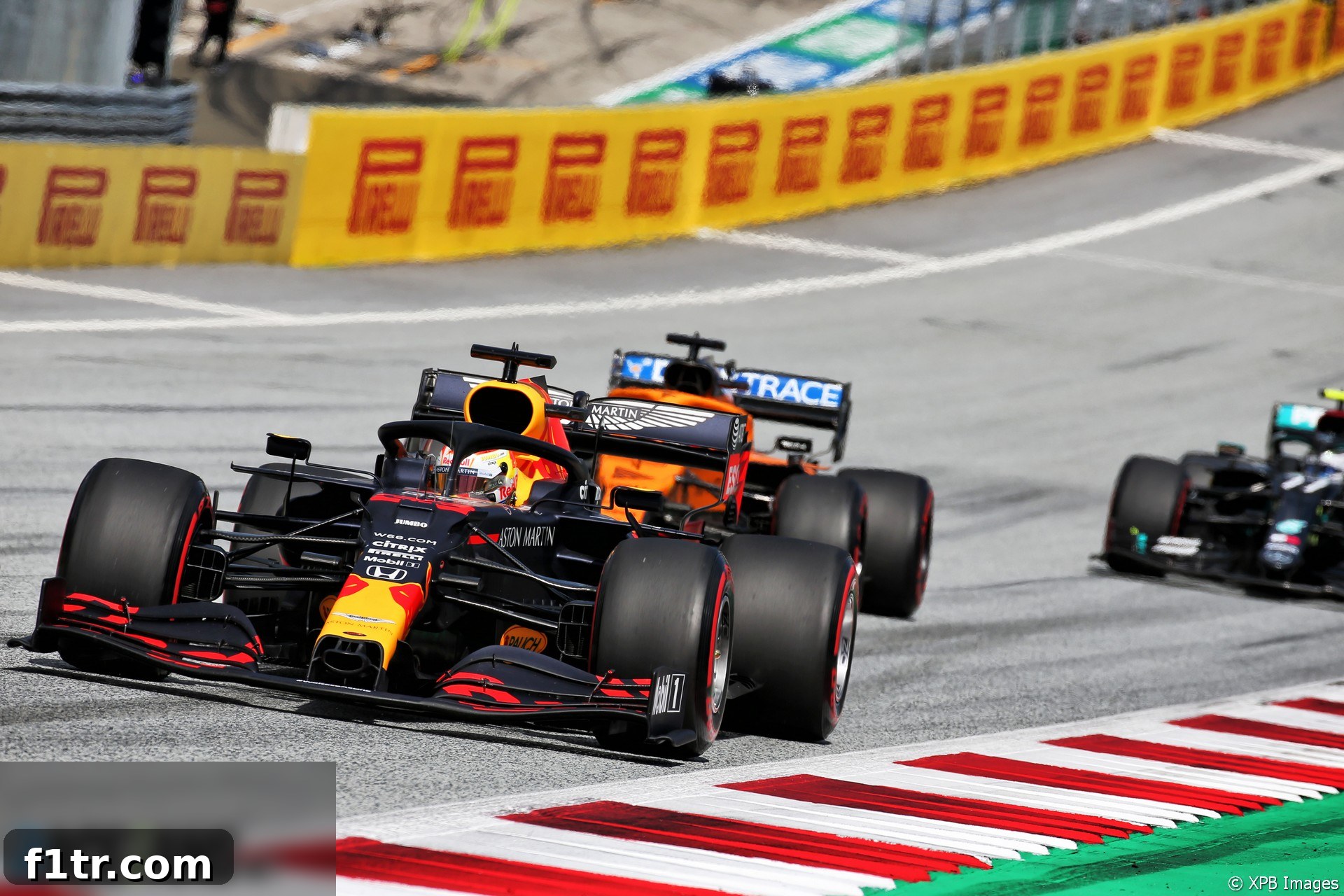
Max Verstappen ‘Shocked’ by Mercedes Pace at Red Bull Ring, Vows Red Bull Comeback
Red Bull Racing’s star driver, Max Verstappen, candidly admitted his astonishment at the blistering pace of the Mercedes W11s following a challenging Grand Prix at the Red Bull Ring. Finishing in third place, trailing the dominant Mercedes duo of Lewis Hamilton and Valtteri Bottas, Verstappen expressed a mixture of frustration and determination after the race.
The Dutchman, driving his Red Bull RB16, found himself increasingly distanced from Lewis Hamilton throughout the event. In the closing laps, he ultimately conceded second position to Valtteri Bottas, who executed a strong recovery drive. By the checkered flag, Verstappen’s car crossed the line a significant 33 seconds adrift of Hamilton’s leading Mercedes, a gap exacerbated by an additional pit stop strategy implemented by his team.
Despite the early pit stop, which was a tactical move aimed at shielding Verstappen from Bottas’s initial challenge, the underlying performance deficit remained glaringly apparent. When questioned by RaceFans about whether this strategic call compromised his team’s efforts to truly challenge Mercedes, Verstappen was unequivocal. “No, we were just too slow,” he stated matter-of-factly. “So, you can do whatever you want. Pitting early, late, or the same, I don’t think it’s going to change the end result.”
He continued, reflecting on the in-race decision, “At the time, I thought we were pitting a bit early. I knew, of course, towards the end of the race I was going to run out of tyres. But it is what it is. I said on the radio, ‘never mind, I’ll just get on with the job’.” This commentary highlights not only his competitive spirit but also a clear recognition of the fundamental speed differential that overshadowed any strategic nuances.
The Shocking Performance Gap: Mercedes’ Dominance Unveiled
Verstappen’s use of the word “shock” perfectly encapsulated the sentiment regarding Mercedes’ overwhelming performance advantage over the rest of the field. “I was just pushing as hard as I could to try and stay with them,” he explained. “But clearly, it’s still not good enough. The gaps compared to the guys behind were massive. I was a bit shocked. I tried everything I could, but it’s still not enough. We’ve still got some work to do.”
The Mercedes W11, driven with precision and power by both Hamilton and Bottas, demonstrated a formidable combination of aerodynamic efficiency, engine power, and tyre management capabilities. This was particularly evident on the long straights and fast corners of the Red Bull Ring, where Red Bull had hoped to leverage their supposed home advantage. However, the superior straight-line speed of the Mercedes, combined with its consistent pace through the corners, left their rivals struggling to keep pace.
This stark reality check in the early stages of the season sent a clear message to the Red Bull garage. While Verstappen’s talent and relentless pursuit of performance are undisputed, the car’s inherent limitations against the reigning champions were painfully exposed. The significant time deficit, particularly over a full race distance, pointed towards fundamental areas where the RB16 needed urgent development.
Strategic Choices and Tyre Management Challenges
The early pit stop for Verstappen was a calculated risk. Teams often use the undercut strategy—pitting a driver early to gain track position on fresh tyres—to leapfrog competitors. In this instance, it was primarily a defensive move against Bottas. However, with Mercedes’ superior overall pace, the strategy did little to close the gap to Hamilton and ultimately left Verstappen with older tyres in the crucial final stages of the race, making him vulnerable to Bottas’s fresh tyre attack.
Verstappen’s acknowledgement of running out of tyre life towards the end of the race underscores a persistent challenge for all teams in modern Formula 1: balancing performance with tyre degradation. While an early stop might offer a temporary burst of speed, it often comes at the cost of reduced grip and pace later in the stint. For Red Bull, without the outright pace to manage their tyres as effectively as Mercedes, such strategic decisions become double-edged swords.
The team’s decision-making process is under constant scrutiny, especially when battling a dominant rival. The pursuit of optimal race strategy often hinges on real-time data and predictive models, but when a significant raw pace deficit exists, even the most ingenious strategies can struggle to yield the desired results. This race served as a crucial lesson in understanding the limitations imposed by car performance when attempting to outmanoeuvre a faster opponent.
Bouncing Back and Championship Ambitions
Despite the challenges faced, Verstappen did manage to secure his first podium finish of the season. This followed a disappointing retirement from the season-opening race at the same venue just a week prior. “To bounce back from zero points last week to a podium now is a good start,” he reflected, highlighting his innate ability to recover and score valuable points for the team.
However, a podium finish, while positive, is not the ultimate goal for a driver of Verstappen’s calibre or a team with Red Bull’s championship aspirations. “But I think as a team we want to win and we want to fight for the championship. But if you want to fight for the championship, of course, you need to win races,” he asserted, articulating the clear objective that drives him and the entire Milton Keynes-based outfit.
The path to challenging for the constructors’ and drivers’ championships is clear: Red Bull must bridge the performance gap to Mercedes. Verstappen pinpointed key areas for improvement. “We need to look into it. I think we were losing quite a bit on the straight as well. So it’s a bit of both at the moment. So we just need to keep on working harder to try and close the gap.” His comments suggest that the team needs to address both power unit performance, particularly straight-line speed, and potentially aerodynamic efficiency or car balance in cornering.
The Road Ahead for Red Bull Racing
The Styrian Grand Prix at the Red Bull Ring provided a stark early-season assessment for Red Bull Racing. While Max Verstappen’s raw speed and aggressive driving continue to be highlights, the team’s car package needs significant upgrades to consistently challenge Mercedes. The engineering and design teams at Red Bull, alongside their engine partners, will be under immense pressure to identify and implement improvements swiftly.
Focus areas will likely include enhancing engine power and reducing drag for better straight-line performance, optimizing aerodynamic efficiency for sustained cornering speed, and refining the car’s setup to improve tyre management over long stints. The intense development battle in Formula 1 means that stagnation is not an option. Every tenth of a second found through upgrades can dramatically alter a team’s fortunes.
Verstappen’s determination remains unwavering. His ability to extract maximum performance from his machinery, even when it’s not the fastest on the grid, makes him a formidable opponent. As the season progresses, all eyes will be on Red Bull to see how quickly they can close this “shocking” gap and provide Max with a car capable of consistently fighting for race victories and, ultimately, the coveted Formula 1 World Championship.
This early season reality check for Red Bull Racing underscores the formidable challenge posed by Mercedes. However, the history of Formula 1 is replete with stories of teams overcoming adversity. Max Verstappen and Red Bull Racing are certainly not ones to shy away from a fight, promising an intriguing development battle as they push relentlessly to turn their championship aspirations into reality.
Related F1 Articles and Updates
- Grosjean to make F1 test return tomorrow for first time since Bahrain horror crash
- Pictures: Wrecked chassis from Grosjean’s Bahrain fireball crash to go on display
- Bottas vs Rosberg: Hamilton’s Mercedes team mates compared after 78 races each
- F1 revenues fell by $877 million in Covid-struck 2020 season
- Hamilton and Mercedes finally announce new deal for 2021 season
Browse all 2020 F1 season articles