Flatrock Motorsports Park: A New Era and Formula 1’s Legendary Longest Tracks
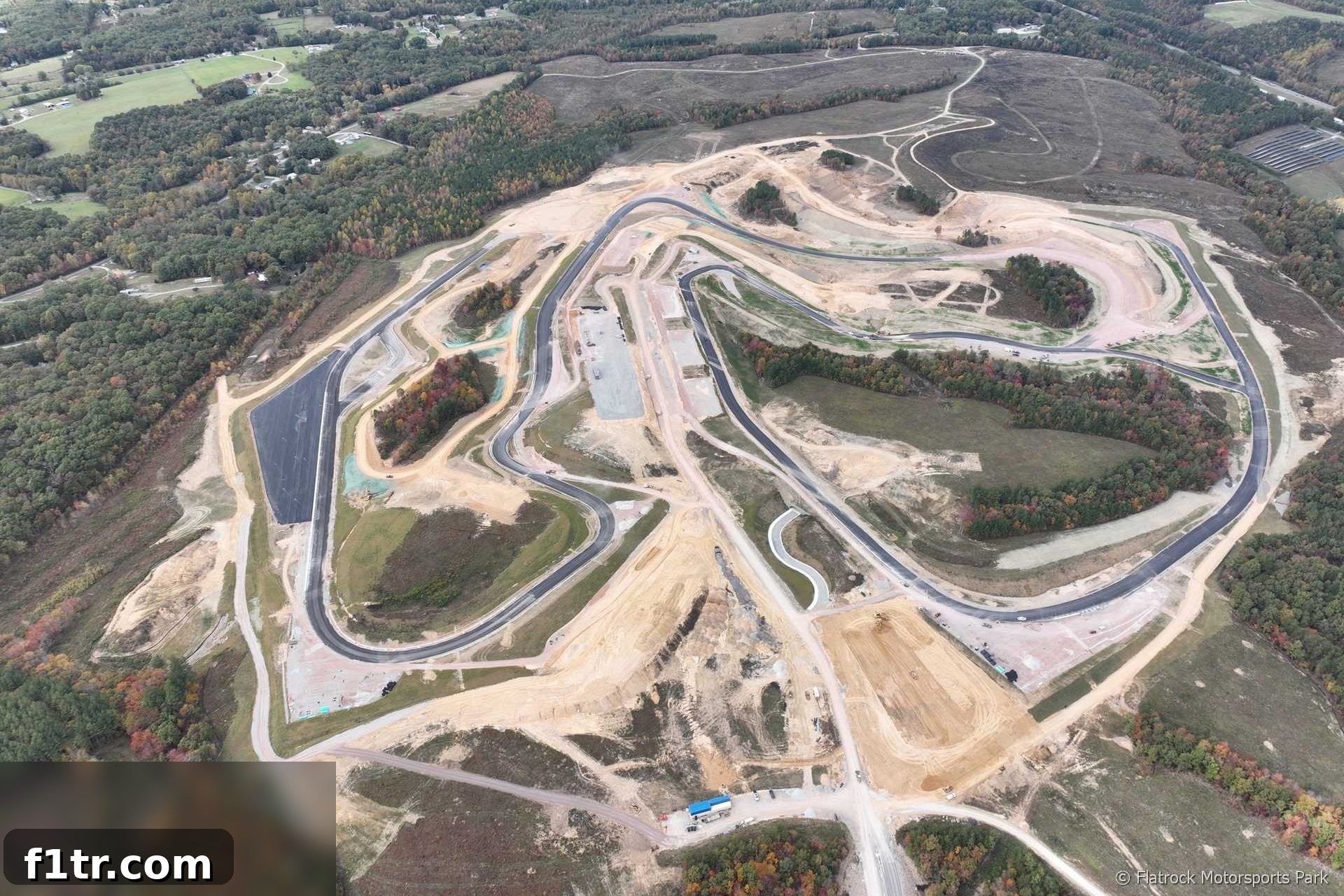
The world of motorsports is constantly evolving, with ambitious new projects pushing the boundaries of circuit design and entertainment. One such development is Flatrock Motorsports Park, the latest brainchild of renowned Formula 1 circuit architect Hermann Tilke. Located in Tennessee, just 70km west of Knoxville, this massive new facility is currently under construction and set to become a premier destination for racing enthusiasts and beyond.
Much like the Circuit of the Americas in Texas, Flatrock is envisioned as a multi-million dollar entertainment hub, designed to host a diverse array of events including concerts, exhibitions, and major motorsports spectacles. The comprehensive motorsports facilities, however, are undoubtedly the main draw. Flatrock will feature multiple circuit layouts, including a 4.2-kilometer Grand Prix configuration and several shorter tracks. But the crown jewel is undoubtedly the endurance layout, which stretches an astonishing 10 kilometers, making it significantly longer than even modern Formula 1’s longest track, Spa-Francorchamps.
Flatrock’s Ambitions and Modern FIA Standards
While Flatrock Motorsports Park has not yet been formally linked to a Formula 1 race, discussions are reportedly underway regarding its potential to host high-profile events such as MotoGP and IndyCar. However, even if Formula 1 were to consider Flatrock, its impressive 10-kilometer endurance layout would face significant regulatory hurdles.
Modern Formula 1 circuits are subject to stringent regulations set by the FIA (Fédération Internationale de l’Automobile). To host a Grand Prix, a track must achieve Grade One status, signifying the highest standards in track layout, safety features, and overall facilities. A key FIA guideline for Grade One circuits specifies a maximum length of seven kilometers. The iconic Spa-Francorchamps circuit, at just over seven kilometers, stands as a notable exception, being the longest Grade One track currently on the F1 calendar by a mere four meters. This strict limit is primarily imposed for safety reasons, ensuring rapid medical and marshal response times across the entire track, a challenge that becomes exponentially greater on ultra-long layouts.
A Look Back: Formula 1’s Legendary Longest Tracks
In the formative decades of the Formula 1 World Championship, such stringent length restrictions did not exist. It was common for circuits to stretch far beyond seven kilometers, sometimes even reaching extraordinary lengths. These historic venues, while no longer part of the modern F1 landscape, played a pivotal role in shaping the sport’s legacy. Below, we delve into the longest circuits that have hosted Formula 1 Grands Prix, showcasing a bygone era of magnificent, sprawling race tracks.
12. Bremgarten – Swiss Grand Prix
Street circuit – 7.2km – 1950-54
The picturesque Bremgarten circuit, located near Bern, was a challenging public road course that hosted the Swiss Grand Prix for the first five seasons of the World Championship. Its beautiful setting in the stunning Swiss countryside belied its dangerous nature, characterized by fast, tree-lined roads and a lack of proper run-off areas. Motorsport was tragically banned in Switzerland following the catastrophic Le Mans accident in 1955, leading to Bremgarten’s permanent removal from the F1 calendar. Legendary driver Juan Manuel Fangio was the only competitor to win the Swiss Grand Prix more than once on this demanding circuit.
11. Porto – Portuguese Grand Prix
Street circuit – 7.5km – 1958, 1960
Before Formula 1 moved to Estoril and later the Algarve International Circuit, the Boavista street circuit in Porto served as the inaugural venue for the Portuguese Grand Prix. This challenging track wound through the city streets, featuring two exceptionally long straights that ran alongside the historic harbourside. It hosted two memorable Grands Prix where lap times consistently exceeded two minutes, a testament to its length and intricate layout. Though its original F1 tenure was brief, the circuit was later partially revived and heavily revised to host rounds of the World Touring Car Championship, allowing a new generation of racers to experience a slice of its legacy.
10. Ain-Diab – Moroccan Grand Prix
Street circuit – 7.6km – 1958
The Moroccan Grand Prix made a solitary appearance on the Formula 1 calendar in 1958. The Ain-Diab street circuit, a temporary layout carved through the coastal city of Casablanca, was characterized by its wide, sweeping corners and relatively high average lap speeds for the era. The 1958 race was won by the legendary Stirling Moss and was a pivotal event, as it crowned Mike Hawthorn as the World Champion. However, it was also marred by a tragic incident, a crash that ultimately claimed the life of Stuart Lewis-Evans, highlighting the inherent dangers of these early, fast street circuits.
9. Interlagos – Brazilian Grand Prix
Permanent circuit – 7.9km – 1973-77, 1979-80
Before the beloved, shorter configuration of Autódromo José Carlos Pace (Interlagos) became synonymous with the Brazilian Grand Prix, the São Paulo circuit was a formidable, nearly 8-kilometer beast. The original layout was radically different, featuring a much longer perimeter. Instead of the familiar Senna Esses, the track continued around its outer edges. Where today’s cars turn right at Ferradura and climb the hill, the old circuit turned left, running in the opposite direction along what is now the back straight. The modern Interlagos is widely celebrated as one of the most successful and exciting revisions of a classic track, retaining its character while enhancing safety and raceability.
8. Clermont-Ferrand – French Grand Prix
Street circuit – 8.0km – 1965, 1969-70, 1972
Known as ‘Charade,’ the Clermont-Ferrand circuit was another magnificent French venue that utilized public roads through the stunning Auvergne countryside. Much like Rouen, it hosted the French Grand Prix multiple times. Charade was renowned for its incredibly twisty and undulating nature, earning it a reputation as a miniature Nürburgring. Its challenging layout is believed to have inspired the ‘Alsace’ track in the Gran Turismo video game series. The circuit’s demanding character was underscored by a serious incident in its final Formula 1 race in 1972, where driver and future Red Bull motorsport consultant Helmut Marko suffered a career-ending eye injury from a stone kicked up by a rival car.
7. AVUS – German Grand Prix
Street circuit – 8.3km – 1959
AVUS, the Automobil Verkehrs und Übungsstraße, stands as one of the most unique and audacious circuits in Formula 1 history. This German track was essentially two impossibly long straights connected by two hairpins, one of which, the “North Curve,” featured an extreme 43-degree banking. Unsurprisingly, its sole Formula 1 race in 1959 was, for many years, the fastest Grand Prix ever recorded, with an average speed of 230 km/h. This record stood until Dan Gurney’s victory at Spa-Francorchamps in 1967. Even in modern F1, only Max Verstappen’s 2023 Italian Grand Prix victory at Monza has surpassed AVUS’s astonishing average speed, cementing its place as a truly extraordinary speed arena.
6. Reims – French Grand Prix
Street circuit – 8.34km – 1950-51, 1953-54, 1956, 1958-61, 1963, 1966
Reims-Gueux, one of several circuits to host the French Grand Prix, was arguably the longest and fastest of them all during its F1 tenure. Hosting the event 11 times across the first 17 World Championship seasons, this eight-kilometer course was characterized by its immense straights and minimal number of corners—just five significant turns. These long, high-speed sections made Reims one of the quickest tracks on the calendar, with average speeds consistently around or above 200 km/h. Its fast and flowing nature put a premium on engine power and aerodynamic efficiency, providing spectacular slipstreaming battles for the spectators.
5. Sebring – United States Grand Prix
Permanent circuit – 8.36km – 1959
Sebring International Raceway, a name synonymous with endurance racing, had the distinct honor of hosting the first-ever dedicated United States Grand Prix in 1959. While the Indianapolis 500 was included in the World Championship up to 1960, Sebring was the first track to organize an F1 race explicitly titled the US Grand Prix. This iconic Floridian track, primarily built on a former airfield, featured a longer version of the layout still largely in use today. The 1959 race was a historic occasion, witnessing Jack Brabham seal his first World Championship at this incredibly punishing and unique circuit.
4. Monza – Italian Grand Prix
Permanent circuit – 10km – 1955-56, 1960-61
The Autodromo Nazionale Monza, revered as the “Temple of Speed” and famous for its current high-speed layout, also holds a significant place in history for its iconic high-banked oval. On four occasions in the mid-1950s and early 1960s, this hallowed oval section was integrated into the Grand Prix layout, creating a unique 10-kilometer figure-of-eight configuration. This audacious design required drivers to effectively cross the pit straight twice in a single lap, making it Monza at its most daunting and rapid. The combined road and oval configuration was last used for Formula 1 in 1961, an event tragically remembered for a dreadful crash on the run to Parabolica that claimed the lives of Wolfgang von Trips and 15 spectators, leading to its discontinuation for F1 racing.
3. Spa-Francorchamps – Belgian Grand Prix
Street circuit – 14.1km – 1950-56, 1958, 1960-68, 1970
The legendary Spa-Francorchamps circuit, widely regarded as one of Formula 1’s most popular tracks today, was once twice its current length and even more terrifyingly fast. The original 14.1-kilometer layout was an epic blast through the undulating Ardennes countryside. While the iconic run from Eau Rouge and Raidillon remains, the old track continued at what is now Les Combes, extending through public roads at extremely high speeds. Without the sophisticated downforce of modern cars, corners like the infamous Masta Kink became legendary, demanding immense precision and unparalleled bravery from drivers. The track eventually rejoined the modern layout at Blanchimont, culminating at La Source as its final corner, before safety concerns ultimately led to its significant shortening.
2. Nürburgring Nordschleife – German Grand Prix
Permanent circuit – 22.8km – 1951-54, 1956-58, 1961-76
Few racing circuits command as much respect and awe as the original Nürburgring Nordschleife – famously known as the “Green Hell.” This monumental 22.8-kilometer track snaked through the Eifel mountains, presenting an unrelenting barrage of challenging corners, elevation changes, and blind crests. Loved by drivers for its ultimate test of skill and feared for its undeniable dangers, the Nordschleife remains an active circuit for other forms of racing, but its Formula 1 tenure ended in 1976. Following countless tragedies and the near-fatal accident of Niki Lauda, the circuit was deemed too unsafe for Grand Prix racing, forever cementing its status as an unparalleled, yet too dangerous, F1 legend.
1. Pescara – Pescara Grand Prix
Street circuit – 25.5km – 1957
Holding the distinction of being the longest circuit ever to host a Grand Prix, the Pescara circuit on Italy’s Adriatic coast measured an incredible 25.5 kilometers per lap. This epic coastal street circuit connected the three towns of Pescara, Cappelle sul Tavo, and Montesilvano, forming a rough triangle. Its layout comprised two extremely long straights linked by a challenging, winding section through the hills. With only the fastest drivers and most powerful cars managing to bring lap times under the ten-minute mark, the Pescara Grand Prix of 1957 stands as a testament to an era when track length and daring were paramount, a record that no Grand Prix circuit has ever surpassed.
The Enduring Legacy of Formula 1 Circuits
From the ambitious vision of Flatrock Motorsports Park to the legendary “Green Hell” of Nürburgring Nordschleife, the evolution of Formula 1 circuits tells a compelling story of engineering prowess, human bravery, and an unyielding commitment to safety. While modern regulations necessitate shorter, more controlled environments, the memory of these historic, sprawling tracks continues to captivate the imagination, reminding us of the sport’s rich and often perilous past. The future of motorsports may emphasize entertainment and accessibility, but the spirit of these magnificent long circuits, where man and machine were pushed to their absolute limits, will forever remain a cornerstone of Formula 1’s heritage.