The 2025 Monaco Grand Prix unfolded as a masterclass in strategic maneuvering, or perhaps, a cautionary tale of regulatory overreach, depending on one’s perspective. The race was profoundly shaped by Formula 1’s newly mandated two-tyre-change rule, a regulation intended to inject excitement but which ultimately gave rise to some truly bizarre and controversial strategies, turning the glamorous street circuit into a slow-motion chess game.
Race Analysis
Driver Frustrations
The Manipulation of Strategy
The Two-Tyre Rule Under Scrutiny
Lap by Lap Positions
Race Gaps and Pace
Lap Times Overview
Fastest Laps
Tyre Strategy Insights
Pit Stop Performance
The 2025 Monaco Grand Prix: A Strategic Conundrum
From the very first lap, it became evident that teams were interpreting the two-tyre rule in novel and often counter-intuitive ways. Several drivers opted for stints lasting a mere single lap, quickly fulfilling one of their mandatory changes to gain a strategic advantage later in the race, or to clear traffic. Isack Hadjar, for instance, visited the pits twice by an astonishingly early Lap 19. This aggressive approach contrasted sharply with that of others, such as Andrea Kimi Antonelli, who made his first pit stop a remarkable 50 laps later, underscoring the vast divergence in strategic thinking that characterized the event.
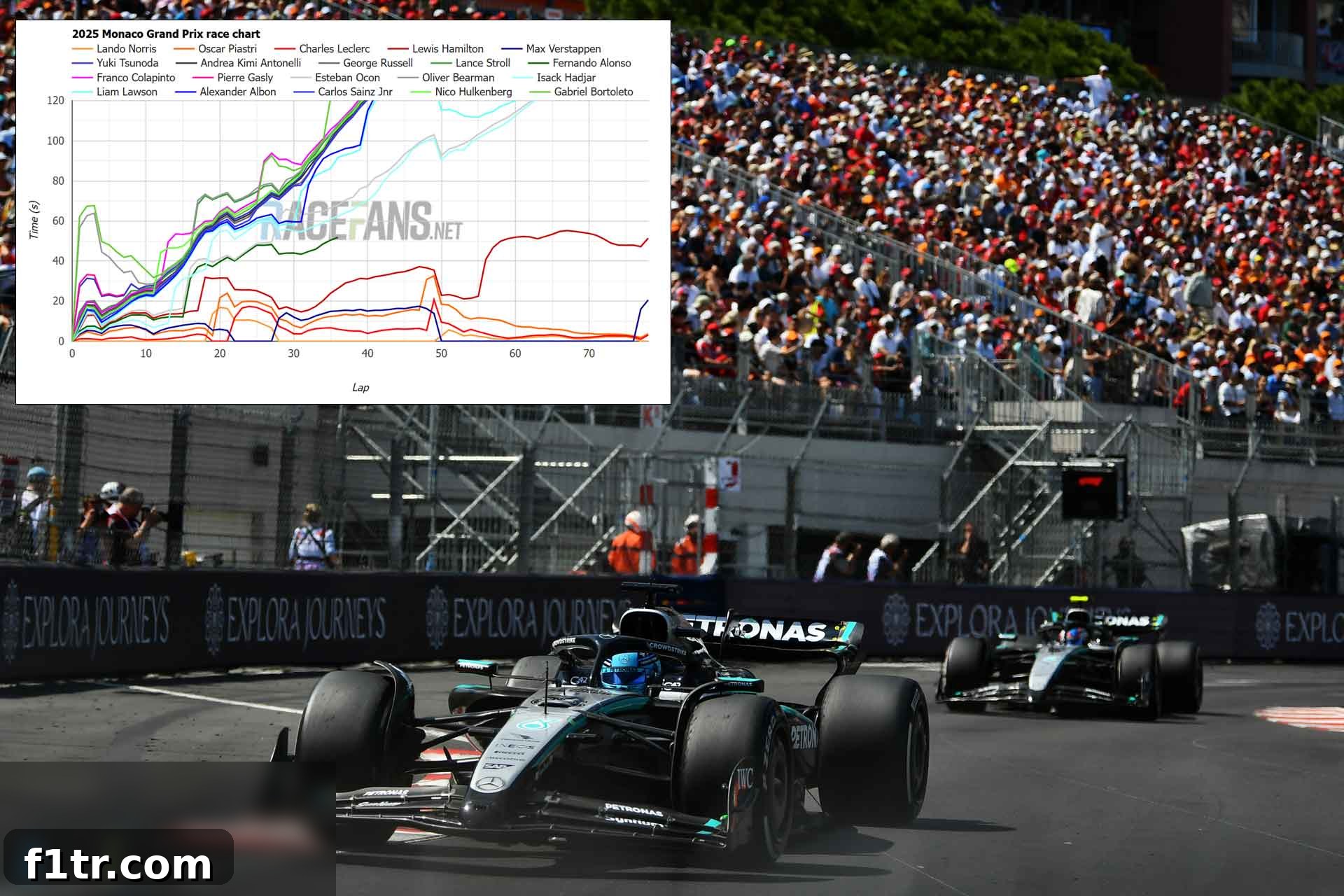
The race charts visually tell a compelling story of the unfolding drama. Beyond the top five, most drivers found themselves rapidly dropping off the standard view of the race graph. A wider zoom reveals Antonelli, a strong candidate for the most frustrating race of anyone, falling more than four minutes behind the leader. This wasn’t a reflection of his pace or skill, but rather a stark illustration of the deliberate tactics employed by rivals ahead. Many drivers were strategically held up, their pace artificially limited to facilitate team-mate strategies or manage tyre wear, transforming the race into a high-speed procession where overtakes were almost non-existent and genuine racing was stifled.
Tales of Frustration: Antonelli and Russell’s Monaco Ordeal
Andrea Kimi Antonelli’s race was a prime example of the frustration felt by many. Trapped behind slower cars, his potential went unrealized. Adding to the tension, his team mate took matters into his own hands on Lap 49, cutting across the Nouvelle chicane to pass Alexander Albon. This bold, rule-bending move sparked immediate controversy. Russell’s race engineer, Marcus Dudley, instructed him to give the place back, but Russell’s defiant response – that he would “rather take the penalty” – highlighted the extent of driver exasperation and the lengths to which they would go to escape the strategic paralysis of the race.
The stewards swiftly addressed Russell’s transgression, escalating his punishment from a standard 10-second sanction to a drive-through penalty. However, the effectiveness of this penalty was debatable. Despite the more severe sanction, Russell’s final position was ultimately no worse than where he was projected to finish before his corner-cutting maneuver. This outcome fueled debates about the fairness and efficacy of penalties in an environment where strategic manipulation could outweigh the sporting consequences of rule breaches. The incident became a microcosm of the larger issues at play, questioning whether the regulations truly promoted fair competition or inadvertently rewarded clever, albeit unsportsmanlike, tactics.
Strategic Manipulation: The Heart of the Controversy
In the aftermath of the Grand Prix, many drivers spoke out, scathingly condemning how the new rules had seemingly increased the motivation for teams to engage in “manipulation” strategies. Even drivers whose teams benefited from these tactics expressed their displeasure. The Williams pair, who were instrumental in holding up a significant portion of the field, publicly complained about the tactics, with Alexander Albon famously quipping that he “could have had a pillow and a coffee in the car and chilled out.” This sentiment underscored a widespread dissatisfaction with the state of racing at Monaco.
These strategic ploys were, in fact, widely anticipated even before the race began. Alexander Albon had accurately predicted that Racing Bulls would utilize Liam Lawson to create a crucial gap for Isack Hadjar, a scenario that unfolded exactly as foretold. Once Racing Bulls had executed their plan, the Williams drivers employed a similar tactic, with Albon strategically making space for Carlos Sainz Jnr. This involved deliberately slowing down, managing pace, and creating a buffer for a faster team mate, often at the expense of other competitors caught in their wake. This intricate dance of strategic sacrifice and gain highlighted the sophisticated, yet often frustrating, layers of team-based strategy that defined the 2025 Monaco Grand Prix, leaving many questioning the spirit of competition.
The Two-Tyre Rule: Intention vs. Reality
The mandatory two-tyre-change rule was introduced as a direct response to the previous year’s Monaco Grand Prix, where an early red flag allowed drivers to complete their single mandatory tyre change and then simply nurse their tyres to the finish, resulting in a distinctly uneventful race. The intention behind the new rule was clear: to prevent a repeat of this “processional” outcome and inject more strategic variation and excitement. However, the reality of the 2025 event painted a different picture. While in 2024 drivers lamented being slower than Formula 2 cars at times, this year, under the revised regulations, some drivers found themselves lapping at an even more glacial pace. The rule, designed to improve the spectacle, inadvertently fostered a race environment characterized by extreme pace management and strategic holding patterns, arguably making the on-track action even less engaging than before. This unintended consequence ignited a furious debate within the F1 community about the efficacy of rule changes and their potential to backfire.
Lap by Lap Positions: Tracking Driver Progression
Analyzing the lap-by-lap positions provides a comprehensive visual narrative of how the race unfolded for each driver. Such a chart allows enthusiasts and strategists alike to track the precise position of every competitor on every lap, offering invaluable insights into overtakes, pit stop timing effects, and how strategic plays impacted a driver’s standing. It would vividly display the drivers caught in the strategic bottlenecks, illustrating the periods where positions remained static for extended periods due to the aforementioned tactical slowdowns, and highlight any rare moments of genuine progression through the field.
Race Gaps and Pace: The Unfolding Narrative
A detailed race chart illustrating the gaps between each driver relative to the leader’s average lap time offers profound insights into the true pace and strategic intent throughout the Grand Prix. By visualizing these gaps, one can observe the periods of deliberate pace management, the impact of slower traffic, and the moments when drivers attempted to push. The dramatic expansion of gaps, particularly for drivers like Andrea Kimi Antonelli who fell minutes behind the leader, would be glaringly evident. This chart effectively tells the story of how team strategies, rather than outright speed, dictated the flow and outcome for much of the field, highlighting the widespread frustration born from being unable to race at full potential.
Lap Times Insights: A Deeper Look at Performance
Examining all the lap times recorded by drivers, with extremely slow laps excluded to maintain focus on competitive performance, provides a granular view of individual and team performance. This data helps to identify periods of aggressive pushing, tyre degradation, and the overall rhythm of the race. While the Monaco circuit is inherently challenging for consistent fast laps due to its tight nature, the 2025 race lap times would reveal the pervasive impact of strategic holding, showing periods where drivers were capable of much faster pace but were constrained by the tactical demands of their teams or the traffic ahead. It would underscore the fact that pure speed was often secondary to strategic adherence.
2025 Monaco Grand Prix Fastest Laps: The Pursuit of Pace
Despite the strategic complexities and the often-slow pace of the main race, the pursuit of individual fastest laps remained a key battle for some drivers, particularly those with a clear track ahead. The fastest lap times often serve as a testament to a car’s raw pace and a driver’s ability to extract performance when the conditions allow, irrespective of their final race position. Here’s a breakdown of each driver’s best effort:
| Rank | # | Driver | Car | Lap time | Gap | Avg. speed (kph) | Lap no. |
|---|---|---|---|---|---|---|---|
| 1 | 4 | Lando Norris | McLaren-Mercedes | 1’13.221 | 164.07 | 78 | |
| 2 | 63 | George Russell | Mercedes | 1’13.405 | 0.184 | 163.66 | 74 |
| 3 | 12 | Andrea Kimi Antonelli | Mercedes | 1’13.518 | 0.297 | 163.4 | 74 |
| 4 | 81 | Oscar Piastri | McLaren-Mercedes | 1’13.745 | 0.524 | 162.9 | 60 |
| 5 | 55 | Carlos Sainz Jnr | Williams-Mercedes | 1’13.988 | 0.767 | 162.37 | 68 |
| 6 | 16 | Charles Leclerc | Ferrari | 1’14.055 | 0.834 | 162.22 | 36 |
| 7 | 44 | Lewis Hamilton | Ferrari | 1’14.090 | 0.869 | 162.14 | 73 |
| 8 | 1 | Max Verstappen | Red Bull-Honda RBPT | 1’14.230 | 1.009 | 161.84 | 45 |
| 9 | 23 | Alexander Albon | Williams-Mercedes | 1’14.597 | 1.376 | 161.04 | 74 |
| 10 | 87 | Oliver Bearman | Haas-Ferrari | 1’14.855 | 1.634 | 160.49 | 6 |
| 11 | 18 | Lance Stroll | Aston Martin-Mercedes | 1’14.877 | 1.656 | 160.44 | 67 |
| 12 | 5 | Gabriel Bortoleto | Sauber-Ferrari | 1’14.884 | 1.663 | 160.42 | 37 |
| 13 | 22 | Yuki Tsunoda | Red Bull-Honda RBPT | 1’14.913 | 1.692 | 160.36 | 75 |
| 14 | 31 | Esteban Ocon | Haas-Ferrari | 1’15.157 | 1.936 | 159.84 | 34 |
| 15 | 27 | Nico Hulkenberg | Sauber-Ferrari | 1’15.223 | 2.002 | 159.7 | 47 |
| 16 | 43 | Franco Colapinto | Alpine-Renault | 1’15.298 | 2.077 | 159.54 | 30 |
| 17 | 30 | Liam Lawson | Racing Bulls-Honda RBPT | 1’15.321 | 2.100 | 159.49 | 54 |
| 18 | 14 | Fernando Alonso | Aston Martin-Mercedes | 1’15.593 | 2.372 | 158.92 | 15 |
| 19 | 6 | Isack Hadjar | Racing Bulls-Honda RBPT | 1’15.981 | 2.760 | 158.11 | 16 |
| 20 | 10 | Pierre Gasly | Alpine-Renault | 1’18.054 | 4.833 | 153.91 | 6 |
Lando Norris delivered the fastest lap of the race in his McLaren-Mercedes, showcasing the potential of his machinery when granted clear track. This impressive feat, achieved on the very last lap, highlights the McLaren’s strong performance capabilities. George Russell and Andrea Kimi Antonelli of Mercedes also posted highly competitive times, demonstrating that despite the strategic handicaps, the underlying pace of certain cars remained formidable. The spread of fastest laps across different teams and at various points in the race underlines the diverse approaches to pace management, with some drivers clearly pushing hard when opportune moments arose, often toward the end of their stints on fresher tyres.
2025 Monaco Grand Prix Tyre Strategies: Navigating the Mandate
The tyre strategies deployed by each driver were perhaps the most scrutinized aspect of the 2025 Monaco Grand Prix, directly shaped by the mandatory two-stop rule. Teams explored a wide spectrum of approaches to meet this requirement, often combining different compounds – Soft, Medium, and Hard – to optimize performance over the lengthy 78-lap race. Common strategies might have involved an early switch to hard tyres for a long middle stint, or a more balanced approach with two medium stints bookending a hard compound. The visual representation of these strategies would highlight the varied timing of pit stops and the specific tyre compounds chosen, offering a clear understanding of how teams attempted to gain an advantage, or at least survive, the unique challenges posed by Monaco and its new rule. The success, or failure, of these strategies dictated a driver’s ability to maintain position or attempt to make progress.
2025 Monaco Grand Prix Pit Stop Times: The Race Against the Clock
In a race where track position and strategic execution were paramount, pit stop performance played a critical, albeit sometimes overlooked, role. While the overarching strategy often dictated when drivers entered the pits, the efficiency of the pit crew in executing rapid tyre changes could significantly impact a driver’s re-entry into the flow of traffic. The data on pit stop times reflects the relentless pursuit of perfection by the teams, even when the broader race narrative was slow.
| Rank | # | Driver | Team | Complete stop time (s) | Gap to best (s) | Stop no. | Lap no. |
|---|---|---|---|---|---|---|---|
| 1 | 44 | Lewis Hamilton | Ferrari | 23.565 | 1 | 18 | |
| 2 | 16 | Charles Leclerc | Ferrari | 23.576 | 0.011 | 1 | 22 |
| 3 | 16 | Charles Leclerc | Ferrari | 23.678 | 0.113 | 2 | 49 |
| 4 | 4 | Lando Norris | McLaren | 23.704 | 0.139 | 2 | 50 |
| 5 | 81 | Oscar Piastri | McLaren | 23.908 | 0.343 | 2 | 48 |
| 6 | 23 | Alexander Albon | Williams | 23.927 | 0.362 | 1 | 32 |
| 7 | 1 | Max Verstappen | Red Bull | 23.95 | 0.385 | 2 | 77 |
| 8 | 18 | Lance Stroll | Aston Martin | 23.978 | 0.413 | 1 | 17 |
| 9 | 63 | George Russell | Mercedes | 24.025 | 0.46 | 2 | 68 |
| 10 | 6 | Isack Hadjar | Racing Bulls | 24.031 | 0.466 | 2 | 19 |
| 11 | 55 | Carlos Sainz Jnr | Williams | 24.049 | 0.484 | 2 | 53 |
| 12 | 27 | Nico Hulkenberg | Sauber | 24.065 | 0.5 | 1 | 12 |
| 13 | 22 | Yuki Tsunoda | Red Bull | 24.086 | 0.521 | 2 | 73 |
| 14 | 1 | Max Verstappen | Red Bull | 24.114 | 0.549 | 1 | 28 |
| 15 | 23 | Alexander Albon | Williams | 24.19 | 0.625 | 2 | 40 |
| 16 | 30 | Liam Lawson | Racing Bulls | 24.206 | 0.641 | 1 | 31 |
| 17 | 5 | Gabriel Bortoleto | Sauber | 24.246 | 0.681 | 3 | 35 |
| 18 | 44 | Lewis Hamilton | Ferrari | 24.256 | 0.691 | 2 | 56 |
| 19 | 6 | Isack Hadjar | Racing Bulls | 24.311 | 0.746 | 1 | 14 |
| 20 | 30 | Liam Lawson | Racing Bulls | 24.32 | 0.755 | 2 | 40 |
| 21 | 43 | Franco Colapinto | Alpine | 24.355 | 0.79 | 1 | 13 |
| 22 | 10 | Pierre Gasly | Alpine | 24.376 | 0.811 | 1 | 1 |
| 23 | 27 | Nico Hulkenberg | Sauber | 24.397 | 0.832 | 2 | 44 |
| 24 | 12 | Andrea Kimi Antonelli | Mercedes | 24.457 | 0.892 | 1 | 69 |
| 25 | 5 | Gabriel Bortoleto | Sauber | 24.483 | 0.918 | 2 | 26 |
| 26 | 43 | Franco Colapinto | Alpine | 24.497 | 0.932 | 2 | 26 |
| 27 | 55 | Carlos Sainz Jnr | Williams | 24.498 | 0.933 | 1 | 48 |
| 28 | 22 | Yuki Tsunoda | Red Bull | 24.525 | 0.96 | 1 | 1 |
| 29 | 4 | Lando Norris | McLaren | 24.545 | 0.98 | 1 | 19 |
| 30 | 87 | Oliver Bearman | Haas | 24.58 | 1.015 | 2 | 17 |
| 31 | 31 | Esteban Ocon | Haas | 24.773 | 1.208 | 2 | 28 |
| 32 | 12 | Andrea Kimi Antonelli | Mercedes | 24.837 | 1.272 | 2 | 71 |
| 33 | 63 | George Russell | Mercedes | 25.063 | 1.498 | 1 | 62 |
| 34 | 14 | Fernando Alonso | Aston Martin | 25.375 | 1.81 | 1 | 16 |
| 35 | 31 | Esteban Ocon | Haas | 25.575 | 2.01 | 1 | 16 |
| 36 | 81 | Oscar Piastri | McLaren | 25.756 | 2.191 | 1 | 20 |
| 37 | 18 | Lance Stroll | Aston Martin | 25.916 | 2.351 | 2 | 64 |
| 38 | 5 | Gabriel Bortoleto | Sauber | 37.243 | 13.678 | 1 | 1 |
| 39 | 87 | Oliver Bearman | Haas | 50.191 | 26.626 | 1 | 1 |
Ferrari demonstrated exceptional efficiency in the pit lane, with Lewis Hamilton and Charles Leclerc recording the fastest stop times, often completing changes in under 24 seconds. This efficiency is a critical advantage, especially on a circuit like Monaco where every millisecond counts in maintaining or gaining track position. However, some drivers experienced notably longer stops. Gabriel Bortoleto and Oliver Bearman, in particular, had significantly extended first stops, indicating potential issues or strategic complications at the very beginning of their races. These longer stops highlight the immense pressure on pit crews and the fine margins that define success and failure in Formula 1, even in a race dominated by other strategic considerations.