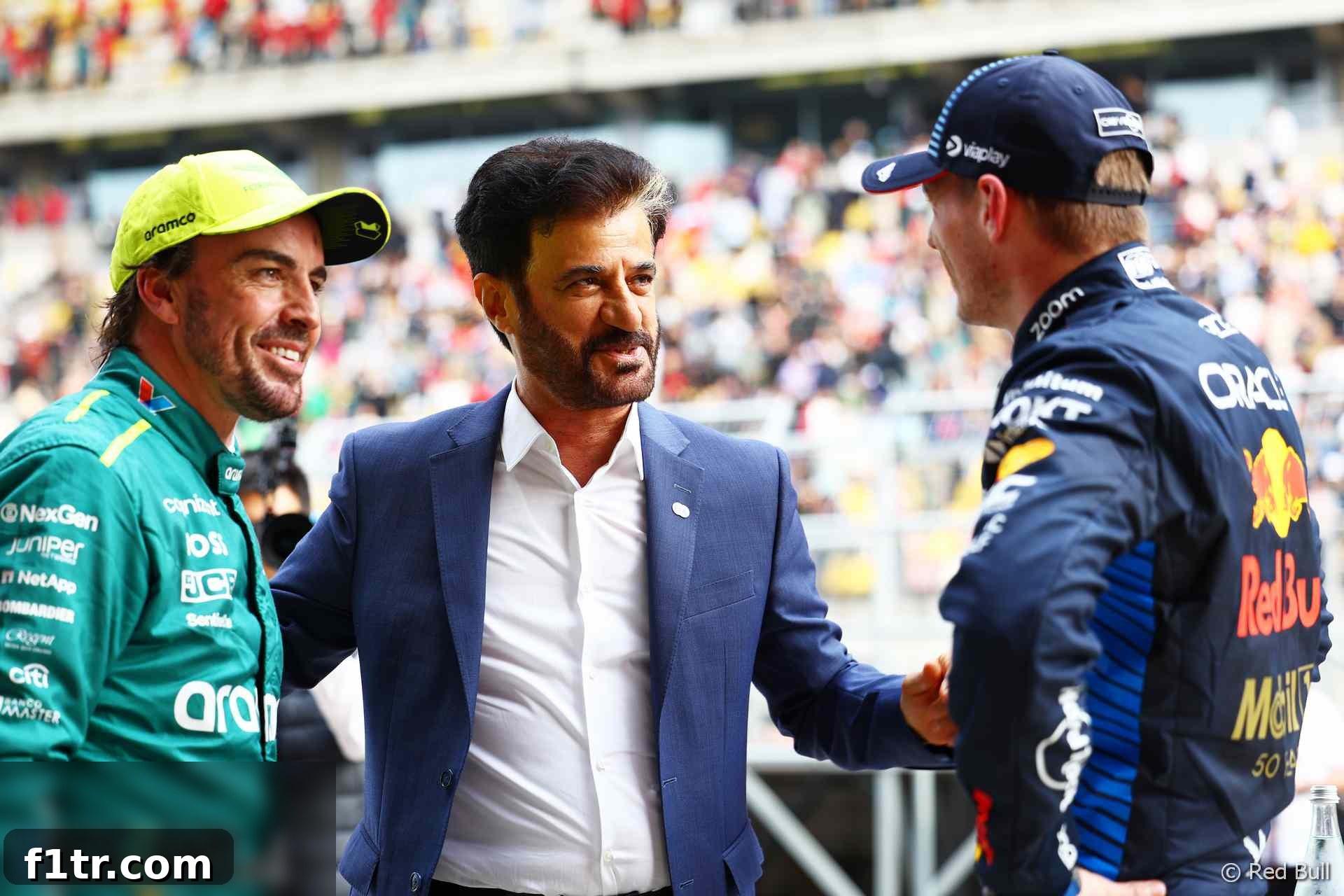
Fernando Alonso, one of Formula 1’s most revered and enduring figures, recently underscored a fundamental truth about elite motorsport: drivers are, whether they like it or not, role models, and their conduct must reflect this immense responsibility. This statement by the two-time world champion carries significant weight, especially in an era of heightened media scrutiny and global fan engagement, and it arrives at a pertinent time, following an incident involving Max Verstappen and his use of a swear word during an official press conference after the Singapore Grand Prix.
Advert | Become a Supporter & go ad-free
Speaking at an event for an Aston Martin sponsor in Chennai, India, Alonso, the most experienced driver in F1 history with 395 race starts, emphasized the profound influence Formula 1 drivers wield. He articulated that the immense public interest and the fervent passion of the fans bestow upon drivers a responsibility that transcends the racetrack. “What the fans bring to the drivers and the sportsmen, I think, is a huge responsibility because you are a role model for many people,” he stated. This sentiment highlights the dual nature of an F1 driver’s life: not just a competitor, but a public figure constantly under the spotlight, whose actions and words resonate far beyond the paddock, influencing millions globally.
Alonso elaborated on this critical point, stressing that this obligation is ever-present, irrespective of personal desire. “You have to be ready to be a role model when you want to do it, and when you don’t want to do it, you still have to do it. When you want to say something that is not correct you have to hold yourself and be political[ly] correct.” This insight offers a glimpse into the demanding reality faced by F1 stars. They are expected to maintain a certain decorum, to articulate their thoughts carefully, and to project an image of professionalism and integrity, even when their natural inclinations might lean otherwise. This pressure to always be “on” and to consider the wider implications of their statements can be a heavy burden, but it is, as Alonso suggests, an intrinsic and non-negotiable part of competing at the highest level of international sport.
The veteran driver further extended this principle of unwavering discipline to the very core of a driver’s preparation. The commitment required to compete at the pinnacle of motorsport demands absolute dedication, regardless of personal mood or motivation. “When you are in a day that you don’t want to train, or you don’t want to prepare yourself for the next grand prix, you have to do it,” Alonso explained. “In the days that you are ready to do it okay, when you are not ready to do it, you still have to do it, because you have that responsibility towards your fans and the people that believe [in] you.” This unwavering work ethic, born out of accountability to fans, underscores the relentless pursuit of excellence that defines an F1 career. It’s a powerful reminder that success in such a competitive arena isn’t just about raw talent, but about a profound and consistent commitment to self-improvement and performance, driven by the knowledge that countless eyes are watching and drawing inspiration.
Advert | Become a RaceFans supporter andgo ad-free
The inspiring impact of F1 drivers is something Alonso frequently encounters and deeply appreciates. “I meet a lot of fans around the world that are obviously following Formula 1, but they will always say ‘you are my inspiration, you are never giving up, you are a fighter’,” he shared. These personal interactions serve as potent reminders for drivers about the profound influence they have. The narrative of resilience, determination, and relentless effort that defines an F1 driver’s career becomes a beacon of hope and motivation for millions, especially younger generations looking up to their sporting heroes. Consequently, this public admiration comes with an unspoken covenant: “So [when] you are a driver or you are in the public spotlight you need to behave properly. So I think the fans give you a lot of love, give you a lot of motivation, but also a huge responsibility to do what they expect from you.” This exchange is a cyclical one, where fan adoration fuels driver motivation, and in turn, drivers are compelled to uphold the high standards expected of them, reinforcing the aspirational nature of the sport and its global appeal.
The backdrop to Alonso’s insightful comments was the recent controversy involving Max Verstappen, who disagreed with the FIA’s mandate against swearing in press conferences. Following an order to undertake a day of “public work” as a penalty, Verstappen notably limited his engagement in subsequent FIA press conferences to terse, brief remarks. This incident underscores the tension between drivers’ personal expressions and the governing body’s efforts to maintain a polished public image for the sport. Alonso’s perspective offers a seasoned counterpoint, suggesting that regardless of personal feelings, the broader role model imperative takes precedence, reflecting a deeply ingrained understanding of Formula 1’s stature and its obligation to its worldwide audience.
Beyond his profound reflections on professional conduct, Alonso also offered a rare glimpse into the origins of his illustrious career, revealing a path less chosen by conscious decision and more by the formative influence of his father. “I didn’t choose to be a driver. It was my father, I have to admit,” he candidly stated. This revelation dispels the common romantic notion of a young prodigy single-mindedly pursuing a dream from inception. Instead, it paints a picture of circumstance and a parent’s guiding hand, a common thread in the early stages of many elite athletic careers where talent is identified and cultivated by dedicated family members.
Advert | Become a RaceFans supporter andgo ad-free
His journey began remarkably early: “In my case, I did my first go-kart race at the age of three, which you can imagine, I didn’t choose to do the race. My father was very happy that day, my mother less.” This anecdote perfectly encapsulates the innocent beginnings of a career that would span decades and reshape the landscape of Formula 1. It speaks to the early immersion required in motorsport, where talent is often identified and nurtured almost from infancy, often before the child can even articulate their own preferences. The initial enjoyment, the development of natural skills, and the subsequent successes then create a self-perpetuating cycle. “Then I think obviously you enjoy what you do, you develop some skills at a young age and then if you do well you have more opportunities. You deliver, you win, you go through categories and then eventually you get to F1.” This progression outlines the arduous, highly competitive ladder that young drivers must climb, each step a testament to their burgeoning talent and relentless drive, ultimately leading to the pinnacle of motorsport.
Interestingly, Alonso revealed a childhood inclination towards another sport: football. “When I was eight, nine, ten years old I remember going on the weekends to race but in the weekdays I was at the school playing football and I was a goalkeeper. And I remember that I was enjoying more playing football than the weekends racing.” This candid admission highlights a common dilemma for child athletes, often torn between different passions or the expectations placed upon them. However, the unique exclusivity and structured path of Formula 1 ultimately swayed his trajectory. “But I could not tell my father. And then in football, there are hundreds, thousands of players. In Formula 1, there are only 20. So it was more appealing, more exclusive!” This practical consideration, coupled with the allure of a highly specialized and elite sport with fewer entry points, likely solidified his path. Despite the undeniable glory and unique opportunities, Alonso acknowledges the personal costs: “But, no, jokes apart, I think I missed a lot of things in life, I’m aware of that.”
The sacrifices inherent in a life dedicated to motorsport from such a young age are profound and far-reaching. Alonso reflected on the impact on his formative years, stating he “didn’t have a normal school time, I was missing a lot of time, I was just racing in Italy and different countries. I was doing the exams in the following weeks and I [was] struggling a little bit.” This relentless travel and competitive schedule meant a childhood far removed from typical experiences, prioritizing racing over conventional education and social development. The pinnacle of this sacrifice was reaching Formula 1 at a remarkably young age: “At the age of 19, I became a Formula 1 driver. The first time I was in a disco, I was 29. So I missed [out on] a lot of things.” These personal insights humanize the journey of an F1 superstar, revealing the stark trade-offs between unparalleled professional success and the missed rites of passage of a conventional youth. It underscores the extraordinary dedication and single-minded focus required to reach and sustain oneself at the very top of global motorsport.
Advert | Become a RaceFans supporter andgo ad-free
Now 43 years old, Alonso’s reflections extend to his future personal aspirations, hinting at a desire for balance beyond the roar of engines. While content with his life’s trajectory, he acknowledges unfulfilled personal goals that are becoming increasingly important. “I don’t have kids: Something that I want to have, as a personal goal, in the next years, not too long, hopefully. And there are things that became not as planned when I was 15 or 16, I probably imagined a different life.” This reveals a deep-seated desire for a more conventional family life, suggesting a natural shift in priorities as his racing career, while still intense, approaches its inevitable twilight. Balancing the relentless demands of Formula 1 with personal milestones is a challenge faced by many elite athletes, and Alonso’s candidness resonates deeply with the human experience.
Alonso’s career has seen him venture beyond Formula 1, notably during a two-season hiatus in 2019 and 2020. During this period, he conquered the legendary Le Mans 24 Hours race, adding a coveted victory to his resume, and made several attempts at the iconic Indianapolis 500. This pursuit was driven by the tantalizing prospect of achieving motorsport’s fabled “Triple Crown”: winning the Monaco Grand Prix in Formula 1, the Le Mans 24 Hours in endurance racing, and the Indy 500 in oval racing. While he triumphed in two of these monumental events, the Indy 500 has remained elusive. “I attempted the Indy 500 three times, didn’t succeed. It’s the only one missing,” he noted, acknowledging the formidable and often unpredictable challenge it presents, where small margins can dictate success or failure.
However, despite the allure of the Triple Crown, Alonso harbors doubts about returning to Indianapolis after his current stint in Formula 1 concludes. “But at the moment it’s not in my plan. I’m very, very focused in Formula 1 now for the next two or three years. I want to win the third world title. This is my first and only priority at the moment.” This unwavering dedication to securing a third F1 championship, a goal that would cement his legacy even further amongst the sport’s all-time greats, speaks volumes about his enduring competitive spirit. He realizes that at 45 or 46 years old, the immense commitment, specialized training, and steep learning curve required for another serious Indy 500 attempt would be “a little bit too much.” This practical assessment reflects a mature understanding of his own limits and the demanding nature of such high-stakes racing, prioritizing a focused effort on his primary goal.
Instead of the Indy 500, Alonso has set his sights on an entirely different, yet equally demanding, motorsport challenge: the Dakar Rally. “I have, as I said, other goals in life as well. I think my next biggest challenge will be the Dakar rally.” His motivation for this endeavor is deeply personal and speaks to his desire for versatility and mastery across different racing disciplines, proving his adaptability. “If I can win Dakar, I think it will be hugely rewarding for me personally because I can win in Formula 1, I can win in endurance racing, win in Le Mans and Daytona, and if I can win in rally as well, it will mean a lot for me as a driver.” This ambition to conquer the grueling off-road marathon, an event known for its brutal conditions and requiring an entirely different skill set, showcases Alonso’s exceptional talent and his relentless drive to push personal boundaries, further cementing his reputation as one of the most complete and versatile drivers in motorsport history. It signifies a future where his competitive fire remains undimmed, channeled into new and exciting challenges that test every facet of his driving prowess.
Advert | Become a RaceFans supporter andgo ad-free
Miss nothing from RaceFans
Get a daily email with all our latest stories – and nothing else. No marketing, no ads. Sign up here:
Formula 1
- One of F1’s greatest races happened 15 years ago today. Or did it?
- “Overtaking is overtaking”: Domenicali denies F1’s yo-yo racing is “artificial”
- The crashes F1 is trying to prevent may be rare – but the danger is obvious
- F1 returning to India soon after 2027 sounds like wishful thinking
- Verstappen loathes F1’s new generation of cars – but what do his rivals reckon?
Browse all Formula 1 articles