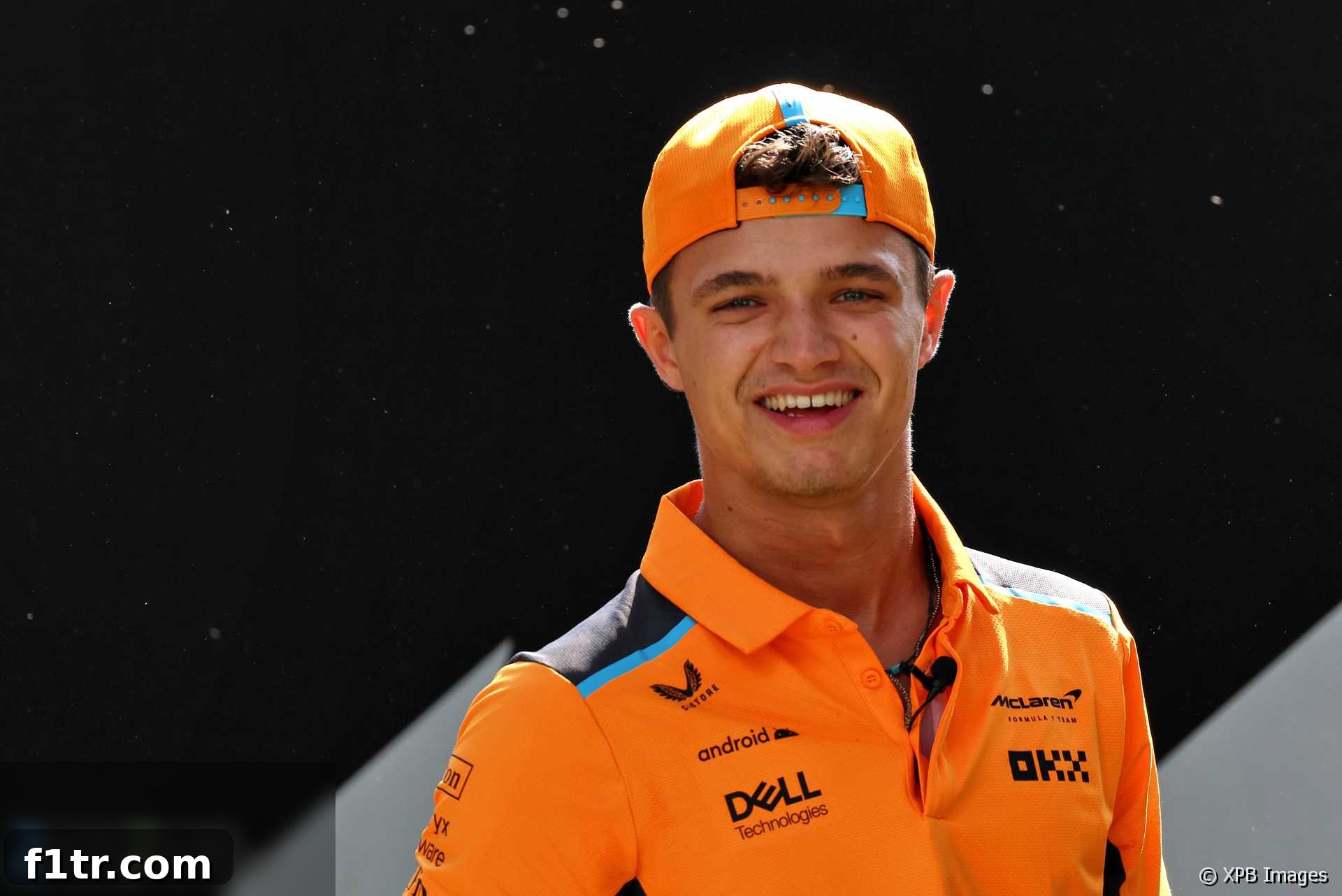
Lando Norris will be the sole McLaren driver to debut the team’s critical new upgrade package at this weekend’s Singapore Grand Prix, a move that underscores the squad’s strategic approach to its mid-season development push.
The highly anticipated enhancements, which promise to be the most significant since the successful Austrian Grand Prix earlier this year, will first be fitted to Norris’s MCL60. His teammate, Oscar Piastri, is slated to receive the full upgrade suite at the subsequent Japanese Grand Prix, highlighting a staged deployment designed to maximize data collection and optimize performance integration.
McLaren’s Latest Evolution: Targeting Weaknesses and Building on Success
A portion of this upgrade, specifically a new rear wing, was initially seen during practice sessions at the Dutch Grand Prix. However, the team opted not to race it there, strategically saving it for the demanding Marina Bay Street Circuit. Norris elaborated, “The rear wing we had in Zandvoort, but we ended up not using it there and saving for here. And then there’s some small things that you’ll probably quite easily see on the rest of the car.” This careful planning suggests McLaren is keen to apply the upgrades where they believe they will deliver the most tangible benefits.
This new development package is internally considered the most impactful performance step since the radical changes introduced at the Austrian Grand Prix. That earlier upgrade proved transformative for McLaren, elevating them from midfield contenders to regular podium challengers. Norris was also the first to run that major aerodynamic development, a pattern that speaks to his experience and ability to provide precise feedback on new components.
“Probably, since Austria, it’s the thing that we believe will help us move forward the most since then,” Norris stated, reflecting the team’s high expectations. Yet, a sense of cautious optimism prevails. “Which has been good, but obviously we’ve not run it on track yet so we don’t want to say too much until we’ve actually got it to work properly. But it’s a good step, the team have worked hard to get at least one of the cars here and then Oscar will have the rest in Japan too. So an exciting couple of weekends for us.”
Strategic Deployment: Why Norris First, Piastri Later?
The decision to initially equip only Norris’s car with the full upgrade package is a common practice in Formula 1, especially when resources are finite or when the team wants to gather initial data with an experienced driver. Norris, having been with McLaren since 2019, possesses an invaluable understanding of the car’s characteristics and how new components alter its behavior. His detailed feedback can accelerate the integration process, allowing the team to fine-tune the setup more effectively before rolling it out to both cars.
Furthermore, running one car with the upgrade and one without (or with an older specification) provides a direct comparison, yielding crucial data points on the upgrade’s true impact. This A/B testing approach is vital for validating computational fluid dynamics (CFD) and wind tunnel predictions against real-world track performance. By the time Piastri receives the package in Japan, the team will have a more robust understanding of its optimal configuration and potential. This staggered rollout minimizes risk and maximizes learning, ensuring both drivers ultimately benefit from a fully optimized package.
Addressing a Core Weakness: Slow-Speed Corner Performance
A central aim of this aerodynamic upgrade is to significantly improve the MCL60’s performance in slow-speed corners, an area that has been a consistent weakness for the car throughout the season. McLaren has demonstrated impressive speed in medium-to-high-speed corners, especially after the Austrian upgrades, but has often struggled on circuits with tighter, slower turns.
Norris confirmed the specific focus: “It’s also a bit more slower-speed biased, which is a bit different to what we had in Austria. So I think that’s why we’re probably a little bit more cautious on saying how big a step or how much it’s going to help because it’s been a bit easier for us to add load in the medium-to-high-speed corners and less so in the very slow-speed. But this is our first time we’ve been able to really target that a bit more. So we’ll see tomorrow.”
Successfully addressing slow-speed corner performance would be a game-changer for McLaren, unlocking greater competitiveness on a wider variety of tracks. Street circuits like Singapore, known for their numerous tight chicanes and hairpins, severely penalize cars that lack agility and traction at lower speeds. If the upgrade delivers as hoped, McLaren could suddenly find itself challenging at circuits where it previously struggled, further cementing its resurgence.
The Post-Austria Trajectory: A Testament to Technical Restructuring
The Austrian Grand Prix marked a definitive turning point for McLaren, following a challenging start to the year and a significant restructuring within its technical department during the off-season. The dramatic improvement seen since then has instilled a renewed sense of confidence and validated the changes made behind the scenes. Norris noted the palpable shift in team morale and development effectiveness.
“It was definitely more than we had over the last few years,” said Norris, reflecting on the impact of the Austrian package. “Sometimes you put stuff on and it’s not really delivered to what we wanted or what it should have done. So definitely after Austria and how much we progressed since then, it gives you more hope that we can just put it on the car and it works.”
This latest package represents a crucial test of whether the revamped technical structure can consistently deliver targeted improvements. “[Since] the restructure and everything, the first opportunity to show something was Austria,” Norris explained. “That was just kind of just putting load on the car. Now it’s a bit more trying to target a few more specific areas, which is the first time we’ve probably done that a little bit more.” This evolution from general load generation to precise area targeting demonstrates a growing sophistication in McLaren’s development process.
Norris’s Perspective: Performance Over Feel
From a driver’s perspective, new upgrades can sometimes improve objective performance without necessarily enhancing the “feel” of the car for the driver. Norris touched upon this nuanced distinction, indicating that while the upgrade should undoubtedly boost lap times, it might not directly cater to his specific driving style preferences immediately.
“So I’m interested. I think it’s not going to help in exactly the places where, from a driving style point of view, I would probably want it,” he admitted. “But it should just help with a bit of overall load, the cornering speeds and just kind of consistency, tyre wear, traction, things like that. Maybe not so much specifically with allowing me to kind of drive the car a bit more in a way that I want, I would say. So it is just performance it’s not something to make me feel better in the car. But we’ll find out the rest of it tomorrow.” This highlights the often-complex relationship between raw performance gains and a driver’s subjective comfort and confidence behind the wheel. Ultimately, in Formula 1, performance reigns supreme, and Norris’s comments underscore his pragmatic approach to maximizing the car’s potential.
The team is eager to gather real-world data from Friday’s practice sessions at Singapore to validate their wind tunnel and simulation findings. The intense demands of the Marina Bay circuit – its high number of corners, bumpy surface, and extreme heat and humidity – will provide a rigorous test for the new components. A strong performance here would not only boost McLaren’s standing in the Constructors’ Championship but also send a powerful message about their engineering prowess and their ambitions for the remainder of the season and beyond.
Bringing the F1 news from the source
RaceFans strives to bring its readers news directly from the key players in Formula 1. We are able to do this thanks in part to the generous backing of our RaceFans Supporters.
By contributing 1 per month or 12 per year (or the equivalent in other currencies) you can help cover the costs involved in producing original journalism: Travelling, writing, creating, hosting, contacting and developing.
We have been proudly supported by our readers for over 10 years. If you enjoy our independent coverage, please consider becoming a RaceFans Supporter today. As a bonus, all our Supporters can also browse the site ad-free. Sign up or find out more via the links below:
- Become a RaceFans Supporter
- RaceFans Supporter FAQ
2023 Singapore Grand Prix Articles & Insights
- Sainz’s Singapore win made Leclerc focus on improving his race pace – Clear
- Singapore and Austin retirements cost me top 10 championship place – Ocon
- How Ocon’s “extreme” height for an F1 driver is helping other tall racers
- Steward’s admission Verstappen should have had penalty frustrates his rivals
- Drivers back Singapore qualifying tweak as rule changes again for Japanese GP
Browse all 2023 Singapore Grand Prix articles