The 2013 Formula One season culminated in a spectacular finale at the Brazilian Grand Prix, a race that not only cemented Sebastian Vettel’s unparalleled dominance but also marked a poignant farewell for several key figures. Held at the iconic Autódromo José Carlos Pace in Interlagos, the event was charged with emotion and high stakes, serving as a fitting end to a memorable year.
Sebastian Vettel, already crowned world champion, arrived in Brazil with an astounding record: an unbroken winning streak stretching back to the summer break. His performance throughout the latter half of 2013 was nothing short of legendary, culminating in his ninth consecutive victory at Interlagos. This historic achievement not only extended his own legend but also saw him equal an F1 record, underscoring a season of complete control and strategic mastery from both Vettel and the Red Bull Racing team.
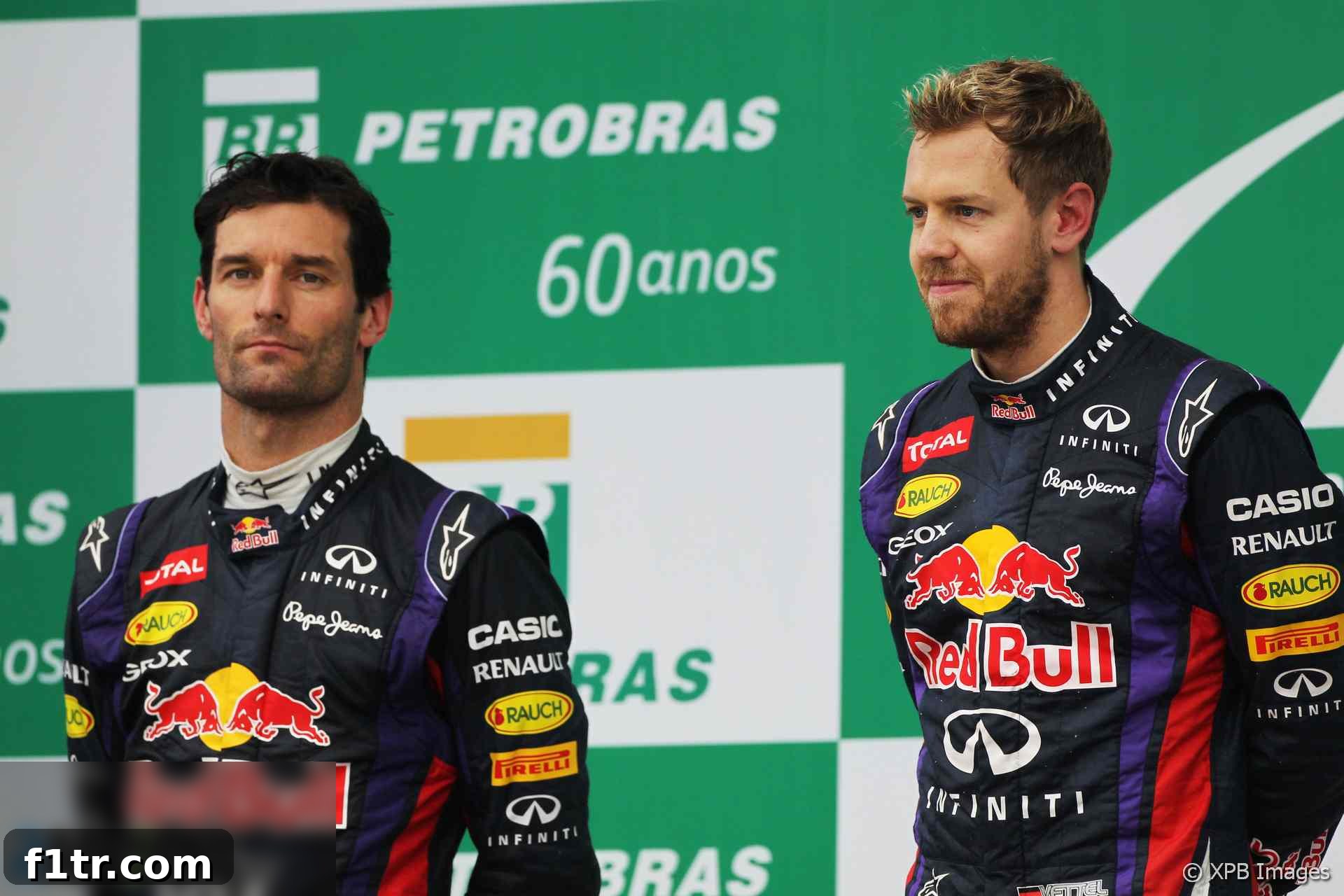
The race also held significant emotional weight for Mark Webber, Vettel’s long-standing Red Bull teammate, who was competing in his final Formula One Grand Prix after a distinguished 12-year career. Webber’s presence on the podium alongside Vettel provided a powerful visual, a symbolic passing of the torch and a testament to the enduring bonds forged in the high-octane world of F1. His farewell was a moment of reflection, not just for him but for fans and competitors alike, as a respected veteran of the sport bowed out.
Rosberg’s Fleeting Glory and a Race of Shifting Fortunes
The build-up to the 2013 Brazilian Grand Prix had been dominated by two days of relentless rain, leaving teams and drivers grappling with uncertainty. Tyre strategy for the race, which began under unexpectedly dry conditions, was a major question mark, adding an extra layer of complexity to the season finale. The grid saw Mercedes’ Nico Rosberg and Lewis Hamilton on the front row, poised to challenge the Red Bulls.
As the starting lights extinguished, the Mercedes duo launched brilliantly, initially seizing the initiative. From pole position, Nico Rosberg masterfully held off Sebastian Vettel into the challenging Turn One. Unlike previous encounters, Rosberg managed to keep the Red Bull behind him as they navigated the treacherous downhill sweep of the Senna S, displaying a strong early command of the race.
Behind them, Lewis Hamilton showcased his customary aggressive start, catapulting his Mercedes into third place. He skillfully demoted Mark Webber’s slower-starting Red Bull and also edged out Fernando Alonso’s Ferrari. However, the Mercedes drivers soon found themselves under immense pressure. Vettel, lurking just behind Rosberg, and Alonso, shadowing Hamilton, symmetrical positions that promised an intense battle. Their grip on the leading positions seemed tenuous, with rivals poised to pounce.
The climb from Junção for the first time on lap one saw Vettel unleash his remaining KERS (Kinetic Energy Recovery System), a strategic burst of power that allowed him to dramatically overhaul Rosberg, crossing the finishing line just two hundredths of a second ahead. This razor-thin margin underscored Vettel’s relentless pursuit and tactical brilliance. Simultaneously, Fernando Alonso mirrored Vettel’s aggression, nudging his Ferrari ahead of Hamilton as the second lap commenced. Alonso wasted no time in his assault, quickly dispatching the second Mercedes to climb into second place by lap four, demonstrating Ferrari’s competitive spirit.
The early laps revealed a vulnerability for the Mercedes drivers who struggled significantly with traction. This played directly into the hands of Mark Webber, who, evidently relishing the rare opportunity to start a race on fresh tyres, began a charge through the field. He rapidly caught and passed both Mercedes cars. By lap seven, Webber had decisively broken clear of Rosberg, his pace almost matching that of his Red Bull teammate. It wasn’t long before he was on Alonso’s tail, signaling a potent comeback for the Australian in his final race.
Webber was performing at his absolute best, channeling all his experience and determination into his last Formula One start. On lap 13, he executed a decisive overtake on Fernando Alonso’s Ferrari, slotting into second place. This move cemented a Red Bull one-two, a familiar sight throughout their dominant years, and a perfect scenario for Webber’s swansong.
Team Orders and Strategic Maneuvers
While the Red Bulls established their lead, the battle behind them intensified. Nico Rosberg’s rear tyres were suffering more than those of his teammate, Hamilton, leading to a noticeable drop in performance. By lap eight, the Mercedes pair found themselves under severe pressure from Felipe Massa, driving his final home race for Ferrari. The trio was incredibly close, separated by a mere 1.2 seconds, setting the stage for some tense radio communications.
Mercedes race engineer Tony Ross was quick to advise Rosberg: “If you have a problem with the tyres don’t hold up Lewis.” As Massa loomed ever larger in Rosberg’s mirrors, the instruction from the pit wall became more direct and unequivocal: “Nico, we’d like you to let Lewis through, we think you might be holding him up.” Rosberg, as a team player, duly complied, allowing Hamilton to pass and pursue a potentially stronger pace.
Just four laps after Rosberg yielded to Hamilton, Felipe Massa successfully breached Rosberg’s defenses, moving into fifth position. Despite Massa’s determined attack, Hamilton had used the intervening period to establish a crucial 2.5-second buffer, giving him a temporary reprieve. Massa made valiant efforts to close this gap before his first pit stop on lap 19. However, two exceptionally quick laps from Massa immediately preceding Hamilton’s own pit stop allowed the Brazilian to execute a perfect undercut, emerging ahead of the Mercedes and further complicating Hamilton’s race.
Massa’s Controversial Penalty and Outrage
The pit lane entrance at Interlagos has long been a notorious bottleneck, a high-speed approach that presents a unique challenge for drivers. To enhance safety and prevent corner-cutting, stricter regulations were in place for the 2013 race, with drivers repeatedly warned more than once not to cross the triangular white area before the pit entrance with all four wheels. This rule was intended to enforce a safer and more uniform entry line, preventing drivers from gaining an unfair advantage by shortening their trajectory.
Following Massa’s impressive move to jump ahead of both Hamilton and Rosberg, both Mercedes drivers quickly reported to their respective teams that Massa appeared to be flouting this critical instruction. Mercedes team principal Ross Brawn later confirmed the reports, stating: “Our drivers had been reporting that Felipe was consistently crossing the white line at pit entry with all four wheels.” The concern was clear: was Massa gaining an illicit advantage?
Massa’s race engineer, Rob Smedley, famous for his passionate radio communications, delivered a stern warning to his driver: “We have a message again, please watch the pit entry. Please don’t cross the pit entry with all four wheels.” Despite this clear directive, the damage was already done. Shortly afterwards, word filtered through from the race stewards: Massa was under investigation. The penalty was swift and decisive.
Smedley’s voice conveyed the grim news: “OK mate, unfortunately we have a drive-through penalty for crossing the white line at the entry to the pit lane. So there you go.” For Massa, who had been on course for a strong and emotional result in his final race for Ferrari on home soil, this news was devastating. He reacted with visible fury, angrily calling the decision “unbelievable” and “unacceptable” over the team radio. When he entered the pits on lap 34 to serve his penalty, he visibly shook his hand in frustration, a raw display of his profound disappointment and anger. The penalty effectively ruined his chances of a memorable farewell podium.
Massa’s criticism of the stewards’ decision continued long after the checkered flag, echoing his frustration during the race. Ferrari team principal Stefano Domenicali joined in, characterizing the penalty as “a bit extreme and forced” and expressing his belief that “I don’t think Felipe’s move gave him any advantage.” This incident cast a dark cloud over what should have been a celebratory final race for Massa at Interlagos, highlighting the fine margins and intense scrutiny under which Formula One operates.
Hamilton and Bottas Clash: A Lap Down, But Still Racing
As one Ferrari’s fortunes plummeted due to the penalty, the other, driven by Alonso, continued its charge, albeit with its own challenges. The race narrative was one of constant flux. Red Bull, known for its rapid pit stops, surprisingly faltered when Mark Webber came in on lap 23. The team was unable to replicate their sub-two-second stop from the United States Grand Prix; instead, Webber endured one of the slowest stops of the race, remaining stationary for over five seconds. This costly delay allowed Fernando Alonso to leapfrog him back into second place.
However, Alonso’s regained position was short-lived. Demonstrating his formidable race pace and aggressive driving, Webber was back ahead of the Ferrari after just two laps, albeit with Alonso fighting tooth and nail to retaliate in the second DRS zone. By the halfway point of the race, Webber had established a comfortable five-and-a-half-second lead over the Ferrari driver. With rain clouds once again threatening, Red Bull exhibited caution, showing no immediate urgency to bring their drivers in for their second round of pit stops.
Valtteri Bottas, driving for Williams, was among the first to make his second pit stop, coming in on lap 41. Emerging from the pits, Bottas displayed impressive pace. On his very first lap out, he shaved over a second off Lewis Hamilton’s time. Hamilton was directly ahead on track, but crucially, he was a lap ahead of Bottas. This distinction is vital in Formula 1; while Bottas was faster, he was not in a direct racing battle for position with Hamilton.
As lap 46 commenced, Bottas had closed the gap sufficiently to activate his DRS, indicating his superior speed. Hamilton, spotting the rapidly approaching Williams on the back straight, made a defensive move, drifting off the racing line to cover the inside of the upcoming corner. This is a common defensive maneuver, but in this instance, it went wrong. As Hamilton attempted to move back towards the racing line, he misjudged the incredible closing speed of the Williams.
The inevitable occurred: the two cars made contact, rear wheel to rear wheel. The impact sent Bottas spinning violently off the track and out of the race, a devastating end to his efforts. Hamilton, meanwhile, was left limping back to the pits with a punctured tyre, his race significantly compromised. An understandably unhappy Bottas immediately relayed his frustration to his team over the radio: “Lewis turned into me.”
The race stewards, after reviewing the incident, evidently concurred with Bottas’s assessment. Hamilton was subsequently handed a drive-through penalty for causing a collision, further compounding his woes. Ross Brawn, Mercedes team principal, accepted the decision with a degree of resignation: “We have to take that one on the chin. We should have kept Lewis better informed of just how quickly the Williams was closing, even though he was a lap down.” This incident highlighted the critical importance of effective communication between the pit wall and the driver, especially when dealing with lapped traffic and differing race objectives.
Red Bull’s Rare Pit Lane Drama
The collision between Bottas and Hamilton had immediate and far-reaching repercussions across the pit lane. Red Bull Racing, ever vigilant for potential Safety Car deployments, reacted swiftly by calling both their drivers in for a double pit stop. At this point, Sebastian Vettel and Mark Webber were separated by a comfortable 12.5 seconds, a margin within which the team had successfully performed stacked stops in the past, as famously demonstrated at Monza. However, on this occasion, the high-pressure situation led to a rare lapse.
Vettel received the call to pit only as he was rounding Junção, the final significant corner before the pit lane entry. This late notification meant his pit crew had precious little time to prepare. In a scene that evoked memories of previous nail-biting championship conclusions, Vettel arrived in his pit box only to find his new front-right wheel conspicuously absent. He sat waiting, stationary for critical seconds, as his crew scrambled to retrieve the correct tyre.
Reflecting on the incident, Vettel commented: “Arguably the team was on the limit, and obviously they were preparing a stop for both cars so they had to get both sets of tyres out, mine and Mark’s. I think it was just a little bit of a rush, because I think the team was afraid of a Safety Car.” This fear of a Safety Car, which could neutralize their lead, pushed the team to the absolute edge, resulting in the unusual delay.
The drama was compounded by Webber’s imminent arrival. “I looked on the big screen and I could see that Seb was in the box, saw on the TV that he was pitting and I thought ‘I hope it’s a replay’,” recounted Webber, vividly describing the moment of realization. “But it wasn’t. When I got over the top, he was in the bloody box so I thought ‘shit, we’ve got a bit on here now’.” The tension in the Red Bull garage was palpable as Webber arrived right behind his teammate, creating a high-stakes bottleneck.
Vettel’s pit stop turned out to be the slowest of the entire race, costing him approximately eight crucial seconds. Webber also lost valuable time, roughly half as much, due to the delay. Despite the significant time loss, Red Bull’s underlying pace and the timing of Ferrari’s stop for Alonso (who pitted on the same lap) meant that Webber was able to leave the pits still ahead of the Spaniard, mitigating some of the damage. This incident highlighted the razor-thin margins and immense pressure involved in Formula One pit stop operations, even for the most accomplished teams.
McLaren Capitalizes on Rivals’ Misfortunes
The various setbacks experienced by Felipe Massa and Lewis Hamilton played directly into the hands of McLaren, a team often adept at capitalizing on the chaos around them. Furthermore, the intense battle between Ferrari and Mercedes for second place in the Constructors’ Championship added another layer of strategic intrigue to the race.
As the second round of pit stops approached, Nico Rosberg found himself steadily closing in on Jenson Button’s McLaren, with Felipe Massa not far behind them both. When Massa and Button simultaneously opted to pit on lap 42, Mercedes made a prudent and ultimately highly effective strategic decision. Instead of attempting a risky undercut to jump Button, they brought Rosberg in on the very next lap, prioritizing keeping him ahead of Massa. This conservative yet intelligent move aimed to secure crucial points for their Constructors’ Championship aspirations rather than chasing a potentially higher but riskier individual race position.
Rosberg expressed his satisfaction with this call from the pit wall: “We could have cleared Jenson in the pits but it was better for us to be conservative and focus on our battle with Ferrari.” This statement perfectly encapsulated Mercedes’ strategic mindset, prioritizing the team’s championship standing over individual glory in this specific instance.
In the final stint of the race, Massa, burdened by his earlier drive-through penalty and perhaps a slight performance disadvantage, could no longer match the pace of the Mercedes nor could he close the gap on Sergio Perez ahead of him. Consequently, he crossed the finish line in a disappointed seventh place. This outcome had significant ramifications for Ferrari, with team principal Domenicali ruing the consequences of the penalty: “With the points he could have scored, the outcome of the Constructors’ Championship could have been different,” he lamented. Indeed, Ferrari ended the 2013 season six points behind Mercedes, a margin that underscored the critical impact of Massa’s penalty.
Behind Massa, the remaining points-scoring positions were filled by Nico Hulkenberg, who struggled notably with understeer throughout the race, Lewis Hamilton, recovering from his collision and penalty, and Daniel Ricciardo, concluding his season on a strong note. Further down the field, the unfortunate demise of Charles Pic due to suspension failure and Giedo van der Garde’s drive-through penalty for failing to heed blue flags extinguished Caterham’s hopes of snatching tenth place in the Constructors’ Championship from Marussia, a battle that had been fiercely contested throughout the season, though Caterham never truly looked like achieving the necessary 13th-place finish.
Vettel’s Historic Victory and Webber’s Emotional Farewell
As the final stint of the race commenced, Fernando Alonso maintained a respectable pressure on Mark Webber, and surprisingly, both he and Webber began to gradually reel in Sebastian Vettel, reducing his seemingly insurmountable lead to just over five seconds at one point. This momentary compression of the leading pack suggested that Vettel’s position at the front might still be in jeopardy. However, the reigning champion, ever the master of race management, sensed the threat and swiftly increased his tempo, pulling away from his pursuers long before any real challenge could materialize.
The persistent threat of rain, which had loomed earlier in the race, made a brief return in the closing laps. While it provided some anxious moments for the teams, the downpour never intensified enough to warrant a switch to intermediate tyres, ultimately proving to be a passing shower. As the final precipitation abated, Alonso’s pace subtly dropped, allowing Webber to pull away once more and consolidate his second-place finish.
Sebastian Vettel crossed the finish line to complete a truly perfect second half of the 2013 season, securing his ninth consecutive victory. This extraordinary achievement placed him in an elite club, equaling the record set by the legendary Alberto Ascari. Despite the monumental nature of this feat, Vettel, with characteristic humility, downplayed the comparison, acknowledging Ascari’s historical significance and perhaps his own desire to forge a unique legacy.
Vettel’s relationship with Mark Webber, while always professional, had never been described as particularly warm or overtly friendly, often characterized by fierce rivalry. Yet, on the podium at Interlagos, a moment charged with emotion, Vettel graciously passed the spotlight to his departing teammate. Webber, draped proudly in the Australian flag, soaked up the atmosphere, accepting the cheers of the crowd and bidding a memorable farewell to Formula One with a fine podium finish – a truly fitting end to his illustrious career.
Moments before, in a deeply personal and poignant gesture, Webber had savoured his final drive back to the pits. He deliberately removed his crash helmet, allowing him to fully absorb the roaring symphony of his V8 engine – a sound that, regrettably, the sport would have to make do without in the following season as F1 transitioned to V6 turbo-hybrid engines. This small act was a powerful symbol of his connection to the machines he had raced for so long.
Reflecting on this unique gesture, Webber shared his thoughts: “Obviously the marshals, the fans, to see… in this sport, it’s not always easy to show the person that’s behind the wheel. We can in lots of other sports but in Formula One we’ve always got the helmet on so it was nice to drive back with the helmet off.” He continued, emphasizing the rare opportunity: “Only time you’re seen with the helmet off is on the podium if we have a good day which we did both, so nice to get it off.” His final moments on track were a personal tribute to a sport that had defined much of his adult life.
He humorously added a detail about his return: “In the last sector, I got it a little bit jammed, so I think the marshals were a little bit worried that I couldn’t turn left but in the end, no it was fine, it was a nice moment to come back, a little bit of a different touch to bring the car back.” This light-hearted remark underscored the mixture of joy, relief, and nostalgia that characterized his departure, making his final moments in an F1 car truly memorable for all who witnessed them.
2013 Brazilian Grand Prix Further Reading
- 2013 F1 season is lowest-rated year since 2009
- Adaptalis wins 2013 Predictions Championship
- Top ten pictures from the 2013 Brazilian Grand Prix
- 2013 Brazilian Grand Prix fans’ video gallery
- 2013 Brazilian Grand Prix team radio transcript
Browse all 2013 Brazilian Grand Prix articles