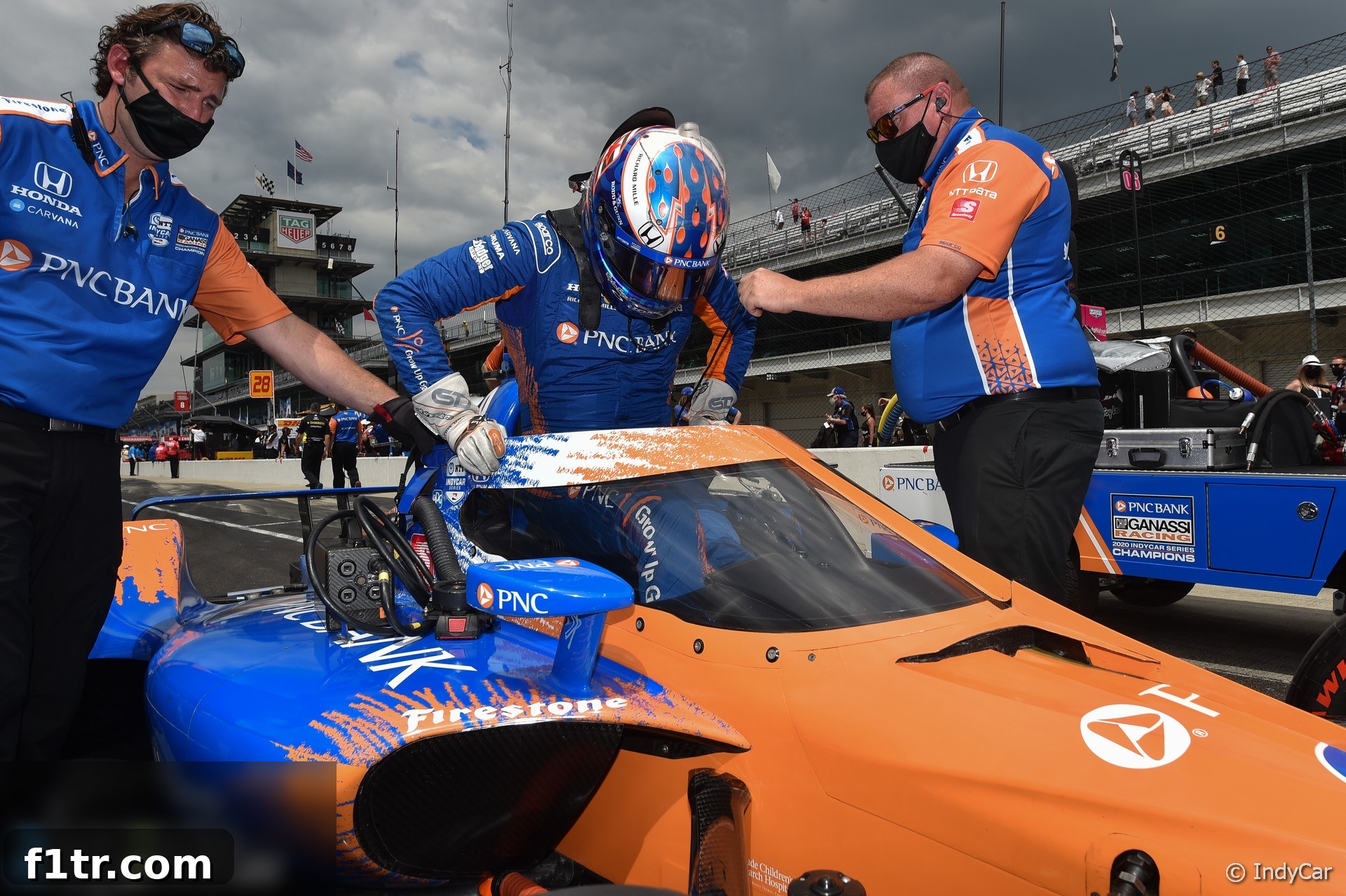
Scott Dixon Secures Dramatic Fourth Indianapolis 500 Pole Position
Scott Dixon, the seasoned Chip Ganassi Racing driver, emerged from the high-pressure Fast Nine qualifying session for the 105th Indianapolis 500 describing his pole-winning run as a “pretty hairy” and “tense” ordeal. The New Zealander’s masterful performance underscored the fine margins and immense skill required to conquer the legendary Indianapolis Motor Speedway, ultimately placing him at the very front of the grid for the most prestigious race in open-wheel motorsport.
The path to pole was fraught with strategic gambles and split-second decisions, both from the cockpit and the pit lane. Dixon openly admitted to a deliberate choice: he did not wish to know the intricate details of the setup changes his dedicated Chip Ganassi Racing mechanics were making to his car. As his Dallara-Honda was being pushed to the end of pit lane for his decisive final qualifying attempt, Dixon observed the frantic adjustments. “I could see the mechanics working on the car as we rolled through, adjusting the wings. I asked them not to tell me,” Dixon recounted, explaining his desire to maintain focus without overthinking the aggressive modifications. “I knew it was only going one way, and that was trimming out more. I knew they were going to be pretty aggressive because we had already started pretty aggressive.”
The Strategic Gamble: Trim and Trust
The art of Indianapolis 500 qualifying involves a delicate balance between outright speed and stability. “Trimming out” refers to reducing downforce by adjusting aerodynamic components like wings. While this significantly boosts straight-line speed – crucial for clocking high average speeds over four laps – it simultaneously makes the car much more challenging to drive through the corners, increasing its instability and the risk of a crash. Dixon’s apprehension was palpable, especially given his car’s dominant performance during Saturday’s initial time trials, where it had already proven to be the fastest.
His conversation with race engineer Michael Cannon before the Fast Nine underscored this internal conflict. “He’s like, ‘Today we’re going to change this, we’re going to change that, change this.’ I’m like, ‘Remember, our car yesterday was pretty good. Are you sure you want to change?’ He’s like, ‘I think it’s going to be a bit better.’ I’m like, ‘All right, I don’t want to know anything else now. Don’t tell me,'” Dixon detailed. This exchange highlights the unwavering trust between driver and engineer, a critical component of success in a sport where decisions can literally be a matter of life and death, and fractions of a second decide victory or defeat. Dixon’s willingness to cede control to his team’s judgment, despite his own reservations, speaks volumes about the collective pursuit of perfection in motorsports.
The Fast Nine Shootout: Pressure Cooker Environment
The Fast Nine qualifying session is a spectacle designed to heighten drama and test nerves. The nine fastest drivers from the previous day’s qualifying session return for a single, four-lap attempt to determine pole position and the first three rows of the starting grid. As the fastest qualifier on Saturday, Dixon had the distinct advantage – and immense pressure – of being the last driver to make his run. This position allows a driver to know exactly what speed they need to beat, but also means they bear the weight of expectation and the knowledge that rivals have already set formidable benchmarks.
Initially, Dixon preferred this “last-man-out” scenario, believing it gave him an edge. However, this sentiment quickly shifted after witnessing the blistering pace of his closest competitors. “I’d prefer going last, for sure,” Dixon said, “But then I didn’t after I saw the ECR and Herta run. I was definitely pretty nervous.” The performances of Colton Herta and the Ed Carpenter Racing drivers, renowned for their qualifying prowess on ovals, sent a ripple of anxiety through the Ganassi camp. Dixon specifically identified Herta as the primary challenger capable of denying him a record-equaling fourth Indy 500 pole position. “I knew his consistency was probably going to be a tick better than the other two, and it sure was,” Dixon remarked, acknowledging Herta’s exceptional precision over the challenging four-lap sprint.
The Razor’s Edge: Dixon’s Pole-Winning Run
Herta’s impressive average speed of 231.655 miles per hour had set a daunting target. Dixon had just one chance to surpass it. The tension mounted as he began his run, and almost immediately, the aggressive setup changes became apparent. “At turn one for the first lap [it] was very loose, and I was already maxed out on all the controls,” Dixon recalled, painting a vivid picture of a car dancing on the edge of control. A “loose” car means the rear end lacks grip, making it prone to sliding, especially at high speeds in corners. For Dixon to be “maxed out on all the controls” so early in the lap indicated an extreme challenge, demanding every ounce of his legendary car control.
The subsequent laps were a testament to his sheer talent and composure. “I knew it was just going to be holding on for lap three and four. Lap four was definitely pretty rough, especially through turn three,” he confessed. Navigating the long, sweeping turns of the Indianapolis Motor Speedway at over 230 mph with a loose car is a perilous act of precision and bravery. Yet, Dixon kept his foot down, maintaining his speed and wrestling the car through the corners. His four-lap average speed of 231.685 mph ultimately proved just enough, snatching pole position by an incredibly slim margin of 0.030 mph over Herta, a difference of mere inches over the entire 10-mile run. It was a spectacular display of daring and dedication.
The Significance of an Indianapolis 500 Pole
While the ultimate goal remains winning the Indianapolis 500 on Sunday, Dixon readily acknowledged the profound significance of securing a fourth pole position. This achievement solidifies his place among the legends of the sport and adds another illustrious entry to his already stellar career. “Winning a pole at the Indianapolis 500 is one of the toughest things to do,” Dixon emphasized. It’s more than just a starting spot; it’s a validation of hundreds, if not thousands, of hours of preparation, engineering, and execution.
For Chip Ganassi Racing, Dixon’s pole was a crowning moment of a near-perfect qualifying weekend. All four of the team’s entries — Dixon, Marcus Ericsson, Tony Kanaan, and Alex Palou — successfully made it into the Fast Nine shootout, an extraordinary feat that speaks volumes about the collective strength, meticulous preparation, and competitive spirit within the Ganassi organization. “From a team standpoint, just how much work and effort goes into building these cars specifically for that pole run, it’s a lot of money and a lot of effort that it takes,” Dixon explained, highlighting the immense investment of resources and human capital required to perform at this elite level.
A Testament to Team Achievement and Future Aspirations
This pole position was not just a personal triumph for Dixon, but a shared victory for every member of Chip Ganassi Racing. The euphoria of such an accomplishment is particularly sweet for a team that has experienced both the highs and lows of IndyCar racing. “We’ve been on the other side of it. We’ve had [pole positions] before, but we’ve started well in the pack, too, where you can’t figure out why you’re in that position,” Dixon reflected, acknowledging the unpredictability and challenges inherent in motorsport. The current success, therefore, tastes all the sweeter. “Definitely feel goods for the team. I know the team is going to be proud of what we achieved today.”
However, the experienced racer was quick to temper the celebrations with a dose of realism. A pole position, while prestigious, is merely the first step towards the ultimate prize. “Again, it’s just the starting position. We have to work on the rest,” he concluded, shifting focus to the grueling 500-mile race ahead. The strategies, pit stops, fuel management, and on-track battles of race day present an entirely new set of challenges. Nevertheless, starting from the coveted pole position at the Indianapolis 500 provides an invaluable advantage, offering clean air, strategic flexibility, and a psychological boost that could prove crucial in the quest for victory.
Related IndyCar Content
- IndyCar driver McLaughlin cleared of injury after crashing through barrier at Barber
- Schumacher says his IndyCar feels like ‘an F2 car, just with better tyres’
- IndyCar “way faster than Formula 1” in some corners, says Grosjean
- FIA to award more F1 superlicence points to IndyCar drivers from 2026
- Schumacher to race full-time in IndyCar with RLL in 2026
Browse all IndyCar articles