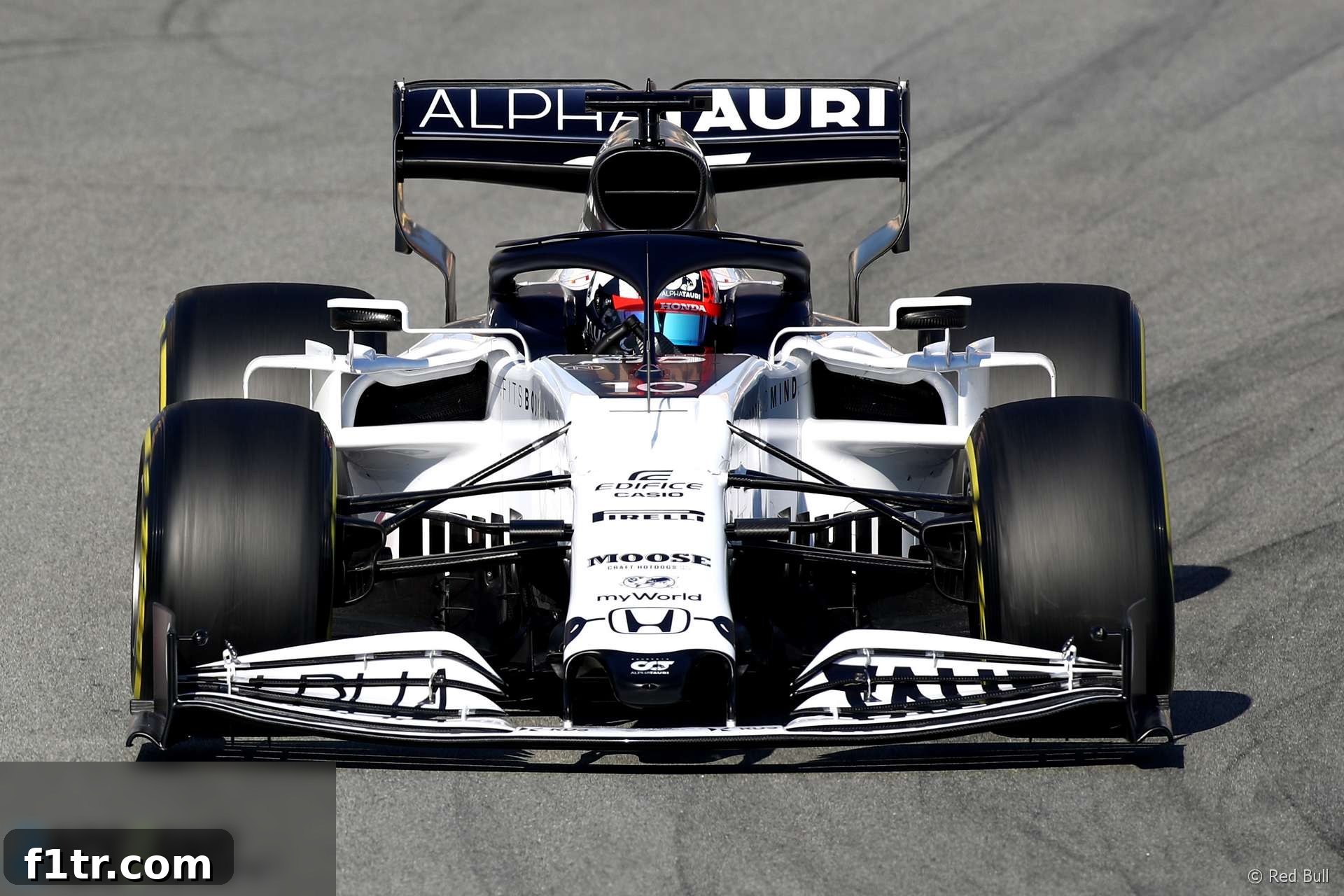
AlphaTauri Faces Uphill Midfield Battle, Pierre Gasly Shares Pre-Season Testing Concerns
Following a rigorous period of pre-season testing, AlphaTauri driver Pierre Gasly has voiced his reservations regarding the team’s competitive standing, casting doubts on their ability to lead the highly contested Formula 1 midfield. While acknowledging positive aspects from their time on track, Gasly’s assessment points to a challenging season ahead for the Italian squad.
Advert | Become a Supporter & go ad-free
Early Impressions: A Mix of Reliability and Pace Concerns for AlphaTauri
“Generally, I think we had a positive test,” Gasly stated, reflecting on the team’s efforts during the pre-season sessions. This initial optimism stemmed primarily from the impressive durability and operational efficiency demonstrated by the AT01, AlphaTauri’s new challenger. “We managed to do a lot of laps, reliability is good,” he confirmed, highlighting a crucial foundation for any successful Formula 1 campaign. The ability to complete extensive mileage without significant mechanical setbacks is vital for data collection and understanding the car’s intricate dynamics, a benchmark AlphaTauri seemingly met.
However, the Frenchman’s comments quickly pivoted to a more cautious tone when discussing the team’s outright speed relative to key competitors. “I feel we obviously would like to be faster than we are,” Gasly admitted, directly addressing the car’s performance envelope. He didn’t shy away from identifying rivals who appeared to hold a significant advantage, specifically naming other prominent midfield contenders. “Racing Point is really fast, McLaren as well, and Renault.” He elaborated, “The [others] are all super fast. I would say the others are a bit stronger in some ways.” This candid appraisal sets the stage for what promises to be an intense and demanding fight for every championship point throughout the season.
The AT01’s Lineage and the Relentless Pursuit of Downforce
The AT01, AlphaTauri’s contender for the upcoming Formula 1 season, bears a strong familial resemblance to its predecessor and, crucially, to its sister team Red Bull Racing’s RB16. This is no coincidence, as the two teams share not only the same Honda power units but also a range of other fundamental components, including gearboxes and hydraulics, a strategic advantage derived from their shared ownership under Red Bull GmbH. This technical synergy allows AlphaTauri to benefit from proven designs and technologies developed by a front-running team, theoretically accelerating their development process and overall performance.
Despite the close ties and shared components, Gasly emphasised that the previous car, the STR14, didn’t suffer from any glaring, fundamental deficiencies that required a complete overhaul. “It’s not like we have big weaknesses, I think it’s general comments,” he explained. This suggests an evolutionary rather than revolutionary approach to the AT01’s design. The continuous improvement cycle in Formula 1 is driven by the relentless pursuit of marginal gains, and Gasly articulated the universal desire shared across the pit lane: “You always want more downforce so high speeds, low speed is a bit mechanical.” Downforce, the aerodynamic force that presses the car into the track, is paramount for cornering speed and overall grip, directly influencing lap times. The quest for more of it, whether through high-speed aerodynamic efficiency or low-speed mechanical grip, remains a constant battle for every team on the grid.
“I don’t think the old car had something wrong in it. But we just need to try to bring a bit more downforce to it, which is going to be the story the whole year and for everybody,” Gasly concluded. This statement underscores the core challenge facing all Formula 1 teams: continuously developing and refining their aerodynamic packages to extract even fractions of a second. It highlights that the competitive landscape is defined not by single, revolutionary breakthroughs, but by a persistent, iterative process of enhancing downforce generation and managing its effects across various speeds and track conditions.
Unpacking Pre-Season Testing: The Art of Interpretation and Development
Pre-season testing in Formula 1 is a critical, albeit often deceptive, phase of the calendar. It serves as the primary opportunity for teams to conduct real-world evaluations of their new cars, test various components, and fine-tune setups before the intense pressure of race weekends. While lap times invariably grab headlines, the true value lies in systematic data collection, component reliability checks, and the exploration of the car’s handling characteristics. Teams meticulously gather information on everything from engine performance and tyre degradation to aerodynamic efficiency and chassis balance, all under varying fuel loads and engine modes.
Gasly acknowledged that the team made some tangible progress in understanding the AT01 following their sessions in Barcelona. “There are a couple of areas we know we improved already since Barcelona, just understanding the car better,” he noted. This process of gaining insight is particularly crucial given the reduced testing schedule. “Because we did six days, which is less than before, and still discovering a new car it takes a bit of time to extract the best of it.” The shortened testing window places a greater premium on efficiency and focused data acquisition, leaving less room for extensive experimental runs or troubleshooting. Drivers and engineers must work in tandem to quickly identify optimal setups and understand the car’s limits, an ongoing process that often extends into the early races of the season.
The compressed testing period also means that the initial findings are rarely definitive indicators of the pecking order. Teams often run varying fuel loads, engine mappings, and tire compounds, making direct comparisons of lap times notoriously unreliable. Some teams might focus on long-run reliability, while others chase ultimate single-lap pace. This strategic ‘sandbagging’ or focused testing means that Gasly’s concerns, while valid, reflect only a snapshot of the competitive picture. The real test of AlphaTauri’s pace and their competitors’ true strength will only come when the lights go out for the first Grand Prix of the season, revealing the genuine performance hierarchy.
The Fierce Fight for Midfield Supremacy
The Formula 1 midfield battle has become increasingly intense in recent years, often proving to be as captivating and unpredictable as the fight for the very top spots. For teams like AlphaTauri, succeeding in this fiercely competitive segment of the grid is paramount. It’s not merely about pride; the difference between finishing seventh and tenth in the Constructors’ Championship can translate into millions of dollars in prize money, significantly impacting future development budgets, staff retention, and the ability to attract top talent and sponsors. Every point scored is hard-won, and the margins separating success from struggle are incredibly fine.
Gasly’s frank assessment places AlphaTauri firmly within this crucible of competition. “But I think for sure we are not at the top of the midfield, we know it. Others have done some good job. We have done a good job but we know it’s not going to be an easy fight for us to make it to the top 10,” he stated. This acknowledges the formidable challenge presented by rivals who have also made significant strides in their car development. Teams like Racing Point, McLaren, and Renault, all mentioned by Gasly, have invested heavily and shown clear intentions to climb the championship ladder, making the competition for ‘best of the rest’ incredibly challenging.
For AlphaTauri, formerly known as Toro Rosso, securing points finishes and consistently battling for positions within the top ten is their primary objective. This represents not just success for the team itself but also serves as a crucial proving ground for emerging talent from the Red Bull junior program. The pressure is therefore multi-faceted: to perform competitively, to develop the car effectively throughout the season, and to justify their position as a significant entity within the Formula 1 ecosystem. The coming season promises to be a true test of their capabilities, their strategic decisions, and their resolve in navigating one of the most competitive midfields in recent memory.
Advert | Become a RaceFans supporter andgo ad-free
Related Content: Dive Deeper into the 2020 F1 Season
Explore a collection of articles and insights from the Formula 1 2020 season, covering key moments, driver analyses, and financial impacts:
- Grosjean to make F1 test return tomorrow for first time since Bahrain horror crash
- Pictures: Wrecked chassis from Grosjean’s Bahrain fireball crash to go on display
- Bottas vs Rosberg: Hamilton’s Mercedes team mates compared after 78 races each
- F1 revenues fell by $877 million in Covid-struck 2020 season
- Hamilton and Mercedes finally announce new deal for 2021 season
Browse all 2020 F1 season articles