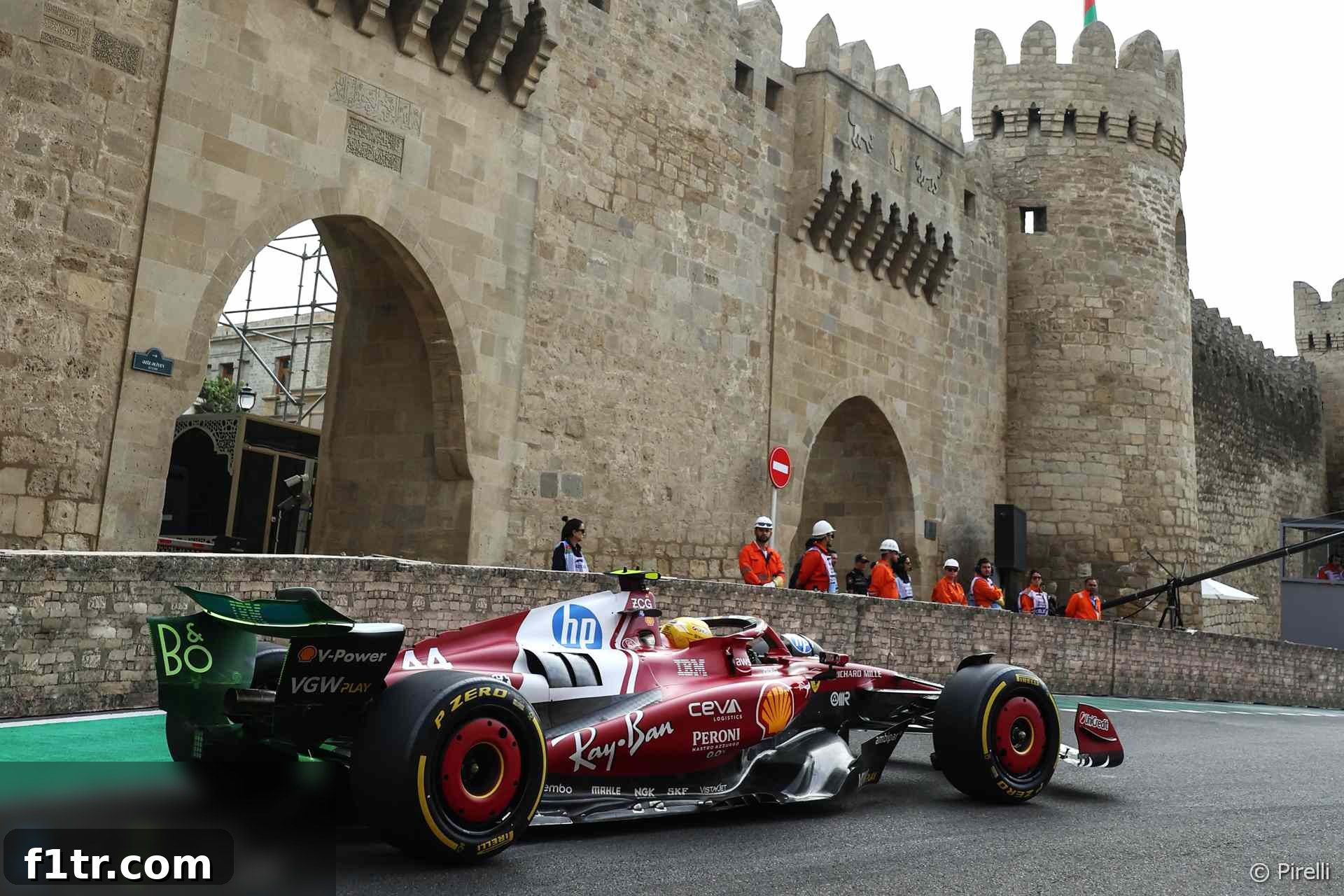
The exhilarating world of Formula 1 descends upon the unique Baku City Circuit, a venue synonymous with drama and unexpected twists. This weekend, anticipation is building as teams and drivers target not just victory, but potentially a new course record, provided the conditions remain favourable. However, the notoriously fickle weather forecast for Azerbaijan means that achieving such a feat is far from a certainty and introduces an unpredictable element into an already high-stakes race weekend.
The Baku City Circuit stands out on the Formula 1 calendar as a street circuit that perfectly blends the technical challenges of tight, slow corners with the sheer ballistic speed of one of the longest straights in motorsport. This creates a fascinating engineering dilemma for teams, demanding a delicate balance between aerodynamic efficiency for straight-line speed and mechanical grip for the numerous 90-degree turns and the iconic, winding castle section. Drivers must master the contrast between high-speed commitment and pinpoint precision, often brushing the unforgiving walls that line the track. The low-grip surface, characteristic of many street circuits, further complicates matters, requiring excellent tyre management and a car setup that can generate consistent traction.
Teams’ 2024 Performance in Context: A Strategic Showdown in Baku
Baku’s unique characteristics inherently favour certain car philosophies and disadvantage others. The combination of extended full-throttle sections, sharp braking zones, and a surface that struggles to offer maximum adhesion typically sorts the field into distinct performance groups. Historically, teams with strong engine power, efficient low-drag aerodynamics, and robust mechanical grip have excelled here. Last year, for instance, Ferrari and Williams demonstrated a surprising resurgence at the Baku City Circuit, appearing significantly more competitive than they did at most other tracks on the calendar. Ferrari, often lauded for its engine prowess, found a sweet spot that allowed them to exploit the long straights while maintaining reasonable cornering performance. Williams, with its generally efficient aerodynamic package, managed to minimise drag, a crucial factor for maximising speed on Baku’s main straight. This historic performance suggests that teams which have evolved their car concepts with similar strengths in mind could be the ones to watch this weekend.
Understanding a team’s potential at Baku requires a deep dive into their car’s intrinsic characteristics. For instance, teams that traditionally struggle with drag may find themselves at a significant disadvantage, unable to compete on the long straight despite good performance in the slower sections. Conversely, a car with exceptional traction control and robust braking stability can gain crucial tenths through the tight, low-speed corners. The setup compromises required are immense; optimising for the main straight might mean sacrificing some downforce and stability in the twisty parts, while focusing solely on cornering speed could leave a car vulnerable to being overtaken. The “brandedchart” below, if visualising this data, would ideally show the delta in performance for each team at Baku compared to their season average, highlighting those who overperform or underperform at this specific venue based on their car’s design philosophy.
Early Indicators: Unpacking Friday’s Practice Sessions and Team Progress
Friday’s practice sessions, while offering the first glimpse of competitive running, often provide a less reliable guide to overall pace than at other circuits, and this weekend in Baku was no exception. Several factors contributed to this ambiguity. Crucially, some drivers found unexpected pace on the medium compound tyre, blurring the true performance hierarchy. Formula 1’s official tyre supplier, Pirelli, has brought its softest range of rubber this weekend – typically the C3, C4, and C5 compounds. However, as has been observed previously at circuits like Imola, Monaco, and Montreal, the very softest compound isn’t necessarily the optimal tyre for a single flying lap or an entire qualifying run. Its rapid degradation and tendency to overheat can make it tricky to extract peak performance over one lap, and it may not offer the consistent grip needed for multiple attempts.
The delicate balance of tyre performance, combined with varying fuel loads and engine modes, always makes Friday data a complex puzzle. McLaren, a team often considered a front-runner, appeared to have a particularly challenging day, visibly struggling to extract genuine pace from their machinery. Whether this was due to experimental setup changes, driver struggles with the track’s evolving grip, or a combination of factors, it was clear they were not operating at their true potential. Conversely, Red Bull Racing, known for their disciplined and strategic approach to practice, appeared to keep plenty in reserve. This conservative approach on Friday is a typical characteristic of the reigning champions, who prefer to gather data and fine-tune their setup rather than chasing headline lap times. This tactic often sees them unleash their true speed only when it truly counts, during qualifying and the race.
Beyond the top teams, the midfield battle also showed early signs of intensity. Various teams were seen running different aero configurations and suspension settings, experimenting to find the sweet spot for Baku’s unique demands. The track itself undergoes significant evolution throughout a race weekend, with rubber being laid down and dust clearing, progressively increasing grip levels. This constant change means that a setup that works well in FP1 might be sub-optimal by FP3, adding another layer of complexity for engineers. The “brandedchart” for improvement, if available, would provide invaluable insight into how each team adapted and refined their package compared to previous sessions or even previous years.
Combined Lap Times: A Glimpse of Pace and the Looming Weather Threat
Despite the complexities of Friday’s sessions, some noteworthy performances emerged. Lewis Hamilton set the pace with an impressive best lap time, demonstrating Ferrari’s potential and underlining his own formidable skill. His fastest lap was fractionally quicker than his team mate’s pole-winning time from last year, signalling a strong start for the Scuderia. However, the shadow of Charles Leclerc looms large over Baku. Leclerc has established himself as something of a Baku specialist, having secured the last four pole positions at this challenging track. He also holds the current outright course record, a blistering 1’40.203 set in 2023. His innate ability to extract maximum performance from the car on a single lap in Baku’s unforgiving environment makes him a perpetual threat for pole.
Historically, track conditions at Baku improve dramatically between Friday and Saturday. As more rubber is laid down and the surface cleans up from incidental debris, grip levels escalate significantly, often leading to lap times improving by over two seconds. Given this trend, it would be no surprise to see Leclerc’s record fall this weekend, as teams unlock more pace and drivers gain confidence. However, this optimistic outlook is heavily tempered by the latest weather forecasts. Some predictions now place the risk of rain on Saturday morning as high as 60% at times. While the chance of rain is expected to decrease ahead of the crucial F1 qualifying session, scheduled for 4 pm local time, the track could already be thoroughly wet by then. A damp or fully wet track would drastically alter the dynamics of qualifying, potentially washing away the rubber laid down on Friday and forcing teams onto intermediate or wet tyres. This would introduce an element of unpredictability, potentially levelling the playing field and opening the door for unexpected heroes or unfortunate mistakes.
A wet qualifying session at Baku would be particularly treacherous. The low-grip surface would become even more challenging, and the narrow confines of the street circuit leave little margin for error. Drivers would have to contend with reduced visibility, especially through the spray generated by other cars, and the ever-present threat of aquaplaning. Car setups, which are usually optimised for dry conditions, would suddenly become a compromise, as teams scramble to adjust for the wet. This could lead to a highly tactical session where tyre choice, car control, and a bit of luck play a greater role than outright pace. The prospect of such conditions only adds to the intrigue surrounding what promises to be an captivating Saturday at the Azerbaijan Grand Prix.
| P. | # | Driver | Team | FP1 time | FP2 time | Gap | Laps |
|---|---|---|---|---|---|---|---|
| 1 | 44 | Lewis Hamilton | Ferrari | 1’44.087 | 1’41.293 | 35 | |
| 2 | 16 | Charles Leclerc | Ferrari | 1’43.256 | 1’41.367 | 0.074 | 40 |
| 3 | 63 | George Russell | Mercedes | 1’43.257 | 1’41.770 | 0.477 | 35 |
| 4 | 12 | Andrea Kimi Antonelli | Mercedes | 1’43.985 | 1’41.779 | 0.486 | 39 |
| 5 | 87 | Oliver Bearman | Haas-Ferrari | 1’44.151 | 1’41.891 | 0.598 | 40 |
| 6 | 1 | Max Verstappen | Red Bull-Honda RBPT | 1’43.790 | 1’41.902 | 0.609 | 37 |
| 7 | 30 | Liam Lawson | Racing Bulls-Honda RBPT | 1’43.903 | 1’41.989 | 0.696 | 39 |
| 8 | 31 | Esteban Ocon | Haas-Ferrari | 1’44.439 | 1’42.167 | 0.874 | 38 |
| 9 | 23 | Alexander Albon | Williams-Mercedes | 1’43.563 | 1’42.177 | 0.884 | 41 |
| 10 | 4 | Lando Norris | McLaren-Mercedes | 1’42.704 | 1’42.199 | 0.906 | 26 |
| 11 | 55 | Carlos Sainz Jnr | Williams-Mercedes | 1’43.859 | 1’42.255 | 0.962 | 41 |
| 12 | 81 | Oscar Piastri | McLaren-Mercedes | 1’43.014 | 1’42.295 | 1.002 | 37 |
| 13 | 6 | Isack Hadjar | Racing Bulls-Honda RBPT | 1’43.975 | 1’42.443 | 1.150 | 40 |
| 14 | 22 | Yuki Tsunoda | Red Bull-Honda RBPT | 1’43.738 | 1’42.444 | 1.151 | 38 |
| 15 | 5 | Gabriel Bortoleto | Sauber-Ferrari | 1’44.087 | 1’42.561 | 1.268 | 40 |
| 16 | 10 | Pierre Gasly | Alpine-Renault | 1’45.418 | 1’42.674 | 1.381 | 39 |
| 17 | 18 | Lance Stroll | Aston Martin-Mercedes | 1’44.329 | 1’42.771 | 1.478 | 39 |
| 18 | 27 | Nico Hulkenberg | Sauber-Ferrari | 1’43.986 | 1’42.820 | 1.527 | 40 |
| 19 | 14 | Fernando Alonso | Aston Martin-Mercedes | 1’44.139 | 1’42.967 | 1.674 | 39 |
| 20 | 43 | Franco Colapinto | Alpine-Renault | 1’45.299 | 1’43.322 | 2.029 | 36 |
A closer look at the combined lap times from Friday’s practice sessions reveals some fascinating insights and potential storylines for the rest of the weekend. Lewis Hamilton’s strong showing for Ferrari at the top of the leaderboard is undeniably a significant statement, confirming the team’s early pace and his own adaptability to the Baku circuit. Charles Leclerc, despite being slightly behind, is still very much in the hunt, and his reputation as a Baku specialist means he cannot be counted out for qualifying honours. Mercedes drivers George Russell and Andrea Kimi Antonelli also demonstrated competitive pace, suggesting that Mercedes could be a dark horse contender, especially if their setup improvements continue.
Oliver Bearman’s performance for Haas-Ferrari, placing him fifth, is a notable highlight. As a young talent, his ability to mix it with more experienced drivers on a challenging street circuit speaks volumes about his potential and the progress of the Haas team. Max Verstappen, in sixth, with Red Bull typically holding back, remains a formidable threat, and it’s highly anticipated that he will unleash more pace on Saturday. The gaps throughout the field are relatively tight, particularly within the top 10, indicating a closely contested qualifying session. McLaren’s Lando Norris and Oscar Piastri, despite their “rough day,” are still within a second of the fastest time, suggesting that once they fine-tune their setup, they could climb higher. The varied performances and the ever-present threat of changing weather make the Azerbaijan Grand Prix weekend a must-watch event, with every session promising edge-of-your-seat action and strategic intrigue.
Miss nothing from RaceFans
Get a daily email with all our latest stories – and nothing else. No marketing, no ads. Sign up here:
2025 Azerbaijan Grand Prix
- Sainz praises “hardest working” engineer who wept after his Baku podium
- McLaren had best car for “95% of races” but Red Bull have caught up – Norris
- Norris couldn’t close a 69-point gap in 14 rounds. Verstappen has to do it in seven
- “That’s not what we discussed”: Ocon’s complaint about Haas’s team orders in Baku
- Verstappen has led more laps than Norris in 2025: Azerbaijan GP stats
Browse all 2025 Azerbaijan Grand Prix articles