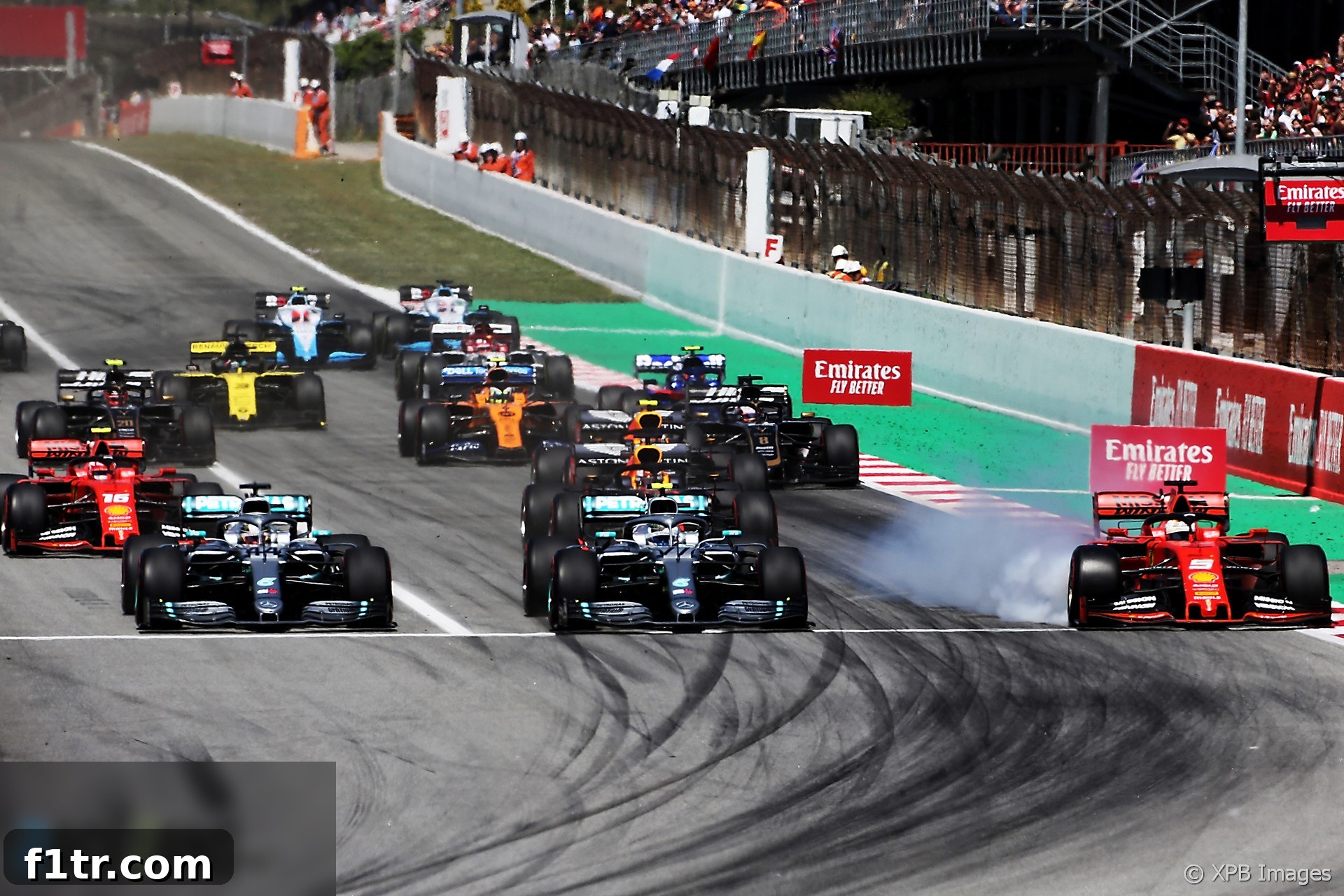
Valtteri Bottas pinpointed the exact moment he lost his chance at victory in the 2019 Spanish Grand Prix: the very start of the race. Despite securing pole position, a mysterious clutch issue immediately thwarted his efforts, allowing Mercedes teammate Lewis Hamilton to surge ahead. This incident proved to be a pivotal moment not only for the race but also in the burgeoning championship battle between the two Silver Arrows drivers.
The Finn, who had been in impressive form leading up to the Barcelona event, started from the coveted pole position. However, as the lights went out, his meticulously planned launch was compromised by an erratic clutch. This unforeseen technical glitch opened the door for Hamilton, who seized the opportunity with a blistering start. The two Mercedes machines, along with Sebastian Vettel in the Ferrari, hurtled side-by-side into the notoriously tight first corner, with Bottas finding himself squeezed between his rivals and rapidly losing ground.
Speaking to the media and his team immediately after the race, Bottas didn’t mince words about his frustration. “It was pretty tight,” he conceded, reflecting on the chaotic opening meters of the race, “but I lost it at the start. There was some strange behavior on the clutch. It was biting, releasing, biting, releasing which I’ve never felt before so I lost it there.” This detailed description highlighted the unpredictable nature of the problem, indicating a mechanical or electronic irregularity rather than a driver error.
The clutch oscillation described by Bottas is a critical issue for any racing driver, especially at the start of a Formula 1 Grand Prix. A perfect launch requires precise control over the clutch to transfer power smoothly from the engine to the wheels, optimizing grip and acceleration. When the clutch engages and disengages erratically, as Bottas experienced, it leads to wheelspin, a bog-down, or an inconsistent power delivery, all of which are detrimental to a fast getaway. In the high-stakes environment of F1, where margins are measured in milliseconds, such a malfunction is catastrophic for pole position advantage.
The Mercedes driver reiterated his concerns to his engineering team on the radio as he returned to the pits, underscoring the severity of the issue. “We lost it at the start,” he reported. “I had some clutch oscillation so we need to look at that.” His insistence on a thorough investigation was clear: “We cannot have that kind of clutch behavior in the race,” he added, emphasizing the need for reliability in components vital to performance. For a team known for its meticulous engineering and relentless pursuit of perfection, a technical fault of this nature would undoubtedly trigger an immediate and deep dive into the telemetry and component analysis.
The 2019 F1 season had started with a renewed sense of purpose for Valtteri Bottas. After a challenging 2018, he had returned with a fresh mindset, famously dubbed “Bottas 2.0.” He had already secured victories in Australia and Azerbaijan, demonstrating a more aggressive and confident approach to his racing. Coming into the Spanish Grand Prix, he led the championship standings, albeit narrowly, over Lewis Hamilton. Holding pole position in Barcelona was another testament to his improved form and pace. The clutch failure, therefore, was not just a loss of a race victory but a significant blow to his championship momentum and potentially his psychological edge.
Despite his personal disappointment, Bottas was quick to acknowledge the incredible performance of his Mercedes team. The German outfit achieved an unprecedented fifth consecutive one-two finish at the Spanish Grand Prix, solidifying their dominant position in the constructors’ championship. “As a team it’s incredible, a fifth one-two in a row is really good,” he stated, highlighting the collective achievement. This level of consistency and performance is a rare feat in Formula 1, underscoring Mercedes-AMG Petronas’s engineering superiority, strategic acumen, and operational excellence.
The significance of this result for Mercedes cannot be overstated. Five consecutive one-two finishes demonstrate a car package that is not only inherently fast but also remarkably reliable and adaptable across different circuits. While Bottas’s individual race was marred by a technical glitch, the overall team performance remained unblemished, with Hamilton converting his strong start into a dominant victory. This consistent points haul was crucial for Mercedes in extending their lead in the Constructors’ Championship, putting pressure on rivals Ferrari and Red Bull Racing.
For Bottas, however, the focus remained on the lost opportunity. He understood the long game of the championship, stating, “I got some good points, every single point is going to count this year so that’s good for sure.” Indeed, even a second-place finish, though frustrating given his starting position, added valuable points to his tally. Yet, the sting of losing a potential victory due to a technical issue rather than being out-driven was palpable. The psychological aspect of racing at the pinnacle of motorsport dictates that drivers must maximize every opportunity, especially when competing against a formidable teammate like Lewis Hamilton.
The incident served as a stark reminder of the fine margins in Formula 1. A single component malfunction, occurring at the most critical moment of the race, can unravel months of preparation and strategy. For Bottas, it was a moment of reflection and a renewed determination to understand and overcome such setbacks. His immediate desire to identify the root cause of the clutch problem showcased his analytical approach and commitment to continuous improvement. Ensuring such issues are addressed swiftly is paramount for any driver aspiring to challenge for the world championship.
The 2019 season continued to be a fierce battle between Bottas and Hamilton. While the Spanish Grand Prix saw Bottas lose ground, his resilience and ability to bounce back were tested throughout the year. The Mercedes team, renowned for its thorough investigations and problem-solving capabilities, would undoubtedly have poured resources into understanding the clutch behavior to prevent any recurrence. Such incidents, though frustrating in the moment, often lead to valuable lessons and improvements in design, manufacturing, or operational procedures, making the entire package stronger.
In conclusion, Valtteri Bottas’s 2019 Spanish Grand Prix was a tale of what could have been. A strong qualifying performance leading to pole position was undone by an unpredictable clutch oscillation at the start, allowing Lewis Hamilton to claim victory. While personally disappointing, the race highlighted Mercedes’ unparalleled team dominance, achieving an extraordinary fifth consecutive one-two finish. Bottas’s focus on understanding the technical issue underscored his determination to maximize every opportunity in his pursuit of the F1 World Championship, demonstrating that even in moments of frustration, the drive for perfection continues.
2019 F1 Season Insights and Related Articles
Delve deeper into the events and narratives that shaped the thrilling 2019 Formula 1 season. From driver reflections to technical analyses, explore the stories behind the headlines.
- Crying in the Melbourne car park at 2019 grand prix was my career low – Ocon
- McLaren Racing reports reduced £71 million loss in 2019
- Kvyat: Hockenheim podium last year was “my biggest achievement” so far
- How the FIA’s new encrypted fuel flow meter targets Ferrari’s suspected ‘aliasing’ trick
- “He smashed my office door”: 23 must-see moments from ‘Drive to Survive’ season two
Browse all 2019 F1 season articles