Advert | Become a RaceFans Supporter & Go Ad-Free
Max Verstappen on Red Bull’s “Over-achievement” and the Mercedes Challenge
Red Bull Racing’s star driver, Max Verstappen, has candidly discussed his current standing in the Formula 1 World Championship, admitting that his position ahead of one of the dominant Mercedes drivers is largely due to his team’s “over-achievement” in several races throughout the season. This revealing insight comes as Verstappen prepared for the Belgian Grand Prix, offering a glimpse into the challenging reality of competing against a formidable rival like Mercedes-AMG F1.
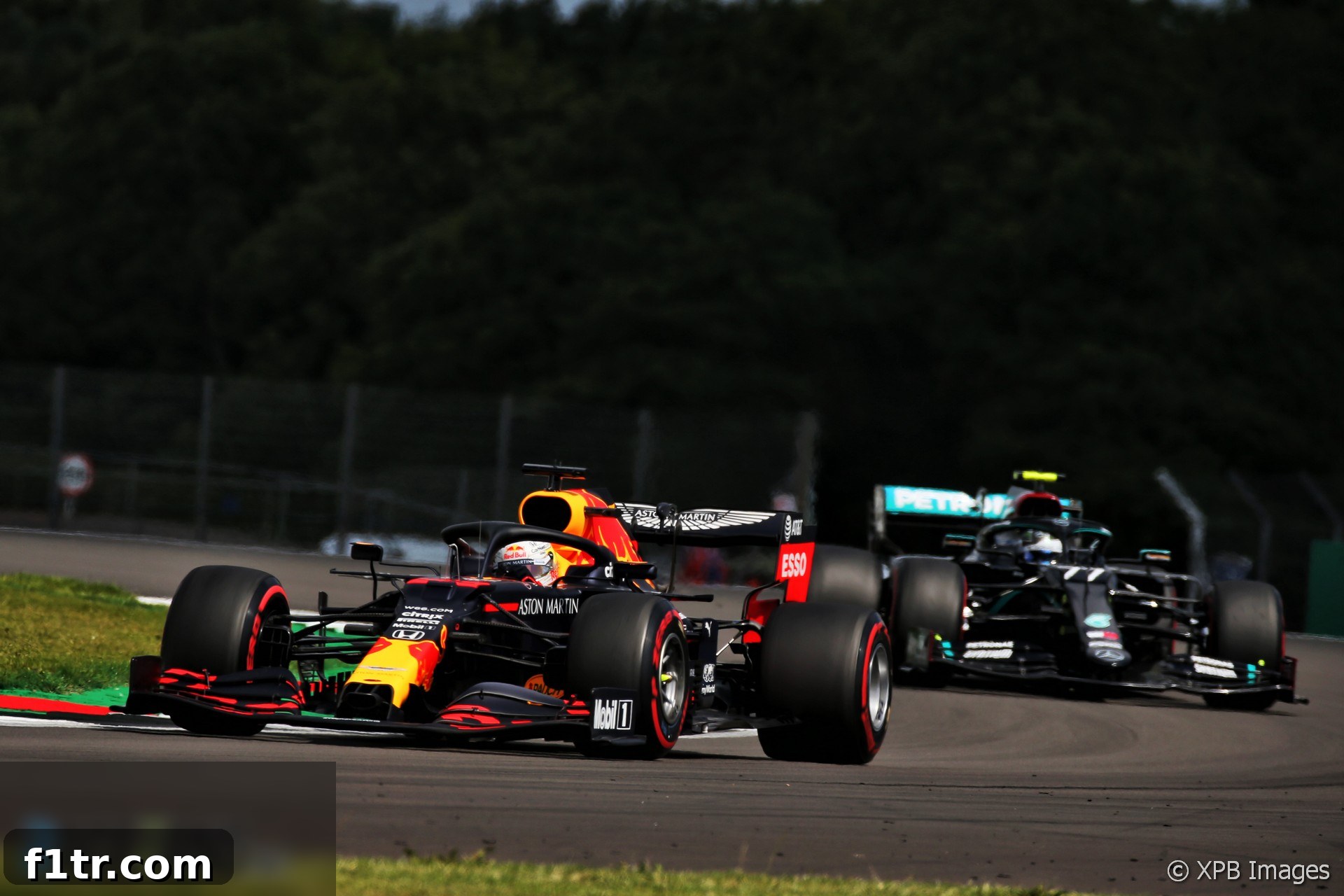
Currently, Verstappen holds a commendable second place in the drivers’ championship standings. He trails the reigning world champion, Lewis Hamilton, by a significant 37 points. However, crucially, he maintains a six-point advantage over Hamilton’s teammate, Valtteri Bottas. This puts him in a unique position, splitting the two Mercedes cars, a feat many would consider a strong performance given the W11’s unparalleled dominance.
“I think looking at pure pace, both of them should be ahead of me in the championship,” Verstappen stated during an FIA press conference, reflecting on the stark performance gap between his Red Bull RB16 and the Mercedes W11. His comments highlight a pragmatic understanding of the competitive landscape, acknowledging that raw speed places Mercedes firmly ahead.
Verstappen further elaborated on the factors contributing to his current championship standing, including elements of fortune and misfortune that have shaped the season for both himself and Bottas. “Of course, Valtteri had one retirement, I had one retirement. Well, retirement, he finished out of the points with a puncture, so no points. Of course, that was unlucky for him and unlucky for me in the first race,” he explained. This comparison points to the fine margins in Formula 1, where a single incident can dramatically alter the championship picture. Bottas’s puncture incident, coupled with Verstappen’s own early-season DNF, underscores how such events can temporarily mask or exaggerate underlying performance differences.
Despite these fluctuations, Verstappen expressed satisfaction with his team’s consistent effort to extract maximum performance from their package. “But I think overall to be second in a few races where I think Mercedes had more pace, we definitely over-achieved a bit, and besides that, I think we always maximised what we could. So I’m happy with that,” he affirmed. This “maximisation” speaks volumes about Red Bull’s operational efficiency, strategic acumen, and Verstappen’s exceptional driving ability – qualities that have allowed them to punch above their weight on race weekends where the car itself might not have been the fastest.
The Stark Reality: Championship Challenge Remains Out of Reach
While his current position in the championship table might suggest a genuine title challenge, Verstappen was quick to temper expectations. He clarified that being ahead of one Mercedes driver does not translate into a realistic bid for the overall championship against Lewis Hamilton. His perspective is grounded in the hard data of car performance, which paints a clear picture of the hierarchy at the top of Formula 1.
“As a team and myself, we are not here to be second or third, we want to fight for the championship,” Verstappen asserted, articulating Red Bull’s ultimate ambition. However, he followed this with a dose of realism: “But we also have to accept the situation we are in that we are not really able to challenge.” This honest assessment underscores the significant performance deficit Red Bull faces against Mercedes, making a direct championship assault virtually impossible under current circumstances.
The gap, according to Verstappen, is not merely superficial. “Yes, it looks like it on paper, but if you look at the pure pace, we are too slow and at the moment are relying on a bit of an ‘off day’ for Mercedes or a bit of luck to win a race. So we still have a lot of work to do,” he explained. This statement is a crucial indicator of the challenges Red Bull faces. An “off day” for Mercedes could involve strategic missteps, an uncharacteristic driver error, or perhaps even a rare reliability issue – factors that are largely outside Red Bull’s control. Relying on such external circumstances rather than inherent car speed highlights the chasm that exists between the two leading teams.
Verstappen’s comments resonate with the sentiment that Red Bull, despite their best efforts, is currently operating in a league below Mercedes in terms of outright performance. The precision of the Mercedes W11, its aerodynamic efficiency, and the sheer power of its engine package have created a benchmark that other teams, including Red Bull, are struggling to match. This performance advantage means that even on tracks where Red Bull typically excels, they must extract every ounce of potential, often driving on the absolute limit, just to stay within touching distance of the silver arrows.
Mercedes’ Winter Gains and Red Bull’s Catch-Up Battle
Red Bull began the 2020 season with a sense of cautious optimism, hoping to finally mount a sustained championship challenge against Mercedes. However, as the season unfolded, it became clear that Mercedes had once again moved the goalposts. Verstappen pinpointed one significant factor contributing to this disparity: Mercedes’ remarkable gains with their power unit during the off-season.
“Clearly they had a very good winter, Mercedes; they found a lot of performance out of their engine. That meant we were a bit behind,” Verstappen observed. The Formula 1 power unit is an incredibly complex piece of engineering, and even marginal improvements in areas like combustion efficiency, turbocharger performance, or energy recovery can translate into significant lap time gains. Mercedes’ engineers appear to have unlocked substantial additional horsepower and efficiency, widening the gap to their competitors, including Honda, Red Bull’s engine partner.
This engine advantage, combined with Mercedes’ chassis and aerodynamic prowess, created a near-unbeatable package in the W11. For Red Bull, playing catch-up against such a formidable opponent is a relentless and arduous task. The development cycle in Formula 1 is incredibly fast-paced, but regulations can often limit the extent to which teams can dramatically overhaul their cars mid-season, especially when it comes to fundamental components like the engine.
Despite the daunting challenge, Verstappen emphasized Red Bull’s enduring spirit. “We’re just trying to do the best we can. Everybody is, of course. We’ll see what the rest of the season will bring. They are still, of course, quite ahead, but we don’t give up. I think that’s the mentality of the team – we will always keep fighting and go for every opportunity that we have,” he declared. This steadfast determination is a hallmark of Red Bull Racing, a team known for its aggressive approach to development and its never-say-die attitude. Even when the championship seems out of reach, the pursuit of race victories and podium finishes remains a powerful motivator, driving the team to continuously innovate and push boundaries.
Advert | Become a RaceFans supporter andgo ad-free
The Road Ahead: 2021 Regulations and 2022’s Major Overhaul
Looking beyond the immediate season, the regulatory landscape of Formula 1 presents both challenges and potential opportunities for Red Bull and other teams hoping to challenge the established order. Verstappen voiced uncertainty regarding Red Bull’s prospects for a significant leap in competitiveness in the upcoming 2021 F1 season, primarily due to the stringent restrictions on car development introduced for that year.
“For next year as well, it might get a bit complicated because the rules are still the same, you’re not allowed to change a lot on the cars,” Verstappen explained. The 2021 regulations were designed as a transitional phase, largely carrying over the technical rules from 2020 due to the economic impact of the global pandemic. This means teams are heavily restricted in the amount of development they can undertake, particularly in aerodynamic areas and major chassis components. While some “tokens” are allowed for specific upgrades, a wholesale redesign or a dramatic closing of a performance gap becomes much harder. This continuity favors teams that already have a dominant package, like Mercedes, and poses a greater challenge for those trying to catch up.
However, a brighter prospect looms on the horizon: the radical new rules slated for the 2022 F1 season. “But then of course there are new rules coming in [for 2022] and it’s a new opportunity for everyone,” Verstappen added, highlighting the hope that a clean slate of regulations brings. The 2022 rules represent a paradigm shift in Formula 1, focusing on ground effect aerodynamics, simplified bodywork, and a more standardized approach to certain components, all aimed at improving racing and making it easier for cars to follow each other closely. Such a fundamental overhaul of the technical regulations offers every team, including Red Bull, a fresh chance to interpret the rules, design an innovative car, and potentially leapfrog the competition. This regulatory reset is widely seen as the best opportunity for a genuine shake-up of the pecking order and a chance for teams like Red Bull to build a truly championship-contending car from the ground up.
For Max Verstappen, a driver of immense talent and ambition, navigating these regulatory shifts while consistently extracting peak performance from his machinery will be key to his future championship aspirations. His ability to “over-achieve” in a car that isn’t always the fastest underlines his status as one of Formula 1’s elite. While the 2020 season served as a stark reminder of Mercedes’ formidable strength, the future holds the promise of new challenges and renewed opportunities for Red Bull to truly contend for the ultimate prize in motorsport.
2020 Belgian Grand Prix
- 2020 Belgian Grand Prix Star Performers
- Ricciardo believes Renault’s Spa set-up breakthrough will work on other tracks
- ‘He should have let me pass’: How Raikkonen saw Giovinazzi’s crash
- Sub-54 second laps will produce a “big mess” in qualifying on Bahrain Outer circuit
- McLaren expect Ferrari will “strike back” after Monza
Browse all 2020 Belgian Grand Prix articles