Sebastian Vettel’s Turkish Grand Prix Gamble: A High-Stakes Tire Decision That Backfired
The 2021 Formula 1 Turkish Grand Prix delivered an unforgettable spectacle of strategic gambles, challenging conditions, and razor-thin margins. Amidst the drama, one particular decision stood out for its audaciousness and subsequent repercussions: Sebastian Vettel’s ill-fated switch to slick tires. The four-time world champion candidly admitted his high-risk strategy backfired, highlighting the delicate balance between calculated risk and catastrophic error in the world of elite motorsport.
Istanbul Park’s Treacherous Embrace: The Context of the Gamble
Istanbul Park is renowned for its demanding layout, and in 2021, persistent damp conditions added another layer of complexity. Rain had made the track wet before the race, but it wasn’t a full-wet scenario throughout. This ‘in-between’ state created a strategic minefield, where teams and drivers had to constantly monitor grip levels, tire wear, and the evolving track surface. Intermediate tires, designed for damp conditions, were the default choice, but as the race wore on, their effectiveness began to wane. The track wasn’t drying fast enough for slicks, yet it was abrasive enough to shred the intermediates, creating a dilemma that would ultimately define several drivers’ races, including Vettel’s.
Advert | Become a Supporter & go ad-free
As the race approached its halfway point, many drivers, including race leaders Valtteri Bottas and Max Verstappen, were struggling with their intermediate tires. The grooves were wearing down, turning them almost into slicks, but without the compound characteristics required for a truly dry track. This phenomenon often creates a mirage of opportunity for drivers, making them wonder if the track is indeed ready for dry weather rubber. It was in this precise window of uncertainty that Vettel and his Aston Martin team made their pivotal call.
The Audacity of the Switch: Rationale Behind Vettel’s Pit Stop
Vettel pitted on lap 38, just after both Bottas and Verstappen had made their respective stops, both opting for fresh sets of intermediate tires. This move from the front-runners solidified the conventional wisdom of staying on intermediates. However, Vettel, who was not in a points-scoring position that offered significant upside with conventional strategy, decided to deviate. He and Aston Martin collectively opted for a dramatic gamble: switching to slick tires. Specifically, they chose the harder medium compound, as the softer compound had proven to be too fragile and unsuited for the conditions during earlier practice sessions.
Explaining his decision post-race, Vettel articulated the rationale: “We had to try. The inters, there was nothing left on them. They were completely worn, looking like slicks themselves. So, we thought the dry [tires] could be as good.” This sentiment perfectly encapsulated the precarious state of the intermediate tires – their performance cliff was steep, and the temptation to try something different, something potentially revolutionary, was immense. For a driver of Vettel’s caliber, with a history of strategic brilliance, the decision was not made lightly. It was a calculated risk, born out of a desire to find an advantage where conventional methods offered little.
The decision was also influenced by the sheer lack of grip on the worn intermediates. Vettel further elaborated, “If you look at the inter tyres, there’s nothing left on them. They look like a slick. So I think I had reason, but obviously, it was the wrong decision.” This highlights the psychological aspect of tire strategy; when a tire is visually degraded to resemble another type, it creates a powerful suggestion for change, even if the underlying track conditions don’t fully support it.
On the Brink: The Immediate Aftermath on Track
The moment Sebastian Vettel left the pits on medium compound slick tires, the gravity of the gamble became immediately apparent. The track, despite appearances and the condition of worn intermediates, was simply not dry enough. The small patches of dampness, the lingering moisture, and the lower track temperatures meant the slick tires struggled to generate any heat or grip. “It was worse than I expected because it was damp still, a little bit here and there or wet,” Vettel confessed. “But the main thing is I couldn’t break the tyre in, and then you’re just sliding all the time. It was clear it was never going to come.”
What followed was a harrowing lap for the German driver. Instead of finding grip and pace, Vettel found himself constantly battling for control. The car was sliding incessantly, making it nearly impossible to maintain a racing line or push for performance. His lap was painfully slow, a stark contrast to the competitive pace he would normally command. He was able to very cautiously navigate the circuit, effectively tiptoeing around corners, just to make it back to the pit lane. The embarrassment was compounded by a visible skid at the pit lane entrance, a testament to the complete lack of adhesion offered by the slicks on the damp surface.
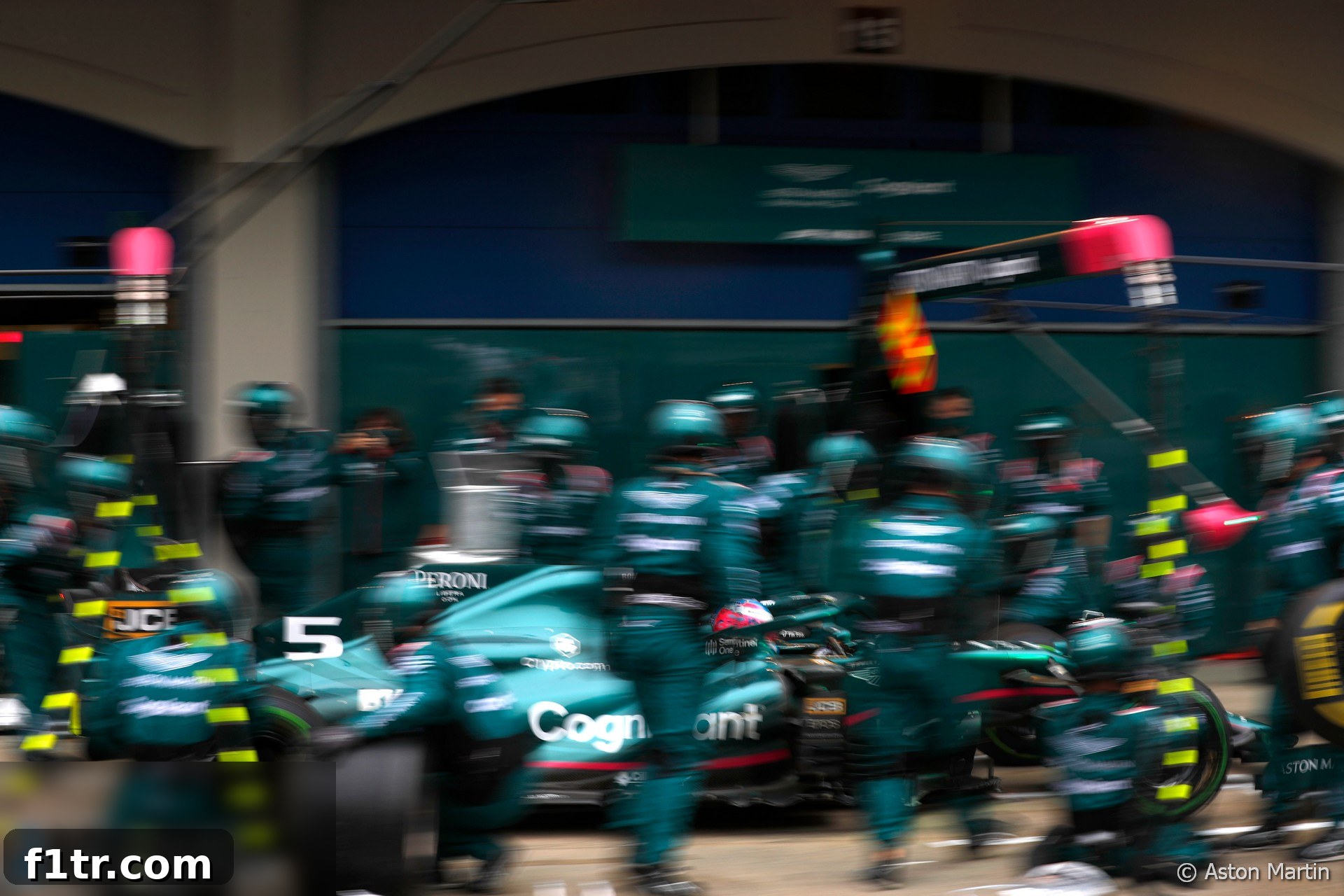
The experiment lasted less than a full lap. The data was unequivocal: the track was not ready. The team quickly realized the error, and Vettel was called back in for another pit stop, reverting to a fresh set of intermediate tires. This double stop within a few minutes was devastating for his race, effectively pushing him further down the order and eliminating any chance of a respectable finish.
Hindsight is 20/20: Vettel’s Post-Race Reflection and Learning
After the race, with the benefit of hindsight, Sebastian Vettel was remarkably pragmatic and self-critical about the decision. He admitted that staying on intermediates was “a no-brainer” in retrospect. However, he emphasized that the clarity of the situation was far less obvious in the heat of the moment, with adrenaline pumping and limited real-time information. “I was tempted already, some laps before, and the inters weren’t getting any better,” he reasoned, explaining the buildup to the decision.
Vettel also drew parallels to the previous year’s Turkish Grand Prix, another race held in challenging, mixed conditions. “People were going on intermediates, but it was a comparable situation to last year,” Vettel explained. “Last year I was thinking 15 laps to go that I wanted to try the slick tyres when the track was a little bit worse. So I thought it’s worth a go, but it proved to be wrong.” This comparison highlights how past experiences can influence current decisions, sometimes leading to misjudgments when conditions are subtly but critically different.
The key learning from Vettel’s experience underscores a fundamental challenge in Formula 1 tire strategy: the operating window. Both intermediate and slick tires have very specific temperature and moisture ranges in which they perform optimally. The 2021 Turkish Grand Prix hovered frustratingly between these two windows, making tire selection a true lottery. Vettel’s gamble was an attempt to break free from the diminishing returns of worn intermediates, hoping the track had crossed the threshold into slick territory. It hadn’t, and the consequences were immediate and costly.
Advert | Become a RaceFans supporter andgo ad-free
The Broader Implications of Tire Strategy in Formula 1
Sebastian Vettel’s Turkish Grand Prix experience serves as a classic case study in the high-stakes world of Formula 1 tire strategy. In conditions that are neither fully wet nor fully dry, the choice between intermediate and slick tires, or even opting for a fresh set of the same compound, can be the difference between victory and despair. Teams invest heavily in meteorology and track condition analysis, yet the dynamic nature of a racing circuit can still spring surprises. The fine line between a genius call and a strategic blunder is often razor-thin.
For back-of-the-grid or mid-field teams like Aston Martin, such gambles are often more justifiable. When fighting for minor points or simply aiming to improve position, a risky strategy offers a higher potential reward than simply following the pack. Front-runners, conversely, tend to adopt more conservative approaches unless a clear opportunity arises. Vettel, not fighting for the championship at this stage, had less to lose by attempting a daring move to gain an advantage.
Historically, F1 is replete with examples of tire gambles. Some, like Lewis Hamilton’s decision to stay out on worn intermediates in China 2007 (which backfired spectacularly), or conversely, his incredible tire management in Turkey 2020 on intermediates to win the championship, showcase the spectrum of outcomes. These moments are often what define races, adding an unpredictable element that captivates fans. Vettel’s gamble, though unsuccessful, was a bold attempt to master unpredictable conditions, underscoring the relentless pursuit of an edge in Formula 1.
Ultimately, Vettel’s brief excursion on slick tires at Istanbul Park was a vivid reminder of the harsh realities of Formula 1. Even for a driver of his immense experience and strategic acumen, the nuances of track conditions and tire behavior can lead to miscalculations. It was a gamble that didn’t pay off, but it highlighted the constant pressure on teams and drivers to push the boundaries of strategy in the quest for performance.
2021 Turkish Grand Prix Insights
- Sainz Believes Fifth Place Was Possible from Back Row Without Slow Pit Stop
- Giovinazzi Ignoring Position Swap Order “Not Ideal” for Alfa Romeo Team
- Valtteri Bottas Becomes 35th Formula 1 Driver to Reach 10 Race Wins
- Medical Car Driver Van der Merwe Likely to Miss Further Races Due to COVID-19 Rules
- Drivers to Ask Masi Why Alonso and Norris Went Unpunished for “Very Clear” Incidents
Browse all 2021 Turkish Grand Prix articles and analyses