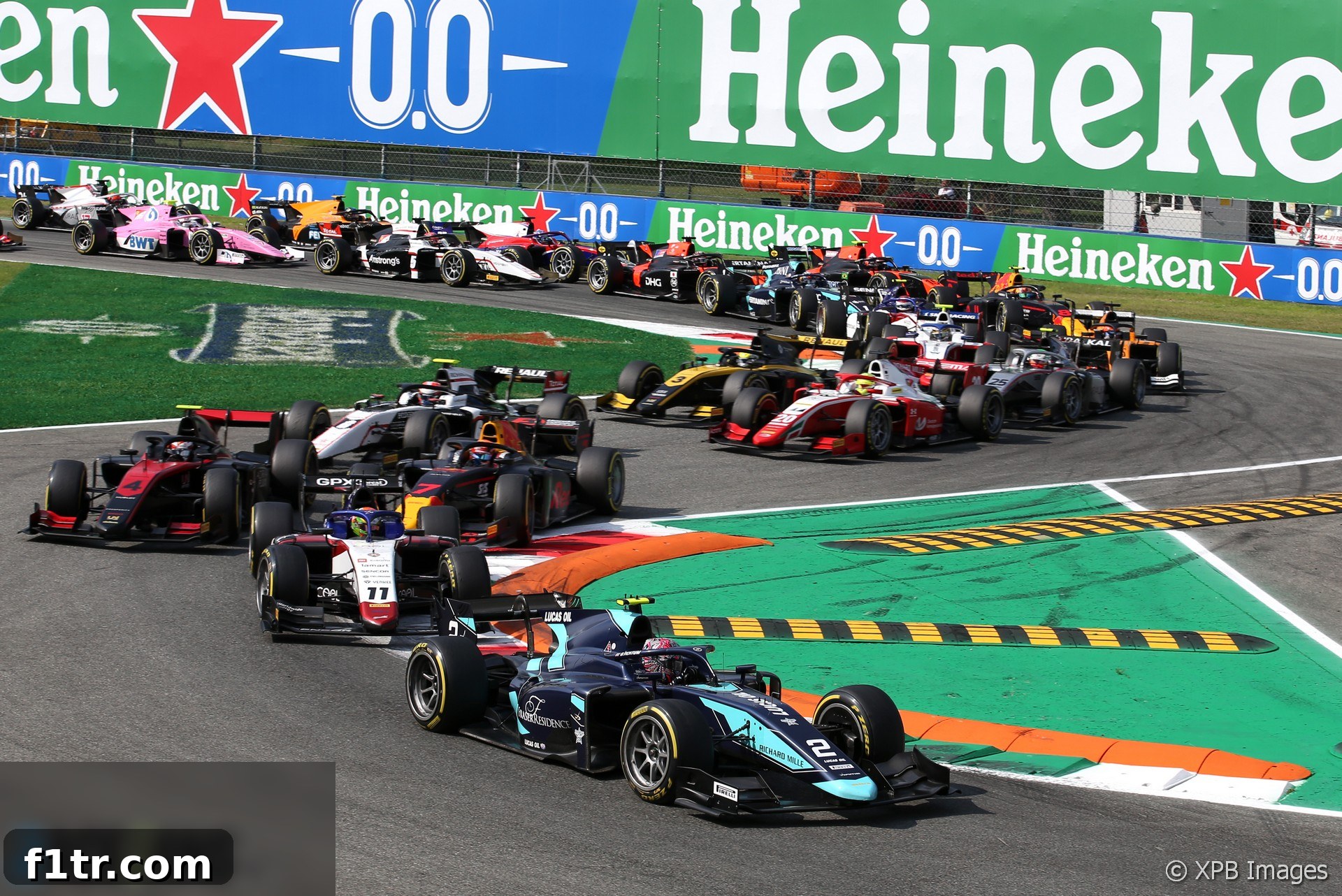
In a dramatic turn of events that has sent shockwaves through the Formula 2 paddock, the DAMS racing team has launched a scathing critique of the championship organisers. Their fierce condemnation comes in the wake of driver Dan Ticktum’s controversial disqualification from today’s sprint race, a race he had decisively won. The incident has reignited long-standing debates about reliability and fairness within motorsport’s premier feeder series, casting a shadow over what should have been a triumphant moment for the young British driver and his team. This unforeseen twist not only robbed Ticktum of a deserved victory but also brought to light a series of systemic issues that DAMS claims have plagued the championship for an extended period.
Advert | Become a Supporter & go ad-free
Ticktum’s disqualification stemmed from a post-race technical inspection where stewards found an insufficient quantity of fuel in his car to take a required sample. The regulations mandate that a specific amount of fuel must remain for testing purposes after the race concludes, and Ticktum’s car unfortunately failed this crucial requirement. This deficiency in fuel meant that despite crossing the finish line first, securing a hard-fought victory after a dominant performance, the triumph was swiftly stripped away. Consequently, Callum Ilott was elevated to the top step of the podium. However, DAMS asserts that this was far from a simple oversight on their part; instead, they attribute the problem to the consequence of a pre-existing and unresolved mechanical flaw – specifically, a faulty fuel tank. This issue, they claim, was well-known to the championship authorities and their suppliers, raising serious questions about accountability and component quality within the series.
DAMS’ managing director, Francois Sicard, did not mince words when expressing the team’s profound frustration and disappointment. He revealed that the team had previously brought the problematic fuel tank issue on Ticktum’s car, along with similar concerns affecting other teams, to the attention of Formula 2 organisers. Yet, despite these repeated notifications, DAMS contends that no effective resolution or repair was implemented by the championship, leading directly to the unfortunate situation that ultimately cost Ticktum his hard-earned victory. This ongoing failure to address critical equipment malfunctions suggests a deeper systemic issue that is undermining the integrity of the competition.
“This fuel tank problem has been known to the championship organisers and their suppliers for several races now,” Sicard stated emphatically, underlining a deep-seated grievance that points to a lack of proactive problem-solving. His comments suggest a critical oversight from those responsible for maintaining the technical standards of the championship. He further elaborated on DAMS’ diligent efforts to mitigate the issue on their own accord, despite the alleged inaction from official channels. “The tank in Dan’s car was serviced three races ago, but we still had an issue. We had the right quantity of fuel for the race, in fact, we put too much in as a safety margin and it’s a miracle we finished.” This testimony highlights the team’s meticulous preparation and their desperate attempts to manage a flaw they believed was beyond their immediate control. The irony of adding extra fuel as a safety net, only for a persistent leak to still result in disqualification, paints a stark picture of the insurmountable challenges they faced. It raises serious questions about the quality and reliability of components supplied across the championship, and the efficacy of troubleshooting by official channels responsible for ensuring a level playing field.
The reliability woes, according to Sicard, extend far beyond Ticktum’s specific incident, significantly impacting the team’s other entry as well. He revealed that the sister car, shared by drivers Sean Gelael and Yuri Vips throughout the season, has also been plagued by a litany of technical difficulties. This broader pattern of failures within the DAMS garage points to a more pervasive issue than an isolated defect in one car. It strongly suggests that the team is grappling with recurrent mechanical shortcomings that are significantly hindering their competitive performance and the crucial development of their young drivers.
“Over 12 races, the number one car had six did-not-finishes due to engine-related issues and now, like many other teams, we have problems with the fuel tank and our case has been the most extreme,” Sicard explained. Six DNFs in just 12 races represents an alarming statistic, equating to a staggering 50% retirement rate for one car due to engine-related problems alone. Such unreliability is profoundly detrimental to any racing campaign, but especially so in a fiercely competitive feeder series like Formula 2, where every point, every lap, and every opportunity to showcase talent is crucial for a driver’s career progression and a team’s championship standing. The fuel tank issue, therefore, adds another layer of complexity and frustration to an already challenging season for DAMS, solidifying their argument that they are battling against equipment flaws rather than purely on-track performance.
The DAMS managing director strongly asserts that the disqualification was a profound injustice, undermining the very spirit of fair competition. “We finished the race but the fuel leak meant we failed scrutineering for something that is totally unrelated to the driver, the team and the engineers, who did their jobs well and properly calculated the fuel quantity. This has deprived Dan and DAMS of a great victory having dominated the entire race, and I understand why he is as gutted as we are.” This statement encapsulates the profound sense of unfairness felt by the entire team. It suggests that despite meticulous preparation, strategic brilliance, and flawless execution by Ticktum and the DAMS engineers, external factors – specifically, a faulty component supplied through the championship – ultimately sabotaged their achievement. The victory was earned through pure skill and strategy, yet unjustly lost due to a technicality stemming from a known manufacturing flaw, impacting both sporting results and team morale.
DAMS is by no means alone in experiencing significant technical setbacks. Sicard’s concerns are echoed by incidents involving other promising talents on the grid. Two other prominent drivers, Yuki Tsunoda and Guanyu Zhou, also encountered severe technical problems during today’s race, further highlighting a worrying trend of widespread unreliability across the Formula 2 field. These consistent and widespread issues suggest that the problem is not isolated to one team or one car but might be indicative of broader component quality, manufacturing inconsistencies, or design challenges affecting the entire championship grid. Such a pervasive situation demands immediate and comprehensive attention from the championship organisers to uphold the integrity and competitiveness of the series.
“These issues cannot continue in such a championship with the budgets required to participate and be competitive,” Sicard declared, drawing a direct link between the substantial financial investment required to enter Formula 2 and the quality of the racing experience. Formula 2 is a notoriously expensive series, with teams and drivers investing substantial sums to compete and progress towards Formula 1. When fundamental reliability issues, particularly those stemming from common components, consistently undermine these investments and compromise results, it becomes an unsustainable model for teams and drivers alike. “It is simply unacceptable,” he concluded, reflecting a sentiment likely shared by many within the paddock who are grappling with similar frustrations. The immense financial strain of motorsport, combined with persistent technical failures, creates an environment where true meritocracy is unfortunately challenged by mechanical lottery.
Sicard emphasized that the problem extends across the entire grid, making it a championship-wide crisis that threatens its very foundation. “Every team on the grid has had far too many problems out of their control since the beginning of the season. Overall reliability is urgently needed.” This powerful statement transforms the incident from a DAMS-specific grievance into a broader indictment of the championship’s operational standards. If teams are consistently battling issues beyond their control – whether engine-related, fuel system-related, or other component failures – it fundamentally compromises the sporting contest. Drivers are unable to showcase their full potential, teams cannot demonstrate their engineering prowess, and the outcome of races can be unfairly influenced by technical lottery rather than pure, unadulterated competition. The call for urgent overall reliability is therefore not just a plea from one team, but a vital demand for the fundamental health, credibility, and future of the championship.
Ultimately, Sicard placed the onus squarely on the championship’s leadership and its network of suppliers to rectify these critical deficiencies. “This is a very competitive championship which has the potential to be great, but it is now up to the organisers and their suppliers to solve all these issues once and for all.” His comments serve as a clear ultimatum: Formula 2 possesses immense potential as a vital stepping stone to Formula 1, attracting top talent and significant investment from around the world. However, its continued success and esteemed reputation are inextricably linked to its operational reliability. If the series cannot guarantee a baseline level of consistent, dependable equipment, it risks alienating participants, jeopardizing sponsor relationships, and eroding fan trust. The future credibility of Formula 2, and its crucial role in nurturing the next generation of F1 stars, hinges on whether the organisers can effectively address these pervasive reliability concerns and restore unwavering faith in the fairness and quality of the racing.
Advert | Become a RaceFans supporter andgo ad-free
Formula Two
- Formula 2 to debut in Miami and Montreal after Iran war cancellations
- Ex-McLaren junior Dunne’s move to Alpine finally confirmed
- Schumacher says his IndyCar feels like ‘an F2 car, just with better tyres’
- The Formula 2 team with an older driver line-up than almost half the F1 grid
- FIA to award more F1 superlicence points to IndyCar drivers from 2026
Browse all Formula 2 articles