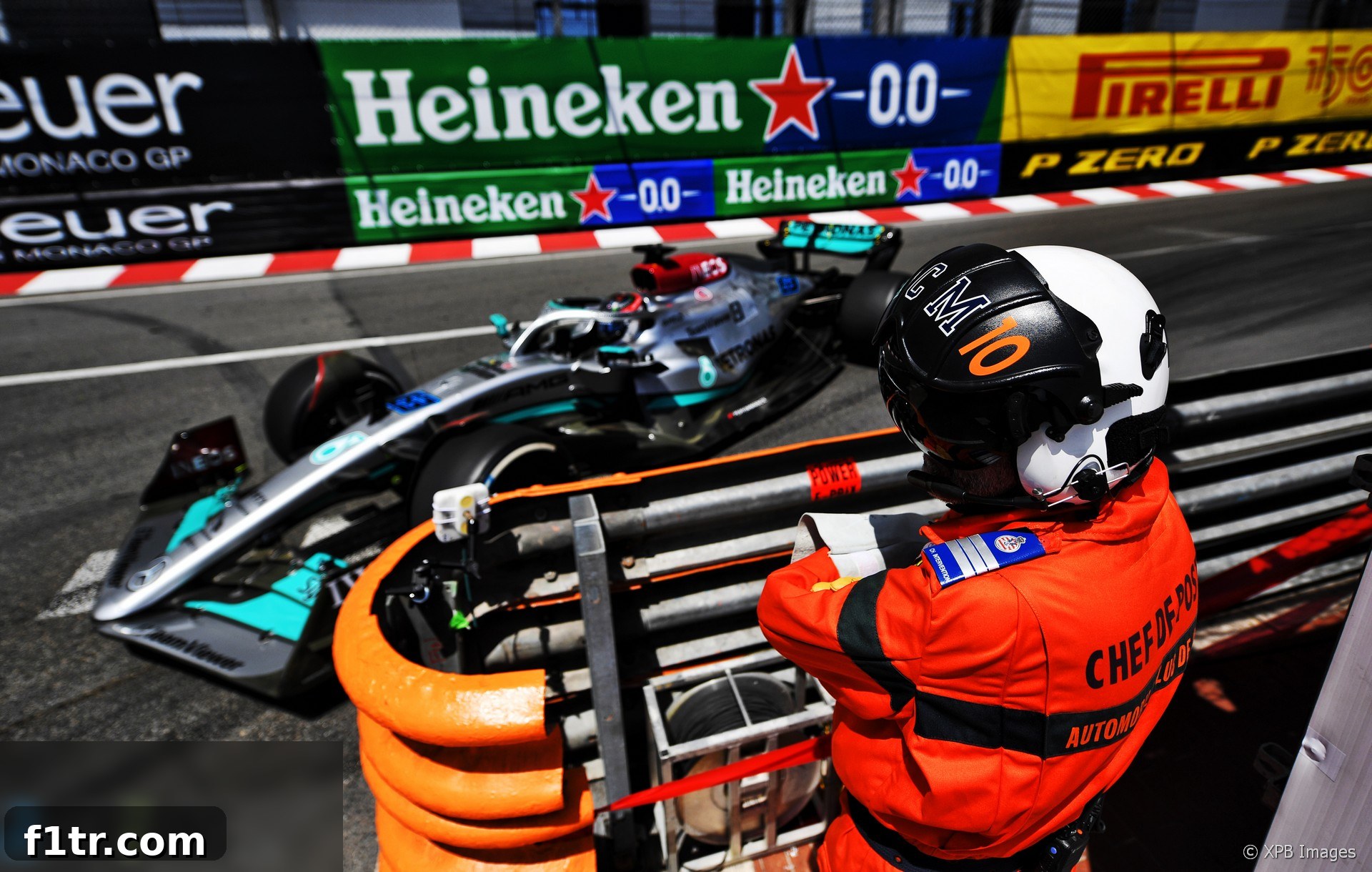
George Russell Navigates Monaco’s Perilous Qualifying, Securing P6 for Mercedes
The iconic streets of Monaco, unforgiving and thrilling in equal measure, once again delivered a dramatic qualifying session for the Formula 1 Grand Prix. Amidst the chaos and red flags, George Russell showcased both immense skill and the enduring challenges faced by his Mercedes team, ultimately securing a respectable sixth position on the grid. However, his journey to P6 was not without its heart-stopping moments, including a significant brush with the barriers that highlighted the knife-edge nature of pushing a Formula 1 car to its limits around the Principality.
A Near Miss at Nouvelle Chicane: Russell’s Heroic Save
In a testament to the fine margins that define Monaco qualifying, Russell revealed a dramatic incident on his final flying lap in Q3. Pushing hard through the demanding Nouvelle Chicane, a critical section of the circuit known for its tight confines and treacherous entry, the young British driver confessed to striking the inside wall. This was the very same spot where Yuki Tsunoda had earlier clipped the barrier during an earlier session, suffering a punctured left-front tyre that forced a temporary halt to proceedings.
Russell, however, was able to escape a similar fate, a testament to his lightning-fast reflexes and the robust engineering of his Mercedes W13. “On my quickest lap, I actually hit the wall on the left of Turn 10 after the tunnel,” Russell explained, detailing the sheer intensity of the moment. “It’s impressive to see how the steering lock was the same rate and you see the wheel sort of completely bend in the wishbone and somehow I just managed to keep it together.” The ‘wishbone’ refers to a crucial suspension component, and for it to visibly flex under impact underscores the severity of the contact. That Russell could maintain control and complete his lap, which saw him improve his time, speaks volumes about his composure under pressure.
Outperforming His Teammate: The Intra-Team Dynamic
Despite the adversity, Russell once again demonstrated his burgeoning talent by out-qualifying his illustrious teammate, Lewis Hamilton. Russell will line up two slots ahead of the seven-time world champion on the grid, continuing a trend of strong performances relative to Hamilton in the early stages of the season. This consistent edge over a legend like Hamilton not only bolsters Russell’s growing reputation but also provides a fascinating subplot to Mercedes’ championship narrative. While the team’s primary focus remains on addressing their car’s fundamental issues, the internal battle between their two drivers continues to generate intrigue.
Russell’s ability to extract more performance from the W13 in qualifying was further evident in his strategy during Q3. He was one of a handful of drivers who managed to put in a second flying lap and improve his time before the session was prematurely red-flagged due to separate, dramatic crashes involving Sergio Perez and Carlos Sainz Jnr. This strategic acumen and timely execution allowed him to solidify his P6 slot amidst a session fraught with interruptions and high-pressure moments.
Mercedes’ Enduring Predicament: Bouncing and Stiffness
While Russell’s P6 was a commendable effort, he readily admitted it wasn’t a cause for celebration. The Mercedes team has been grappling with significant challenges throughout the 2022 season, primarily stemming from their W13 car’s “porpoising” phenomenon and overly stiff suspension settings. These issues, which cause the car to bounce violently at high speeds, have severely hampered their performance and made the car notoriously difficult to drive.
Monaco, with its unique characteristics, brought these problems into sharp focus. The circuit, renowned for its low-speed corners, tight chicanes, and undulating surfaces, offers no respite for a car struggling with ride compliance. Russell articulated the team’s predicament: “We’ve really struggled with compliance of the car – it’s been really stiff this weekend.” The inherent stiffness required to manage porpoising on other circuits proved to be a major detriment on the bumpy, close-confines of Monaco.
This starkly contrasted with the encouraging progress Mercedes had shown at the previous Spanish Grand Prix, where a significant upgrade package appeared to alleviate some of the car’s issues, particularly in high-speed corners and straight-line performance. Russell highlighted this disparity, explaining, “Following Barcelona, our strengths were straight-line speed and the high-speed corners and there’s none of those in [Monaco].” The absence of high-speed sections in Monaco meant that the car’s previous improvements were largely irrelevant, instead exposing its weaknesses in low-speed maneuverability and over bumps.
A Realistic Assessment: P6 Reflects True Pace
Despite being beaten to fifth place on the grid by McLaren’s Lando Norris, Russell maintained a pragmatic outlook. He believes that P6 is a fair and accurate reflection of Mercedes’ current pace and the limitations of their W13 package around the iconic Monaco street circuit. “This place is thrilling to drive, even if it’s not the pole,” said Russell, acknowledging the sheer joy of tackling the circuit. “But it is a little bit tough for us all as a team when you feel like you’ve kind of optimised it and you only come home with P6.”
His honesty continued, “P6 is not a result to be celebrating, but I think when you look at it objectively, there was no reason for us to be any higher.” This mature assessment underscores Russell’s understanding of the team’s current position in the pecking order and his ability to extract the maximum from a challenging situation. His satisfaction with his individual lap, despite the red flag, was also evident: “I think I was still four tenths up on Lewis and Fernando [Alonso], so that was promising.” This shows confidence in his personal performance even when the car isn’t at its best.
Looking Ahead: The Monaco Grand Prix Race
Starting from sixth on the grid at Monaco presents its own unique set of challenges and opportunities. Overtaking is notoriously difficult, making qualifying position paramount. While P6 is not ideal for a team with Mercedes’ championship ambitions, it puts Russell in a strong position to capitalize on any incidents or strategic opportunities that may arise during the race. Points will be the primary objective, and with both Mercedes cars starting within the top ten, the team will be hoping to consolidate their position in the Constructors’ Championship.
The Monaco Grand Prix is famed for its unpredictability, and with the potential for Safety Cars and changing weather conditions, a strong strategic call could still propel Russell further up the order. However, the fundamental issues with the W13 will likely persist, making consistency and careful driving crucial for converting his qualifying effort into a solid race result. Russell’s drive through the pain barrier in qualifying, demonstrating both raw speed and intelligent car management, sets the stage for what promises to be another gripping installment of the Formula 1 season in Monaco.