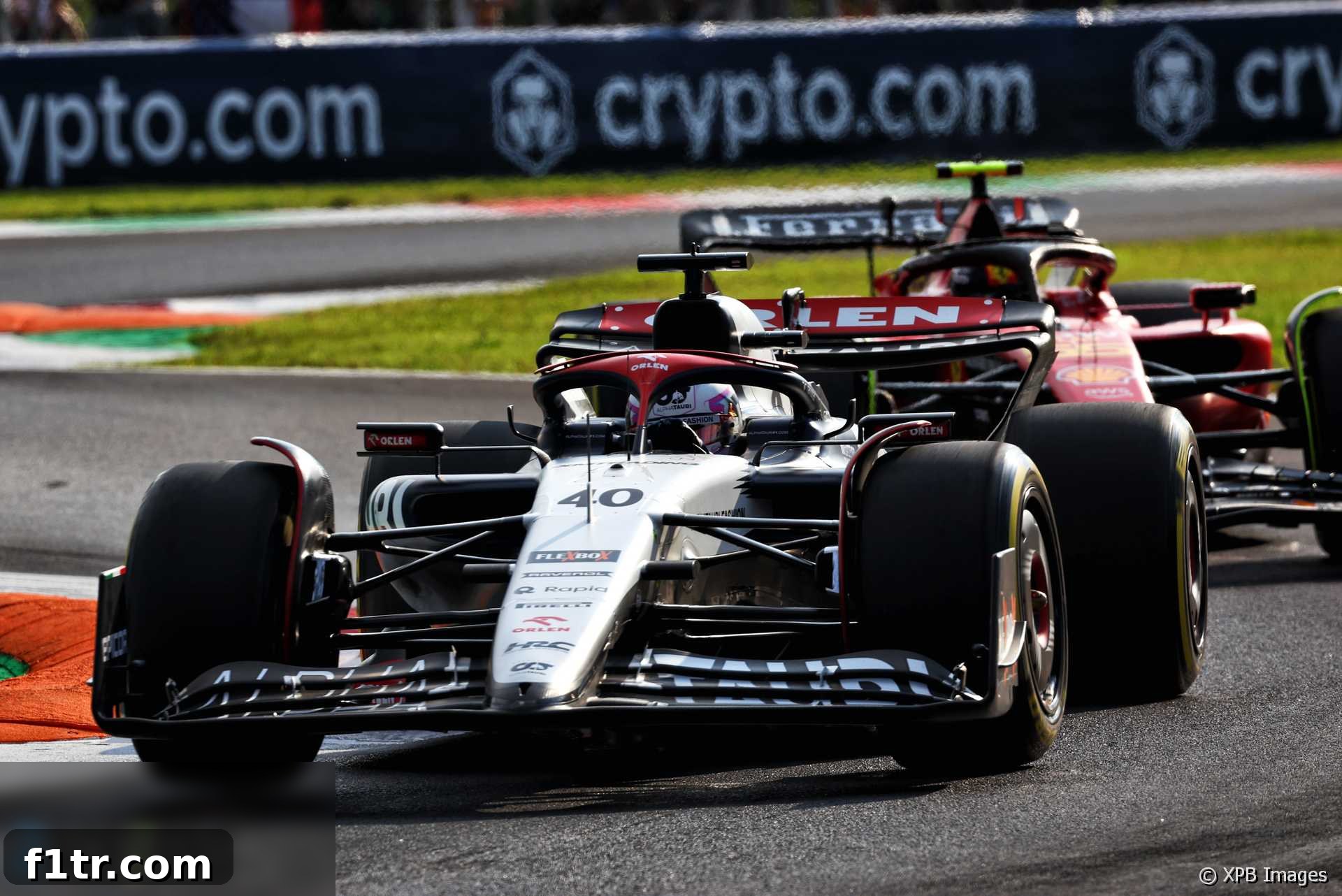
Liam Lawson’s Rapid Ascent: Navigating Formula 1’s Demands from Zandvoort to Monza
The world of Formula 1, renowned for its meticulous precision and years of planning, thrust young Liam Lawson into an unprecedented challenge during the Dutch Grand Prix at Zandvoort. With a mere 16 hours separating the official announcement of his Formula 1 debut from his first on-track session, the situation was nothing short of a baptism of fire. Lawson himself admitted the extreme pressure of the moment, stating, “In a preferred world, you’d have a week or two to really get everything sorted in your mind. But it was in like 12 hours for us.” This incredibly tight turnaround left little to no room for extensive preparation, a stark contrast to the typical lead-up for a Grand Prix weekend.
Stepping into the AlphaTauri AT04, Lawson took the place of an injured Daniel Ricciardo. While an immense challenge, the circumstances were made somewhat less daunting by the “extremely supportive” presence of Ricciardo himself and the valuable guidance of his teammate, Yuki Tsunoda. Despite the overwhelming pressure, the unfamiliarity of the car, and a circuit he had limited experience with, Lawson delivered a commendable performance at Zandvoort. He managed to qualify 19th and, against the odds, expertly navigated the often treacherous, rain-affected circuit conditions to finish a respectable 13th. His debut was a clear demonstration of raw talent, remarkable adaptability, and steely composure, immediately capturing the attention of the F1 paddock and fans worldwide.
Monza Preparations: The Advantage of Time and Technology
Following his impressive Zandvoort debut, the widely anticipated news broke that Lawson would once again take the wheel at the iconic Monza circuit for the Italian Grand Prix. Crucially, this confirmation provided Lawson with a luxury he had been deprived of just days earlier: time. With almost four full days before the first practice session, this extended window allowed for a significantly more comprehensive and structured preparation regime, a stark difference from his hurried entry into the Dutch event.
Lawson’s itinerary was meticulously planned, beginning with a vital visit to Red Bull’s state-of-the-art simulator in Milton Keynes. This invaluable time was dedicated to familiarizing himself with the unique, high-speed characteristics of Monza, often dubbed “The Temple of Speed.” He was able to refine his driving lines, understand braking points, and experiment with various setup configurations in a controlled environment. Simulator sessions are an indispensable tool for any Formula 1 driver, particularly for a rookie adapting to a new car and an unfamiliar track under immense pressure. This virtual immersion allowed him to build a foundational understanding before ever hitting the actual asphalt.
Following his intensive simulator work, Lawson traveled to Italy to spend crucial time at AlphaTauri’s factory. This period was not merely a formality but an integral part of his deeper integration into the team. Working closely with his engineers, strategists, and mechanics, he was able to deepen his understanding of the AT04, discuss data from his Zandvoort performance, and fine-tune his approach for the upcoming weekend. This collaborative environment fostered stronger working relationships, enhancing communication and mutual trust – elements that are absolutely vital for optimizing performance on track. “It obviously feels better having done more and more preparation for the weekend,” Lawson shared with media, including RaceFans, upon his arrival at Monza. He further emphasized, “So, simulator included, it was good also to spend more time with the team, especially with my engineers. Obviously it definitely helps going into this weekend.” This comprehensive level of preparation provided him with a tangible boost in confidence and a more grounded approach to the challenges that lay ahead.
Despite the significantly improved preparation, Lawson admitted that the whirlwind nature of his sudden F1 entry meant there was little room for introspection regarding his Zandvoort debut. All his attention was firmly fixed on the present and the immediate future – the second race of his Formula 1 career. “There’s just a lot of work trying to prepare for this,” he explained. “So that kind of takes over everything else. Takes over completely the focus. Not a huge amount of time [to reflect].” This singular focus underscored the demanding nature of F1, where the relentless pursuit of peak performance constantly eclipses past events, no matter how extraordinary or memorable.
Qualifying Performance: Close to the Top Ten at the Temple of Speed
The tangible benefits of Liam Lawson’s meticulous preparation were quickly evident during the Monza weekend’s initial sessions. In the free practice sessions, he showcased impressive pace and growing confidence, registering the 14th fastest time. Notably, he outperformed his more experienced AlphaTauri teammate, Yuki Tsunoda, in these early runs. This early indication of his increasing comfort with the car and the unique characteristics of the Monza circuit generated considerable optimism within the AlphaTauri garage, hinting at strong potential for the crucial qualifying session.
As qualifying commenced, the pressure on Lawson intensified, but he maintained his composure and delivered a strong performance. He expertly navigated the fast straights and challenging chicanes of Monza, securing an impressive 12th position on the grid for Sunday’s race. This placed him just one spot behind Tsunoda, highlighting the close internal competition within the team. The narrow margin of 0.164 seconds separating the two AlphaTauri drivers, with Tsunoda only 0.013 seconds shy of making it into the crucial Q3 segment, underscored the fierce competitiveness of the midfield and the team’s promising underlying pace on a challenging track.
Reflecting on his qualifying effort, Lawson expressed a nuanced mix of satisfaction with the progress made and a hint of disappointment regarding the untapped potential. “We definitely had more time in it,” he asserted, acknowledging that both AlphaTauri cars had the capability for even greater performance. “With both cars so close to Q3, there was clearly potential to be in there. So it’s a little bit disappointing, but happy with the step we made from [Friday]. We’ve obviously closed the main gap, but it’s the last little bit needs to still come.” This sentiment perfectly encapsulated the relentless pursuit of perfection inherent in Formula 1, where every hundredth of a second can dictate a driver’s grid position and, ultimately, their race outcome. The fine margins at the pinnacle of motorsport mean that even a strong performance can leave a driver feeling that more was achievable.
Lawson also hinted at a specific incident that might have cost him that crucial fraction of a second needed for a Q3 berth. He recounted a moment during his hot lap: “I had a car go off in front of me and drop gravel all over the track, so that definitely didn’t help.” Such unexpected obstacles are a common hazard in qualifying, especially on circuits like Monza where drivers push the limits to the absolute maximum. Even a small amount of gravel on the racing line can disrupt grip and force a driver to momentarily lift off the throttle, thereby compromising vital lap time. While undoubtedly frustrating, it served as another invaluable learning experience for the young driver, demonstrating the unpredictable elements that can profoundly influence a Formula 1 weekend.
Race Day Dynamics: Strategic Battles and Overtaking at Monza
Race day at Monza presented Liam Lawson with a fresh set of challenges and opportunities to further demonstrate his burgeoning Formula 1 capabilities. AlphaTauri opted for a two-stop strategy, starting him on the medium compound tyres to allow for greater flexibility and strategic options later in the race. However, the initial moments of the Grand Prix proved to be a hurdle. Lawson openly admitted, “I had a bad start, and that’s where we really lost the chance [to score]”. In the fiercely competitive midfield of Formula 1, a poor getaway from the grid can dictate the entire trajectory of a race, often forcing drivers into recovery drives rather than enabling them to launch offensive assaults for precious points-scoring positions. Despite this early setback, Lawson quickly composed himself and began to meticulously demonstrate his race craft and burgeoning confidence.
As the race unfolded, Lawson began to make his mark. On lap 12, he executed a decisive and bold overtaking maneuver on Nico Hulkenberg with a well-timed lunge at the challenging Rettifilo chicane. This move not only showcased his aggression and commitment but also his growing confidence in the AlphaTauri car’s limits. A lap later, he pitted for his first scheduled stop, switching to the more durable hard compound tyres. This strategic choice was aimed at extending his stint and potentially gaining track position as other drivers cycled through their own pit windows. As the pit stop phase settled and other competitors made their scheduled stops, Lawson found himself elevated to an impressive 11th place during his second stint, demonstrating the effectiveness of the team’s strategy and his own ability to manage tyre wear and maintain consistent pace.
The closing stages of the Grand Prix saw Lawson engaged in further wheel-to-wheel battles, meticulously picking his way through the field. He successfully executed overtakes on Lance Stroll and, notably, his former Formula 2 rival Logan Sargeant, illustrating his capability to compete head-on with established names on the grid. He crossed the finish line in 12th position, a solid result in itself. However, his efforts were further rewarded after the chequered flag when Oscar Piastri received a penalty for twice exceeding track limits while battling directly with Lawson. This penalty elevated Lawson to 11th place, positioning him tantalizingly close to the coveted points-scoring positions. While not a points finish, it marked a significant improvement from his starting position and served as another testament to his growing prowess and strategic understanding in the demanding world of Formula 1.
Post-Race Insights: Learning, Disappointment, and the Road Ahead
Even with significantly enhanced preparation for the Italian Grand Prix, the unforgiving and complex nature of Formula 1 meant that Liam Lawson continued to encounter novel situations and invaluable learning opportunities during the Monza race itself. He specifically highlighted the perpetual challenge of understanding the nuances of tyre performance: “knowing how much the step up in grip is going to be from compound to compound.” This intimate knowledge of how different tyre compounds behave under varying race conditions – when to push, when to conserve, and how they ultimately influence the car’s balance and handling – is a critical skill that only comes with extensive seat time and accumulating experience at the highest level. Furthermore, he noted the vital importance of comprehending the car’s reactions to setup changes: “And, when you make changes, what it’s going to do to the car. Things like that, that you have to feel first before you can even know basically where to use the extra grip or whatever it is.” This intricate feedback loop between driver input, dynamic car behavior, and precise engineering adjustments is absolutely fundamental to optimizing performance in Formula 1.
Overall, Lawson described himself as “more comfortable, but just a little bit disappointed with the race,” a sentiment that was entirely understandable given how agonizingly close he came to securing his first Formula 1 points. The gap to tenth place, the final points-scoring position, was a mere 6.582 seconds after 51 intense laps of racing. This translates to needing to find just 0.13 seconds per lap – a tantalizingly small margin in F1 terms – to have broken into the highly coveted top ten. “I think we maybe had the pace for points, I’m not sure, we have to look into it,” he mused, indicating that the team would conduct a thorough post-race analysis of all data. “Much, much more prepared [but] unfortunately not enough to fight for points today. I think it definitely helps with all the work we did leading up. I feel much more comfortable in the car.” His comfort in the car is a crucial indicator of his progress, suggesting that with more experience, the points will undoubtedly follow.
Adding to the complexity of fully evaluating Lawson’s Monza performance was the unfortunate early retirement of his teammate, Yuki Tsunoda. Tsunoda’s race ended due to a power unit problem before the start, robbing the team, and Lawson himself, of the most direct and useful benchmark for his efforts. Despite this, Lawson expressed a “good feeling” in the car, suggesting he was able to extract a significant amount of pace from it. However, he candidly admitted that his limited seat time meant that many of the intricate procedures within the cockpit, beyond the fundamental actions of steering and using the pedals, still required greater familiarity and automaticity. “There’s a lot to do behind the wheel of the car and it’s obviously better if you don’t have to look down at what you’re doing. And that’s something that takes a little bit of time,” he explained. This highlights the sheer cognitive load placed on an F1 driver, managing complex systems, data streams, and radio communications at breakneck speeds, an area where accumulating experience is truly invaluable.
Future Prospects: Seizing a Priceless Opportunity
With Daniel Ricciardo’s return to full fitness and racing still uncertain, particularly for the upcoming races before the Qatar Grand Prix, Liam Lawson is widely expected to continue his stand-in role for the next Grand Prix in Singapore. This provides him with yet another extended lead-up time for event preparations, offering a continued and invaluable opportunity to further integrate with the AlphaTauri team, deepen his understanding of the F1 car, and refine his skills on one of the most demanding circuits on the calendar. Each race weekend now represents a priceless chance for Lawson to unequivocally demonstrate his capabilities, not only to AlphaTauri and the wider Red Bull hierarchy but also to the entire Formula 1 paddock. His impressive performances under immense pressure are effectively a real-time audition for a permanent seat in the sport, whether with AlphaTauri or potentially elsewhere in the highly competitive future of Formula 1.
However, despite the positive momentum and the growing confidence he exhibits, Lawson remains remarkably pragmatic about his long-term future in Formula 1. When directly asked about the certainty of his continued role beyond the immediate future, he stated with a sense of realism, “no idea what’s going to happen.” This element of uncertainty is a common reality for many young drivers aspiring to establish themselves in Formula 1, where decisions are often made at the highest levels of management and can change with astonishing rapidity based on performance, strategy, and external factors. For now, Lawson’s focus remains squarely on making the absolute most of every single lap, every practice session, and every race. He currently possesses a rare and invaluable opportunity to gain crucial top-tier experience, showcase his undeniable talent, and carve out a lasting place for himself in the pinnacle of motorsport. Each passing Grand Prix serves as a critical stepping stone in what promises to be an exciting and impactful career, with the young New Zealander eager to prove beyond any doubt that he truly belongs among the elite.
Bringing the F1 news from the source
RaceFans strives to bring its readers news directly from the key players in Formula 1. We are able to do this thanks in part to the generous backing of our RaceFans Supporters.
By contributing 1 per month or 12 per year (or the equivalent in other currencies) you can help cover the costs involved in producing original journalism: Travelling, writing, creating, hosting, contacting and developing.
We have been proudly supported by our readers for over 10 years. If you enjoy our independent coverage, please consider becoming a RaceFans Supporter today. As a bonus, all our Supporters can also browse the site ad-free. Sign up or find out more via the links below:
- Become a RaceFans Supporter
- RaceFans Supporter FAQ
2023 Italian Grand Prix
- Despite close battles at Monza, F1 drivers want more powerful DRS
- Monza “frustrating” for Alonso but Aston Martin expect better form in coming races
- F1 changed rules to stop Mercedes in 2021 but we won’t ‘cry foul’ now – Wolff
- McLaren will bring ‘follow-up to Austria upgrade’ before focusing on 2024 car
- Magnussen explains why his driving style rarely works with the Haas VF-23
Browse all 2023 Italian Grand Prix articles