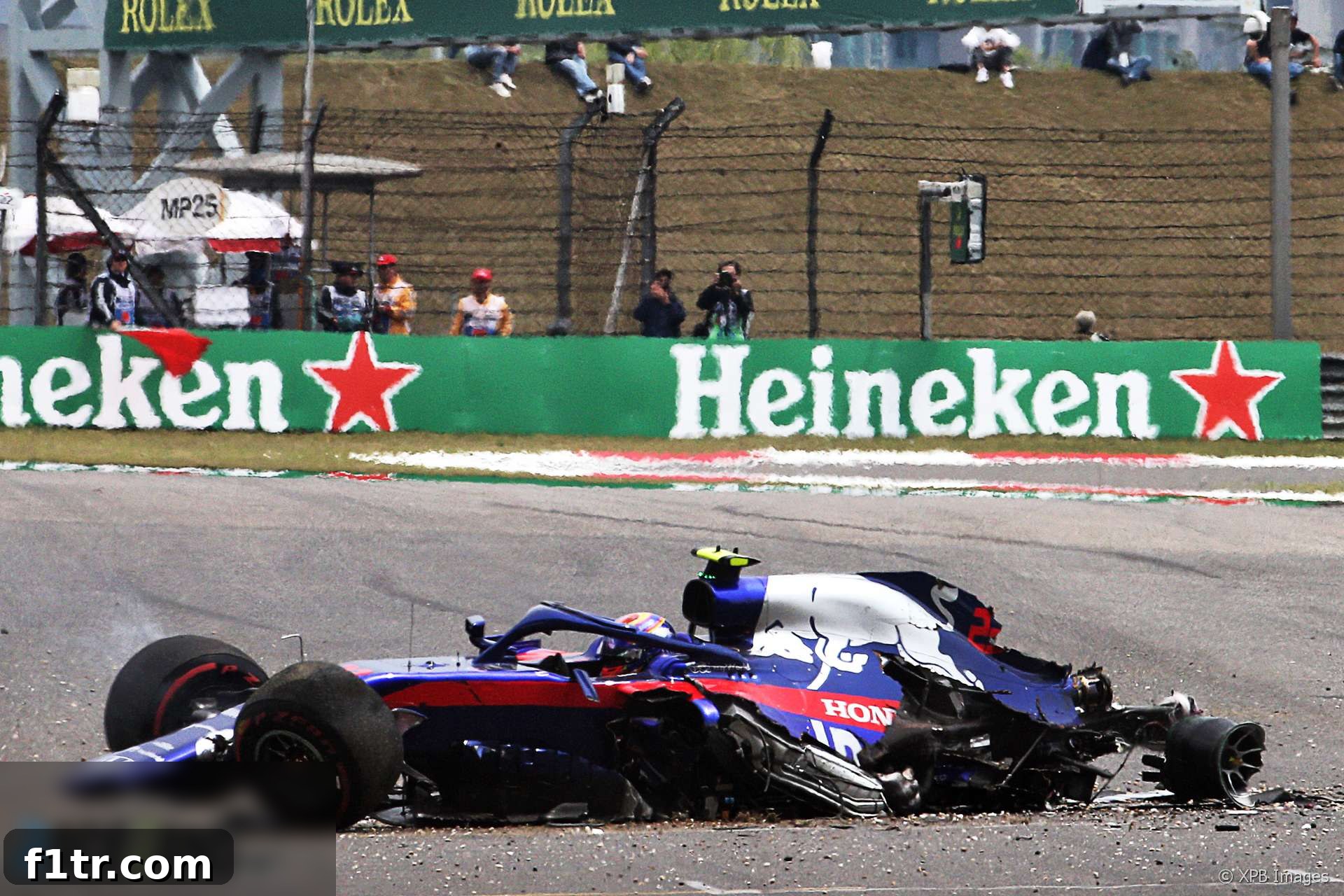
The 2019 Chinese Grand Prix, a milestone event marking the 1000th Formula 1 World Championship race, began with an unexpected and costly setback for rookie driver Alexander Albon. During the crucial final practice session (FP3) ahead of qualifying, the then-Toro Rosso driver suffered a significant crash that not only ruled him out of the subsequent qualifying session but also forced his team into extensive repairs. Albon, demonstrating characteristic honesty and accountability, immediately owned up to the incident, attributing it to being “a bit keen with the right foot.” This admission set the tone for a weekend of recovery and resilience for the young Thai-British talent, highlighting the fine margins and immense pressures faced by drivers at the pinnacle of motorsport.
The incident unfolded dramatically at the very end of the final practice session. As drivers pushed the limits to find crucial tenths of a second on the challenging Shanghai International Circuit, Albon’s STR14 spun out of control. The car careered off the track at the exit of the final corner, Turn 16, making heavy contact with the protective barrier. The impact was severe enough to necessitate immediate medical checks for Albon, who thankfully emerged physically unharmed. However, the visual damage to his Toro Rosso machine was substantial, leaving little doubt about the extensive work required by the mechanics.
Albon’s immediate frustration stemmed not just from the crash itself, but from the promising performance he and the Toro Rosso team had shown throughout FP3. Prior to the incident, the team had demonstrated genuine pace, indicating a strong possibility of challenging for a coveted spot in Q3 – the final segment of qualifying where the fastest ten cars compete for pole position. “I think we showed a bit of our pace in FP3, which is what makes it more frustrating because I think we deserved to be fighting there in Q3,” Albon candidly explained in response to a question from RaceFans. This sentiment underscored the missed opportunity and the personal disappointment of letting a competitive edge slip away due to a driving error.
Recounting the specifics of how he lost control, Albon described the tricky nature of the Astroturf run-off area at the exit of Turn 16. This particular section of the track is often exploited by drivers seeking to carry more entry speed into the corner and shave precious milliseconds off their lap times. “That area of the track, there is lap time there, you can run a bit wide, it just helps you bring that entry speed into the corner,” he elaborated. It was a line he had successfully adopted in previous runs and on the day prior, suggesting a calculated risk that, on this occasion, had gone awry.
The critical moment arrived when Albon applied “a bit too much throttle on the Astro.” Engaging the artificial grass surface with excessive power is notoriously risky, as it significantly reduces grip compared to asphalt. “You always get one snap, it’s quite normal when you get on the Astro over there,” Albon explained, detailing the initial loss of control. However, what followed was a more severe reaction: “But it snapped and then it snapped the other way.” This rapid oscillation, often referred to as a ‘tank-slapper,’ left Albon as a mere passenger in his own car, unable to regain control. “Once you get a tank-slapper you’re kind of a passenger and I was hoping it would snap left to kind of spin me onto the circuit but it went right into the wall,” he painfully recalled, illustrating the helplessness of the situation as the car veered irreversibly towards the barrier.
In the aftermath, Albon reflected on what he could have done differently, admitting a degree of “greedy” driving. His self-assessment revealed a clear learning point for the future: “If I did it differently I would just obviously have backed off once I realised at that point I was losing the car, I’d’ve released the throttle and not finished the lap, just bring it back on track.” While acknowledging the difficulty of making such a split-second decision in the heat of the moment, his words conveyed a deep understanding of the importance of knowing when to concede a lap and prioritize safety and car integrity over marginal gains. This mature perspective highlighted Albon’s burgeoning professionalism and his commitment to continuous improvement, crucial traits for a rookie navigating the cutthroat world of Formula 1.
The implications of the crash extended beyond Albon’s personal disappointment. For the Toro Rosso team, it meant a frantic race against time to prepare a replacement chassis for Sunday’s grand prix. The severity of the impact necessitated replacing the car’s survival cell, the fundamental safety structure designed to protect the driver. This monumental task ensured that Albon’s STR14 would have to pass scrutineering again before the race, a standard procedure for cars undergoing such extensive rebuilds. The sheer scale of the repair job underlined the force of the collision and the robust safety standards implemented in modern F1 machinery.
While the crash meant Albon couldn’t set a time in qualifying, jeopardizing his participation in the main race due to the stringent 107% rule, the stewards showed leniency. This rule dictates that any driver failing to lap within 107% of the fastest time in Q1 is typically not allowed to start the race. However, considering Albon’s demonstrable pace in earlier practice sessions and the unfortunate circumstances of his incident, the stewards granted him permission to start. Similarly, Antonio Giovinazzi, who also faced qualifying challenges, received the same dispensation. This decision was a significant relief for Albon, allowing him the opportunity to salvage his race weekend, albeit from the very back of the grid, presenting a formidable challenge to carve his way through the field.
The 2019 season represented a pivotal year for Alexander Albon, his debut season in Formula 1 with Toro Rosso. Having been brought back into the Red Bull fold after a previous departure from their junior programme, Albon quickly showed impressive speed and adaptability. Prior to the Chinese Grand Prix, he had already begun to turn heads with solid performances and a mature approach that belied his rookie status. This incident in Shanghai, while a momentary setback, became another chapter in his steep learning curve. It offered a harsh but valuable lesson in managing aggression and understanding the limits, both of the car and the track, under competitive pressure. Such experiences are often what forge the resilience and tactical awareness required to succeed at the highest level of motorsport.
The challenge Albon faced on Sunday was immense: starting from the pit lane, he had to navigate the complexities of the Shanghai International Circuit and battle through a competitive field to make any meaningful progress. His ability to recover from such a significant incident, both mentally and physically, would be a testament to his character. For Toro Rosso, the extensive repairs and the need to get their driver back on track demonstrated the unwavering commitment and professionalism of the entire team, working tirelessly against the clock. The Chinese Grand Prix, ultimately, became an early test of Albon’s mettle and his capacity to overcome adversity, shaping his journey through an eventful rookie season that would later see him promoted to the senior Red Bull Racing team.
More from the 2019 F1 Season
- Recalling Key Moments from the 2019 F1 Season
- Team Performances and Financials in the 2019 F1 Championship
- Driver Highlights and Unforgettable Podiums from 2019
- Technical Innovations and Controversies of the 2019 Regulations
- Behind the Scenes: Insights into the 2019 F1 Season
Explore all articles related to the 2019 F1 season