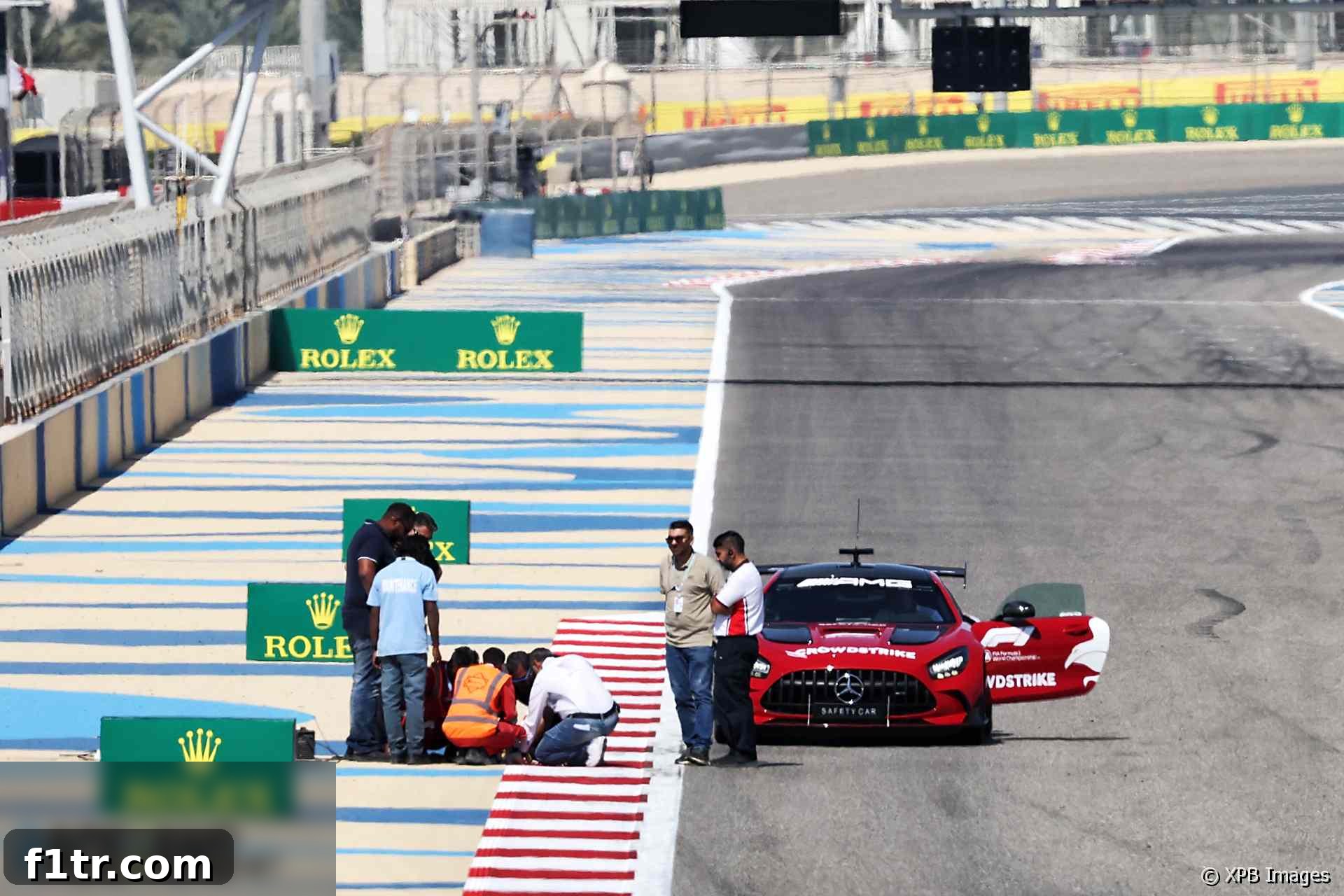
The high-stakes world of Formula 1 pre-season testing was brought to an abrupt halt at the Bahrain International Circuit today, as a seemingly minor piece of track infrastructure caused significant damage to a top contender’s car and sparked renewed concerns over safety protocols. The incident saw Charles Leclerc’s Ferrari sustain damage after striking a loose drain cover, a moment eerily foreshadowed by his teammate, Carlos Sainz Jnr, who was actively attempting to alert marshals to the danger just seconds before the collision.
The morning session, crucial for teams to gather vital data ahead of the new season, was abandoned following the incident. Leclerc’s car, along with Lewis Hamilton’s Mercedes, made contact with the dislodged debris, with the Ferrari bearing the brunt of the impact, suffering damage to its floor. This disruption underscored the razor-thin margins in Formula 1, where even a small oversight can have multi-million-dollar consequences and significantly impede a team’s preparation.
Sainz’s Unsettling Foresight and Frustration
For Carlos Sainz, the scene unfolded with an unsettling sense of déjà vu. The Spaniard had experienced a similar incident just last year when his car struck a broken water valve cover during practice for the Las Vegas Grand Prix. Today, he found himself in a unique and rather frustrating position, witnessing the unfolding danger firsthand. “I was actually standing right in front of the drain cover when it came out, because I went on track to see,” Sainz recounted to the official Formula 1 channel, his words reflecting a blend of shock and a deep understanding of the potential peril.
Sainz’s immediate concern stemmed from the realisation that the marshals positioned near Turn 11 had not yet noticed that the drain cover had worked loose from its position on the kerb. With his past experience vividly in mind, he moved swiftly to warn them, acutely aware of the imminent danger to any approaching car. “I was looking at it [thinking] ‘yellow flag it, yellow flag it, yellow flag it, someone’s going to take it!'” he vividly described. His urgent internal plea, however, came too late. “Boom, my team mate came and took it.” The sound of Leclerc’s car striking the cover, just as Sainz was about to convey his warning, must have been a profoundly frustrating moment for the Ferrari driver.
The Spaniard expressed a poignant sense of personal responsibility, even though the incident was entirely beyond his control. “So, I felt like it could have been avoided in a way. I missed it by one lap because I went to speak to a marshal and just when I was speaking to him, ‘yellow flag it…’ So I feel a bit to blame.” This sentiment highlights not only Sainz’s dedication to safety but also the intense pressure and the split-second nature of decision-making that characterises Formula 1, even for those observing from the sidelines.
Immediate Aftermath and Ferrari’s Recovery Efforts
The damage sustained by Leclerc’s Ferrari required immediate attention. The team quickly set about fitting a spare floor to the car, a process that consumed valuable testing time. Meanwhile, extensive repairs were undertaken on the track surface at the Bahrain International Circuit to ensure the integrity of the racing line. The interruption led to an early lunch break for all teams, providing the circuit staff with the necessary window to rectify the issue.
Originally, Sainz was scheduled to take over the car for the afternoon session. However, due to the lost morning running and the need to maximise track time, Leclerc remained in the cockpit for the first hour after running resumed ahead of schedule. Subsequently, Sainz took over the driving duties, completing the final four hours of the day’s session. This alteration to the planned schedule, while necessary, inevitably impacts a team’s meticulously organised testing programme, potentially leading to compromises in data collection and component evaluation.
Recurring Safety Concerns: Echoes of Las Vegas
This incident in Bahrain is not an isolated occurrence but rather a troubling echo of past safety concerns regarding track infrastructure. The Las Vegas Grand Prix in 2023 saw Carlos Sainz Jnr’s car severely damaged after hitting a loose water valve cover during practice. That incident, which resulted in significant repair costs and penalties for Ferrari, led to strong criticisms from the team. Ferrari team principal Frederic Vasseur openly voiced his frustration at the time, stating that marshals were “too slow to red-flag the session” after the initial damage to the track surface was spotted.
The recurrence of such an issue, particularly involving a drain cover, raises serious questions about the ongoing vigilance and inspection protocols at Formula 1 circuits worldwide. These incidents, while rare, underscore the immense forces exerted by F1 cars, which can exploit any weakness in track infrastructure. The high speeds and downforce generated by these machines can literally lift or dislodge components that would remain secure under normal conditions. The fact that two separate incidents, both involving Ferrari cars and related to loose track elements, have occurred within a relatively short period highlights a systemic challenge that needs rigorous examination by the FIA and circuit organisers.
The Critical Importance of Pre-Season Testing
Pre-season testing is an absolutely vital phase for Formula 1 teams. It is their only opportunity to run their new cars extensively, gather real-world data, validate simulations, and identify any unforeseen issues before the competitive season begins. Every hour of track time is meticulously planned and invaluable. Lost running, such as that caused by the drain cover incident, can have profound implications, setting a team back in their development schedule and potentially impacting their performance in the early races of the championship.
For Ferrari, a team striving to close the gap to their rivals and mount a stronger championship challenge, the disruption was particularly unwelcome. The intricate dance of evaluating new components, fine-tuning setups, and allowing both drivers ample time to acclimatise to the new machinery is delicate. Incidents like these not only cost time but also financial resources, as damaged parts must be replaced, often with spare components that are themselves costly and finite during the testing phase.
Ensuring Future Safety and Vigilance
The Bahrain incident serves as a stark reminder that while Formula 1 pushes the boundaries of engineering and human performance, the fundamental safety of its participants relies on robust and foolproof track infrastructure. Circuit designers, constructors, and event organisers are tasked with ensuring that every inch of the track, from the racing line to the kerbs and runoff areas, can withstand the immense stresses of Grand Prix racing.
Following such incidents, thorough investigations are typically conducted by the FIA and the respective circuit to determine the root cause of the failure. This includes reviewing construction methods, inspection schedules, and the efficacy of safety protocols. The role of marshals, as the first line of defence on track, is also paramount. Their training, communication systems, and reaction times are continuously evaluated and refined to minimise risks. While the marshals are volunteers and perform an invaluable service, these incidents highlight the absolute necessity for rapid detection and response to potential hazards, especially given the blistering speeds of modern F1 cars.
As Formula 1 continues to expand globally and races at an increasing number of venues, maintaining consistently high standards of track safety becomes an even greater logistical and operational challenge. The Bahrain incident, like its predecessor in Las Vegas, will undoubtedly trigger further discussions within the sport about how to prevent such occurrences and ensure that the integrity of the track surface is absolute, allowing drivers to push to the limits without fear of unforeseen dangers from below the tarmac.
Formula 1 Insights & Updates
- One of F1’s greatest races happened 15 years ago today. Or did it?
- “Overtaking is overtaking”: Domenicali denies F1’s yo-yo racing is “artificial”
- The crashes F1 is trying to prevent may be rare – but the danger is obvious
- F1 returning to India soon after 2027 sounds like wishful thinking
- Verstappen loathes F1’s new generation of cars – but what do his rivals reckon?
Browse all Formula 1 articles