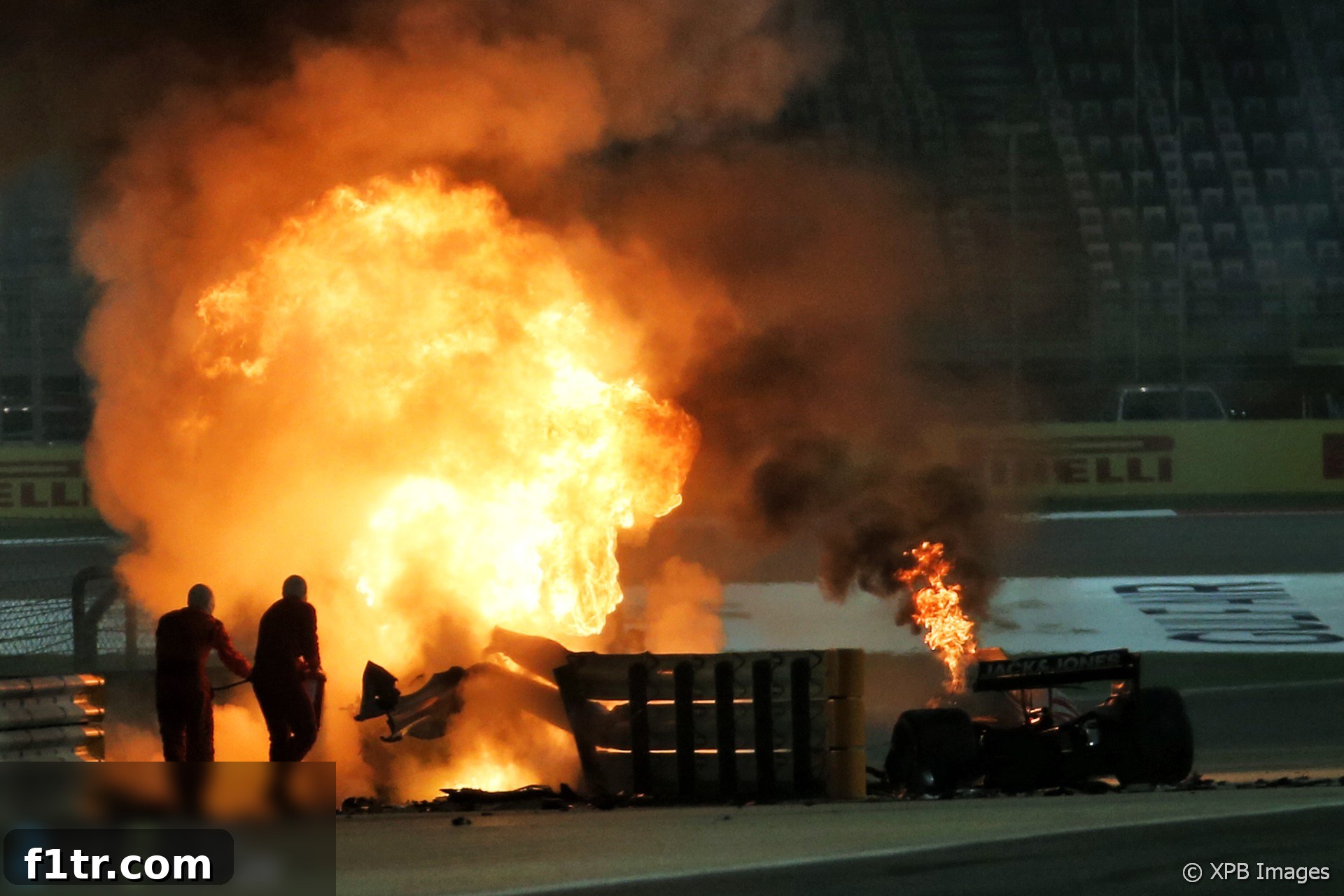
The harrowing events of the 2020 Bahrain Grand Prix left an indelible mark on the world of Formula 1. Romain Grosjean’s horrific crash, a fiery spectacle that saw his Haas car split in two and engulfed in flames, served as a stark reminder of the inherent dangers of motorsport. While the miraculous escape of the French driver was a testament to modern F1 safety, the subsequent handling of the incident’s broadcast by Formula 1 itself ignited a significant debate among drivers and fans alike. Among the most vocal critics were Sebastian Vettel and Daniel Ricciardo, who both expressed strong disapproval of the repeated replays of the terrifying accident.
The incident unfolded on the opening lap, a high-speed collision that propelled Grosjean’s car into the barrier, resulting in an immediate and massive fireball. For 28 agonizing seconds, Grosjean was trapped within the inferno before bravely extracting himself, aided by the swift response of medical and marshaling teams. Footage of this incredible escape and the devastating impact was replayed numerous times during the race suspension. Crucially, these replays were not shown until it was confirmed that Grosjean had emerged from the wreckage without life-threatening injuries, a policy F1 implemented to avoid distressing viewers unnecessarily.
Sebastian Vettel’s Stance: Prioritizing the Human Element Over Spectacle
Four-time world champion Sebastian Vettel, then driving for Ferrari, revealed his personal reaction to the broadcast. He candidly admitted that he actively chose to stop watching the continuous replays being shown on screens around the circuit.
“Once I got the message he was out of the car, obviously that was a big relief,” Vettel stated, reflecting on the initial wave of anxiety that swept through the paddock. “Then I didn’t look at the images too much. I went to my room and just waited to get ready again, which I guess was a good thing.”
Vettel’s discomfort went beyond his personal viewing preference; he fundamentally disagreed with the editorial decision to repeatedly air the footage. His critique was rooted in a profound respect for the humanity of the drivers and the stark reality of their profession.
“I disagree with the fact that you have to show the images over and over again. In the end, we are human beings racing and not objects,” Vettel asserted. His powerful statement underscored a crucial point: while Formula 1 is a global spectacle, the individuals behind the wheel are flesh and blood, susceptible to immense physical and psychological trauma. He challenged the perceived public appetite for such dramatic visuals, drawing a clear distinction between what might be considered “exciting” from a distance and the terrifying reality experienced by the driver.
“I know that people like the car being on fire and crashes and it’s exciting but actually it’s not exciting when you’re in the car,” he elaborated, highlighting the disconnect. “Maybe it’s something we can learn as well, that we don’t need to repeat showing the images.” Vettel’s appeal was not just a personal sentiment but a call for Formula 1’s broadcast team to exercise greater sensitivity and discretion, considering the impact on everyone involved, from the drivers to their families and team personnel.
Daniel Ricciardo and the Collective Driver Concern
Sebastian Vettel was not alone in his condemnation. Daniel Ricciardo, an outspoken and popular figure in the paddock, was equally critical, expressing his disgust at the repetitive nature of the replays. Ricciardo’s comments, made immediately after the race, reflected a broader sentiment among the drivers, many of whom found the constant re-airing of such a horrific incident insensitive and unnecessary, particularly while they were still processing the initial shock and preparing to get back into their own cars.
The collective concern among drivers highlights an important ethical dilemma for sports broadcasters: how to balance the need to report significant events with the responsibility to protect the well-being and privacy of the athletes. While F1’s policy of waiting for confirmation of driver safety before showing replays is a step in the right direction, the sheer volume and repetition of those replays raised questions about exploitation of trauma for entertainment value.
The Paradox of Returning to the Cockpit
Despite the harrowing nature of the crash and his strong feelings about the replays, Vettel also reflected on the immediate psychological challenge of returning to competition. Interestingly, he found a paradoxical comfort in getting back into the car relatively quickly.
“Of course, you are human and we love what we do and that comes first,” Vettel said in response to a question from RaceFans. “But even if you respect what you do, then you probably still underestimate what can happen. I don’t think anybody expected that type of accident today.”
The shock of Grosjean’s crash was profound because of its rarity in modern F1, where safety standards have advanced dramatically. Such a fiery, high-impact incident felt like a relic from a more dangerous era. Yet, for drivers, dwelling on such events can be counterproductive to their focus and performance.
“So it was a bit weird but ultimately I guess it was the best to get straight back in the car and not wait for a week and think too much,” Vettel concluded. This speaks to the unique psychological makeup of Formula 1 drivers, who must compartmentalize risk and focus intensely on the task at hand. The best way to overcome fear or apprehension, for some, is to confront it head-on, to get back behind the wheel and re-establish the familiar rhythm of racing, rather than allowing the mind to linger on potential dangers.
Broader Implications: Safety, Ethics, and Fan Engagement
The Grosjean crash and the subsequent debate over its broadcast transcended individual opinions, touching upon fundamental aspects of Formula 1: safety, broadcast ethics, and the nature of fan engagement. On the one hand, the incident undeniably showcased the incredible advancements in F1 safety, particularly the life-saving ‘Halo’ device, which was instrumental in protecting Grosjean’s head. The integrity of the chassis, the swift deployment of medical personnel, and the fire suppression systems all worked in concert to avert a far greater tragedy.
On the other hand, the discussion around replays highlighted the ongoing tension between F1’s desire to be a thrilling spectacle and its responsibility to its athletes. While crashes are an undeniable, albeit unwelcome, part of motorsport, the manner in which they are presented to a global audience can significantly shape public perception and impact those directly involved. Sensationalizing accidents, even those with positive outcomes, risks trivializing the genuine dangers drivers face and diminishing the extraordinary skill and courage required to compete at the highest level.
Moving forward, F1’s leadership and broadcasters face the challenge of finding a more nuanced approach. This involves informing the audience effectively about the drama and intensity of the sport, including significant incidents, while simultaneously upholding the dignity and well-being of its participants. The feedback from seasoned drivers like Vettel and Ricciardo serves as a powerful reminder that while the show must go on, it should never overshadow the human element at the very heart of the sport.
2020 Bahrain Grand Prix Related Articles
- Grosjean reunited with helmet which saved him from huge fire in 2020 Bahrain crash
- Pictures: Wrecked chassis from Grosjean’s Bahrain fireball crash to go on display
- Grosjean reveals extent of burns to right hand
- ‘I put both my hands in the fire’: Grosjean describes his 28 seconds trapped in an inferno
- “Thank you for saving my life” Grosjean tells crash scene marshals
Browse all 2020 Bahrain Grand Prix articles