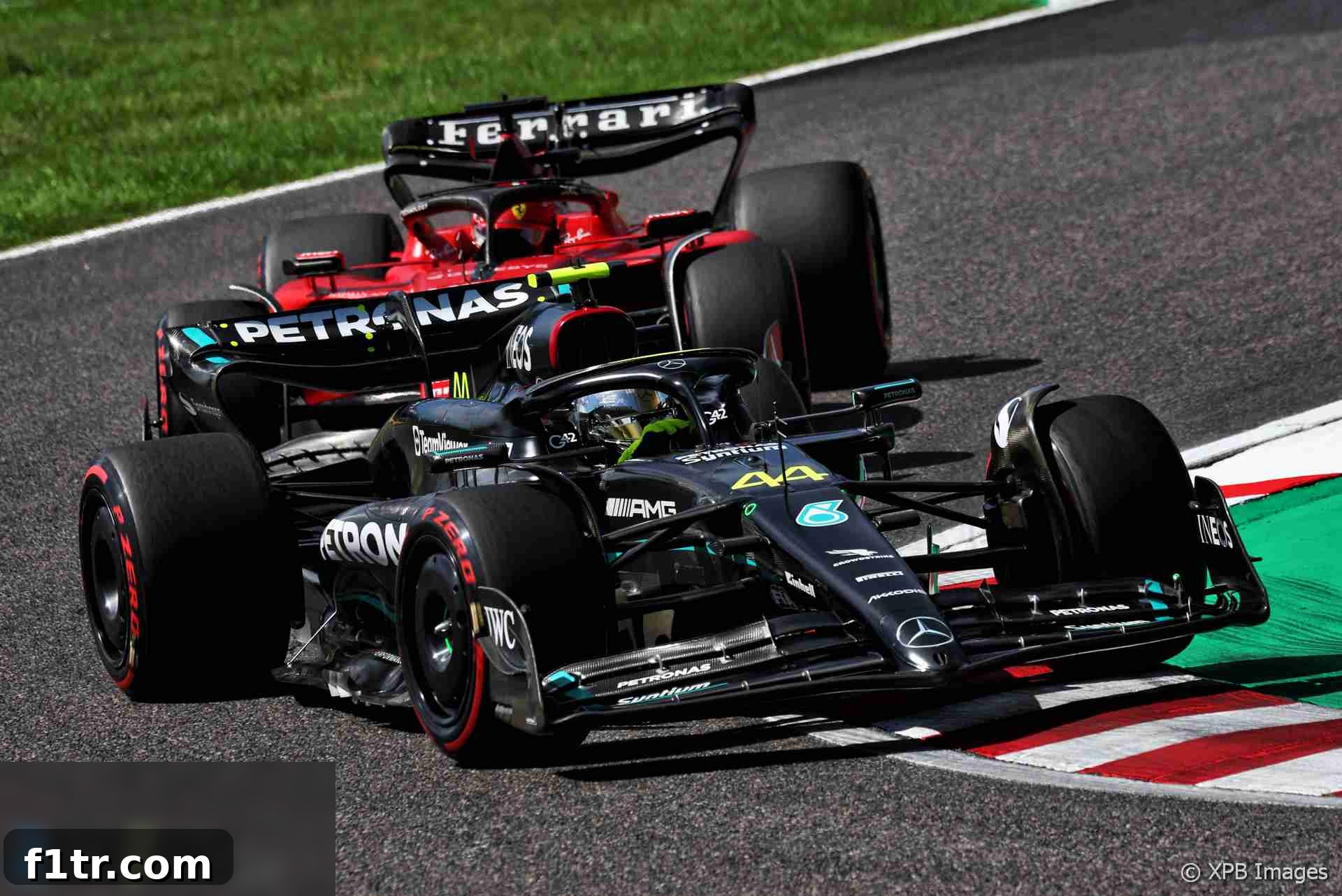
Lewis Hamilton has voiced significant concerns regarding Mercedes’ ability to bridge the performance gap with Red Bull before the commencement of the next Formula 1 season. Following a qualifying session for the Japanese Grand Prix where he lagged over a second behind the dominant Red Bull car, Hamilton’s apprehension underscores a fundamental challenge facing the Silver Arrows.
Max Verstappen demonstrated Red Bull’s formidable pace by securing pole position, lapping half a second quicker than any other competitor. Hamilton, qualifying in a distant seventh, finished 1.031 seconds adrift of the Dutch driver’s benchmark. This stark difference in performance at Suzuka, a circuit renowned for its demanding high-speed corners, highlights a persistent issue for Mercedes throughout the 2023 season.
Despite a challenging Friday practice session, where Hamilton found himself a lowly 14th, the Mercedes team managed to make notable progress overnight. Hamilton expressed satisfaction with the car’s feel on Saturday, indicating effective adjustments. However, this improvement, while welcome, proved insufficient to bring them into contention with Red Bull’s blistering speed.
“Yesterday was horrendous, but we made some good changes overnight, and the car was feeling really good today, so I was much happier with it,” Hamilton disclosed to the official F1 website. “Just unfortunately, we’re not quick enough.” His words reflect a frustrating reality for a team accustomed to championship contention, now struggling to consistently challenge for race victories.
Mercedes’ Fundamental Weakness: The Rear Downforce Deficit
Hamilton pinpointed a specific area of critical weakness for Mercedes: a significant deficit in rear downforce. This deficiency, he explained, is particularly evident in the high-speed first sector of circuits like Suzuka. “We’re a long way away on rear downforce, so that’s why we’re so slow in the first sector. But the laps felt really good,” he added, emphasizing that his driving felt strong despite the car’s inherent limitations.
The seven-time world champion’s observations reveal that Mercedes’ car concept struggles to generate sufficient downforce at the rear, especially when compared to rivals like Red Bull. This imbalance means the car lacks stability and grip through fast corners, forcing drivers to manage the throttle and steering more conservatively, inevitably losing precious tenths of a second. In the ultra-competitive world of Formula 1, such margins dictate success or failure.
“In qualifying I was giving it everything, but that seven-tenths deficit that we have in sector one is all rear end,” Hamilton elaborated in an interview with Sky Sports. “Our car has loads of load on the front and not as much as we need on the rear. And so we’re a long way down on that.” This detailed breakdown clarifies that the W14, Mercedes’ 2023 challenger, possesses an aerodynamic philosophy that prioritizes front-end grip, potentially at the expense of rear stability. While a strong front end can be beneficial in certain low-speed scenarios, it becomes a liability on high-speed tracks where overall aerodynamic efficiency and balanced downforce are paramount.
“Crazy” Gap: Doubts for the 2024 Season
The sheer scale of the performance gap has instilled a sense of worry within Hamilton about Mercedes’ prospects for the upcoming 2024 season. “We’re one second away,” he stated with palpable concern. “It’s like, crazy. To close that gap before next year, at this point to still be a second down on a track like this is definitely worrying for us as a team.”
A one-second deficit in Formula 1 is colossal, representing a significant challenge that typically requires fundamental design changes rather than incremental upgrades. For a team of Mercedes’ caliber, renowned for its engineering prowess and strategic acumen, such a performance disparity is not only unexpected but also deeply concerning. It suggests that the problem extends beyond minor tuning adjustments and points to a more ingrained issue with the car’s fundamental aerodynamic concept.
Hamilton firmly believes this is a “concept” issue, not merely a setup problem. “For me, that’s clearly concept. For me it’s 100% clear that it’s concept and we’ve got to make sure we change that for next year, which hopefully we will,” he asserted. This strong conviction implies that Mercedes may need to rethink its entire design philosophy for the 2024 car, the W15, moving away from the “zero-pod” or low-sidepod approach that characterized the W13 and W14, and potentially adopting principles closer to those employed by Red Bull.
Learning from Rivals: Aston Martin and McLaren’s Progress
The challenging situation for Mercedes is further highlighted by the progress made by other teams on the grid. Hamilton cited Aston Martin and McLaren as examples of teams that have demonstrated significant leaps in performance. “There’s a steep gap that we have to close for next year, but you’ve seen what the Astons did coming into this year, so they can make big steps. We’ve seen what the McLaren have done this year by going down the Red Bull route, they’re now ahead of us here on a track like this.”
Aston Martin, powered by Mercedes engines, surprised many by starting the 2023 season as the closest challenger to Red Bull, making a dramatic improvement from their 2022 performance. Similarly, McLaren, after a difficult start, introduced substantial upgrades mid-season that propelled them forward, consistently challenging for podiums and even victories. Crucially, both teams have been observed to adopt design philosophies that bear a striking resemblance to elements of Red Bull’s highly successful car. This suggests that the “Red Bull route,” characterized by specific aerodynamic concepts, particularly around the sidepods and floor, is currently the most effective path to performance in the current regulatory era.
For Mercedes, this presents a double-edged sword. On one hand, it offers proof that significant gains are possible within the current regulations. On the other, it underscores the urgency for Mercedes to fundamentally alter its approach and potentially abandon its own distinct design philosophy that has not yielded the desired results. The challenge for Mercedes is not just to replicate the visible aspects of Red Bull’s design but to understand and integrate the underlying aerodynamic principles that make it so effective, all while adhering to the budget cap and development timelines.
The Road Ahead for Mercedes-AMG F1
The task facing Mercedes-AMG F1 is monumental. Closing a one-second deficit to the sport’s current benchmark team, Red Bull Racing, requires an exhaustive effort across all departments. It involves not just aerodynamicists and engineers but also strategic leadership from figures like Toto Wolff and technical direction from James Allison, who recently returned to a more hands-on technical role.
The stability of the technical regulations for 2024 offers a glimmer of hope, as teams can carry over much of their development and apply lessons learned from the current season. However, simply evolving the current car concept, which Hamilton identifies as flawed, will likely not be enough. A more radical departure might be necessary, one that involves significant redesigns of key components, particularly the rear-end aero package.
The competitive landscape of Formula 1 is unforgiving. While Mercedes enjoyed an unprecedented era of dominance for eight consecutive seasons, the shift in regulations in 2022 fundamentally altered the pecking order. The team’s initial interpretation of the ground-effect era regulations proved suboptimal, leading to a car that suffered from porpoising and, as Hamilton points out, a fundamental lack of balanced downforce. The subsequent struggle to unlock consistent performance has been a source of frustration for both drivers and fans.
For Lewis Hamilton, a driver whose career has been defined by championship battles, the prospect of another season starting a second behind the leaders is profoundly challenging. His contract extension with Mercedes signals his continued faith in the team, but it also places immense pressure on the Brackley-based outfit to deliver a competitive package for 2024. The upcoming months will be crucial for Mercedes as they race against time, not only on track but also in the design and development departments, to ensure their next challenger can truly contend for victories and bring them back into the fight for the world championship.
Related Formula 1 Insights:
- Norris: Red Bull’s dominance down to ‘small things which make a big difference’
- Mercedes must halve deficit to Red Bull before 2024 season starts – Hamilton
- Mercedes expect “tight” fight for second in championship after Ferrari gains
- Norris breaks Hulkenberg’s record for most points without a win in F1
- Transcript: What Alonso really meant by being “thrown to the lions” at Suzuka
Browse all 2023 Japanese Grand Prix articles