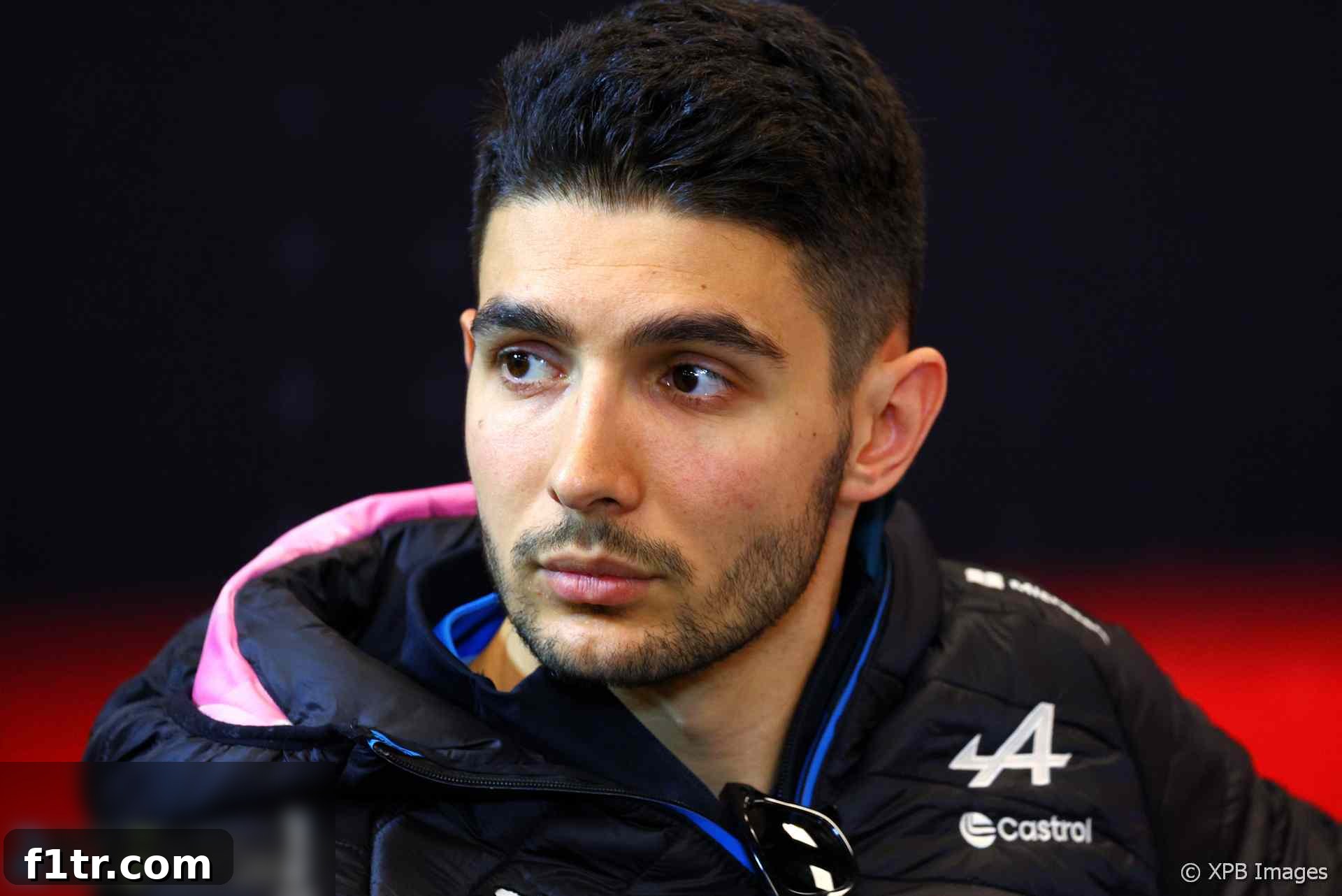
Esteban Ocon’s Alpine Exit: Unpacking the Future of a F1 Talent
The Formula 1 paddock is abuzz with speculation following the announcement that Esteban Ocon will conclude his five-season tenure with Alpine at the end of the current championship. Ocon himself has stated that news regarding his next career move “will be announced in due course,” a statement that only fuels the intense interest in the competitive driver market. This development, confirmed by Alpine just eight days after a controversial collision between Ocon and his teammate Pierre Gasly at the Monaco Grand Prix, has cast a long shadow over the French team’s already challenging season.
While Alpine’s official statement on Monday was careful to assert that driver and team “have agreed together to part ways,” avoiding any direct link to the Monaco incident, it’s not difficult to infer a deeper dissatisfaction from both sides. The collision, which saw Ocon attempt an aggressive overtake on Gasly, leading to significant damage for both cars and Ocon’s eventual retirement, drew a sharp rebuke from team principal Bruno Famin, who publicly warned of “consequences.” This public dressing-down certainly intensified the scrutiny around Ocon’s future, even if the groundwork for his departure had likely been laid long before.
Advert | Become a Supporter & go ad-free
Alpine’s Tumultuous Journey: A Decline in Performance and Shifting Ambitions
Esteban Ocon joined the Enstone-based outfit in 2020, back when it still competed under the iconic Renault banner. At that time, the team was a regular points contender, consistently battling in the midfield and occasionally challenging for stronger results. Ocon’s arrival marked the fifth season since Renault’s return as a full manufacturer team, signaling a clear ambition for climbing the constructors’ standings. However, in 2021, a strategic rebranding saw the team transform into Alpine, bringing with it a revised vision and a new set of objectives.
The initial ‘five-year plan’ for success was swiftly replaced by an ambitious ‘100-race plan’ under the Alpine identity. This weekend’s Canadian Grand Prix marks the 75th event since that rebrand, yet the team has little to celebrate in terms of substantial progress. While Alpine initially showed promising signs, notably with Ocon’s memorable, albeit fortuitous, victory at the 2021 Hungarian Grand Prix, and a solid fourth-place finish in the constructors’ championship in 2022, the trajectory has since taken a steep downturn.
Managerial Turmoil and Technical Exodus
The 2022 season, which saw Otmar Szafnauer take charge (a figure Ocon knew well from their time at Force India), appeared to be a step in the right direction. However, this momentum proved unsustainable. In 2023, Alpine failed to build on its P4 success, instead regressing to sixth in the championship, significantly outpaced by the resurgent McLaren and Aston Martin teams. This period was marked by a series of unsettling managerial changes. Alpine CEO Laurent Rossi, who had openly criticized the team’s performance after a poor showing in Baku earlier in the year, was replaced by Bruno Famin.
Famin, in turn, ushered Szafnauer out the door after a mere year and a half in the role, followed swiftly by long-standing sporting director Alan Permane. The turmoil didn’t stop there. The technical division has since suffered a major exodus of talent. Chief Technical Officer Pat Fry departed for Williams around the same time as Szafnauer. Following the A524 car’s uncompetitive debut at the season-opener, Technical Director Matt Harman and Head of Aerodynamics Dirk de Beer also left the team. Adding to the brain drain, another long-serving team member, Rob White, departed just last week.
Advert | Become a RaceFans supporter andgo ad-free
Such significant and rapid personnel changes, especially within key leadership and technical roles, inevitably destabilize a Formula 1 team. The impact is clearly visible on track, where Ocon and Gasly have collectively amassed a paltry two points so far this season, a stark contrast to the 44 points they had at this stage last year. Only the point-less Sauber team currently sits beneath Alpine in the constructors’ standings, highlighting the depth of their current crisis. This steep decline from being a solid midfield contender to battling at the back of the grid certainly created an environment where mutual dissatisfaction between a competitive driver and his struggling team was almost inevitable.
The Monaco Incident: A Catalyst for Change?
Whispers about Ocon exploring options for the 2025 season had been circulating well before the Monaco Grand Prix. However, that fateful race brought the underlying tensions to a head, vividly illustrating why Alpine might be actively seeking a change in its driver line-up. Ocon’s on-track incident with Gasly, his teammate, was not an isolated event but rather played into an existing narrative about his aggressive and uncompromising approach.
Esteban Ocon’s Driving Style and Reputation
Esteban Ocon is undeniably a fast and committed driver. His sheer determination was powerfully demonstrated in last year’s grueling race at Losail, where he famously threw up in his car on his way to a hard-fought seventh place, showcasing an iron will to perform under extreme conditions. Yet, for all his evident strengths, Ocon has also cultivated a reputation for being overly uncompromising with his teammates, a perception that could prove detrimental to his career prospects.
This reputation was notably forged during his time at Force India, where he frequently clashed with his then-teammate, Sergio Perez. Their on-track battles were intense and often bordered on reckless, with both drivers giving as good as they got. At times, it seemed Ocon’s improving speed and assertiveness were becoming a handful for the more experienced Perez. The pairing ultimately dissolved when Lance Stroll’s father acquired the team, placing his son alongside Perez – a decision that garnered much sympathy for Ocon at the time, despite his good relationship with his replacement.
Now, as Ocon faces an uncertain future, the question for prospective team principals is two-fold: are they sufficiently convinced of his potential as a driver, and equally importantly, are they convinced of his ability to be a cohesive team player? Ocon himself appeared sensitive to this public perception when he issued a statement last Friday – almost certainly aware of Alpine’s decision – emphasizing that he has “always followed the instructions I have been given and raced to achieve the maximum for and with my team.” This carefully worded defense highlights the critical importance of a driver’s image beyond raw speed in the cutthroat world of Formula 1.
Advert | Become a RaceFans supporter andgo ad-free
Mercedes’ Influence: Ocon’s Past and Potential Future
A pivotal player in Ocon’s career trajectory has consistently been Mercedes. The German manufacturer has repeatedly stepped in to aid Ocon when he found himself at a career crossroads. The first instance was at the end of 2014, after he clinched the European Formula 3 title but lost crucial backing from his management program. Mercedes again intervened following his unfortunate ejection from Force India at the close of the 2018 season, ensuring he remained within the F1 ecosystem, albeit initially as a reserve driver.
The burning question now is whether Mercedes will once again find a suitable role for him in 2025. A coveted seat at the top Mercedes team appears highly unlikely, as the Silver Arrows are reportedly giving serious consideration to their promising Formula 2 junior, Andrea Kimi Antonelli, for a future drive. It’s a hard truth Ocon might have to confront: on past occasions, when Mercedes needed to replace drivers like Valtteri Bottas or even Nico Rosberg, they ultimately looked elsewhere. If Ocon ends his career without ever having the opportunity to race for Mercedes, he will likely reflect that it was at least partly because his performances elsewhere, despite their flashes of brilliance, weren’t consistently impressive enough to warrant a main team drive.
Exploring Ocon’s Options for 2025: Where Next?
Given the limited options within Mercedes’ customer teams, Ocon’s choices are constrained. McLaren’s driver lineup is currently full and secure, as is Aston Martin’s for the foreseeable future, assuming Lance Stroll opts to continue driving. This leaves Williams as potentially Ocon’s most viable and attractive option. At Williams, Logan Sargeant’s place is widely acknowledged to be under significant threat due to inconsistent performances. Williams has shown signs of revival under the leadership of Team Principal James Vowles, making it a more appealing prospect than it might have been in previous years.
Ocon’s relationship with Williams is also relevant, having worked with Pat Fry, Williams’ current CTO, at Alpine. This familiarity could ease his transition. The opportunity at Williams would allow Ocon to demonstrate his capabilities in a potentially less pressurized environment than Alpine has become, and with a team that is actively rebuilding and seeking experienced talent alongside Alex Albon. However, even a move to Williams is not guaranteed, with other drivers also vying for the limited seats available on the grid.
The Road Ahead: Ocon’s F1 Future Hangs in the Balance
The current situation mirrors a challenging period in Ocon’s career five years ago. In 2019, he found himself on the sidelines, facing a season without a drive, before Mercedes ultimately guided him to his current team. He vividly recounted that experience earlier this year, describing how he wept in a car park at the Melbourne circuit as the 2019 season began without him, a deeply emotional moment that underscored the fragility of an F1 career.
As the 2024 season progresses, the unsettling question looms: will Esteban Ocon face a painful repeat of that scenario at the beginning of next year? His career, once again, appears to be significantly influenced, if not ultimately decided, by the choices and interventions of Mercedes team principal Toto Wolff. While Ocon has proven his speed and resilience, his future in Formula 1 will depend on how potential employers weigh his talent against his track record regarding teammate relations, and whether there is a suitable seat available where he can thrive and contribute positively to a team’s long-term ambitions.
Become a RaceFans Supporter
RaceFans is run thanks in part to the generous support of its readers. By contributing £1 per month or £12 per year (or the same in whichever currency you use) you can help cover the costs of creating, hosting and developing RaceFans today and in the future.
Become a RaceFans Supporter today and browse the site ad-free. Sign up or find out more via the links below:
- Become a RaceFans Supporter
- RaceFans Supporter FAQ
Advert | Become a RaceFans supporter andgo ad-free
Related Formula 1 Articles
- One of F1’s greatest races happened 15 years ago today. Or did it?
- “Overtaking is overtaking”: Domenicali denies F1’s yo-yo racing is “artificial”
- The crashes F1 is trying to prevent may be rare – but the danger is obvious
- F1 returning to India soon after 2027 sounds like wishful thinking
- Verstappen loathes F1’s new generation of cars – but what do his rivals reckon?
Browse all Formula 1 articles