Bottas Masters Sochi Autodrom in Eventful 2020 Russian Grand Prix First Practice
The 2020 Formula 1 Russian Grand Prix weekend at the Sochi Autodrom kicked off with a dramatic and unexpected first practice session, seeing Valtteri Bottas comfortably set the fastest lap. However, the session was equally defined by the surprising struggles of his Mercedes teammate, Lewis Hamilton, who finished an uncharacteristic 19th, and two significant crashes involving Carlos Sainz Jr. and Nicholas Latifi. The 90-minute run provided a glimpse into the teams’ preparations for the race, amidst a mix of promising upgrades and frustrating incidents.
From the outset, the session was marked by an immediate flurry of activity, a contrast to the slower starts observed in recent Monza and Mugello practices. Teams wasted no time hitting the track, many keen to evaluate new aerodynamic packages. McLaren, in particular, was testing an evolved “nosebox” design, building on their Mugello update, while Racing Point introduced new parts for Lance Stroll’s car. This early eagerness hinted at a highly competitive weekend, with teams pushing hard to gain an edge.
Valtteri Bottas Sets the Pace with Confidence
Mercedes driver Valtteri Bottas quickly established himself as the benchmark, demonstrating strong pace and consistency throughout the session. Despite the ‘green’ nature of the track – meaning low grip due to a lack of rubber laid down – Bottas adapted swiftly, eventually topping the timings with a 1’34.923. His performance on both the medium and harder compound tyres showcased the W11’s inherent speed and Bottas’s comfort with the circuit. This strong start bodes well for his weekend, positioning him as a strong contender for pole position and a potential race win. His ability to extract performance early on highlighted Mercedes’ formidable package, even as other teams grappled with the challenging conditions.
Hamilton’s Uncharacteristic Struggle and Setbacks
In stark contrast to his teammate’s commanding performance, Lewis Hamilton endured a remarkably subdued session, finishing 19th among the 19 drivers who set a time. His difficulties began early when a lock-up led to a significant flat-spot on his front-left tyre, forcing him back to the pits for a replacement. This incident severely limited his running, especially on the hard compound tyres, which were the only ones he managed to set a representative time on. Furthermore, his attempt to clock a faster lap on soft tyres was interrupted by the Virtual Safety Car (VSC) period triggered by Carlos Sainz Jr.’s crash. The combination of these setbacks meant Hamilton couldn’t find a rhythm or extract the typical performance from his Mercedes, leaving him with a significant amount of work to do ahead of the subsequent practice sessions to recover his usual pace and confidence at the Sochi Autodrom.
Dramatic Crashes Disrupt the Session
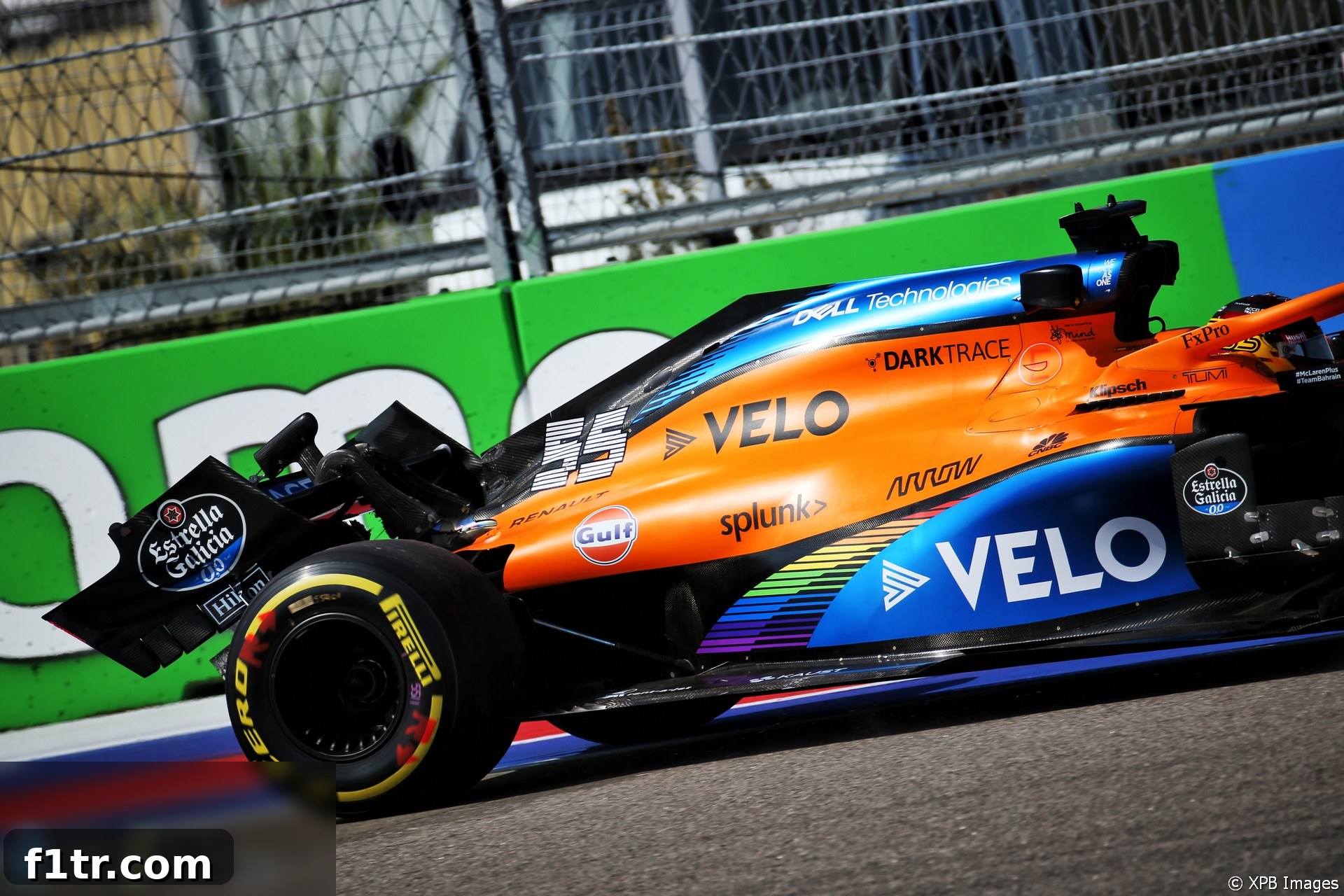
The practice session was punctuated by two separate and costly crashes, both occurring at the demanding Turn 7. First, Carlos Sainz Jr.’s McLaren MCL35 slid backwards into the barriers, causing substantial damage to both the rear wing and the car’s rear structure. Although Sainz managed to limp back to the pits, under strict instructions from his engineer to proceed as slowly as possible due to the damage, the incident effectively ended his session after only half an hour of running. This was a significant blow for McLaren, as it prevented them from gathering crucial data on their newly introduced “nosebox” upgrade. The team was unable to repair the car before the session concluded, highlighting the severity of the impact.
Later in the session, Nicholas Latifi suffered an even heavier shunt in almost the same spot. While drivers had been warned about crosswinds affecting Turns 10 and 13, both Sainz and Latifi’s incidents appeared to be a loss of rear grip in the 90-degree Turn 7 corner. Latifi’s Williams FW43 crashed side-on into the barrier, with the left side of his car heavily crumpled into the tyre barriers. This necessitated a brief red flag period to safely retrieve the extensively damaged Williams. These crashes underscored the treacherous nature of Turn 7, demanding precision and careful throttle application, especially on a relatively ‘green’ track surface with evolving grip levels. The incidents will undoubtedly prompt teams to analyse telemetry and advise their drivers on how best to approach this tricky corner in future sessions.
Midfield Action and Other Noteworthy Performances
Beyond the leading Mercedes drivers and the unfortunate crash victims, the midfield battle was already heating up in FP1. Daniil Kvyat, racing on home soil, showed impressive early pace in his AlphaTauri, briefly topping the timesheets on medium tyres before Bottas surpassed him. This performance suggests AlphaTauri could be a strong contender in the midfield this weekend. The Renaults of Daniel Ricciardo and Esteban Ocon also demonstrated solid speed, consistently placing high up the order and confirming their strong form from recent races. Max Verstappen in the Red Bull-Honda was his usual consistent self, finishing third, indicating Red Bull’s potential to challenge Mercedes, albeit still with a noticeable gap to Bottas. The Racing Point cars, with Lance Stroll running new components, also showed promise, securing top-six positions for both Sergio Perez and Stroll. These early indicators point towards a fascinating battle for positions behind the dominant Mercedes throughout the weekend.
Track Conditions and Lap Time Evolution
The Sochi Autodrom circuit was described as “very green” at the start of the weekend, a common phenomenon in the first practice session of any Grand Prix. A green track refers to a surface with minimal rubber laid down by racing cars, resulting in lower grip levels compared to later sessions. This explains why the fastest lap time set by Bottas, a 1’34.923, was over three seconds slower than Charles Leclerc’s 2019 pole position time of 1’31.628. As more cars run and rubber is deposited onto the track surface, grip levels will progressively increase, leading to significantly faster lap times in qualifying and the race. The initial lack of grip compounded the challenges for drivers, particularly in tricky corners like Turn 7, contributing to incidents like those involving Sainz and Latifi. Teams will be closely monitoring track evolution to fine-tune their car setups and tyre strategies for optimal performance as the weekend progresses.
Looking Ahead: Implications for the Weekend
The first practice session at the 2020 Russian Grand Prix provided a mixed bag of results and challenges. Valtteri Bottas’s dominant performance firmly establishes him as a serious contender, while Lewis Hamilton’s rare struggle adds an intriguing element of uncertainty to Mercedes’ usual command. The crashes for Sainz and Latifi highlight the unforgiving nature of the Sochi circuit and the fine margins at the pinnacle of motorsport, impacting their teams’ data gathering and potentially requiring significant repair work. As teams analyse the data from this eventful session, the focus will shift to finding further performance, refining setups, and mastering the circuit ahead of FP2, FP3, and the crucial qualifying session. The stage is now set for a compelling battle at the Sochi Autodrom, with every team and driver looking to maximise their potential and minimise errors in the sessions to come.
2020 Russian Grand Prix First Practice Classification
| Pos. | No. | Driver | Car | Best lap | Gap | Laps |
|---|---|---|---|---|---|---|
| 1 | 77 | Valtteri Bottas | Mercedes | 1’34.923 | 13 | |
| 2 | 3 | Daniel Ricciardo | Renault | 1’35.430 | 0.507 | 22 |
| 3 | 33 | Max Verstappen | Red Bull-Honda | 1’35.577 | 0.654 | 22 |
| 4 | 11 | Sergio Perez | Racing Point-Mercedes | 1’35.796 | 0.873 | 23 |
| 5 | 18 | Lance Stroll | Racing Point-Mercedes | 1’35.965 | 1.042 | 21 |
| 6 | 31 | Esteban Ocon | Renault | 1’36.061 | 1.138 | 23 |
| 7 | 26 | Daniil Kvyat | AlphaTauri-Honda | 1’36.230 | 1.307 | 22 |
| 8 | 23 | Alexander Albon | Red Bull-Honda | 1’36.254 | 1.331 | 24 |
| 9 | 5 | Sebastian Vettel | Ferrari | 1’36.323 | 1.400 | 23 |
| 10 | 10 | Pierre Gasly | AlphaTauri-Honda | 1’36.706 | 1.783 | 25 |
| 11 | 16 | Charles Leclerc | Ferrari | 1’36.896 | 1.973 | 23 |
| 12 | 55 | Carlos Sainz Jnr | McLaren-Renault | 1’36.970 | 2.047 | 8 |
| 13 | 4 | Lando Norris | McLaren-Renault | 1’37.110 | 2.187 | 28 |
| 14 | 99 | Antonio Giovinazzi”>Antonio Giovinazzi | Alfa Romeo-Ferrari | 1’37.201 | 2.278 | 17 |
| 15 | 7 | Kimi Raikkonen | Alfa Romeo-Ferrari | 1’37.230 | 2.307 | 23 |
| 16 | 20 | Kevin Magnussen | Haas-Ferrari | 1’37.430 | 2.507 | 22 |
| 17 | 63 | George Russell | Williams-Mercedes | 1’37.595 | 2.672 | 24 |
| 18 | 8 | Romain Grosjean | Haas-Ferrari | 1’37.649 | 2.726 | 24 |
| 19 | 44 | Lewis Hamilton | Mercedes | 1’37.716 | 2.793 | 18 |
| 20 | 6 | Nicholas Latifi | Williams-Mercedes | 1’37.784 | 2.861 | 11 |
First Practice Visual Gaps
Valtteri Bottas – 1’34.923
+0.507 Daniel Ricciardo – 1’35.430
+0.654 Max Verstappen – 1’35.577
+0.873 Sergio Perez – 1’35.796
+1.042 Lance Stroll – 1’35.965
+1.138 Esteban Ocon – 1’36.061
+1.307 Daniil Kvyat – 1’36.230
+1.331 Alexander Albon – 1’36.254
+1.400 Sebastian Vettel – 1’36.323
+1.783 Pierre Gasly – 1’36.706
+1.973 Charles Leclerc – 1’36.896
+2.047 Carlos Sainz Jnr – 1’36.970
+2.187 Lando Norris – 1’37.110
+2.278 Antonio Giovinazzi – 1’37.201
+2.307 Kimi Raikkonen – 1’37.230
+2.507 Kevin Magnussen – 1’37.430
+2.672 George Russell – 1’37.595
+2.726 Romain Grosjean – 1’37.649
+2.793 Lewis Hamilton – 1’37.716
+2.861 Nicholas Latifi – 1’37.784
Drivers more than ten seconds off the pace omitted.
More on the 2020 Russian Grand Prix
- Despite F1 drivers’ concerns, stewards don’t give penalty points for “minor infringements”
- 2020 Russian Grand Prix Star Performers
- “Slower” Ferrari only beat us because of Q3 tyre rule – Tost
- “I may not always get it right” says Hamilton after penalty criticism
- Why did the stewards make their second U-turn this year on a Hamilton penalty call?
Browse all 2020 Russian Grand Prix articles