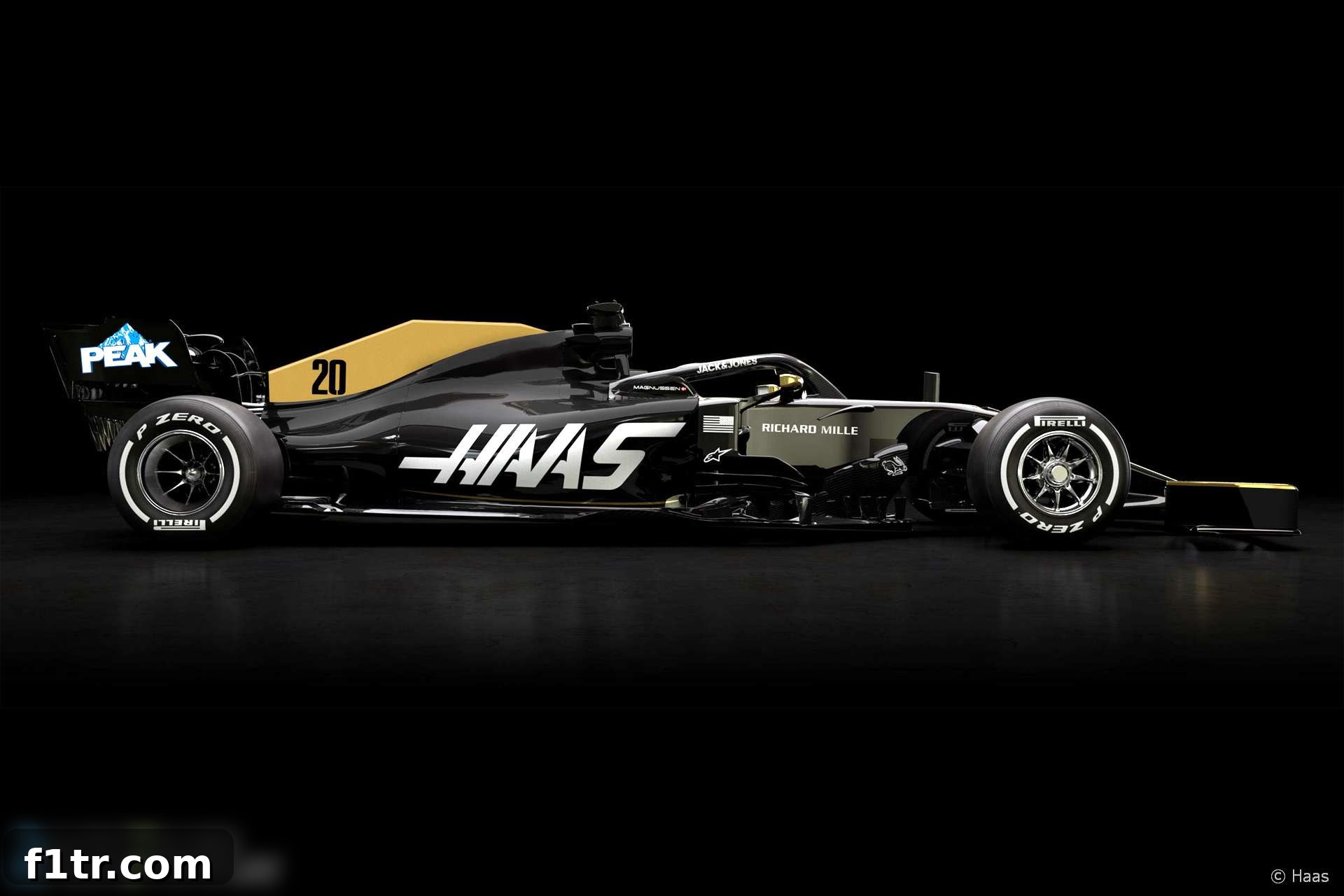
In a significant shift that has captured the attention of the Formula 1 community, the Haas F1 Team has unveiled the first images of its car following the official termination of its tumultuous title sponsorship with Rich Energy. The visual change marks a pivotal moment for the American outfit, signaling a fresh start after a partnership fraught with controversy and public drama.
The highly anticipated split between Haas and Rich Energy was formally announced in the wake of the Italian Grand Prix at Monza, drawing a definitive line under an association that had begun with much fanfare but ultimately spiraled into a series of public disagreements and legal battles. Rich Energy had entered the sport as Haas’s inaugural title sponsor, imbuing the team’s VF-19 challenger with its distinctive black and gold livery, a color scheme that quickly became synonymous with the team’s presence on the grid throughout the early part of the 2019 season.
However, the collaboration was plagued by issues long before its official conclusion. A crucial turning point occurred at the Canadian Grand Prix, where Haas was compelled to remove Rich Energy’s prominent stag logo from its cars. This decision came after the energy drink brand suffered a significant legal defeat in a copyright infringement case. Cycle manufacturer Whyte Bikes successfully argued that Rich Energy’s logo bore an uncomfortably close resemblance to its own registered trademark, forcing a swift and embarrassing redesign for the F1 team. This incident foreshadowed the deeper cracks in the partnership, indicating a lack of due diligence or a disregard for intellectual property rights on Rich Energy’s part, which inevitably reflected poorly on Haas.
With the Rich Energy name now entirely expunged from the car’s exterior, observers might expect a complete overhaul of the livery. However, initial images published by Haas on its official website reveal a more nuanced transition. While the explicit branding of the former sponsor is gone, a residual gold coloring subtly remains in certain areas of the car. This choice could represent a gradual phasing out of the previous aesthetic, a nod to the team’s history during the partnership, or perhaps a temporary measure before a more comprehensive redesign is introduced. The retention of some gold elements offers a visually intriguing link to the recent past while firmly closing the chapter on the contentious title sponsorship.
Prior to the arrival of Rich Energy, the Haas F1 Team proudly displayed the corporate colors of its parent company, Haas Automation. The cars were famously clad in the distinctive grey and red livery, a direct representation of the global machine tool building enterprise founded and owned by Gene Haas, the visionary behind the Formula 1 team. Gene Haas has consistently utilized his F1 presence as a powerful marketing and promotional platform for Haas Automation, emphasizing American engineering and precision on a global stage. This historical context underscores the significance of the Rich Energy sponsorship as a departure from the team’s core identity, and its removal perhaps signals a return to a more purist branding strategy centered around its founder’s primary business.
Adding further weight to the official separation, Haas has concurrently taken steps to formally remove Rich Energy from its official team name. This administrative change, enacted ahead of the Singapore Grand Prix, ensures that all official communications, branding, and listings will no longer associate the team with the energy drink company. This meticulous approach to severing ties demonstrates Haas’s commitment to swiftly and thoroughly distancing itself from a partnership that had become more of a liability than an asset.
The genesis of the split can be traced back to a series of bizarre and highly public social media posts from Rich Energy in July. In a startling and unsanctioned move, the company’s official Twitter account declared that it had unilaterally ceased its sponsorship of the Haas team, citing “poor performance” as the primary reason. This extraordinary statement sent shockwaves through the paddock and the wider motorsport community, as it was made without any prior consultation or agreement with Haas. Although Rich Energy later retracted this controversial statement, attributing it to an unauthorized individual, the damage to the relationship was irreparable. The incident highlighted a profound disconnect and a lack of professional communication between the partners. Ultimately, Haas confirmed last week that both parties had “amicably agreed to end their partnership together in the FIA Formula One World Championship with immediate effect,” a statement designed to project an image of mutual consent, despite the preceding public discord.
The departure of Rich Energy not only impacts the visual identity of the Haas F1 team but also carries significant financial implications, particularly for a smaller, independent outfit like Haas. Title sponsorships are crucial revenue streams in Formula 1, providing essential funding for car development, operational costs, and personnel. While Haas Automation remains the steadfast backbone of the team’s funding, the loss of a major external sponsor necessitates a strategic reassessment of the team’s commercial future. The team will undoubtedly be actively seeking a new title sponsor or a collection of significant partners to bolster its financial stability and competitive aspirations.
This episode serves as a cautionary tale in the high-stakes world of Formula 1 sponsorships. Brands entering the sport often seek rapid exposure and a powerful association with cutting-edge technology and global reach. However, the integrity and professionalism of the sponsoring entity are paramount. Rich Energy’s public antics, from its initial bold claims to its ill-advised social media pronouncements and subsequent legal entanglements over its logo, created a whirlwind of negative publicity that ultimately overshadowed any potential positive impact for Haas. For a team striving for credibility and consistency on the grid, such external distractions are profoundly unwelcome and detrimental.
Looking ahead, the Haas F1 Team faces the challenge of not only finding a suitable replacement for its title sponsor but also of re-establishing a clear and positive brand narrative. The team, under the steady leadership of Guenther Steiner and the unwavering commitment of Gene Haas, will likely emphasize its roots in American innovation and the core values of Haas Automation. This recalibration is an opportunity to shed the baggage of the Rich Energy era and to forge stronger, more stable commercial relationships built on mutual respect and shared objectives. The focus will undoubtedly return to on-track performance, which, despite the sponsorship drama, remained a key area of concern for the team during the 2019 season. Addressing the car’s performance and securing consistent points finishes will be the most effective way for Haas to attract new, reputable partners and solidify its position in Formula 1.
The saga also highlights the importance of comprehensive due diligence in sponsorship agreements within motorsport. Both parties are expected to uphold contractual obligations and maintain a professional demeanor, particularly when operating on such a prominent global platform. While the reasons for Rich Energy’s behavior remain open to speculation, its actions undoubtedly complicated Haas’s efforts to compete effectively in a highly competitive environment. For Haas, moving forward involves learning from this experience and ensuring that any future partnerships are robust, transparent, and aligned with the team’s long-term vision and values. The visual transformation of the VF-19 is more than just a livery change; it’s a symbolic step towards renewed stability and a focused pursuit of success on the global stage of Formula 1.
Stay Updated with the Latest from RaceFans
Ensure you don’t miss any breaking news, insightful analysis, or exclusive content from RaceFans by connecting with us on social media:
- Join the RaceFans community on Facebook for engaging discussions and updates.
- Follow RaceFans on Twitter for real-time news and instant reactions.
- Subscribe to get daily email updates directly from RaceFans, delivering the most important F1 news straight to your inbox.
Explore More from the 2019 F1 Season
Delve deeper into the events and stories that shaped the 2019 Formula 1 season with our comprehensive archive of articles:
- Esteban Ocon reflects on a challenging moment: “Crying in the Melbourne car park at 2019 grand prix was my career low.”
- Analysis: McLaren Racing reports significantly reduced £71 million loss in 2019, showcasing financial improvements.
- Daniil Kvyat on his Hockenheim success: “Hockenheim podium last year was ‘my biggest achievement’ so far.”
- Technical insight: How the FIA’s new encrypted fuel flow meter targets Ferrari’s suspected ‘aliasing’ trick.
- Behind the scenes: “He smashed my office door”: 23 must-see moments from ‘Drive to Survive’ season two.
Browse all articles covering the captivating 2019 F1 season.