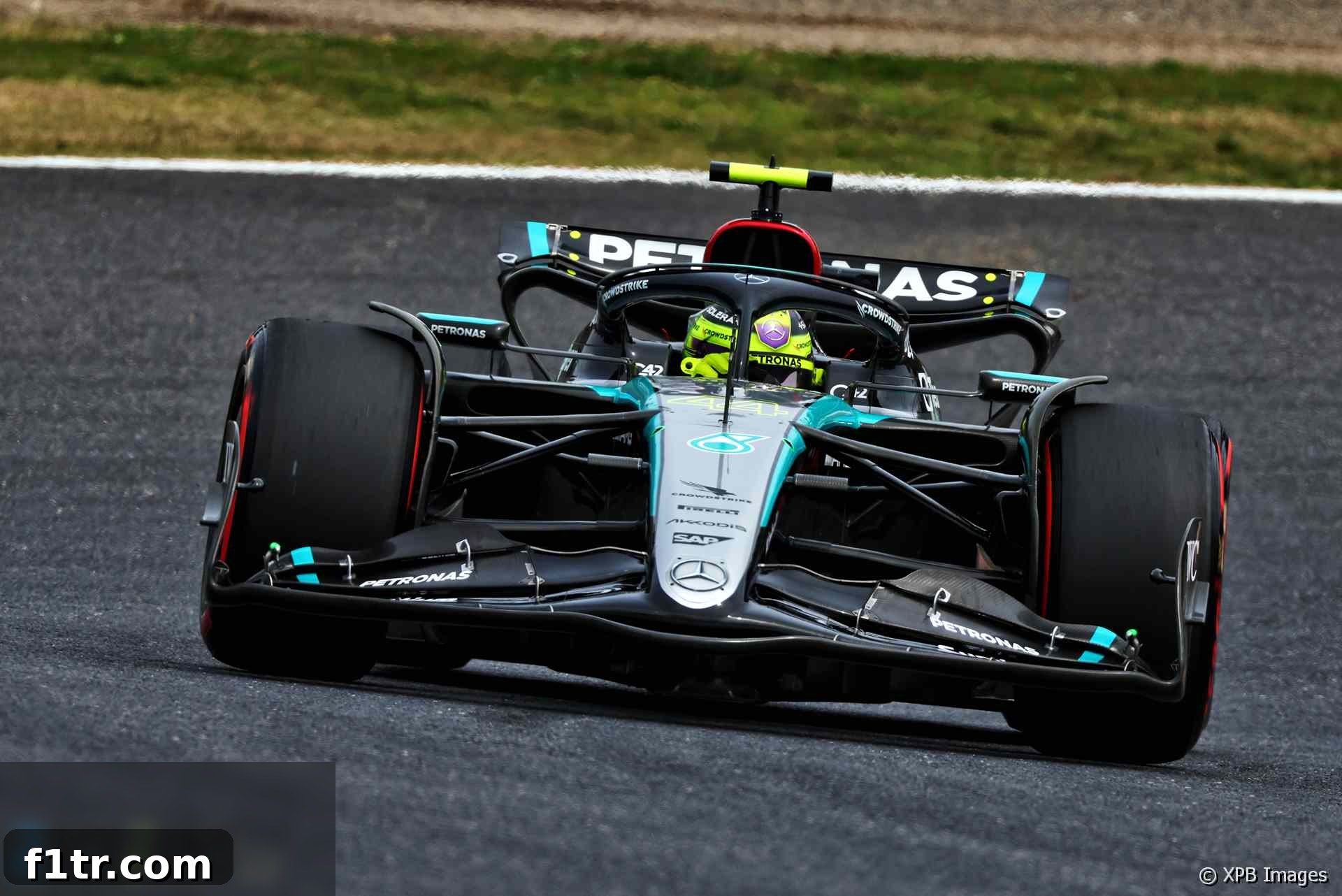
Lewis Hamilton expressed palpable optimism following his strongest qualifying performance of the 2024 Formula 1 season at the legendary Japanese Grand Prix. The seven-time world champion will line up his Mercedes W15 in seventh position on tomorrow’s grid at Suzuka, a result he believes signifies genuine, tangible progress for the Brackley-based squad.
Speaking to Sky Sports after the session, Hamilton shared his positive outlook: “I was giving it absolutely everything out there. The team has done an exceptional job over the past week, delving deep into our data, understanding the car’s characteristics, and meticulously making the necessary adjustments to our setup. This collective effort is truly starting to pay off.”
This particular qualifying session held added significance for Hamilton, as it marked the first time this season he has out-qualified his highly-regarded teammate, George Russell. Hamilton attributed this breakthrough to a more disciplined approach to car setup during the practice sessions. “This is actually the first weekend I’ve consciously avoided going crazy with the setup changes, and I haven’t been testing a multitude of different configurations. It feels like I’m back to a more normal, focused routine,” he explained.
This streamlined approach seems to have yielded dividends, allowing Hamilton to find a greater sense of harmony with the W15. “I think we’ve successfully managed to get the car into a much nicer working window this weekend. As a result, every single lap out there has been genuinely enjoyable to drive, which is a fantastic feeling for a driver,” he added, highlighting the importance of car balance and responsiveness for maximizing performance.
Unlocking the W15’s Potential: A Deeper Understanding
Remarkably, Hamilton qualified in the exact same seventh position at Suzuka six months prior during the previous Japanese Grand Prix. While Mercedes has achieved higher starting positions this year, including George Russell’s third-place start in Bahrain, Hamilton emphasized that today’s seventh place showcases a more significant underlying improvement: a considerable reduction in the performance gap to their closest rivals, particularly Red Bull.
“The other guys at the front are still a little bit faster, no doubt,” Hamilton acknowledged. “Last year, we were typically a second, or even just over a second, off the pace of the Red Bull cars in qualifying. To be seven tenths better this time around is a clear step forward and a really encouraging sign of the progress we are making.”
He further reflected on the fine margins in Formula 1: “I think perhaps if we had executed something a little bit differently, maybe we could have squeezed another tenth out of the car. Possibly. But truthfully, beyond that, I felt like that was everything we had in the bag today.” This sentiment underscores the team’s ongoing journey to extract every ounce of performance from their current package.
Mercedes arrived at Suzuka without any major aerodynamic or mechanical updates to the W15. This fact makes the progress even more noteworthy, as Hamilton affirmed that the improvements stem primarily from an enhanced understanding of the car’s inherent characteristics and how to optimize its existing components. This deep dive into data and driver feedback is proving to be a powerful development tool.
“I now know exactly where the car’s fundamental weaknesses lie; where it’s not strong enough,” Hamilton revealed, illustrating his deep connection with the machinery. “I can distinctly feel those limitations from within the cockpit, and crucially, I am now able to articulate precisely to the engineers where we need to focus our development efforts and push for improvements in specific areas. This clarity is invaluable.”
Building Confidence: Race Day Hopes and Long-Term Vision
Looking ahead to Sunday’s race, Hamilton maintained his positive outlook. “I’m genuinely hoping that the race will prove to be even stronger for us tomorrow. I’ve really enjoyed the entire driving experience so far this weekend, which bodes well for a consistent performance over race distance,” he stated, indicating that the W15’s improved working window might translate into better race pace and tire management.
Hamilton expressed robust confidence in the team’s current development trajectory and the direction they are taking with the W15. He highlighted the challenges Mercedes has faced in recent seasons with car setup consistency. “What we’ve predominantly noticed is that from track to track, it has been extraordinarily difficult to achieve the optimal setup. We’ve often found ourselves significantly off the mark each time we arrived at a new circuit. In some places, it genuinely felt like nothing we could do would bring the car into its ultimate ‘sweet spot’ of performance.”
The concept of a car’s “sweet spot” is crucial in Formula 1. It refers to the narrow operating window where the tires, aerodynamics, suspension, and overall balance work in perfect harmony, allowing the driver to extract maximum performance and confidence. When a car is in its sweet spot, it feels predictable, responsive, and incredibly fast. Mercedes has openly admitted their struggles to consistently find this elusive state with their recent cars.
“However, this weekend at Suzuka, the car is much more comfortably within that sweet spot,” Hamilton observed with satisfaction. “So, my hope is that this positive trend continues into the following races. Once we can consistently achieve this baseline level of optimization, our focus will then shift entirely to simply adding more inherent performance and speed to the car itself.” This strategy emphasizes the importance of understanding the current package before introducing significant upgrades.
The team’s renewed understanding of the W15 provides a strong foundation for future development, enabling them to make more informed decisions about upgrades and setup changes. Hamilton’s feedback, coupled with extensive data analysis, is crucial in steering the team towards a more competitive future. Mercedes is not just chasing performance but also consistency, aiming to be a contender at every circuit on the calendar, irrespective of track characteristics.
The Road Ahead for Mercedes and Hamilton
This positive qualifying result at Suzuka is a significant morale booster for the entire Mercedes AMG Petronas F1 Team, especially as they navigate the challenges of the current season and look towards a pivotal year in 2025. For Lewis Hamilton, in particular, demonstrating strong form and contributing to the team’s understanding and development is paramount, even as he prepares for his much-anticipated move to Ferrari. His commitment to finishing his tenure at Mercedes on a high note remains unwavering.
The Japanese Grand Prix is renowned for its demanding layout, high-speed corners, and technical challenges, making it an excellent barometer for a car’s overall performance and balance. Hamilton’s comfort and enjoyment behind the wheel at Suzuka suggest that Mercedes has indeed made a significant step in the right direction, addressing some of the fundamental handling issues that plagued the W15 in earlier races. The ability to push the car hard and feel confident in its responses is a testament to the hard work put in by the engineers and strategists back at the factory and trackside.
While the gap to the front-runners like Red Bull and Ferrari remains, the reduction in that gap from over a second to seven-tenths is a crucial psychological and performance victory. It suggests that Mercedes is no longer just treading water but actively swimming towards the competitive pace setters. The team’s focus on unlocking the existing car’s potential through setup optimization and a deeper understanding, rather than solely relying on new parts, demonstrates a mature and intelligent approach to overcoming their current challenges.
The race on Sunday will provide the ultimate test of this newfound understanding and the W15’s true potential. Suzuka’s circuit characteristics often lead to exciting and strategic races, with tire management and overtakes playing a critical role. Hamilton’s starting position of seventh offers a solid platform from which to attack, aim for strong points, and potentially challenge for higher positions should opportunities arise. This weekend’s performance serves as a beacon of hope for Mercedes fans, indicating that the journey back to the very front of the grid, while challenging, is certainly underway.
2024 Japanese Grand Prix
- “Am I in a race here or what?”: How Ferrari aced their Suzuka strategies
- Suzuka showed Mercedes “have a more stable platform” now
- Ferrari’s strategy gains in 2024 are “purely down to the car” – Sainz
- Tsunoda ‘at Verstappen and Alonso’s level’ with Suzuka performance – Marko
- Japan was first race where Red Bull’s winning margin was bigger than last year
Browse all 2024 Japanese Grand Prix articles