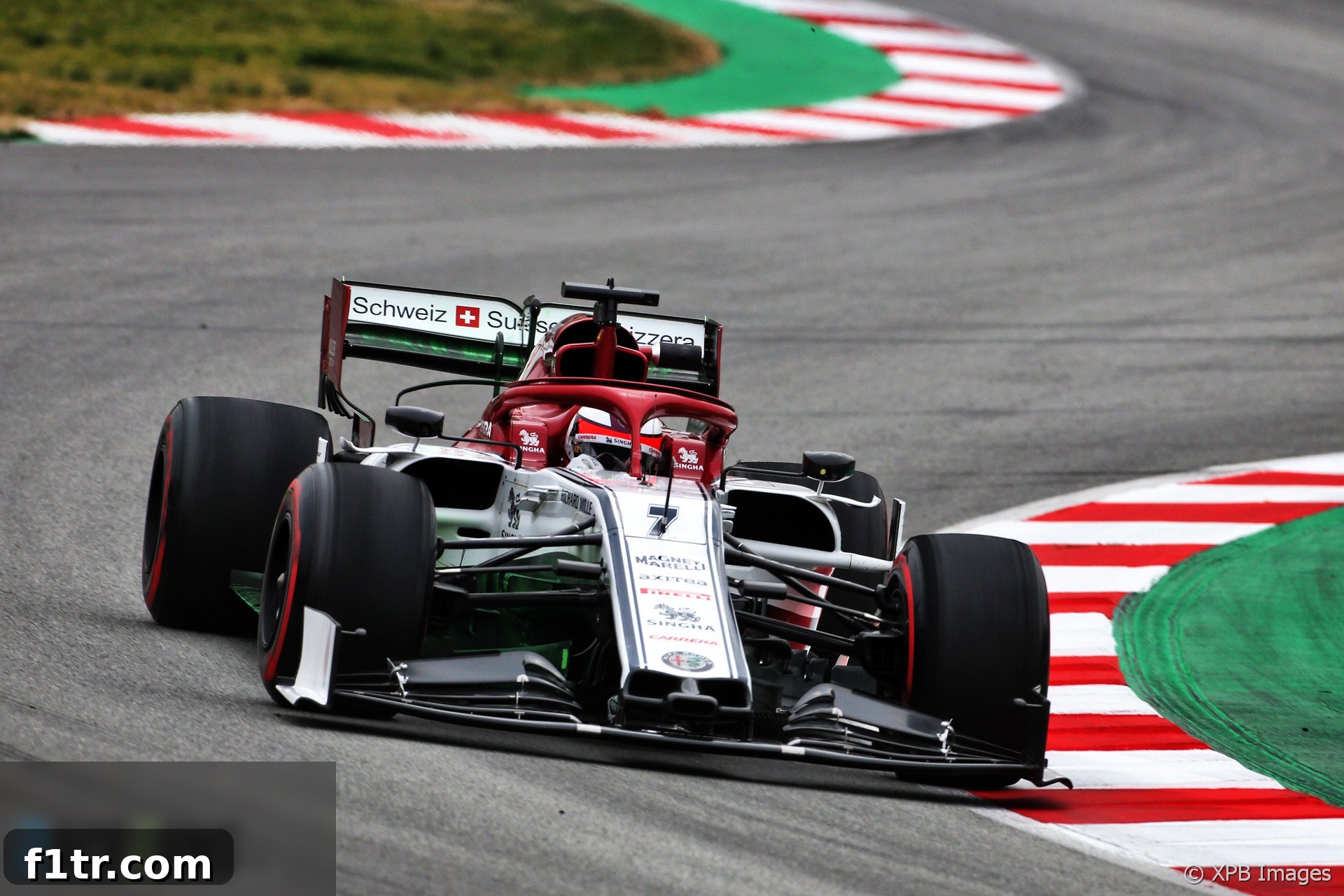
As the Formula 1 pre-season testing continued its crucial second day at the iconic Circuit de Catalunya in Barcelona, an unexpected front-runner emerged, capturing the attention of fans and pundits alike. Kimi Raikkonen, the seasoned Finn behind the wheel of the Alfa Romeo C38, delivered a standout performance during the morning session, hinting at significant potential for his new team. His blistering lap time not only topped the charts for the day but also set the fastest benchmark of the testing period so far, injecting a dose of excitement and intrigue into what is typically a period of cautious optimism and data gathering.
Raikkonen’s impressive 1’17.762 lap was achieved on the softest available Pirelli compound, the C5 tyres, demonstrating both the car’s inherent speed and the driver’s ability to extract maximum performance. This particular lap was a remarkable feat, shaving nearly four-tenths of a second off the previous best time, which had been set by Ferrari’s Sebastian Vettel on the opening day. Such a significant improvement from a team that spent much of the previous season battling in the midfield suggests that Alfa Romeo might be poised for a more competitive showing in the upcoming 2019 championship. While testing times always come with caveats – teams run different fuel loads, engine modes, and test programmes – Raikkonen’s display undoubtedly put Alfa Romeo on the radar, suggesting their winter development has yielded promising results.
Ferrari, ever the benchmark, saw their four-time world champion Sebastian Vettel settle for the second-fastest time of the morning. Running on the slightly harder C3 compound, Vettel’s focus was less on outright single-lap pace and more on understanding the new SF90’s characteristics over longer runs and varied setups. His consistent presence near the top of the leaderboard, despite not pushing for the absolute fastest time on the softest rubber, underscored Ferrari’s robust performance and reliability. The Maranello squad appeared to be methodically working through their testing agenda, gathering invaluable data on tyre degradation, aero performance, and engine mapping, all crucial elements for a championship challenge.
Midfield Scramble: Renault, Toro Rosso, and Red Bull Show Their Hand
Beyond the top two, the midfield battle continued to intensify, with several teams improving their best times of the test. Nico Hulkenberg, driving the Renault RS19, put in a strong performance to secure the third-fastest time with a 1’18.800. This solid outing for Renault signals their aspirations to climb further up the constructor standings. The French team’s consistent running and improved pace suggest that they are making good progress with their new package, aiming to close the gap to the front-runners and cement their position as a formidable midfield contender.
Hot on Hulkenberg’s heels was Daniil Kvyat in the Toro Rosso STR14, who posted a competitive 1’18.897. This impressive showing placed the young Russian just two-thousandths of a second quicker than Max Verstappen in the Red Bull. Toro Rosso’s strong performance, particularly being so close to their sister team running Honda power, is an encouraging sign for their season prospects. It highlights the continued integration and development of the Honda power unit, which is now also supplying Red Bull Racing. The close timings among these midfield teams are a thrilling prelude to what promises to be an intensely competitive season.
Max Verstappen, despite being nudged down to fifth place, had a morning dedicated to extensive aerodynamic experimentation rather than chasing headline lap times. The Red Bull driver completed a relatively modest 33 laps as the team evaluated various aerodynamic configurations. This included running a distinctive ‘Montreal-specification’ low-downforce rear wing at one stage, a common practice during pre-season testing. Such a wing is typically designed for circuits requiring less drag, indicating Red Bull’s comprehensive approach to understanding their new RB15 across a wide range of track conditions and setup requirements. Their focus on data acquisition over outright speed is a clear indication of their long-term strategy, building a strong foundation for performance throughout the year.
Incidents and Setbacks: Haas, McLaren, and Williams
The morning session wasn’t entirely without interruption. Pietro Fittipaldi, driving the Haas VF-19, caused the only red flag of the session when his car came to a halt on track. Despite the momentary stoppage, Fittipaldi managed to set the sixth-fastest time, demonstrating the Haas car’s underlying pace. Following his run, he handed the car over to teammate Romain Grosjean for the afternoon’s schedule, allowing both drivers to gain valuable track time and feedback on the new challenger. Such minor incidents are a regular part of pre-season testing, as teams push the limits of their new machinery and iron out any early reliability kinks.
McLaren faced a challenging start to their day, with Carlos Sainz Jnr’s car experiencing a gearbox problem discovered overnight. This issue sidelined the MCL34 for the first two hours of the day, a significant loss of crucial testing time for a team eager to improve after several difficult seasons. Once the mechanics resolved the issue and Sainz finally got on track, he managed to complete 27 laps, providing some much-needed data. However, his session wasn’t entirely smooth, as he had a minor off-track excursion at Turn 14, highlighting the fine margins and demands of pushing a new car to its limits. McLaren’s focus during testing remains firmly on reliability and consistent performance, aiming to lay a stable foundation for the upcoming campaign.
At the other end of the spectrum, Valtteri Bottas, in the Mercedes W10, was the slowest of the drivers to set a timed lap, yet paradoxically, he completed the most laps of anyone during the morning session. This strategy is typical for Mercedes during testing, prioritizing data collection, long-run simulations, and understanding the car’s behaviour over raw pace. Their focus is clearly on reliability and accumulating mileage, ensuring their championship-winning machine is robust and predictable. Mercedes’ measured approach is a testament to their confidence and systematic methodology in preparing for another title assault.
Meanwhile, the struggles continued for Williams. Their 2019 car, the FW42, had still not made its track debut during the morning session. However, there was a glimmer of hope as the car finally arrived at the circuit, with the team expecting to get its testing programme underway in the afternoon. Williams’ significant delay in getting their car on track is a major setback, costing them invaluable development and setup time compared to their rivals, an issue that could heavily impact their early-season performance.
Unpacking the Data: Tyre Compounds and Testing Philosophy
Understanding the context of pre-season testing involves delving into the specifics of tyre compounds and team strategies. Pirelli provides five different dry weather compounds, from C1 (hardest) to C5 (softest). Each compound offers varying levels of grip and durability, impacting lap times and strategic options during a race weekend. Kimi Raikkonen’s fastest lap on C5 tyres indicates strong one-lap pace, but teams like Ferrari and Mercedes often focus on the more durable C2 or C3 compounds for longer runs to simulate race conditions, gather degradation data, and fine-tune their setups for consistent performance. It’s a delicate balance between showing outright speed and meticulously preparing for the gruelling demands of a full season.
Ultimately, pre-season testing is not about winning races but about understanding the car. Teams use these precious days to confirm simulation data, test new components, validate aerodynamic concepts, and ensure the reliability of every system. Fuel loads, engine modes, and specific test items vary wildly between teams and even within a single day, making direct comparisons of lap times often misleading. What truly matters is the data collected, the issues identified and resolved, and the overall confidence built within the team ahead of the first Grand Prix. Raikkonen’s rapid lap provides a fascinating storyline, but the true measure of performance will only come when the lights go out in Melbourne.
Morning Session Times and Lap Counts
| Pos. | Car number | Driver | Team | Model | Best time | Gap | Laps | Tyres |
|---|---|---|---|---|---|---|---|---|
| 1 | 7 | Kimi Raikkonen | Alfa Romeo | C38 | 1’17.762 | 64 | C5 | |
| 2 | 5 | Sebastian Vettel | Ferrari | SF90 | 1’18.350 | 0.588 | 80 | C3 |
| 3 | 27 | Nico Hulkenberg | Renault | RS19 | 1’18.800 | 1.038 | 63 | C4 |
| 4 | 26 | Daniil Kvyat | Toro Rosso | STR14 | 1’18.897 | 1.135 | 48 | C3 |
| 5 | 33 | Max Verstappen | Red Bull | RB15 | 1’18.899 | 1.137 | 33 | C3 |
| 6 | 51 | Pietro Fittipaldi | Haas | VF-19 | 1’19.249 | 1.487 | 48 | C4 |
| 7 | 55 | Carlos Sainz Jnr | McLaren | MCL34 | 1’19.354 | 1.592 | 27 | C3 |
| 8 | 11 | Sergio Perez | Racing Point | RP19 | 1’20.102 | 2.340 | 43 | C3 |
| 9 | 77 | Valtteri Bottas | Mercedes | W10 | 1’20.693 | 2.931 | 88 | C3 |
Advert | Become a RaceFans supporter andgo ad-free
2019 F1 Season Insights
- Crying in the Melbourne car park at 2019 grand prix was my career low – Ocon
- McLaren Racing reports reduced £71 million loss in 2019
- Kvyat: Hockenheim podium last year was “my biggest achievement” so far
- How the FIA’s new encrypted fuel flow meter targets Ferrari’s suspected ‘aliasing’ trick
- “He smashed my office door”: 23 must-see moments from ‘Drive to Survive’ season two
Browse all 2019 F1 season articles