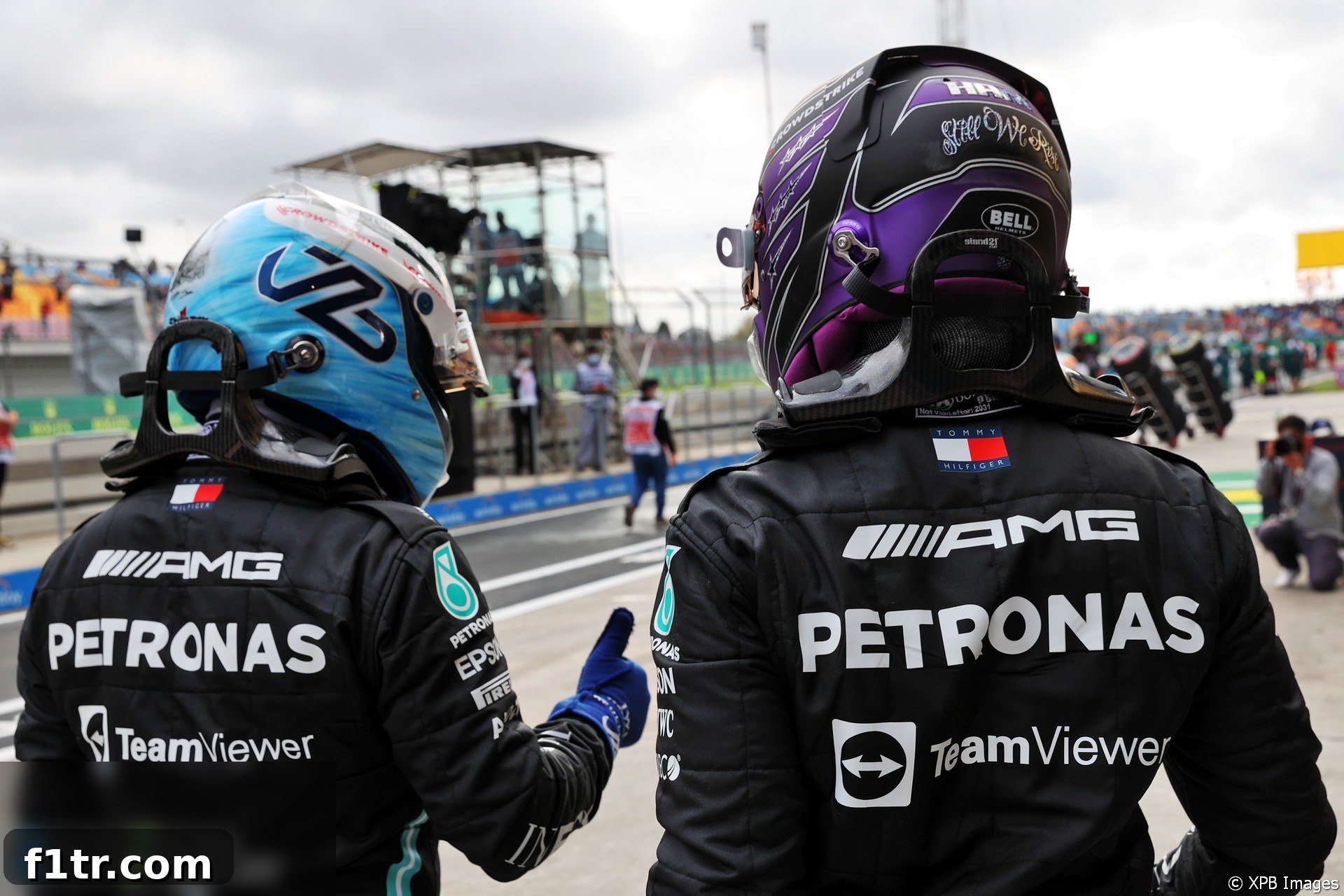
The 2021 Formula 1 season delivered a championship battle for the ages, and the Turkish Grand Prix qualifying session at Istanbul Park was a prime example of the intense strategic warfare that defined it. With Lewis Hamilton facing a significant grid penalty, Mercedes executed a meticulously planned qualifying performance, securing the best possible outcome by locking out the front row. This session was not merely about raw speed; it was a intricate dance of timing, tyre management, and razor-thin margins that set the stage for a potentially decisive race in the championship narrative.
From the outset, the Mercedes W12s showcased formidable pace during practice, hinting at a dominant one-two finish in qualifying. However, the looming shadow of Hamilton’s engine change, which incurred an unavoidable 10-place grid penalty, added a layer of profound strategic complexity to the Saturday session. For Mercedes, the specific order in which their drivers finished became paramount. If Valtteri Bottas secured pole position ahead of Hamilton, the championship leader would be relegated to 12th on the starting grid. Conversely, if Hamilton managed to outpace his teammate, he would start a crucial place higher in 11th. While Bottas was guaranteed pole regardless of Hamilton’s exact position (due to Hamilton’s penalty), having Hamilton qualify fastest was unequivocally in Mercedes’ best interests, offering him a slightly better springboard for his charge through the field on Sunday.
Advert | Become a Supporter & go ad-free
The decisive Q3 segment unfolded with palpable tension. After their initial flying laps, it was Bottas who held the provisional pole position, placing the onus on Hamilton to find additional pace. As the cars emerged for their final runs, Hamilton took to the track ahead of Bottas, delivering a blistering lap that propelled him to the top of the time sheets. His speed through the demanding final sector, which features two of Istanbul Park’s slowest and most technical corners, proved to be the differentiating factor. Hamilton’s ability to extract performance from the tyres in this crucial part of the circuit ultimately separated him from his teammate. The suspense then shifted to Max Verstappen, Mercedes’ primary rival, who completed his final Q3 lap but failed to dislodge either Mercedes from the front row. With Verstappen’s challenge negated, the biggest threat to Mercedes’ ideal outcome was gone.
This sequence of events immediately raised a pertinent question among observers: did Mercedes instruct Bottas to back out of his final flying lap to cement Hamilton’s higher qualifying position? The opportunity was certainly present, with Bottas crossing the finish line a full 18 seconds after Verstappen had completed his run, providing ample time for a team order to be issued. However, Bottas was unequivocal in his post-session remarks, making it abundantly clear that no such instruction had come from his team. “I wasn’t asked to slow down and I was definitely going for it,” he confirmed, putting an end to speculation.
Bottas elaborated on his performance, explaining the subtle struggles he encountered during his final effort. “I started to struggle a bit with the front end in the last sector,” he revealed. “I just had some understeer in turn 12 and 14, so I could feel I was losing a bit of time. Probably used the tyres a bit more, earlier in the lap. So I was fully going for it, for sure.” This honest assessment highlighted the delicate balance required to extract peak performance from the Pirelli tyres over an entire qualifying lap, especially on a circuit known for its challenging demands on tyre management. The subtle difference in tyre degradation or management between the two Mercedes drivers, particularly in the critical final sector, was ultimately decisive in Hamilton’s favor.
Beyond the internal Mercedes battle, the strategic wisdom of allowing Bottas to push to the absolute limit became evident. Instructing Bottas to slow down carried inherent risks, primarily from other drivers who could potentially improve their times. Charles Leclerc, in the Ferrari, was one such threat, running just behind the Mercedes pair and capable of a strong lap. While the Ferrari driver ultimately finished almost three-tenths of a second behind Bottas, the margins in Formula 1 are so fine that any compromise could have allowed Leclerc to split the Mercedes cars, a scenario the team would undoubtedly want to avoid. Maintaining Bottas’s competitive pace ensured a robust front-row lock-out, providing the best possible buffer against rivals and maximizing Mercedes’ strategic advantage for the race.
Max Verstappen and Red Bull Racing remained a potent threat throughout qualifying. Verstappen’s final Q3 lap saw him fall short of Bottas’s time by less than two-tenths of a second. He informed his team via radio that his battery hadn’t delivered the expected power towards the end of his lap. Later, Verstappen clarified that this was due to his management of the battery energy earlier in the lap, rather than a technical issue with the car itself. While Verstappen downplayed the impact, stating that the lost time wouldn’t have been sufficient to snatch pole position, this incident underscored the razor-thin margins that separated the top contenders. Red Bull’s consistent pressure meant that Mercedes could afford absolutely no chances when it came to their drivers’ lap times, reinforcing the team’s decision (or lack thereof) not to interfere with Bottas’s final push.
The Istanbul Park circuit itself played a significant role in the qualifying narrative. Its unique combination of high-speed sweeps and challenging technical sections demanded a finely balanced car setup and exceptional driver skill. The W12’s inherent strengths, particularly its aerodynamic efficiency and power unit performance, were well-suited to the circuit. However, Bottas’s reports of front-end instability in the final sector highlighted the delicate tightrope walk of tyre management and setup required to consistently extract peak performance. Hamilton’s mastery of these challenging conditions, especially his ability to maintain grip and precision in the critical final turns, proved to be the ultimate differentiator between the two Mercedes drivers, showcasing not only his driving prowess but also the subtle nuances of car optimization.
Advert | Become a RaceFans supporter andgo ad-free
Bottas Radio From His Final Run
The radio transcript from Bottas’s final run offers a fascinating glimpse into the real-time communication and strategic awareness within the Mercedes garage. The absence of any direct command to slow down during Bottas’s decisive lap supports his later statements, indicating a clear decision by the team to let their drivers compete fairly for the fastest time. The constant updates from race engineer Musconi, detailing the positions and progress of other competitors, underscore the high-pressure environment of Q3 and the meticulous attention to detail required to navigate it successfully. The debrief following the session, confirming Bottas’s P2 but eventual pole position due to Hamilton’s penalty, and highlighting Hamilton’s superior Sector 3, encapsulates the essence of this strategically charged qualifying session.
| Musconi | We’ve got three cars about to start a lap in sector three. Lewis at the last corner. |
| Musconi | Lewis is finishing his lap, correction. |
| Musconi | We’ve got Leclerc now on the start/finish line starting a lap. Behind him, Tsunoda. |
| Musconi | So Alonso’s got a seven second gap ahead to Norris. Expect a tiny bit of bunching. |
| Musconi | And Stroll behind on an out-lap. Leclerc has aborted. Only car on a lap is Tsunoda, 20. |
| Musconi | Plenty of time in hand. Perez in the last corner is going. Verstappen now is going. And Norris five ahead will go soon. |
| Musconi | Strat two. |
| Musconi | Tsunoda still 16 behind. Alonso two-and-a-half ahead. Four ahead. Four-and-a-half. Five seconds. |
| Musconi | No radio communication during Bottas’ final timed lap So currently P2. |
| Musconi | Got Lewis and Leclerc finishing but Lewis is already ahead. |
| Musconi | So confirm P2. Lewis, yourself, super Max, Leclerc, Gasly, Alonso, Perez, Norris, Stroll and Tsunoda. Good job. |
| Bottas | Well done guuys, good job. So that’s pole tomorrow yeah? |
| Musconi | Affirm. |
| Musconi | And you’re coming into the pit lane. |
| Bottas | Copy. |
| Musconi | So Lewis’ fastest lap was the first one. |
| Musconi | It was mainly sector three, a tenth and a half. |
Advert | Become a RaceFans supporter andgo ad-free
In conclusion, the 2021 Turkish Grand Prix qualifying was a masterclass in strategic execution by Mercedes. Despite the complexities introduced by Lewis Hamilton’s engine penalty, the team achieved the optimal outcome. Valtteri Bottas’s eventual pole position, combined with Hamilton’s raw pace to qualify fastest, positioned the Silver Arrows perfectly for a high-stakes race. While the whispers of team orders were quickly dispelled by Bottas’s firm denial and the inherent risks such a command would entail, the session underscored Mercedes’ commitment to competitive integrity within their strategic framework. Max Verstappen and Red Bull, as always, kept the pressure high, reminding everyone of the fine margins that define championship battles at the pinnacle of motorsport. As the grid was set, the stage was undeniably prepared for an enthralling and potentially championship-defining contest at Istanbul Park.
2021 Turkish Grand Prix
- Fifth place was possible from back row without slow pit stop – Sainz
- Giovinazzi ignoring position swap order was “not ideal”, admit team
- Bottas becomes 35th Formula 1 driver to reach 10 race wins
- Medical Car driver van der Merwe likely to miss further races due to Covid-19 rules
- Drivers to ask Masi why Alonso and Norris went unpunished for “very clear” incidents
Browse all 2021 Turkish Grand Prix articles