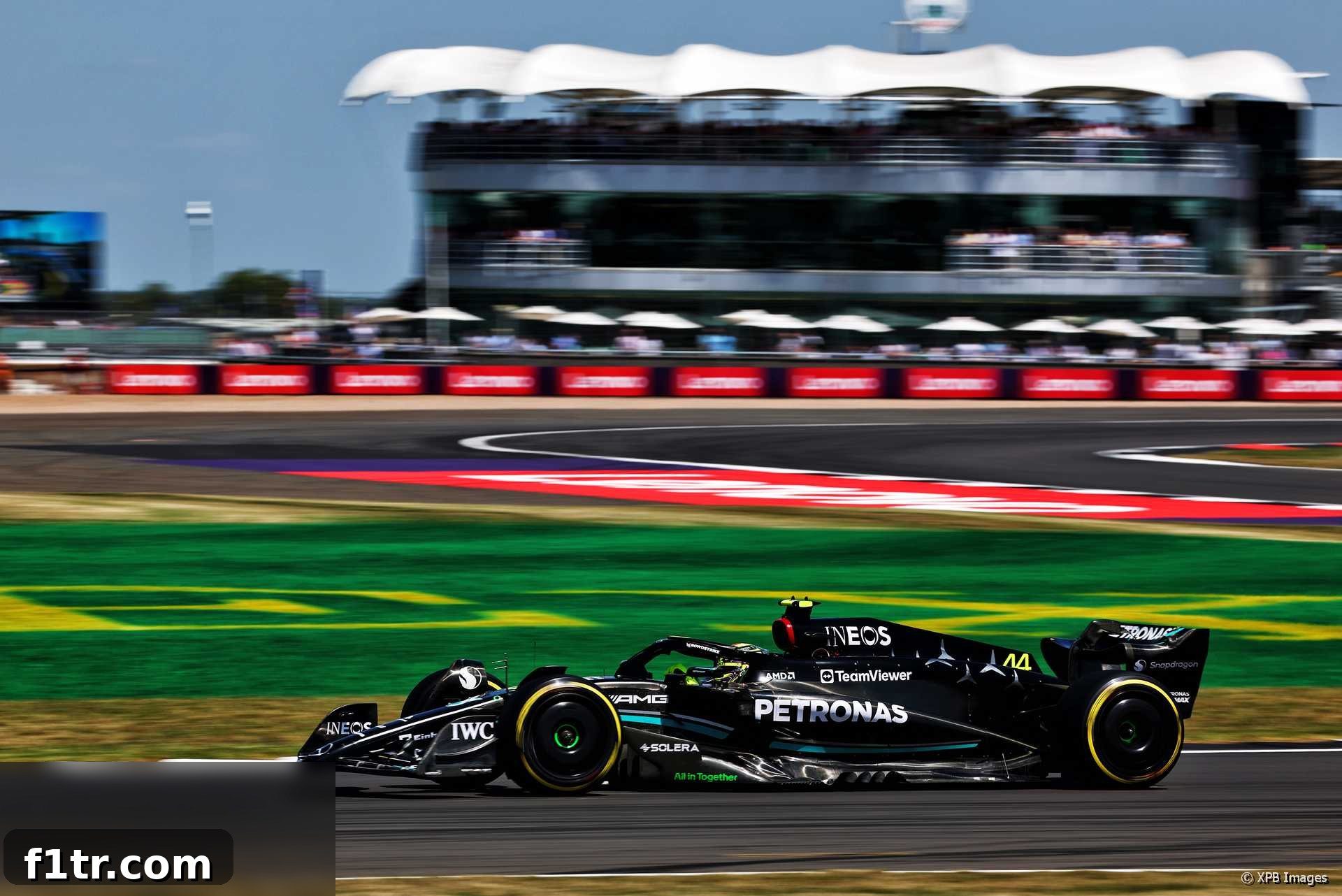
In a surprising turn of events at their home Grand Prix, Mercedes-AMG Petronas Formula One Team drivers Lewis Hamilton and George Russell openly admitted their bewilderment regarding the W14’s lack of competitive pace during Friday’s practice sessions for the British Grand Prix. The duo, usually a formidable force, found themselves scratching their heads after struggling to extract performance from their car at Silverstone, leaving them well outside the top ten and significantly off the leading pace.
Advert | Become a Supporter & go ad-free
Mercedes’ Pace Puzzle: A Challenging Friday at Silverstone
Both Hamilton and Russell concluded Friday’s running outside the coveted top ten positions in both Free Practice 1 (FP1) and Free Practice 2 (FP2). Their fastest laps were more than a full second slower than the blistering benchmark set by championship leader Max Verstappen in his dominant Red Bull, a gap that raised immediate concerns within the Mercedes garage and among their loyal fanbase. The iconic Silverstone circuit, often a happy hunting ground for the Silver Arrows, instead presented an unexpected enigma for the team.
The day began with a somewhat cautious approach to tyre compounds. Neither Mercedes driver ventured onto the soft tyres during the first hour of running in FP1, instead opting for the medium compound. However, the subsequent switch to the softest available rubber in FP2 did not yield the anticipated performance leap. Russell, reflecting on the day’s struggles, expressed his confusion about the discrepancy between their expectations and the reality on track.
George Russell’s Disbelief: “We Were Nowhere”
Speaking after the sessions, George Russell didn’t mince words about the team’s performance. “Definitely not our finest Friday,” he conceded, a sentiment that underscored the team’s frustration. Russell elaborated on the perplexing nature of their pace, or lack thereof. “We need to try and get to the bottom of it because the pace in FP1 was looking reasonably good on the medium tyre. We thought we were right up there if we took the softs, but in FP2 we were nowhere. So we just need to try and understand that.”
The young Briton highlighted the extensive adjustments made to the W14 between the two practice sessions, suggesting that these changes, combined with the track conditions, might have played a significant role in their downturn in performance. “We definitely made quite a few changes from FP1 to FP2, but we maybe didn’t compensate enough for the conditions. All learning, but just a difficult afternoon for sure.” This speaks to the delicate balance required in Formula 1 car setup, where even minor alterations can have profound effects on lap times, especially when ambient and track conditions are fluctuating.
Russell also pointed towards a recurring issue that might be exacerbating their performance woes: the impact of high temperatures. With track temperatures soaring above 40 degrees Celsius throughout both sessions, a common occurrence during the height of the European summer, Russell suspects the warm weather could be a contributing factor. “We’ve seen a small trend that when the temperature is hotter we seem to take a bit of a step backwards,” he explained. “We’ve got some ideas why that is.” Understanding and mitigating this sensitivity to heat will be crucial for Mercedes as the season progresses, particularly given the varying climates of the global F1 calendar. Russell concluded his remarks with a determined outlook, stating, “I’m still a bit sweaty since I jumped out the car. So I just need to dig into the data of the team and see what we can do for tomorrow.” This immediate focus on data analysis is standard practice in F1, where every millisecond counts, and engineers will burn the midnight oil to decipher the telemetry.
Advert | Become a RaceFans supporter andgo ad-free
Lewis Hamilton’s Setup Conundrum: A “Tough Car to Drive”
George Russell’s teammate, the seven-time world champion Lewis Hamilton, echoed the sentiment of perplexity, particularly concerning the car’s optimal setup. The discussions between the two drivers highlighted a divergence in their setup approaches, yet a shared struggle with the fundamental characteristics of the W14. “Me and George were just talking and he’s like ‘I’m over here with the set-up’ and I’m over here,” Hamilton recounted. “He was like, ‘I’m thinking of coming to where you are, but then your lap time’s slow’. And I was like, ‘well, I was thinking to come to where you are’.” This candid exchange reveals the deep-seated challenge Mercedes faces in finding a consistent and effective baseline for their car, a recurring theme throughout the current regulatory era.
Hamilton’s comments provided further insight into the car’s inherent difficulties, a narrative that has followed the W14, and its predecessor, since the introduction of the new ground effect regulations. “Car-wise, we’re battling the same thing the majority of the time. It’s a tough car to drive and no matter what we do to set-up and that, it continues to be a tough car to drive,” he asserted. This difficulty in taming the W14 has been a significant hurdle for Mercedes, preventing their drivers from consistently extracting maximum performance and often leading to unpredictable handling characteristics.
A particularly telling observation from Hamilton concerned the performance on different tyre compounds: “I didn’t feel any improvement between tyres, which shows something’s wrong. We’re missing something.” In modern Formula 1, the soft compound tyres are designed to offer a significant grip advantage over medium or hard compounds, translating to faster lap times over a short burst. The fact that Hamilton perceived no such improvement indicates a fundamental issue with how the car is interacting with the tyres, or perhaps an inability to switch them on effectively. This could point to deeper aerodynamic or mechanical balance problems that prevent the car from leveraging the extra grip available. However, a glimmer of positivity emerged from their longer runs: “Then on the long run, it didn’t seem to be too bad. So that’s a positive at least.” This suggests that while outright single-lap pace might be lacking, the W14 could potentially offer more consistent performance over a race distance, which could become a strategic advantage on Sunday.
The Elusive Balance: Silverstone’s Demanding Corners
Hamilton admitted that the car “didn’t feel particularly great” on the soft tyres, underscoring the balance issues as the paramount challenge. Silverstone, with its iconic high-speed corners like Copse, Maggotts, Becketts, and Chapel, is incredibly demanding on a car’s aerodynamic and mechanical balance. “This track’s really about trying to weigh the scales the whole way around,” he explained, painting a vivid picture of the delicate compromise required. “Making compromises here and there.”
The Briton elaborated on the W14’s unpredictable handling: “There’s such a fine edge on the balance and such a big balance window. It’s back and forth. It’s never just like ‘here’ and you can just drive it. It’s like one end to the other end of the spectrum, from braking to turn-in into mid to exit of every corner. So it’s a good battle.” This description paints a picture of a car that is not only difficult to drive at its limit but also provides inconsistent feedback, forcing the drivers to constantly adapt and battle its inherent instability. Such a car is incredibly mentally and physically draining, making it hard to find a rhythm and push for those crucial tenths of a second. The dynamic nature of Silverstone’s layout, transitioning from flat-out sections to intricate corner sequences, mercilessly exposes any car’s weaknesses in balance and stability.
Overnight Endeavors: Searching for Solutions
With Saturday’s crucial qualifying session looming, the Mercedes team, including its star drivers, is under immense pressure to find solutions. Hamilton confirmed that the team would be working diligently through the night to address the balance issues. “The balance, we’ll try and work on it tonight and Mick [Schumacher] could do some work in the sim tonight. So hopefully we’ll come up with something tomorrow.” The involvement of reserve driver Mick Schumacher in the simulator is a critical element of modern F1 operations. Sim drivers can run countless virtual laps, experimenting with different setup configurations and providing real-time feedback to the engineers at the track, often pinpointing potential directions for improvement more efficiently than on-track testing allows. This collaborative effort, blending driver feedback, engineering analysis, and simulator work, is Mercedes’ best hope of turning their fortunes around for qualifying and the race.
The stakes are particularly high at Silverstone, being Mercedes’ home Grand Prix. The team will be acutely aware of the expectations from their home crowd and sponsors. Overcoming such significant challenges on a Friday to deliver a competitive package on Saturday is a testament to the relentless nature of Formula 1 development and the sheer determination of the teams involved. While the gap to the front seems substantial, F1 is notorious for its ability to throw up surprises, and a breakthrough in understanding the W14’s behaviour could significantly alter their weekend trajectory. Mercedes’ history is laden with examples of overcoming adversity, and their fans will be hoping that the data gathered on Friday, combined with the tireless work of their engineers and drivers, will unlock the car’s hidden potential for the remainder of the British Grand Prix weekend.
Advert | Become a RaceFans supporter andgo ad-free
2023 British Grand Prix Related Articles
- Norris is “growing” closer to the champion who inspired him to race
- Second supplier part failure ‘a frustrating issue we must solve’ – Alpine
- Albon ‘surprised’ to be quicker than Alonso at end of British GP
- Bottas admits Alfa Romeo ‘were expecting to be better than this’ in 2023
- McLaren now “finding performance quicker” after emulating Red Bull’s design
Browse all 2023 British Grand Prix articles