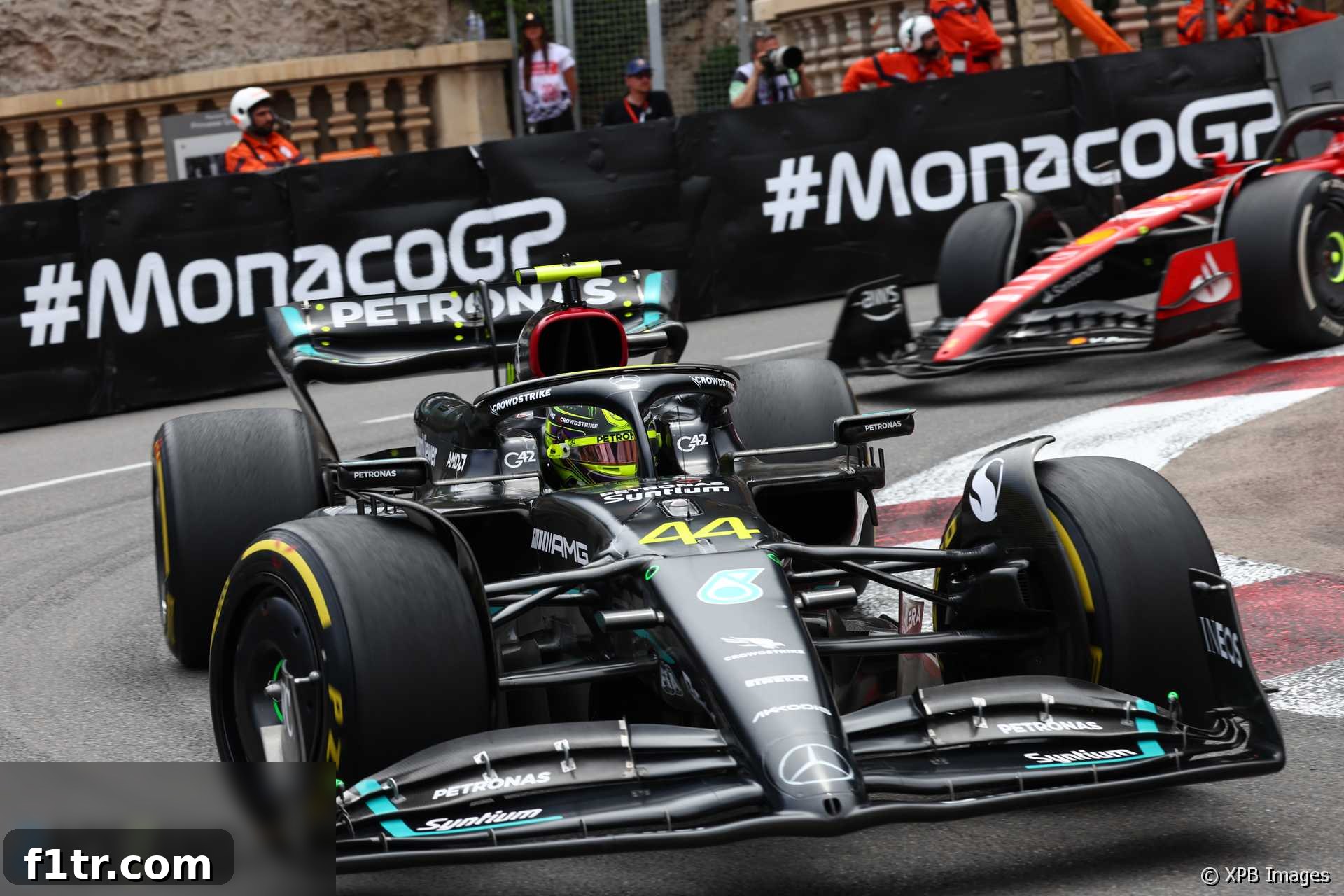
The highly anticipated debut of Mercedes’ significant W14 upgrade package finally arrived at the Monaco Grand Prix. Originally slated for the Emilia-Romagna Grand Prix, its cancellation meant the narrow, low-speed streets of Monte Carlo became the unexpected proving ground for the revised car. While Monaco’s unique characteristics — its tight corners, undulating surface, and minimal high-speed sections — made it challenging to draw definitive conclusions about the aerodynamic efficiency of the new components, the weekend offered the first glimpse into Mercedes’ renewed development direction.
Advert | Become a Supporter & go ad-free
Despite the inherent difficulties of evaluating a major upgrade on such a specific circuit, Mercedes could take some encouragement from their most successful weekend of the season up to that point. Seven-time world champion Lewis Hamilton secured a solid fourth-place finish, closely followed by his talented teammate George Russell in fifth. This double points haul, while not a victory, indicated a step forward in performance and consistency, allowing the team to be “in the mix” with key rivals. However, the precise extent of the upgrades’ effectiveness, particularly in high-speed conditions, remained shrouded in mystery due as much to the circuit as to the newness of the package itself.
Mercedes Team Principal Toto Wolff articulated a sense of cautious optimism after the Monaco weekend, viewing it as a “positive note” despite the inherent challenges. He acknowledged that the team found themselves competing directly with both Aston Martin and Ferrari, a significant improvement from previous outings where they often lagged behind. This competitive resurgence, even on a circuit that historically hasn’t favored the W14’s previous iterations, offered a glimpse of the potential underlying the new development path. Wolff’s remarks underscored the transitional phase the team was undergoing, focusing less on immediate results and more on foundational understanding.
“Our car was awful last year, and this time around, it’s not good, but it is better,” Wolff candidly admitted to media, including RaceFans. He stressed the importance of not getting carried away by a single event, particularly one as anomalous as Monaco. “We really need to be careful. We’ve got to go to Barcelona, collect more data. It’s a new baseline.” His pragmatic approach highlighted the team’s commitment to methodical data collection and analysis rather than speculative pronouncements. He tempered expectations, adding, “I don’t expect us clearing Aston Martin and Ferrari there either. It is more about understanding what does this car do now, and how do we need to set it up?” This statement perfectly encapsulated the team’s primary objective: to establish a comprehensive understanding of the new car’s characteristics and operational window.
Wolff firmly believes that once the team thoroughly verifies the efficacy of the changes and confirms they are indeed a step in the right direction, they possess the internal capabilities to make substantial progress. This confidence stems from Mercedes’ proven track record of relentless development and optimization once a clear path is identified. “We’re really good at grinding away: once we decide for a development direction, then we grind away,” he asserted. He cited their impressive recovery in the 2022 season, where, despite starting with a car that was “terrible at the beginning of the season,” they managed to secure a dominant victory at Interlagos. This serves as a powerful testament to the team’s engineering prowess and their ability to extract performance even from challenging packages. Such a mindset suggests a long-term commitment to climbing back to the top, rather than seeking quick fixes.
Advert | Become a RaceFans supporter andgo ad-free
One particular characteristic of the upgraded W14 that Wolff observed in Monaco continued a familiar trend for Mercedes’ F1 cars. “I think we’ve been better in FP1 actually than FP2 and the rest of the weekend,” he noted. This pattern suggests that as the track surface ‘grips in’ – becoming more rubbered-in and faster – the W14 tends to lose a degree of its competitive edge. This phenomenon points to potential underlying sensitivities in the car’s aerodynamic platform or suspension setup that become more pronounced under evolving track conditions. For Mercedes, with a largely new package, this learning process is intensive. “The more a track grips in, the less performing we are. And it’s really a lot of learning at the moment because everything is new. We got to just collect the data and then set the car up in any way,” Wolff explained, emphasizing the urgent need for comprehensive data acquisition to fully comprehend and exploit the new car’s potential.
Adding a technical perspective, Mercedes’ Trackside Engineering Director Andrew Shovlin highlighted the specific challenges posed by the Monaco circuit in assessing aerodynamic performance. The bumpy nature of the street circuit necessitates a higher amount of suspension travel, meaning the car’s aerodynamic platform is constantly shifting. This dynamic environment makes it exceedingly difficult to obtain consistent and reliable aerodynamic data, as the car is rarely in a stable condition. “The limited data that you get – which, aerodynamically, it’s very hard here because the car’s are never in the same condition for more than a moment – that all looks fine,” Shovlin confirmed. Despite the data limitations, initial feedback aligned with expectations. He further elaborated on the inherent unpredictability of Monaco, stating, “The difficult bit is you come to Monaco, you never know quite where you’re going to stack up,” underscoring why concrete conclusions are elusive from this particular venue.
Consequently, the team’s focus swiftly shifted to the upcoming Spanish Grand Prix at the Circuit de Catalunya, Barcelona. This track is universally regarded as a more representative test for Formula 1 cars due to its diverse range of corners, high-speed sections, and predictable surface. Mercedes is eager to get the upgraded W14 onto this circuit to gather comprehensive data and draw some firm conclusions about its true potential. Barcelona will serve as the crucial validation ground for the development path chosen by the team, offering insights that Monaco simply couldn’t provide.
“We’ve had bits of the weekend where we looked a bit more competitive than the Q3 final showing,” Shovlin admitted, acknowledging the fleeting glimpses of performance in Monaco. However, he stressed the team’s enthusiasm for a more conventional track. “But we’re really looking forward to just getting on to a proper track like Barcelona, see where we are and if we need to do more work and more development. And that’s what we’re expecting to be getting on with.” This collective eagerness within the team highlights the strategic importance of Barcelona for their entire 2023 campaign and beyond, as it will dictate the trajectory of their mid-season development.
Advert | Become a RaceFans supporter andgo ad-free
The performance of Mercedes at Barcelona is poised to be a pivotal moment, as it “is going to define the path ahead for us,” according to Shovlin. This candid assessment underscores the high stakes associated with the Spanish Grand Prix. The team understands that validating their current development direction is paramount. If the upgrades perform as expected, it will provide a clear and encouraging roadmap for future iterations of the W14. Conversely, if the data reveals unexpected issues or a lack of desired performance, it could necessitate a re-evaluation of their approach. “We’re fully expecting to have a lot of work to do,” Shovlin added, indicating that regardless of the initial results, the pursuit of optimal performance is a continuous and demanding process.
While the definitive emphasis on set-up and development will undoubtedly come from extensive track time at Barcelona, the “positive” feedback received from both Lewis Hamilton and George Russell in Monaco has already provided the team with an invaluable starting point. This driver feedback, collected under the challenging conditions of the street circuit, corresponds well with the expectations derived from simulations and internal analyses. It suggests that the theoretical gains predicted by the engineering team are translating into tangible improvements on track, at least in certain aspects.
“The work we’ve been doing on the simulator has shown that it’s in the right direction. So we’re quite comfortable that what we have done will have been a step forward,” Shovlin confirmed, articulating a quiet confidence within the team. The correlation between simulator data and real-world performance is a critical indicator of a development program’s health, and Mercedes appears to be seeing positive alignment. This congruence bolsters their belief that they are on the correct trajectory in their quest to unlock the W14’s full potential.
However, Shovlin was also quick to contextualize Mercedes’ progress within the broader competitive landscape of Formula 1. “The problem is at this stage of the year, you have Aston Martin bringing an update, Alpine have brought more updates. Everyone’s bringing bits to the car,” he observed. This constant arms race of development means that even a significant step forward by one team might be matched or even surpassed by others. Therefore, trusting in their own process and tools becomes paramount. “So I think you’ve just got to trust your own tools and your own direction,” Shovlin concluded, emphasizing the need for conviction in their chosen path amidst the relentless pace of innovation from rivals.
Adding another layer of complexity, the team’s development efforts are also intrinsically constrained by the sport’s cost cap regulations. Shovlin highlighted the practical realities of operating within these financial limits. “What we have brought to this car is just a case of what can you achieve in a cost cap in a short space of time,” he explained. This means that while the Monaco upgrade package represents a significant “step,” it is by no means the final form or the ultimate performance target for the W14. “So it’s a step but not where we want to end up,” Shovlin clarified, reinforcing that Mercedes has a much grander vision for the car’s competitiveness that will require continuous, yet financially prudent, development over the remainder of the season and into the next.
Bringing the F1 news from the source
RaceFans strives to bring its readers news directly from the key players in Formula 1. We are able to do this thanks in part to the generous backing of our RaceFans Supporters.
By contributing £1 per month or £12 per year (or the equivalent in other currencies) you can help cover the costs involved in producing original journalism: Travelling, writing, creating, hosting, contacting and developing.
We have been proudly supported by our readers for over 10 years. If you enjoy our independent coverage, please consider becoming a RaceFans Supporter today. As a bonus, all our Supporters can also browse the site ad-free. Sign up or find out more via the links below:
- Become a RaceFans Supporter
- RaceFans Supporter FAQ
Advert | Become a RaceFans supporter andgo ad-free
2023 Monaco Grand Prix Related Articles
- Mercedes ready to “grind” their way to competitiveness after major W14 update
- Verstappen surpasses Vettel as winner of most races for Red Bull
- How the first team to fit intermediate tyres in Monaco got the call right
- Verstappen’s Monaco pole run was the completion of his 2021 Jeddah lap – Horner
- Haas thrilled as upgrade performance exceeds wind tunnel predictions
Browse all 2023 Monaco Grand Prix articles