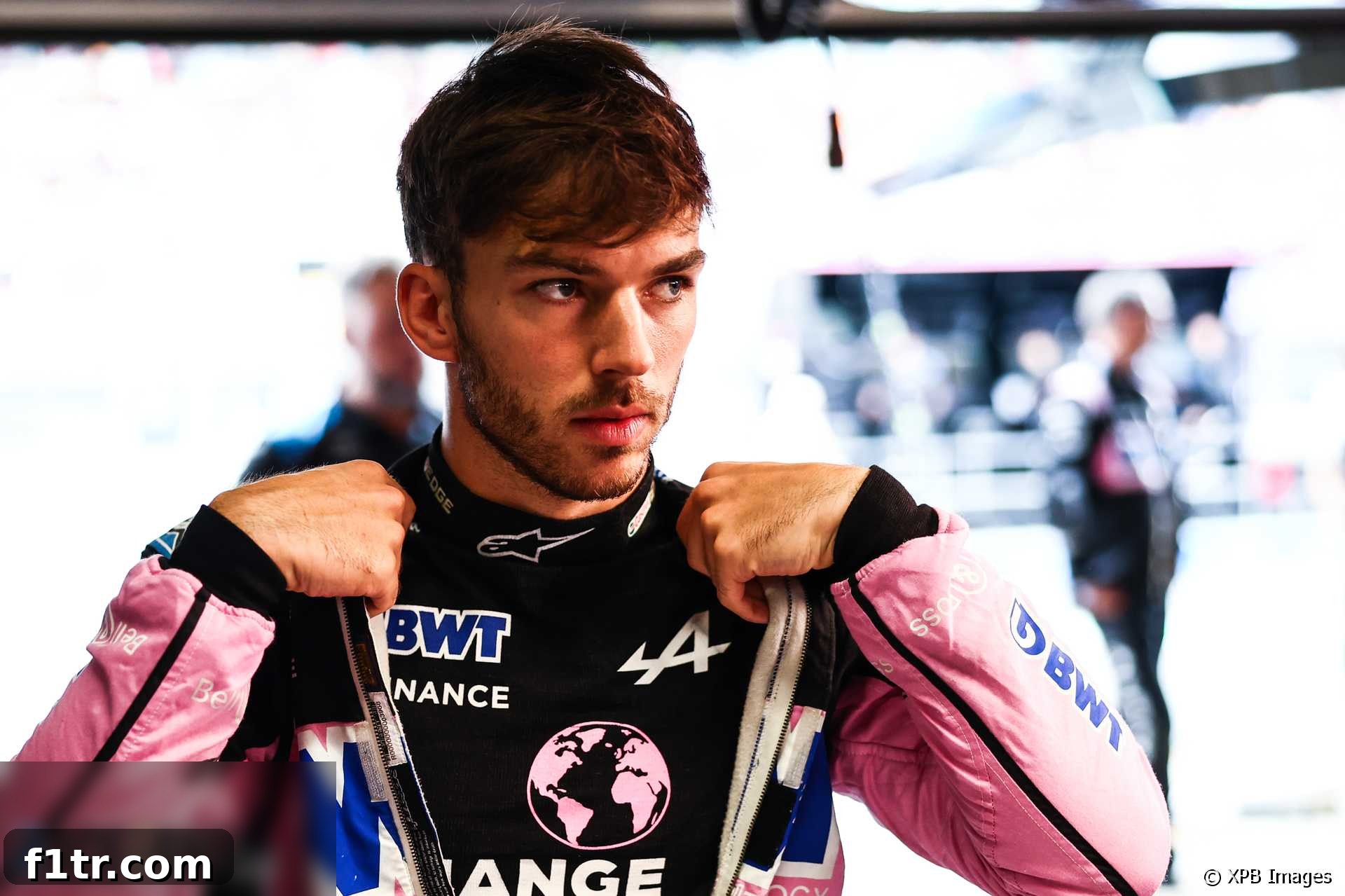
Pierre Gasly Hit with Double Grid Penalty for Impeding at Spanish Grand Prix Qualifying
Alpine driver Pierre Gasly saw his best qualifying performance since joining the team significantly undermined by the stewards at the Spanish Grand Prix. Handed two separate three-place grid penalties for impeding rivals during Saturday’s qualifying sessions, Gasly’s superb fourth-place start position was swiftly revoked, relegating him to tenth on the grid for Sunday’s race. This dramatic shift came after a qualifying session that initially promised a triumphant return to the front rows for the French driver, having narrowly edged out seven-time world champion Lewis Hamilton for the second row by a mere two-thousandths of a second.
The penalties stemmed from two distinct incidents: one involving Carlos Sainz Jnr of Ferrari in Q1 and another with reigning world champion Max Verstappen of Red Bull during Q2. These decisions, while impacting Gasly’s immediate prospects, also highlight the stringent enforcement of impeding rules in Formula 1, crucial for maintaining fair competition and driver safety on track.
A Promising Qualifying Derailed: The Road to P4 and Back
The Circuit de Barcelona-Catalunya, a familiar proving ground for Formula 1 machinery, witnessed a remarkable Saturday for Pierre Gasly and the Alpine team. Throughout the practice sessions, the A523 showed promising pace, culminating in a qualifying effort that saw Gasly extract maximum performance. His lap in Q3 was a testament to his skill and the team’s ongoing development, placing him squarely on the second row – a position he hadn’t achieved since the 2021 Turkish Grand Prix. This P4 grid slot would have been his strongest start since making the switch to Alpine at the beginning of the 2023 season, signaling a significant upturn in form and potential for a strong points haul.
The elation, however, was short-lived. Following the conclusion of qualifying, Gasly was summoned to the stewards’ office for separate investigations concerning two alleged impeding infringements. The scrutiny of on-track actions is a routine part of Formula 1, but for a driver to face two such investigations in a single qualifying session is relatively uncommon, let alone to be found guilty on both counts. The subsequent six-place demotion fundamentally altered the complexion of his Spanish Grand Prix weekend, transforming a celebratory mood into one of frustration and strategic recalculation.
Incident One: Impeding Carlos Sainz in Q1
The first incident occurred during the opening phase of qualifying (Q1), a critical period where drivers push to secure a spot in the next segment. Carlos Sainz Jnr, on a flying lap, encountered Gasly in the final corners of the circuit. The high-speed nature of these turns demands absolute clarity and a clear track for drivers to extract maximum performance. Any obstruction, even momentary, can significantly compromise a lap time and force a driver to abort.
Gasly’s defense to the stewards centered on the difficulty of his situation. He explained that he was already attempting to move out of the way for the first Ferrari, driven by Charles Leclerc, and given the extremely high-speed delta and the immediate proximity of Sainz’s car (Car 55) to Leclerc’s (Car 16), he felt he had nowhere safe or practical to go to avoid impeding Sainz. The stewards, however, did not accept this explanation. Their review of the evidence, including telemetry and onboard footage, indicated that Gasly “could have moved further to the right at the exit of turn 13.” This suggests that while Gasly might have perceived his options as limited, the stewards believed there was still a margin for him to avoid obstructing Sainz’s crucial lap.
Stewards’ Decision on Sainz Incident
The stewards heard from the driver of car 10 (Pierre Gasly), the driver of Car 55 (Carlos Sainz), team representatives and reviewed positioning/marshalling system data, video, team radio and in-car video evidence.
The driver of car 10 stated he was aware that the second Ferrari (car 55) was behind but felt he could do nothing to avoid impeding because of the high speed delta and closeness of car 55 to car 16. However it is the view of the stewards that he could have moved further to the right at the exit of turn 13.
Incident Two: Blocking Max Verstappen in Q2
The second infringement occurred in the subsequent qualifying phase, Q2, where the pressure intensifies as drivers fight for a spot in the top-ten shootout. This time, Max Verstappen was the aggrieved party, encountering Gasly at Turn 5. Unlike the Sainz incident, where the focus was primarily on Gasly’s driving, the Verstappen incident highlighted a critical breakdown in communication from the Alpine pit wall.
The stewards’ investigation revealed that Gasly’s team failed to provide him with an “appropriate warning” about Verstappen’s rapid approach. Crucially, Gasly had been informed by his team that cars behind him were on a “slow lap,” leading him to believe he had sufficient space and time on track. This miscommunication meant Gasly was unaware of the imminent danger posed by Verstappen, who was on a fast lap and closing in quickly. The responsibility for this type of incident often falls jointly on the driver and the team, as clear and timely radio messages are paramount for safe and fair navigation during qualifying sessions, especially on busy circuits like Barcelona.
Stewards’ Decision on Verstappen Incident
The stewards heard from the driver of car 10 (Pierre Gasly), the driver of car one (Max Verstappen), team representatives and reviewed positioning/marshalling system data, video, team radio and in-car video evidence.
The team failed to give appropriate warning to the driver of car 10, of the approach of car one, having told him that cars behind were on a slow lap.
The Stewards’ Rationale: Upholding Fair Play and Safety
The application of grid penalties for impeding is a fundamental aspect of Formula 1’s sporting regulations, designed to ensure both driver safety and competitive fairness. Impeding a driver on a flying lap not only jeopardizes their qualifying attempt but can also create dangerous situations, particularly in high-speed sections or blind corners. The stewards’ decisions underscore the strict interpretation of these rules, regardless of intent or perceived difficulty in avoiding the infringement.
In the Sainz incident, the core of the ruling was that Gasly had a viable option – moving further to the right – which he did not take. This emphasizes the driver’s ultimate responsibility to be aware of their surroundings and act proactively to avoid interference. For the Verstappen incident, the blame was explicitly shared with the team. F1 teams are equipped with sophisticated telemetry and live tracking data, enabling them to provide precise, real-time information to their drivers. A failure to relay accurate information, such as the speed and status of an approaching car, is deemed a serious lapse that directly contributes to an impeding offense.
While the penalties were substantial in terms of grid positions, it’s notable that Gasly did not incur any penalty points on his Super Licence for either incident. This distinction often signifies that while a sporting infringement occurred, the stewards did not deem the action to be reckless or dangerous to a degree that warrants points accumulation, which could eventually lead to a race ban. Nevertheless, the loss of six grid places is a significant punishment that will undeniably complicate his Spanish Grand Prix.
Pierre Gasly’s Disappointment and Determination
Speaking after the penalties were confirmed, Gasly expressed his clear disappointment but also a resilient determination. “It’s a real pity we will not start from the second row tomorrow after the penalty for impeding,” he stated, acknowledging the missed opportunity for what would have been a landmark start for Alpine this season. He attributed the incidents to “very unfortunate with the traffic, cars so close together and the high-speed final corners,” highlighting the inherent challenges of managing track position during qualifying sessions at a busy circuit.
Despite the setback, Gasly remained pragmatic and forward-looking. “We have to accept it, move on and keep our heads down for tomorrow where I know we can still have a strong race.” This mindset will be crucial as he prepares to tackle the Spanish Grand Prix from tenth position. Starting from the middle of the pack presents a completely different strategic challenge compared to a front-row start. He will need to navigate the congested opening laps carefully, manage tire degradation effectively, and potentially rely on astute strategy calls from the pit wall to recover positions.
Implications for Alpine and the Spanish Grand Prix
The grid penalties for Pierre Gasly carry significant implications not only for his individual race but also for Alpine’s overall constructors’ championship aspirations. A P4 start would have provided an excellent platform for a substantial points haul, crucial in their ongoing battle in the midfield. Dropping to P10 means Gasly faces a tougher fight to break into the top points-scoring positions, where overtakes are notoriously difficult at the Circuit de Barcelona-Catalunya.
The Spanish Grand Prix is often seen as a barometer for car performance due to its demanding mix of high-speed corners, technical sections, and a long main straight. A strong showing here is a good indicator of a car’s overall package. While Gasly’s pace was evident in qualifying, the team will now need to adapt its race strategy to mitigate the impact of the grid drop. This could involve aggressive tire strategies, early pit stops, or relying on safety car interventions. The focus will now shift to maximizing every opportunity to climb through the field and salvage as many championship points as possible.
Navigating the Barcelona Circuit: A Strategic Race Awaits
Starting from P10 on the grid at Barcelona presents a unique set of strategic dilemmas. The Circuit de Barcelona-Catalunya is renowned for being a challenging track for overtaking, particularly in race conditions. The long run down to Turn 1 offers an initial opportunity, but after that, most passes require significant tire advantage or a bold move. Gasly will be among a closely matched group of cars, meaning any gains will be hard-fought.
Alpine’s strategists will need to be on top form, considering alternative tire compounds for the start, managing degradation over long stints, and reacting swiftly to any race incidents. Gasly’s ability to manage his tires and execute clean overtakes will be paramount. While the disappointment of losing a prime grid slot is palpable, the inherent competitive spirit of Formula 1 means the focus immediately shifts to recovery. A strong drive through the field could still yield valuable points and demonstrate the true potential of both Gasly and the Alpine A523, even from a compromised starting position.
Related Formula 1 News and Insights
- Ben Sulayem raises safety concerns over “too many people on the grid” at races
- Why Ferrari say their change in design is the result of “discipline”, not “copying”
- Hamilton and Russell were seeking tow from Sainz when they collided – Mercedes
- Red Bull’s Spanish GP diffuser update was ‘inspired by rivals’ including Williams
- Why McLaren always doubted second-row start in Spain would lead to points finish
Browse all 2023 Spanish Grand Prix articles