Romain Grosjean’s Fiery Resilience: Navigating Setbacks at the Detroit Grand Prix
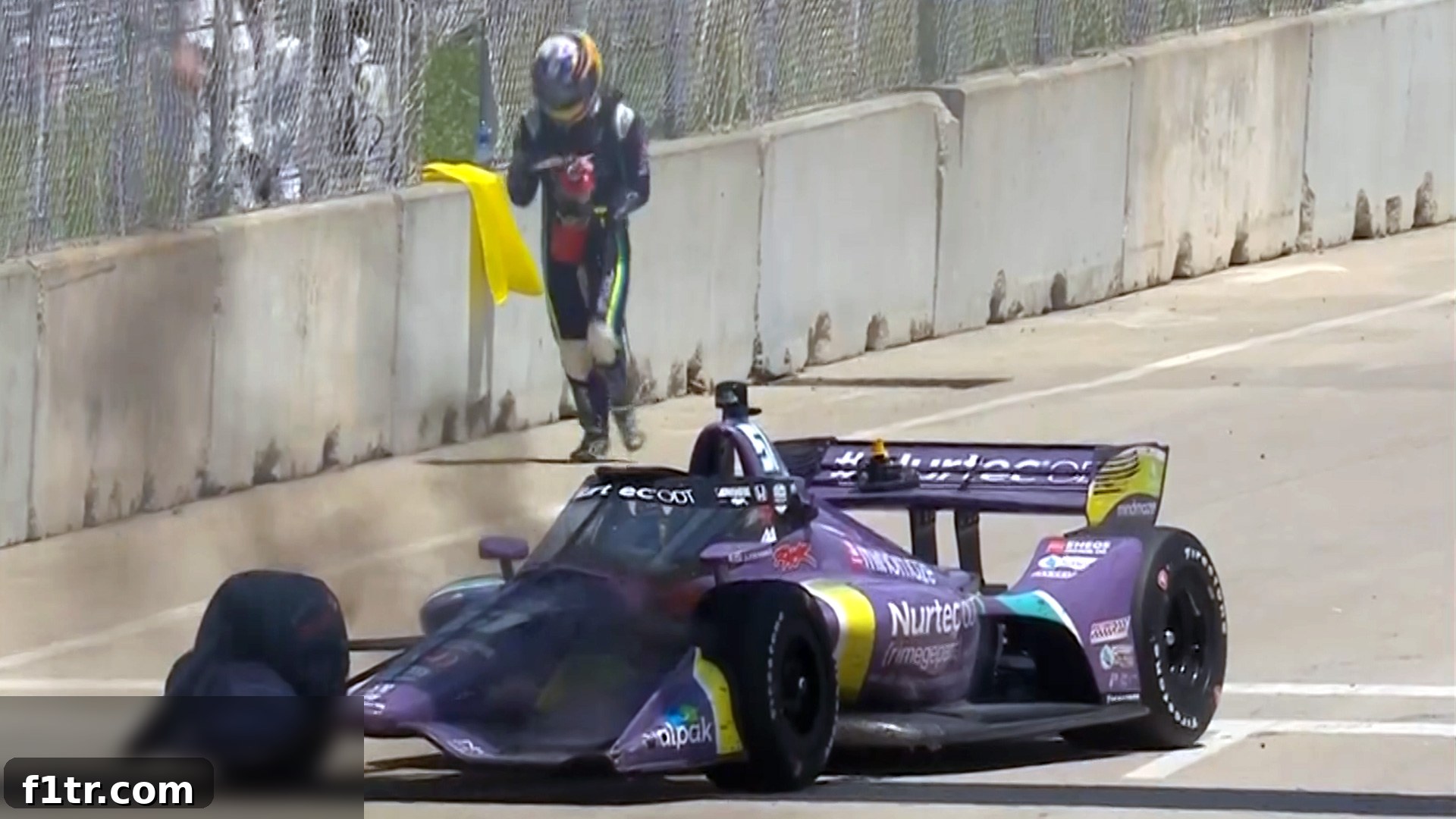
Six months following the harrowing Bahrain Grand Prix crash that dramatically concluded his illustrious Formula 1 career, Romain Grosjean once again confronted the specter of fire – this time, a much smaller, albeit symbolic, blaze in his IndyCar machine. The two-race spectacle at the Detroit Grand Prix encapsulated a frustrating yet undeniably promising chapter in the Frenchman’s nascent IndyCar journey, marked by flashes of brilliance, unfortunate collisions, and a stubborn refusal to yield.
The Dale Coyne Racing with Rick Ware Racing driver’s weekend on the challenging Belle Isle street circuit unfolded with a recurring, exasperating pattern. Each morning brought impressive qualifying results, showcasing the raw speed and potential of a genuine contender. Yet, come race time, minor skirmishes, self-inflicted errors, and mechanical gremlins conspired to shunt him outside the coveted top ten, often culminating in an eye-catching, premature retirement.
Saturday’s race saw Grosjean, pushing the limits, make an unforced error, crashing out on his own and triggering a pivotal red flag. The following day, Sunday, presented a different yet equally dramatic conclusion: a spin attributed to brake failure, swiftly followed by his front discs igniting in a concerning flare-up. Instinctively, Grosjean’s past experiences took over. Fearing for his car, he reached for a fire extinguisher to tackle the flames himself, a stark echo of his escape from the inferno in Bahrain. Fortunately, the swift arrival of the safety team allowed them to take control, pulling him away from his smouldering machine before he needed to deploy the extinguisher.
A Weekend of Unfulfilled Potential: Highs and Lows in Detroit
Despite the dramatic conclusions, the Detroit double-header clearly demonstrated the latent speed and adaptability of the former F1 star. His qualifying performances were nothing short of exceptional, hinting at a far greater potential than the final results suggested. Grosjean left Belle Isle without seeing the chequered flag in either race, a frustrating outcome for any driver, particularly one known for his fighting spirit.
Reflecting on the whirlwind weekend, Grosjean himself acknowledged the eventful nature of the races. “It was a pretty eventful weekend in Detroit,” he stated, a touch of understatement perhaps. He remained positive about his raw pace, adding, “I think we had two mega qualifying results with a third yesterday and fifth today.” These results were not merely good; they placed him firmly amongst the front-runners in a fiercely competitive series, proving his capability to extract maximum performance from his number 51 entry.
Saturday’s Frustrations: A Self-Inflicted Setback
Saturday’s first race began with Grosjean holding a solid position within the top ten. However, he soon found his car’s balance proving challenging to manage early on. “We struggled a bit more with the balance,” he explained, highlighting the fine margins that define success on a street circuit. Despite these difficulties, he was successfully navigating the pack and maintaining his position after a red flag restart, appearing poised to make progress. “We were hanging in there at the restart following the red flag and we were looking good.”
His ambition, however, proved to be his undoing. While attempting an aggressive overtaking maneuver on veteran driver Simon Pagenaud, the two made contact. “I made an attacking move on Simon Pagenaud but sadly we touched, and it caused a puncture,” Grosjean recounted. This incident dropped him significantly down the order to 21st place. Eager to recover lost ground and find pace at the back, Grosjean pushed too hard. “After that, I was running at the back and I was trying to find some pace, but I was a bit optimistic, and I ended up in the wall.” It was a costly error, one that underscored the brutal learning curve of IndyCar racing where even minor misjudgments can lead to significant consequences.
Sunday’s Fiery Conclusion: Brake Failure and Persistent Spirit
Sunday’s race commenced with Grosjean once again in the thick of the action, battling intensely from the very first corner. An early, audacious lunge from Alexander Rossi resulted in Grosjean being squeezed between Rossi and Scott Dixon. All three drivers made minor contact, a testament to the close-quarters nature of IndyCar starts, which inevitably cost Grosjean valuable positions at a critical stage of the race. “I got sandwiched at the race start and I lost a fair bit of positions,” he elaborated, detailing the immediate disadvantage.
Later in the race, following both drivers’ second pit stops, Grosjean was embroiled in a tight battle with Jack Harvey. During an attempted overtake, Grosjean punted Harvey into a half-spin, an incident that was swiftly reviewed by race control. The stewards deemed it avoidable contact, penalizing Grosjean with a drive-through penalty. This significantly hampered his progress, relegating him to 18th place for the majority of the race. He remained in this position, fighting to claw back time, until his dramatic retirement due to the blazing brakes.
Despite the series of unfortunate events, Grosjean maintained his composure and even managed a wry smile as he reflected on the day. “Then we tried to come into the race, but I picked up a drive-through penalty and we tried to come back from there,” he said, outlining the uphill battle. Describing the dramatic end, he added, “Eventually we had a brake fire, and I had to extinguish a fire, but we’re all good here.” This light-hearted remark underscored his remarkable resilience, especially given his recent history with fire-related incidents.
Crucially, Grosjean found positives to take away from an otherwise challenging weekend. “I think the positive of the day is that we improved the car a lot from yesterday and we can now look forward to Road America.” This forward-looking perspective is characteristic of a top-tier athlete, always seeking to learn and improve, regardless of immediate setbacks.
The Bigger Picture: Leaders’ Circle and IndyCar Adaptation
Romain Grosjean’s journey in IndyCar is more than just individual race results; it’s a crucial component of his team’s broader aspirations. His number 51 Dale Coyne Racing with Rick Ware Racing entry currently holds 16th place in the IndyCar entrant championship standings. This position is significant as it combines Grosjean’s personal results with those of his former Haas F1 colleague, Pietro Fittipaldi, who competed for the team at Texas and the Indianapolis 500. The ultimate goal for these full-time entrants is to finish within the top 22 in the championship by season’s end, which guarantees a substantial $1 million USD bonus as part of the highly coveted IndyCar Leaders’ Circle programme. This financial incentive is vital for independent teams like Dale Coyne Racing, making every point, and every race, incredibly important.
Grosjean’s adaptation from the highly technical world of Formula 1 to the more raw and physically demanding IndyCar series continues to be a central theme of his season. The cars are different, the circuits often more varied, and the racing style is arguably more aggressive and less forgiving of errors. His impressive qualifying speed demonstrates that the underlying talent and pace are undoubtedly there. The challenge now lies in translating that raw speed into consistent, clean race finishes, managing the car, and navigating the often chaotic race conditions that are a hallmark of IndyCar.
Beyond the Flames: A Symbol of Enduring Passion
The image of Romain Grosjean instinctively reaching for a fire extinguisher, mere months after escaping one of motorsport’s most horrific crashes, is deeply symbolic. It speaks volumes about his unwavering passion for racing, his dedication to his craft, and his sheer mental fortitude. Where many might have stepped away from the sport after such a traumatic event, Grosjean embraced a new challenge, finding joy and fierce competition in IndyCar.
His Detroit Grand Prix weekend, with its blend of brilliance and misfortune, serves as a powerful microcosm of his IndyCar experience so far. It highlights the immense potential he possesses, tempered by the inevitable learning pains and the unforgiving nature of top-tier motorsport. Yet, through it all, his determination to succeed remains undimmed, his focus firmly set on the next challenge.
Looking Ahead to Road America
With Detroit behind him, Grosjean and his team are now shifting their attention to Road America, a very different beast of a track. This classic road course offers sweeping corners and high-speed sections, a stark contrast to the tight confines of Belle Isle. It’s a circuit that often rewards bravery and precision, attributes Grosjean has in abundance. The aim will be to harness the qualifying pace he has consistently shown and transform it into a strong, clean race result, free from the incidents and mechanical issues that plagued his Detroit outing.
Romain Grosjean’s IndyCar journey is still in its early chapters. While Detroit may have been a challenging weekend, it was also another testament to his remarkable spirit and commitment. The motorsport world will undoubtedly be watching closely as he continues to push the limits, chase victory, and define this exciting new phase of his decorated racing career.
Further Reading on IndyCar
- IndyCar driver McLaughlin cleared of injury after crashing through barrier at Barber
- Schumacher says his IndyCar feels like ‘an F2 car, just with better tyres’
- IndyCar “way faster than Formula 1” in some corners, says Grosjean
- FIA to award more F1 superlicence points to IndyCar drivers from 2026
- Schumacher to race full-time in IndyCar with RLL in 2026
Browse all IndyCar articles