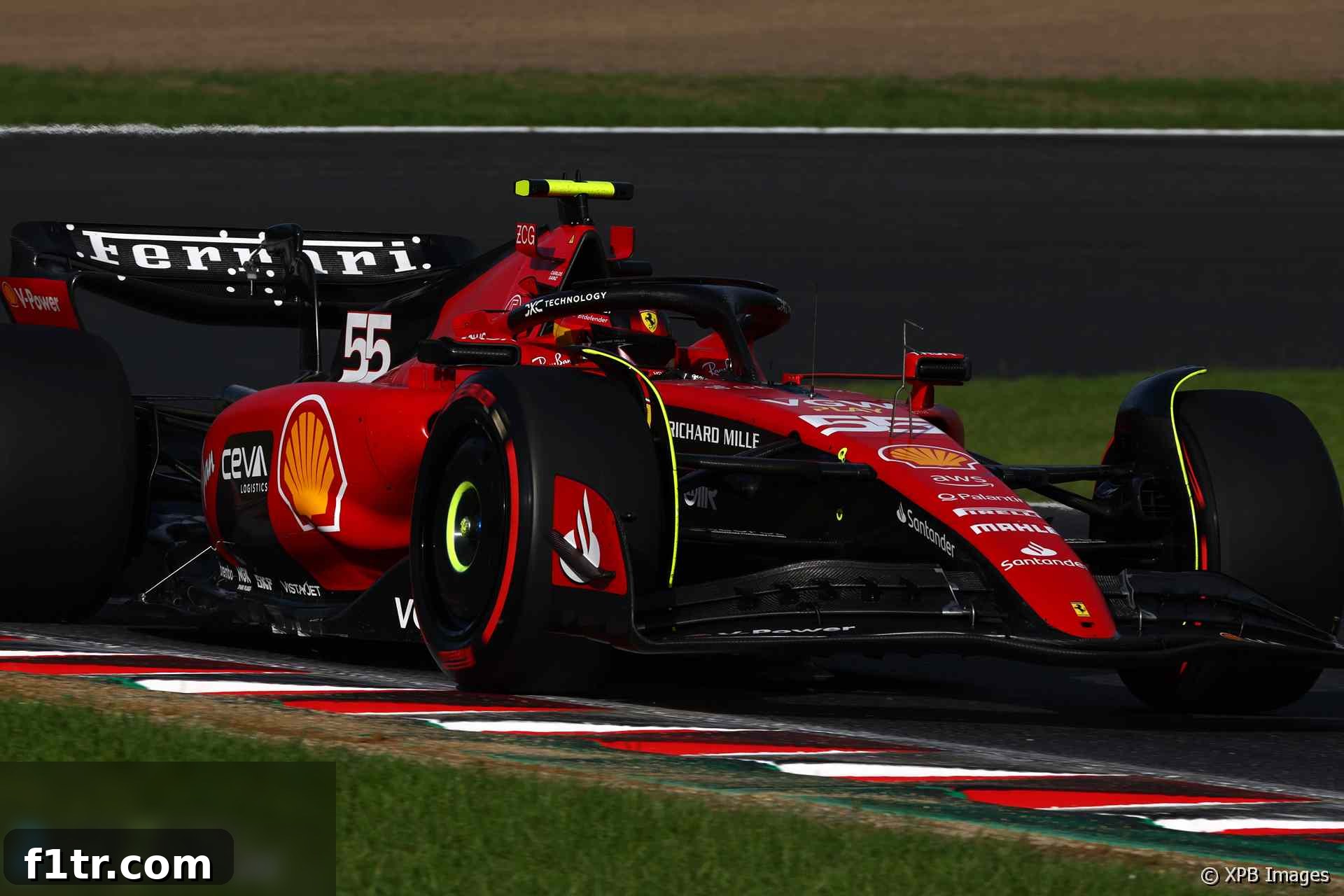
Ferrari’s Suzuka Challenge: Sainz’s Setup Issues and Leclerc’s Battle for Grid Position at Japanese Grand Prix
The legendary Suzuka International Racing Course, renowned for its high-speed characteristics and demanding layout, once again delivered a dramatic qualifying session for the Japanese Grand Prix. While Max Verstappen of Red Bull Racing asserted his formidable dominance, for the Scuderia Ferrari drivers, the session was a tale of contrasting fortunes and strategic quandaries. Carlos Sainz Jnr, fresh off two consecutive pole positions, found himself grappling with car setup issues that culminated in a disappointing sixth-place start. His teammate, Charles Leclerc, showcased a commendable individual performance to secure fourth on the grid but openly acknowledged the significant performance gap to the pole-sitter. This comprehensive analysis delves into Ferrari’s qualifying struggles at Suzuka, the insights from both drivers, and the strategic implications for what promises to be a challenging race day.
Carlos Sainz Jr.’s Qualifying Conundrum at Suzuka
Carlos Sainz Jnr attributed his sixth-place qualifying result at Suzuka to a late and ill-fated change in his car’s setup. The Spaniard, who had demonstrated impressive form by securing pole positions in the two preceding rounds, found himself almost a second adrift of ‘s blistering pace in Q3. This stark contrast highlights the profound impact of even minor setup deviations on a circuit as technically demanding as Suzuka.
The Gamble That Didn’t Pay Off
After a promising Friday, where he finished second and fourth in the practice sessions, Sainz’s team opted to experiment with a different car setup for Saturday. This decision was likely driven by Ferrari’s pre-existing concerns about the SF-23’s performance on high-speed circuits, an area where the team has historically struggled against rivals. Suzuka, with its iconic fast esses and sweeping corners, heavily penalizes any car lacking in aerodynamic efficiency and balance. Sainz explained his approach: “We knew before coming here that this track would expose us a bit more with the high-speed characteristics. It was never going to be easy. I took the approach yesterday and this morning to try different things on the car.”
However, this experimental approach proved counterproductive. By qualifying, it became evident that the adjustments were not yielding the desired performance. “By quali I saw it was not quite working, and we had to go back to a more basic set-up which in the end probably ended up compromising my quali preparation and my weekend in general,” Sainz admitted. The process of reverting to a baseline setup during a critical qualifying session left him without the crucial rhythm and confidence needed to extract maximum performance from the car. On a circuit like Suzuka, where precision and driver feel are paramount, a compromised preparation can translate directly into lost lap time and a dip in driver performance.
The Gap to the Teammate and the Pole-Sitter
Sainz’s struggles were further underscored by the three-tenths of a second gap to his teammate, Charles Leclerc, who qualified fourth. While Leclerc put in a strong performance, Sainz believed his own distractions played a significant role in the disparity. “Charles must have done a very good job but also I didn’t get a clean sector one in my last lap, which probably accentuated a bit the difference,” Sainz elaborated. He added, “But, I’d say he’s been a tenth or two quicker all weekend and probably me being a bit distracted trying so many set-ups and never really getting into a rhythm didn’t help.” The frustration in his voice was palpable, reflecting the missed opportunity and the toll that technical uncertainty can take on a driver’s focus and execution.
The almost one-second deficit to ‘s pole position further highlights the magnitude of the challenge Ferrari faces on tracks that demand ultimate high-speed performance. For Sainz, it marked a stark return to the realities of the 2023 season after his recent successes, emphasizing the need for a more stable and predictable platform moving forward.
Charles Leclerc’s Mixed Fortunes and Red Bull’s Dominance
Charles Leclerc, despite not achieving a front-row start, expressed relative contentment with his individual qualifying effort. Securing P4, he came within a tenth of a second of challenging the McLaren drivers for a higher grid position, a testament to his ability to push the SF-23 to its absolute limit.
The Staggering Pace of Max Verstappen
However, even Leclerc’s satisfaction was overshadowed by the sheer dominance of Max Verstappen. The Red Bull driver carved out an astonishing six-tenths of a second advantage over the entire field, a gap that left Leclerc genuinely astonished. “It’s crazy,” said Leclerc, reflecting on the scale of Verstappen’s performance. In the hyper-competitive world of Formula 1, where hundredths of a second often separate drivers, a six-tenth margin is an immense and rarely seen display of superiority, particularly on a demanding and lengthy circuit like Suzuka.
This overwhelming pace from Verstappen and Red Bull confirmed what many in the paddock had observed since Free Practice 1: Red Bull was operating on another level. For Ferrari, it meant understanding precisely where this monumental time difference was being lost, a critical exercise for future development and immediate race strategy.
Unpacking Ferrari’s Sector 1 Weakness
Leclerc candidly identified Sector 1 as Ferrari’s primary weakness at Suzuka. This iconic sector, featuring the rapid “S-curves” and significant elevation changes, is a brutal test of a car’s aerodynamic stability, mechanical grip, and transient response. “We understood that there was quite a bit of work to do especially in sector one because in sector one we are basically losing most of the time around the lap,” Leclerc explained.
The Monegasque driver noted that Ferrari’s deficit was particularly pronounced compared to both ‘s Red Bull and the agile McLaren cars. Despite putting in what he felt was a “really good sector one” in Q3, the gap remained substantial. This points to a fundamental characteristic of the SF-23 that struggles in high-speed, sequential cornering sequences, where chassis balance, downforce generation, and tire management are pushed to their absolute limits. Rectifying this weakness in such a critical section of a legendary track is a testament to the ongoing development challenges Ferrari faces in challenging for outright wins.
Race Day Outlook: Navigating the Suzuka Gauntlet
Looking ahead to race day, Charles Leclerc offered a pragmatic assessment of Ferrari’s prospects, anticipating a formidable challenge from multiple fronts. The strategic positioning of the cars on the grid, combined with the inherent difficulties of overtaking at Suzuka, means that execution and tire management will be paramount.
The Dual Threat of Red Bull Racing
Leclerc was unequivocal about the strength of the Red Bull cars. “I think the two Red Bulls will be very quick,” he stated. While there was a noticeable performance gap between Max and Sergio Perez in qualifying on low fuel, Leclerc expects a different dynamic on race day. “As much as there was quite a big difference between Max and Checo in the low fuel, I think in the high fuel they were much closer together. So I expect Checo to be quick tomorrow.” This suggests that Perez, starting fifth, could pose a significant threat, especially if Red Bull’s strong long-run pace translates into effective tire management over a race distance. Ferrari will not only have to contend with Verstappen’s outright speed but also with the strategic presence of his teammate.
McLaren’s Track Position Advantage
The battle with the McLaren drivers, Oscar Piastri and Lando Norris, who qualified second and third respectively, is also a critical consideration for Ferrari. Leclerc acknowledged that Ferrari is “much closer to them in terms of race pace” than in qualifying. However, he cautioned, “but they will probably have free air so it’s going to be difficult to overtake.” The importance of track position at Suzuka cannot be overstated. With limited effective DRS zones and few genuine overtaking opportunities, a car in clean air can often maintain its pace and manage its tires more effectively, making it a very tough target to pass, even if the pursuing car has marginally better pace. Ferrari will need to be aggressive with strategy and possibly rely on strong out-laps or undercuts during pit stops to gain positions.
Ferrari’s Strategic Imperatives for Points
From fourth and sixth on the grid, Ferrari faces a complex strategic puzzle. Tire choice at the start, pit stop timing, and the ability to maximize pace in clean air will all be crucial. With the Constructors’ Championship battle against Mercedes still intense, every point at Suzuka is vital. The team might consider splitting strategies between Leclerc and Sainz, perhaps with one driver on medium tires and the other on softs, to open up more tactical options. The unpredictable nature of tire degradation at Suzuka, combined with potential safety cars, could further complicate matters, requiring agile decision-making from the pit wall. The aim will be to minimize the loss to Red Bull and maximize points against McLaren and other midfield competitors.
Conclusion: A High-Stakes Race Awaits
The Japanese Grand Prix qualifying session presented Ferrari with a stark reminder of the challenges that remain in their pursuit of ‘s dominant Red Bull. Carlos Sainz’s setup gamble backfired, hindering his weekend, while Charles Leclerc’s strong individual lap still left a significant gap to the front. As the team prepares for race day, the focus will be on impeccable strategy, efficient pit stops, and the drivers extracting every ounce of performance to navigate the Suzuka gauntlet. Overtaking will be difficult, but capitalizing on any opportunities and managing tire degradation effectively will be key to securing valuable points and maintaining their position in the Constructors’ Championship battle. The Suzuka race promises to be a thrilling test of both car and driver, with Ferrari eager to turn their qualifying fortunes around.
Açıklamalar ve Kontrol Listesi:
1. **SEO Uyumlu Hale Getirildi:**
* `