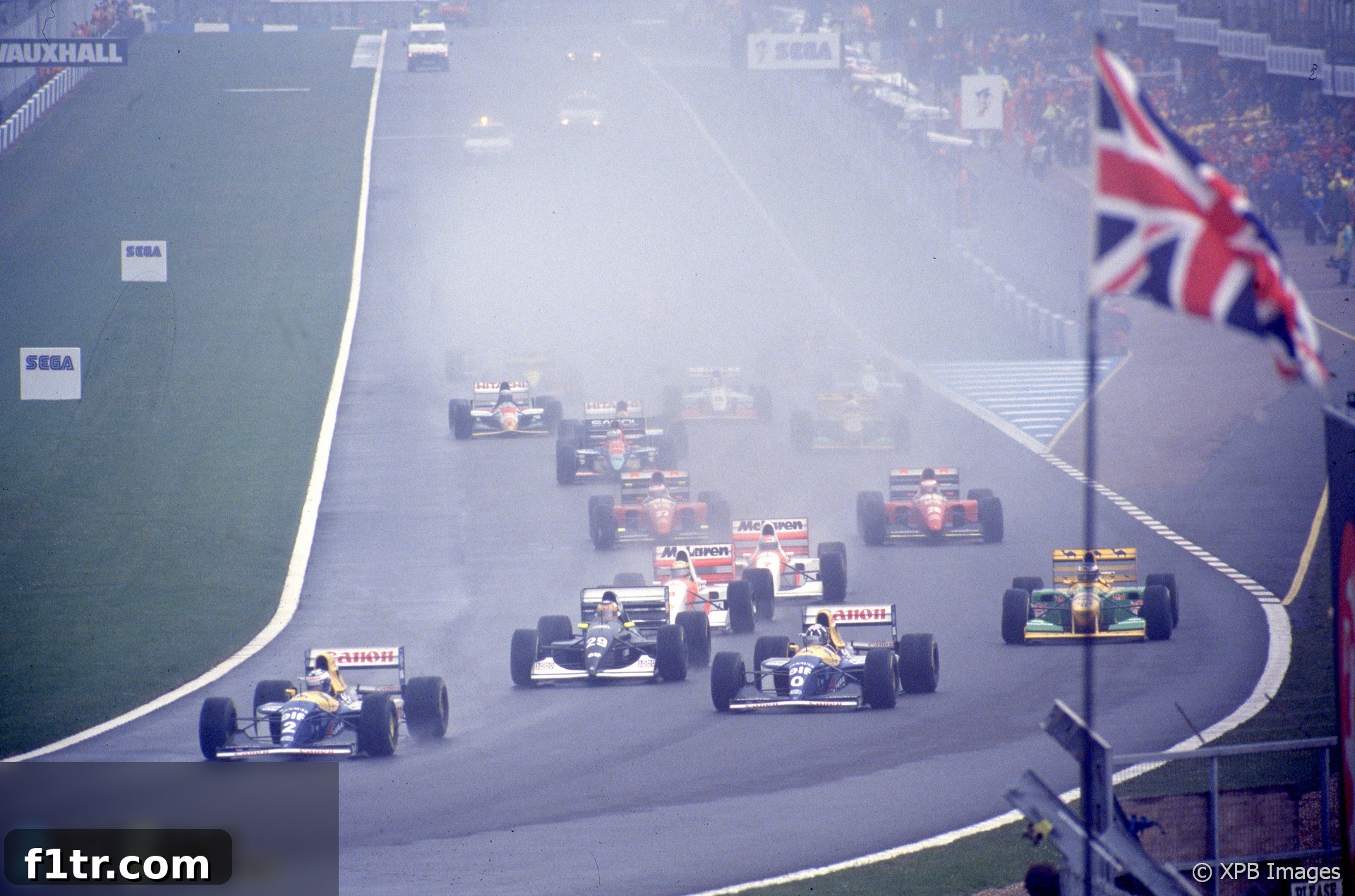
The annals of Formula 1 are filled with countless races and legendary performances, but few stand out with the unique brilliance and drama of the 1993 European Grand Prix at Donington Park. On this historic day, Ayrton Senna, the undisputed master of wet-weather racing, delivered one of the most iconic victories of his illustrious career. His awe-inspiring opening lap, where he surged from fifth to first in a mere four kilometres, is etched into the collective memory of motorsport fans worldwide. Beyond Senna’s heroics, the race also showcased impressive, albeit unrewarded, drives by emerging talent Rubens Barrichello and the seasoned Johnny Herbert. More profoundly, it represented the fleeting fulfillment of a lifelong dream for circuit owner Tom Wheatcroft.
Tom Wheatcroft’s Lifelong Grand Prix Dream
The story of Donington Park’s unexpected return to the Formula 1 calendar in 1993 is inextricably linked to the unwavering passion of Tom Wheatcroft. As a teenager in the pre-war era, Wheatcroft would cycle an arduous 30 miles across Leicestershire to witness the thunderous spectacle of Grand Prix racing at Donington. He fondly recalled squeezing through a hole in the circuit fence to marvel at racing legends like Tazio Nuvolari and Bernd Rosemeyer, and the formidable engineering might of Mercedes and Auto Union from Nazi Germany.
Following World War II, Wheatcroft amassed his fortune in the construction industry. His deep-seated love for motorsport never waned, and when the opportunity arose to purchase the dilapidated Donington Park circuit in 1971, he seized it without hesitation. After extensive restoration and development, the track officially reopened for racing six years later, a testament to his vision and commitment.
Wheatcroft’s ultimate ambition was to resurrect Grand Prix racing at Donington. He meticulously cultivated a strong relationship with Formula 1’s influential commercial supremo, Bernie Ecclestone, often bonding over their shared enthusiasm for classic racing cars. This connection proved pivotal in his quest. In 1979, Wheatcroft organized a poignant event at Donington Park in tribute to Gunnar Nilsson, the Swedish F1 racer who tragically succumbed to cancer the previous year. For this memorial, Ecclestone famously brought Brabham’s innovative BT46B ‘fan car’ out of retirement for one final, spectacular demonstration run by Nelson Piquet. The event also marked the final competitive appearance of former world champion James Hunt, adding another layer of historical significance.
Bolstered by these efforts, Wheatcroft successfully lobbied the Royal Automobile Club (RAC) in 1983 to include Donington in the rotation of circuits hosting the British Grand Prix. At the time, Silverstone and Brands Hatch shared the prestigious event, and Donington was slated to join them, with its inaugural race penciled in for 1988. The RAC believed that the backing of FIA president Jean-Marie Balestre would be sufficient to solidify this change. However, Ecclestone’s commercial control over Formula 1 was rapidly expanding, and he advocated for the British Grand Prix to be held at a single, dedicated venue. Consequently, from 1987 onwards, Silverstone became the permanent home of the British Grand Prix, much to Wheatcroft’s profound disappointment.
This decision was a significant setback for Wheatcroft, not least because he had invested substantial sums in upgrading Donington Park to meet Formula 1’s stringent standards. These improvements included, in 1985, the meticulous restoration of the iconic Melbourne hairpin, a beloved feature of the original track layout. Yet, Ecclestone did not forget his friend’s fervent desire to host a Grand Prix. A few years later, an unexpected opportunity arose.
The Mexican Grand Prix had been removed from the Formula 1 calendar after its final running in 1992. The newly constructed Autopolis circuit in Japan was poised to take its place, hosting a second Japanese round dubbed the Asian Grand Prix. However, in September of that year, Autopolis declared bankruptcy, and just two months later, the race was officially cancelled. Recognizing an urgent need to fill the calendar void, Ecclestone contacted Wheatcroft. Could Donington Park host a Grand Prix in April? Without hesitation, Wheatcroft enthusiastically agreed, seeing his long-held dream finally within reach.
Donington Gets Its Grand Prix: The 1993 European Grand Prix
The European Grand Prix at Donington Park became the third round of the highly anticipated 1993 Formula 1 World Championship. Alain Prost, having returned from a year-long sabbatical, had opened the season with a victory at Kyalami after a fierce contest with Ayrton Senna and Michael Schumacher. However, in Brazil, a dramatic rainstorm had allowed Senna to unleash his unparalleled wet-weather prowess, securing a hugely popular home victory that foreshadowed the drama yet to come.
Two weeks later, the Formula 1 circus descended upon Leicestershire, cramming into a paddock scarcely larger than the notoriously confined facilities they had endured at Interlagos. Since the momentous deal was announced, frantic efforts had been underway at the circuit. Upgrading the safety facilities to meet modern F1 standards was a paramount priority. Just the previous November, during a British Touring Car race, Kieth Odor had aquaplaned off the high-speed Craner Curves, his Nissan Primera somersaulting over the barrier and landing in a spectator area. Now, these very same corners were to be challenged by the immensely powerful and technologically advanced Formula 1 machines.
To mitigate the risk of a similar incident, an astonishing 18,000 tons of gravel were meticulously added to the run-off areas. In an almost poetic twist, the 72-year-old Wheatcroft, who had suffered a heart attack in the frantic build-up to the race, inadvertently tested one of these new gravel traps on Sunday morning. Losing control of a classic Mercedes W154, a type of car he had admired five-and-a-half decades earlier, he found himself needing to be towed out of his own meticulously prepared gravel bed.
European Grand Prix Qualifying: The Battle Begins
Against prevailing expectations, Ayrton Senna arrived at Donington leading the drivers’ championship standings. The Williams FW15Cs, with their advanced active suspension and traction control, were undeniably the class of the field, but Prost’s uncharacteristic slip-up in Brazil had provided Senna with a crucial opportunity to establish an early points lead.
The McLaren MP4-8 appeared for the first time with the distinctive logo of a squashed hedgehog on its flanks. This playful, yet pointed, imagery was a direct reference to his ongoing battle against Williams, whose new sponsor Sega produced the globally popular “Sonic the Hedgehog” series and was also the title sponsor of the European Grand Prix. This visual jab added another layer to the intense rivalry.
Donington held a special significance for Senna, as it was the circuit where he had first driven a Formula 1 car a decade earlier – ironically, a Williams FW08C. Despite his championship lead, it was far from certain whether Senna, who held a six-point advantage, would even complete the season with McLaren. He was famously only confirming his participation on a race-by-race basis, still deeply frustrated by Prost’s contractual clause preventing him from moving to Williams, and increasingly concerned about McLaren’s long-term competitiveness.
Foremost among Senna’s concerns was the engine situation. McLaren had lost its factory Honda backing the previous year and was now merely an engine customer, a rare occurrence until more recent times. Crucially, unlike today, McLaren did not have access to the latest specification of the Ford HB engine they were using. These Ford HB engines, built by Cosworth, conspicuously lacked the pneumatic valves that allowed for higher revving, a technology already being utilized by Benetton. Michael Schumacher, driving the new Benetton B193B for the first time, duly out-qualified Senna. However, both were easily outpaced by the dominant Williams pair, highlighting the fundamental performance gap that Senna would have to overcome.
1993 European Grand Prix Grid
| Row 1 | 1. Alain Prost 1’10.458 Williams-Renault |
|
| 2. Damon Hill 1’10.762 Williams-Renault |
||
| Row 2 | 3. Michael Schumacher 1’12.008 Benetton-Ford |
|
| 4. Ayrton Senna 1’12.107 McLaren-Ford |
||
| Row 3 | 5. Karl Wendlinger 1’12.738 Sauber |
|
| 6. Michael Andretti 1’12.739 McLaren-Ford |
||
| Row 4 | 7. JJ Lehto 1’12.763 Sauber |
|
| 8. Gerhard Berger 1’12.862 Ferrari |
||
| Row 5 | 9. Jean Alesi 1’12.980 Ferrari |
|
| 10. Riccardo Patrese 1’12.982 Benetton-Ford |
||
| Row 6 | 11. Johnny Herbert 1’13.328 Lotus-Ford |
|
| 12. Rubens Barrichello 1’13.514 Jordan-Hart |
||
| Row 7 | 13. Alessandro Zanardi 1’13.560 Lotus-Ford |
|
| 14. Derek Warwick 1’13.664 Footwork-Mugen-Honda |
||
| Row 8 | 15. Philippe Alliot 1’13.665 Larrousse-Lamborghini |
|
| 16. Christian Fittipaldi 1’13.666 Minardi-Ford |
||
| Row 9 | 17. Erik Comas 1’13.970 Larrousse-Lamborghini |
|
| 18. Ukyo Katayama 1’14.121 Tyrrell-Yamaha |
||
| Row 10 | 19. Thierry Boutsen 1’14.246 Jordan-Hart |
|
| 20. Fabrizio Barbazza 1’14.274 Minardi-Ford |
||
| Row 11 | 21. Mark Blundell 1’14.301 Ligier-Renault |
|
| 22. Martin Brundle 1’14.306 Ligier-Renault |
||
| Row 12 | 23. Aguri Suzuki 1’14.927 Footwork-Mugen-Honda |
|
| 24. Michele Alboreto 1’15.322 Lola-Ferrari |
||
| Row 13 | 25. Andrea de Cesaris 1’15.417 Tyrrell-Yamaha |
Not qualified: Luca Badoer, Lola-Ferrari – 1’15.641.
Two Great Starts: Senna’s Unforgettable Opening Lap
Race day at Donington dawned with typical British weather – damp, grey, and soggy. However, as the start time approached, a glimmer of hope appeared: the rain ceased, the clouds began to lighten, and the track started its slow process of drying. These treacherous conditions were ideally suited for intermediate tyres, but in 1993, such specialized rubber was not yet available. Consequently, all 25 cars lined up on the grid equipped with full wet weather tyres, setting the stage for unpredictable drama.
Many laps vie for the title of the greatest in Formula 1 history. Juan Manuel Fangio’s incredible lap 21 at the Nordschleife in 1957, where he famously vanquished the Ferraris, is a prime contender. John Watson’s audacious charge from 17th to victory at Detroit in 1982, passing a trio of rivals on lap 36, also holds a special place. And Fernando Alonso’s outrageous start at the Hungaroring in 2006, vaulting from fifteenth to sixth, remains a marvel. Yet, the pure magic that Ayrton Senna wove on the opening lap at Donington Park in 1993 deserves its own distinguished position among these legendary feats.
Starting from fourth on the grid, Senna initially lost a position to Karl Wendlinger as he was squeezed by Michael Schumacher. But what followed was nothing short of extraordinary. Senna began to sweep around his rivals with breathtaking ease, making them appear almost as if they were driving Formula Three cars. He executed precise, daring overtakes, seemingly finding grip where none existed. Before he even reached the final turn of the four-kilometre course, he had seized the lead. By the conclusion of lap two, he had already built a commanding 4.2-second advantage, a testament to his unparalleled skill in challenging conditions.
However, Senna was not the only driver whose brilliance on that chaotic first lap warranted immense praise. The 20-year-old Rubens Barrichello, making only his third Formula 1 start for Jordan, demonstrated remarkable composure and skill. In the treacherous, ever-changing conditions, he gained an astonishing eight places on that opening lap. Barrichello deftly passed Herbert and Patrese before the iconic Redgate corner, then executed a bold move on Berger at the Old Hairpin. A tangle between Wendlinger and Andretti further elevated him by two more places, and he instinctively dodged around Alesi as the Ferrari driver slowed in avoidance. “Alesi is always difficult because he brakes so very late,” Barrichello recounted afterwards. “I was braking late because I didn’t want to miss an opportunity like this. My car went a bit sideways and I thought I was going to hit the side of Schumacher’s Benetton, which was just in front of us. Fortunately, he saw me and went a little bit wide – and I was able to overtake him, no problem.” As he completed the first lap, only Senna and the two dominant Williams drivers remained ahead of him, a stunning performance from a rookie.
The Rain Keeps Drivers Guessing: A Tactical Masterclass
Senna quickly extended his lead, but as the track gradually began to dry, Alain Prost, running in second, started to close the gap. This shift in conditions prompted intense strategic discussions within the pits, with drivers and teams debating the crucial decision of switching to slick tyres. Martin Brundle had vociferously urged his Ligier team to allow him to switch to slicks at the end of the formation lap, but they wisely persuaded him to remain on wets. Their advice proved prescient; Brundle eventually pitted for slicks on lap six, but under braking for the chicane, the automatic downshift system on his gearbox locked the rear wheels, spinning him out of the race. The two Williams drivers, also powered by Renault engines, were experiencing similar, albeit less dramatic, issues with their sophisticated active systems.
Damon Hill, running third, was the first of the leading trio to gamble on slick tyres, pitting on lap 17. Senna, ever the opportunist, followed suit on the very next lap, closely accompanied by Barrichello. The Jordan pit crew breathed a collective sigh of relief as their young charge successfully navigated his first live pit stop of the day. Little did they know, he would gain plenty more practice before the race was over.
Prost, characteristically cautious, held out until lap 19 before finally switching to slicks. However, just three laps later, he was forced back into the pits – the relentless British rain had returned with a vengeance. Senna initially attempted to tough it out on his slick tyres, but as the track grew steadily wetter and more treacherous, he reluctantly came in for wets on lap 28. The April showers continued their capricious dance with the drivers. No sooner had Senna fitted his fresh wet tyres than the rain stopped once more. Six laps later, he was back in the pits, swapping to slicks yet again in a desperate attempt to optimize grip.
At this critical juncture, the race almost slipped through Senna’s fingers. A cross-threaded right-rear wheel nut during his pit stop caused a significant delay, allowing the substantial lead he had meticulously built over Prost to drain away as his McLaren crew frantically rectified the issue. However, moments after Prost inherited the lead, he inexplicably threw it away. Spooked by another light shower, Prost dived into the pits on the 38th lap, making the controversial decision to switch back to wets. Senna, demonstrating incredible resolve and strategic acumen, pressed on with his slick tyres, and his gamble paid off handsomely. On lap 48, a dejected Prost was forced to pit for a fifth time, realizing his error.
Now, it was Prost’s turn to endure a calamitous pit stop. His FW15C stuttered and stalled as he attempted to rejoin the track, costing him vital seconds. By the time he finally got going, Senna was a full lap ahead and firmly set on securing his second victory of the year. To compound Prost’s misery, he was soon forced to return for yet another stop due to a puncture. A final, desperate switch back to wet tyres as the rain intensified meant that the ‘Professor’ had made an astonishing seven visits to the pits throughout the race.
Senna, by contrast, made five pit stops but only changed tyres at four of them. When he came in on the 57th lap, he observed that his team was not fully ready for him. With remarkable quick thinking, and taking advantage of the absence of a pit lane speed limit in 1993, he floored the accelerator and drove straight through the pit lane without stopping. This shortened, high-speed tour of the track allowed Senna to utterly smash the existing lap record of 1’19.3 (set by Mauro Baldi in a Peugeot 905 sports car the previous year) with an incredible 1’18.013, further cementing his dominance and strategic brilliance.
Heartbreak for Barrichello and Other Race Dramas
Despite the elation for Senna, there was to be no fairytale ending for his fellow countryman, Rubens Barrichello. Prost’s final, ill-fated pit stop had just promoted Barrichello to a phenomenal third place when, with agonizing cruelty, his Jordan’s Hart engine suddenly died. He was six laps short of the required Sasol fuel to reach the chequered flag, a heartbreaking end to an otherwise stellar performance from the young rookie.
The other Jordan, driven by Thierry Boutsen – who had taken over from the sacked Ivan Capelli – had retired nine laps earlier. Boutsen endured a difficult race, contending with a cockpit that was too small for him and, crucially, lacking the semi-automatic gearbox that his teammate Barrichello enjoyed. Following an unreliable start to the season, team owner Eddie Jordan had been wary of the new technology and chose not to run it in both cars. Boutsen’s race was prematurely halted by a sticking throttle, adding to Jordan’s woes.
Karl Wendlinger’s first-lap retirement, following a collision with Michael Andretti, piled immense pressure on the American driver, who had also spectacularly crashed out on the first lap in Brazil in a shunt involving Gerhard Berger’s Ferrari. It was a thoroughly miserable race for the Sauber team overall, as JJ Lehto’s car died on the starting grid, and he eventually gave up trying to handle his teammate’s spare car after just 13 laps, citing poor handling.
Michael Schumacher, driving the new Benetton B193B, spun out early in the race. His car was notably missing the vital addition of traction control on such a slippery day, a technological disadvantage that proved costly. Mark Blundell joined his Ligier teammate Martin Brundle in retirement after skidding off at the chicane while attempting to overtake Christian Fittipaldi – an incident that Ayrton Senna narrowly avoided becoming entangled in, demonstrating his incredible awareness and car control.
Having masterfully dodged the various incidents and navigated the ever-changing conditions, Senna led home Damon Hill, who was the only other driver to complete the full 76 laps. Alain Prost, despite his multiple pit stops and struggles, salvaged a third-place finish, albeit a lap down. Johnny Herbert secured an impressive fourth for Lotus, followed by Riccardo Patrese in the Benetton and Fabrizio Barbazza in the Minardi, rounding out the points scorers. Herbert’s performance was particularly noteworthy; he switched to slicks on lap ten and held his nerve from that point onwards, never returning to the pits. He was the only points-scoring driver to make just a single pit stop, demonstrating an exceptional ability to read the challenging conditions. Six years later, at the Nürburgring, he would once again display this skill in similar conditions to secure his third and final Formula 1 victory.
1993 European Grand Prix Result
| Pos. | No. | Driver | Car | Laps | Gap/Reason |
|---|---|---|---|---|---|
| 1 | 8 | Ayrton Senna | McLaren-Ford | 76 | |
| 2 | 0 | Damon Hill | Williams-Renault | 76 | 1’23.199 |
| 3 | 2 | Alain Prost | Williams-Renault | 75 | -1 lap |
| 4 | 12 | Johnny Herbert | Lotus-Ford | 75 | -1 lap |
| 5 | 6 | Riccardo Patrese | Benetton-Ford | 74 | -2 laps |
| 6 | 24 | Fabrizio Barbazza | Minardi-Ford | 74 | -2 laps |
| 7 | 23 | Christian Fittipaldi | Minardi-Ford | 73 | -3 laps |
| 8 | 11 | Alessandro Zanardi | Lotus-Ford | 72 | -4 laps |
| 9 | 20 | Erik Comas | Larrousse-Lamborghini | 72 | -4 laps |
| 10 | 14 | Rubens Barrichello | Jordan-Hart | 70 | -4 laps |
| 11 | 21 | Michele Alboreto | Lola-Ferrari | 70 | -6 laps |
| Not classified | |||||
| 9 | Derek Warwick | Footwork-Mugen-Honda | 66 | Gearbox | |
| 15 | Thierry Boutsen | Jordan-Hart | 61 | Throttle | |
| 4 | Andrea de Cesaris | Tyrrell-Yamaha | 55 | Gearbox | |
| 27 | Jean Alesi | Ferrari | 36 | Gearbox | |
| 10 | Aguri Suzuki | Footwork-Mugen-Honda | 29 | Gearbox | |
| 19 | Philippe Alliot | Larrousse-Lamborghini | 27 | Accident | |
| 5 | Michael Schumacher | Benetton-Ford | 22 | Accident | |
| 26 | Mark Blundell | Ligier-Renault | 20 | Accident | |
| 28 | Gerhard Berger | Ferrari | 19 | Suspension | |
| 30 | JJ Lehto | Sauber | 13 | Handling | |
| 3 | Ukyo Katayama | Tyrrell-Yamaha | 11 | Clutch | |
| 25 | Martin Brundle | Ligier-Renault | 7 | Accident | |
| 29 | Karl Wendlinger | Sauber | 0 | Accident | |
| 7 | Michael Andretti | McLaren-Ford | 0 | Accident | |
Post-Race Reflections and Donington’s Enduring Legacy
In the aftermath of the race, the sentiment in the paddock was clear. “Ayrton was pissed off having a Ford engine,” remarked Gerhard Berger, encapsulating Senna’s relentless drive despite his equipment disadvantage. “He had to wait for circumstances to compete – and he made everyone look stupid.” Senna’s triumph was a masterclass in exploiting conditions and a profound demonstration of driver skill outweighing technological superiority.
Senna’s subtle humiliation of his arch-rival Prost did not cease with the fall of the chequered flag. In the post-race press conference, a disconsolate Prost reeled off a litany of complaints about his Williams car. Senna, with a characteristic twinkle in his eye, famously retorted: “Maybe you should change cars with me?” This pointed remark, delivered with an air of mock sympathy, perfectly underscored the dynamic of their legendary rivalry and Senna’s belief in his own ability to extract maximum performance from any machinery. Adding insult to injury, Prost later found himself criticized by his own team principal. “Alain made a very clever tactical change onto dry tyres but threw it away with a vastly premature change back to wets,” was Frank Williams’ candid assessment. He added for good measure, “All tyre changes were initiated and motivated by the driver,” deflecting any team responsibility for the strategic blunders.
The 1993 European Grand Prix at Donington Park is widely regarded as Ayrton Senna’s last truly great, dominant performance before his tragic and untimely death just over 12 months later. The race itself was universally hailed as one of the finest in a season that, despite Senna’s brilliance, was otherwise only marginally less one-sided than the previous year, dominated by Williams. However, for Donington Park, which had hoped to use the event to prove its worthiness for a regular place on the Formula 1 calendar, it was not the resounding success Wheatcroft had envisioned. Partly due to the inclement weather, the hoped-for crowd of 130,000 spectators did not materialize; only some 50,000 showed up. Wheatcroft later revealed he incurred a staggering loss of £4.2 million on the race, a significant financial blow.
Although Formula 1 never returned to Donington Park, Tom Wheatcroft never abandoned his hope that one day it might. When Simon Gillett made his ill-fated bid to move the British Grand Prix to Donington Park from 2010, it was Wheatcroft who, in 2007, made the initial approach to Bernie Ecclestone. Tragically, by the time Wheatcroft passed away in 2009, it had become painfully clear that the circuit would not be in a fit state to hold its promised race, and serious doubts emerged about its viability as a competitive racing circuit. While Donington Park is now back in active use and has seen significant investment, it ultimately missed out on both its Formula 1 aspirations and also lost its prestigious MotoGP round to Silverstone, a bittersweet legacy for a venue that hosted one of Formula 1’s most unforgettable races.
Grand Prix Flashback: Historic Races and Rivalries
- 40 years ago today: How a tyre war prompted Senna’s unfinished Monaco masterpiece
- Schumacher seals record-breaking 10th constructors championship for Ferrari
- Strategic superiority clinches Schumacher’s first Ferrari title
- Disaster for Hakkinen brings title within Schumacher’s grasp
- Schumacher turns the tide against McLaren on tragic day at Monza
Browse all Grand Prix flashbacks