Australian Grand Prix Near-Miss Prompts Urgent F1 Restart Procedure Review
The thrilling yet chaotic 2023 Australian Grand Prix saw its share of drama, not least a critical incident during a Safety Car restart that has prompted Formula 1 stewards to call for an immediate review of the formation lap procedure before standing restarts. A dangerous near-miss involving multiple drivers highlighted a potential loophole in current regulations, raising significant safety concerns within the sport and igniting a broader discussion about procedural refinement.
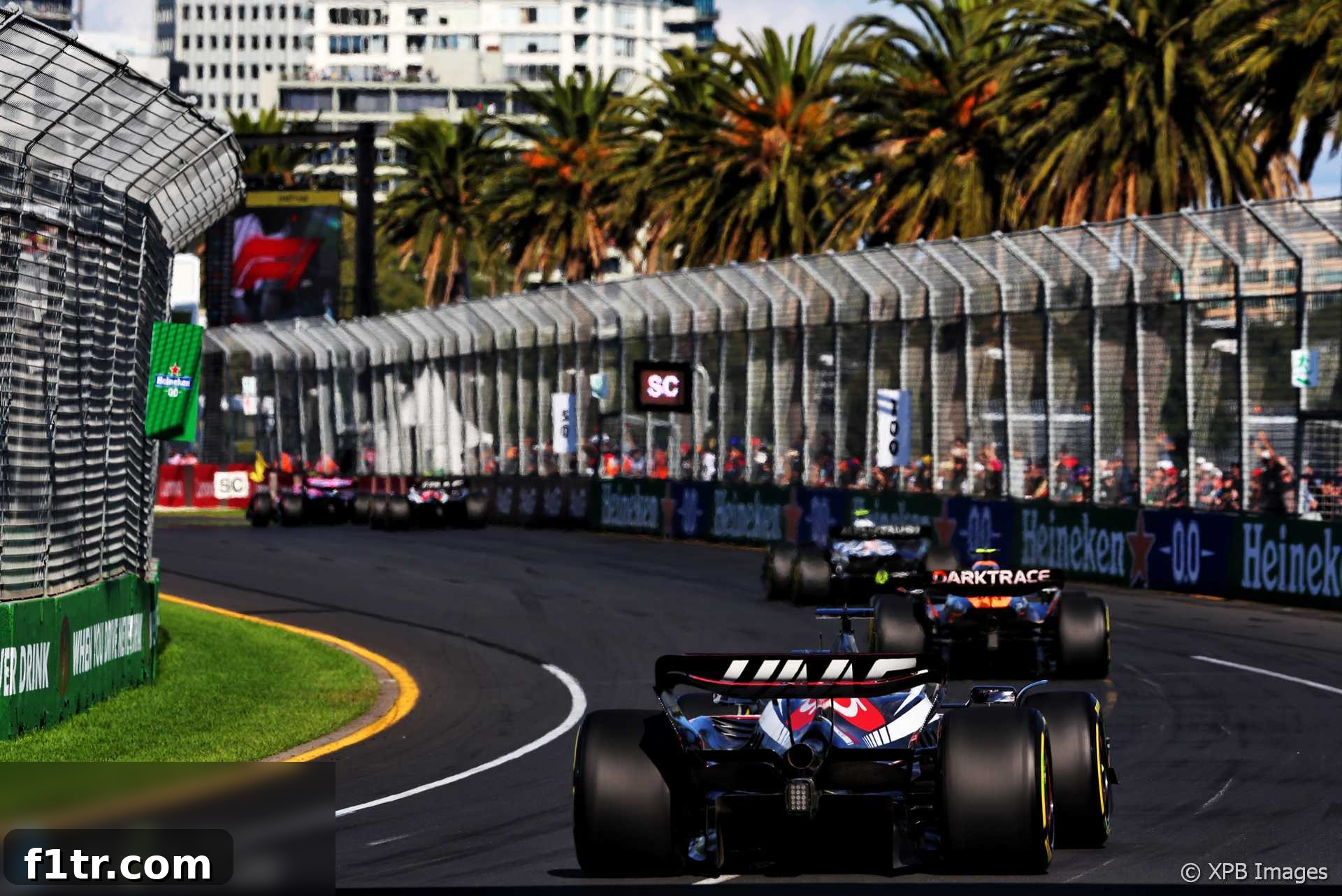
The incident unfolded prior to the first standing restart of the race, a consequence of a red flag triggered by Alexander Albon’s high-speed crash. As the cars gathered behind the Safety Car, preparing for the restart, a concerning bunching of the field occurred at the challenging Turn 6 of the Albert Park circuit. Several vehicles slowed abruptly, almost coming to a complete halt, forcing Kevin Magnussen to take drastic evasive action, which included running wide onto the gravel trap to avoid what could have been a multi-car collision. This moment of extreme tension underscored the need for clarity and robust safety protocols during such critical phases of a race.
Advert | Become a Supporter & go ad-free
Following the race, the stewards initiated a comprehensive investigation into the Safety Car procedure. Their primary objective was to ascertain whether any driver had failed to adhere to the prescribed restart protocol. Despite the gravity of the near-miss and the clear safety implications, the stewards ultimately concluded that no further action would be taken against any individual driver, pointing instead to systemic issues within the regulations themselves, rather than individual culpability. This decision shifted the focus from penalization to prevention, emphasizing a need for rule adjustments.
The Chain Reaction: Russell’s Slow Pit Exit and the Stretched Field
The stewards’ meticulous investigation brought to light a crucial detail: a surprisingly slow getaway from the pit lane by Mercedes driver George Russell inadvertently played a significant role in creating the subsequent confusion and danger. As the grid departed the pit lane behind the Safety Car for the initial restart, Russell found himself positioned in seventh place, directly behind Nico Hulkenberg’s Haas. This seemingly minor event initiated a complex chain reaction across the entire field.
Russell’s delay in pulling away from the pit lane exit was substantial. By the time he finally joined the racetrack, Hulkenberg had already navigated Turn 3, creating an immediate gap. This initial delay had a cascading effect, causing the entire field to become significantly strung out. The disparity in positions and speeds was stark: Kevin Magnussen, in 18th and last place, was still exiting the pit lane while race leader Lewis Hamilton was already making his way through Turn 7. This wide spread meant drivers were operating under vastly different conditions and speeds, forcing those further back to push hard to catch up, unwittingly setting the stage for the precarious situation that followed at Turn 6.
The Dramatic Bunching and Near Collisions at Turn 6
The critical moment arrived when the Safety Car lights, indicating its impending return to the pit lane, extinguished at Turn 6. At this point, Hamilton, as the race leader, assumed control of the pace. As is common practice in Formula 1, he slowed down considerably to allow the pack to bunch up, ensuring a tight formation for the upcoming standing start. Meanwhile, George Russell, having been initially slow to leave the pits, had significantly sped up to close the gap to the cars ahead of him. He eventually pulled up behind Hulkenberg as they rapidly approached the entry of Turn 6. Russell’s determined efforts to catch the leading group resulted in a considerable speed difference for the cars behind him as they rapidly converged, creating a compression effect.
Turn 6 itself presents a unique challenge on the Albert Park circuit, boasting a blind entry due to the unforgiving barrier on the inside. This inherent characteristic significantly exacerbated the danger of the situation. Several drivers in the middle of the pack – including Lando Norris, Oscar Piastri, Carlos Sainz Jnr, Nyck de Vries, Esteban Ocon, and Sergio Perez – responded to Hamilton’s slowing by significantly reducing their speeds, almost to a crawl, as they navigated the corner, meticulously holding their positions. However, directly behind them, drivers like Zhou Guanyu, Valtteri Bottas, Logan Sargeant, and Kevin Magnussen arrived at terrifyingly high speeds, exceeding 200 km/h. Confronted with an almost stationary wall of cars ahead in a blind corner, they were forced into sudden, violent braking and frantic, last-second evasive maneuvers to avoid catastrophic collisions.
Advert | Become a RaceFans supporter andgo ad-free
Drivers’ Alarms: “Very Dangerous What They’re Doing”
The immediate aftermath of the near-miss was a stark testament to the extreme danger and confusion of the situation. Zhou Guanyu had to swerve sharply and dramatically to avoid colliding with Sergio Perez. Logan Sargeant narrowly missed hitting Valtteri Bottas, almost running off the track himself in the process. In perhaps the most dramatic individual maneuver, Kevin Magnussen was forced to drive entirely onto the gravel trap to prevent a multi-car pile-up, highlighting the sheer desperation of the situation.
The radio communications from drivers immediately after the incident underscored their profound alarm and frustration, serving as raw and authentic evidence of the perceived threat. A visibly shaken Sergio Perez exclaimed over his team radio, “Why do they stop, these guys? It’s very dangerous what they’re doing.” His sentiment was echoed by Zhou Guanyu, who expressed similar outrage and concern: “That’s f***ing dangerous, guys. They stopped on the exit of Turn 6.” These unvarnished reactions from experienced Formula 1 professionals undeniably highlighted the severe safety breach that had occurred and the urgent need for action.
Stewards’ Verdict: No Penalties, But Systemic Concerns Identified
Following a thorough investigation into the precarious restart procedure, the stewards made the considered decision not to issue any penalties to the drivers involved. This ruling, while perhaps surprising given the dangerous nature of the incident, was rooted in their understanding that no single driver intentionally or overtly violated the specific wording of the rules as they stood. Instead, their findings pointed to a confluence of factors, primarily highlighting inherent flaws within the existing regulations governing such restarts, rather than individual culpability for rule-breaking.
The stewards’ detailed their observations, providing a clear explanation of the unfolding events: “When [Russell] and the cars behind caught up with the cars in front, they were met with a significant speed delta between the two groups resulting in a situation where a number of cars had to take evasive action.” They unequivocally stated their conclusion on the matter, declaring, “This was not at all an ideal situation from a safety point of view.” Despite Russell’s slow departure from the pits being identified as a primary catalyst for the staggered field, the stewards carefully concluded that “it would not be necessary or appropriate to penalise [Russell] for a slow start from the pit lane.” Their decision underscored a nuanced view: while a driver’s actions contributed, the underlying regulatory framework allowed for such a dangerous scenario to unfold without explicit rule-breaking, prompting a call for review rather than punishment.
A Call for Regulatory Reform: Standing Starts Under Scrutiny
Despite their decision not to intervene with penalties against individual drivers, the stewards did not shy away from making a critical recommendation: a thorough re-evaluation of the current regulations concerning race restarts, particularly those involving a standing start procedure. They drew a clear and vital distinction between standing restarts and rolling restarts, emphasizing that the inherent differences in their dynamics necessitate distinct regulatory approaches to ensure maximum safety.
The crux of their recommendation centered on the existing rule that grants the lead car the authority to dictate the pace even when a standing start is initiated from the pit lane – a procedure that is fundamentally different from a conventional rolling start. “We do consider that part of the problem is the regulation that permits the lead car to set the pace even when the restart is for a standing start from the pit lane (as opposed to a rolling start),” the stewards explained, pinpointing the specific area of concern. They went further, advocating for a serious and immediate review: “This should perhaps be looked at in the future to see if this is appropriate for a restart of this nature.” This proactive suggestion highlights a commitment to enhancing safety, acknowledging that while current rules were technically followed, they might not be optimally designed for all restart scenarios, particularly in high-pressure, close-quarter racing.
Advert | Become a RaceFans supporter andgo ad-free
Broader Safety Discussions and the Future of F1 Regulations
The incident at the Australian Grand Prix and the subsequent, significant recommendation from the stewards are not isolated events but rather feed into a broader, ongoing conversation within Formula 1 regarding safety and continuous regulatory improvements. Formula 1’s governing body, the FIA, and the various F1 teams are slated to hold crucial meetings during the racing break leading up to the Azerbaijan Grand Prix. These extensive discussions are expected to cover a wide array of potential rule changes, including, but certainly not limited to, the structure and format of sprint race weekends, which have also been a point of contention and discussion.
The Safety Car restart procedure, especially for standing starts following red flags, will undoubtedly be a key item on the agenda for these high-level meetings. Such moments of high drama and potential peril, while unsettling, serve as powerful reminders that while Formula 1 consistently pushes the boundaries of engineering and human skill, driver safety must always remain the paramount concern. The collective aim across all stakeholders – F1, FIA, and the teams – is to refine the rules in a way that preserves the unparalleled spectacle and intense competition of racing while effectively mitigating foreseeable risks. This proactive approach ensures that incidents like the one witnessed at Turn 6 in Melbourne become valuable lessons for a safer future, rather than recurring dangers that could mar the sport.
Support Independent F1 Journalism
This platform thrives on the generous support of its dedicated readers. By contributing, you play a vital role in covering the ongoing costs of creating high-quality, in-depth Formula 1 content, hosting, and continuous development – ensuring the vibrant F1 community always has a trusted source for news and analysis.
Consider becoming a supporter today to help sustain this important work and enjoy an ad-free browsing experience. Discover how you can contribute or find out more through the links below:
- Become a Supporter
- Supporter Frequently Asked Questions
2023 Australian Grand Prix: Related Content
- Australian GP to forbid fans from entering track at end of this year’s race
- I only missed one chance to score points this year – Albon
- Formula 1’s stewards should listen to drivers less, not more
- Mercedes unsure whether gains seen in Melbourne were ‘track-specific’
- Why Ferrari saw a ‘real step forward in pure performance’ in point-less Australian GP
Browse all 2023 Australian Grand Prix articles