The crucial question dominating Friday practice at the Austrian Grand Prix wasn’t simply which team held the speed advantage, but rather the enigmatic challenge of tyre degradation – specifically, when will those tyres inevitably lose their edge and force a strategic pit stop? This underlying uncertainty set the stage for a fascinating weekend at the Red Bull Ring, a circuit known for its punishing demands on rubber.
Advert | Become a Supporter & go ad-free
A sudden rain shower during the second practice session, precisely when drivers were pushing their limits in final qualifying simulations, threw a significant spanner in the works. Not only did this prevent us from seeing every driver’s true representative pace on a dry track, but it also drastically reduced the grip levels across the circuit for the last thirty minutes of running. This meteorological intervention meant that the comprehensive data on tyre wear, usually meticulously gathered during Friday’s long runs, became compromised, adding another layer of complexity to teams’ strategic planning.
Tyre Compounds and Unpredictable Data
The latter half of Friday’s running was largely dedicated to long stints, with some teams opting for the softest C5 tyre, but most focusing on the C4 compound. A significant factor influencing this choice was Pirelli’s introduction of new prototype rear tyre constructions, particularly for the C4 compound, which were widely used throughout the day. Consequently, teams lacked sufficient comparable data on the performance of the actual C4 rear tyres – the softest compound used during the preceding Styrian Grand Prix – over extended runs in the relatively mild conditions of the circuit.
However, the afternoon rain further diminished the usefulness of much of this end-of-practice data. Tyre degradation rates on a wet or damp track are fundamentally different from those on a dry surface, making direct comparisons and future predictions challenging. For instance, Ferrari had already noted particularly severe graining issues with their tyres in first practice. Charles Leclerc subsequently undertook extensive long runs on both of the softer compounds in second practice. While there was a noticeable reduction in front-right locking and less visible graining in the afternoon session, it appeared this came at the expense of outright lap time, as both Carlos Sainz Jnr and Leclerc finished a disappointing 13th and 16th fastest, respectively, highlighting the compromises they faced.
Red Bull’s Dominance and Strategic Bluffs
Unsurprisingly, Sergio Perez of Red Bull demonstrated remarkable longevity on the C4 tyre, extending a planned 21-lap stint to an impressive 30 laps. Both Red Bull and AlphaTauri drivers consistently topped the time sheets on the C4 compound in both sessions. Max Verstappen’s benchmark pace on this compound was only surpassed by the Mercedes drivers, who were utilizing the even softer C5 tyres. This immediately signaled Red Bull’s formidable strength on the Red Bull Ring layout, particularly with mid-range tyre compounds.
Pirelli officially quoted a 0.7-second lap time difference between the C4 and C5 compounds. However, Verstappen’s exceptional pace hinted that this gap could be halved when bolted to the potent Red Bull chassis. This observation resonated with Mercedes’ Lewis Hamilton, who acknowledged his rivals held a two-tenths advantage and fully expected them to “turn up a little bit more” come qualifying. Red Bull’s preference to prioritize running on the C4, with only a combined nine laps logged by Perez and Verstappen on the C5 in second practice, left the true extent of their advantage on the softest tyre somewhat obscured. Was the team genuinely cautious, or were they playing a subtle strategic game, keeping their ultimate C5 pace under wraps?
Red Bull team principal Christian Horner dismissed the C5 as “pretty racy” and “very much a one-lap special,” suggesting it could prove “tricky” in qualifying and questioning if teams could “afford not to take it in Q2” given its significant delta. Such downplaying of his team’s capabilities, particularly their potential to advance to Q3 on a slower compound, is a classic strategic bluff. Throughout both practice sessions, the Red Bull car consistently generated heat in its tyres quicker than rivals, achieving optimal operating temperature more efficiently. This inherent trait, combined with its superior aerodynamic stability, meant the Red Bull maintained greater grip even in the final sector, a section where cars with less downforce typically struggled with sliding and tyre graining. This difference was particularly stark in the Ferrari and Aston Martin camps, whose drivers often wrestled with significant oversteer. While Leclerc demonstrated remarkable skill in consistently saving his car, Aston Martin’s Lance Stroll was less fortunate, spinning twice during his runs, underscoring the delicate balance required at this circuit.
Strategic Dilemmas and Midfield Challenges
Pirelli’s Formula 1 head, Mario Isola, offered crucial insights, suggesting that the faster C5 compound is “close to a qualifying tyre” at the Red Bull Ring. This implies that for teams aiming for a conventional one-stop race strategy, starting on the softest C5 tyre would be highly undesirable. Isola elaborated: “That is obviously affecting the qualifying tomorrow because if they want to plan a race on one-stop strategy they have to start on the medium and move to the hard. If they are forced to qualify with the soft the strategy has to be a two-stop.” This statement underscores the strategic high-stakes game that unfolds during qualifying, where a decision on tyre compound for Q2 can dictate the entire race strategy.
For the front-running teams like Red Bull and Mercedes, their significant performance advantage over the rest of the grid offers a degree of flexibility. If they anticipate lapping the field once again, they can potentially factor in a two-stop strategy without major concerns about falling into traffic when approaching slower cars. This luxury is not afforded to the ‘best of the rest’ outfits, such as Ferrari and McLaren, who were the closest competitors to the top two in the Styrian Grand Prix. For these teams, the problem is reversed. They might struggle to complete the race efficiently with a single stop due to higher tyre degradation, but opting for a two-stop strategy carries the substantial risk of losing valuable track position and ultimately finishing outside the points-scoring positions. Their Friday strategy reflected this delicate balancing act.
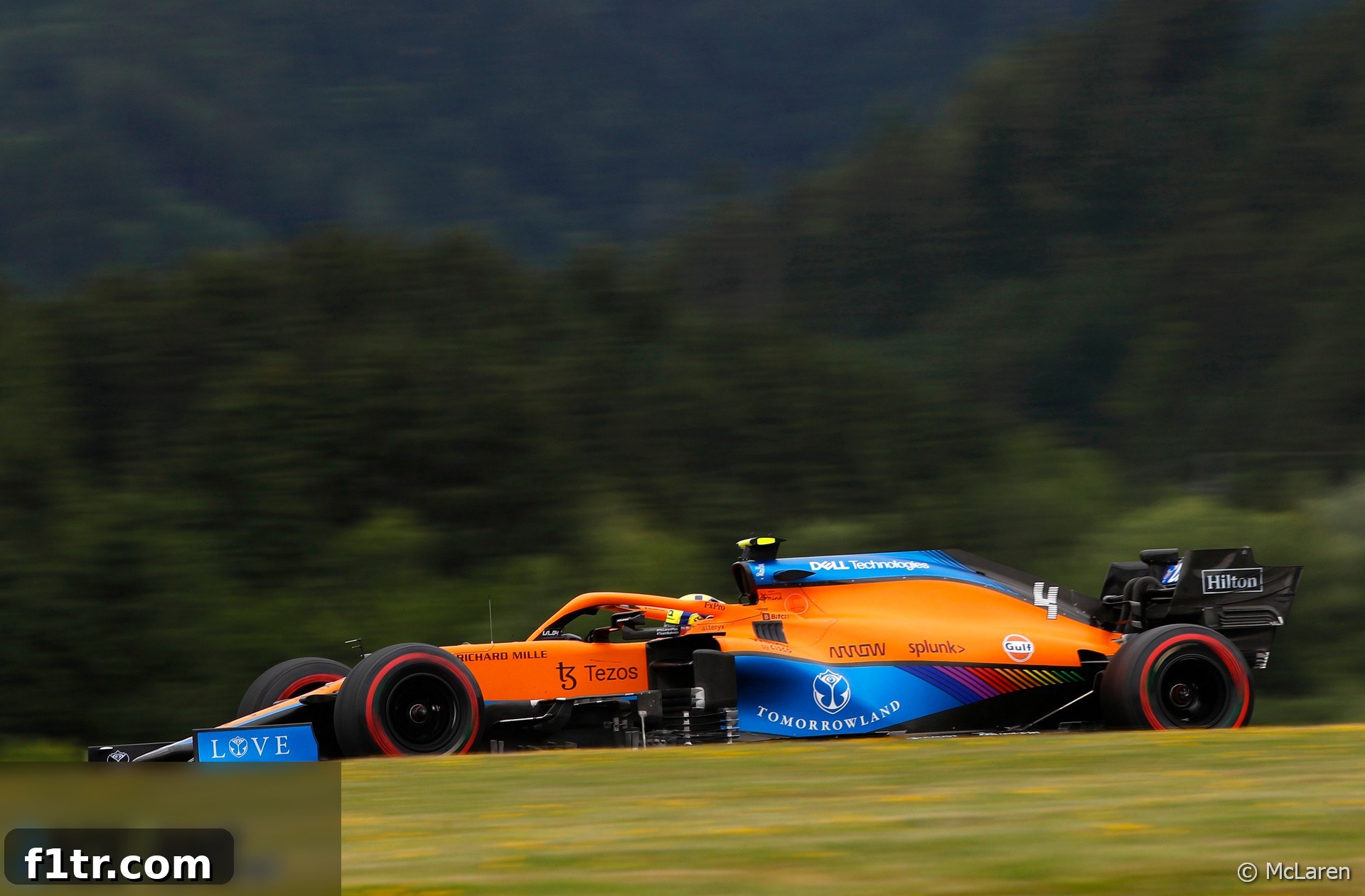
Ferrari and McLaren were the only teams to extensively use the C3 (medium) tyre during the morning session. McLaren’s Lando Norris, in particular, completed two dedicated stints on the C3 in the afternoon. Despite his efforts, Norris remained uncommitted to a single-stop strategy for the race, confessing that the softer compounds were “quite difficult to manage” at the Red Bull Ring. Having experimented with various tyre and setup combinations throughout Friday, Norris enters Saturday’s practice sessions with an advantageous position: he has one more set each of the C4 and C5 compounds available than the Mercedes and Red Bull drivers he is so keen to challenge. This meticulously planned Friday program could potentially reward him handsomely over the crucial next two days of the Grand Prix weekend.
Beyond the Main Battle: Practice-Only Drivers
Friday also provided a platform for several practice-only drivers, offering a glimpse into future talent and valuable data collection for their respective teams. Guanyu Zhou delivered a solid performance in his inaugural official F1 session with Alpine. He diligently completed essential aero testing for the team, posting a respectable 14th fastest time in FP1, showcasing composure and pace. Alfa Romeo’s reserve driver Callum Ilott similarly did no harm to his ambitions for a full-time race seat in 2022, navigating a trouble-free session to finish 16th. Although a second slower than Kimi Raikkonen, who utilized an extra set of soft tyres, Ilott’s clean running was commendable. Meanwhile, Williams’ Roy Nissany managed to outpace regular driver Nicholas Latifi in his session, adding another interesting footnote to Friday’s proceedings.
Quotes: Dieter Rencken
Advert | Become a RaceFans supporter andgo ad-free
Combined Practice Times
| Pos | Driver | Car | FP1 | FP2 | Total laps |
|---|---|---|---|---|---|
| 1 | Lewis Hamilton | Mercedes | 1’05.709 | 1’04.523 | 61 |
| 2 | Valtteri Bottas | Mercedes | 1’05.445 | 1’04.712 | 63 |
| 3 | Max Verstappen | Red Bull-Honda | 1’05.143 | 1’04.740 | 70 |
| 4 | Lance Stroll | Aston Martin-Mercedes | 1’06.203 | 1’05.139 | 61 |
| 5 | Sebastian Vettel | Aston Martin-Mercedes | 1’06.444 | 1’05.268 | 64 |
| 6 | Yuki Tsunoda | AlphaTauri-Honda | 1’05.474 | 1’05.356 | 71 |
| 7 | Pierre Gasly | AlphaTauri-Honda | 1’05.726 | 1’05.379 | 73 |
| 8 | Fernando Alonso | Alpine-Renault | 1’05.393 | 34 | |
| 9 | Charles Leclerc | Ferrari | 1’05.409 | 1’05.708 | 65 |
| 10 | Carlos Sainz Jnr | Ferrari | 1’05.431 | 1’05.620 | 69 |
| 11 | Lando Norris | McLaren-Mercedes | 1’05.880 | 1’05.466 | 60 |
| 12 | Antonio Giovinazzi | Alfa Romeo-Ferrari | 1’05.511 | 32 | |
| 13 | Sergio Perez | Red Bull-Honda | 1’05.726 | 1’05.516 | 68 |
| 14 | Esteban Ocon | Alpine-Renault | 1’05.980 | 1’05.527 | 64 |
| 15 | Kimi Raikkonen | Alfa Romeo-Ferrari | 1’05.586 | 1’05.624 | 60 |
| 16 | Daniel Ricciardo | McLaren-Mercedes | 1’06.181 | 1’05.698 | 61 |
| 17 | George Russell | Williams-Mercedes | 1’05.819 | 36 | |
| 18 | Mick Schumacher | Haas-Ferrari | 1’06.583 | 1’05.911 | 63 |
| 19 | Nicholas Latifi | Williams-Mercedes | 1’06.978 | 1’06.014 | 72 |
| 20 | Nikita Mazepin | Haas-Ferrari | 1’07.316 | 1’06.173 | 64 |
| 21 | Guanyu Zhou | Alpine-Renault | 1’06.414 | 28 | |
| 22 | Callum Ilott | Alfa Romeo-Ferrari | 1’06.564 | 23 | |
| 23 | Roy Nissany | Williams-Mercedes | 1’06.683 | 33 |
Advert | Become a RaceFans supporter andgo ad-free
Teams’ Progress vs 2020
NB. The quickest lap times set in both last year’s race at the Red Bull Ring have been used as a reference.
Go ad-free for just £1 per month>> Find out more and sign up
2021 Austrian Grand Prix
- Vasseur on Alfa’s “huge step forward” and why he’s vexed by technical directives
- How Ricciardo “got some enjoyment back” after “really low” first race in Austria
- F1’s penalty points are not “harsh” and won’t be reviewed this year – Masi
- Austrian double showed Sainz found his feet faster than 2021’s other big-name moves
- 2021 Austrian Grand Prix Star Performers
Browse all 2021 Austrian Grand Prix articles
The crucial question dominating Friday practice at the Austrian Grand Prix wasn’t simply which team held the speed advantage, but rather the enigmatic challenge of tyre degradation – specifically, when will those tyres inevitably lose their edge and force a strategic pit stop? This underlying uncertainty set the stage for a fascinating weekend at the Red Bull Ring, a circuit known for its punishing demands on rubber.
Advert | Become a Supporter & go ad-free
A sudden rain shower during the second practice session, precisely when drivers were pushing their limits in final qualifying simulations, threw a significant spanner in the works. Not only did this prevent us from seeing every driver’s true representative pace on a dry track, but it also drastically reduced the grip levels across the circuit for the last thirty minutes of running. This meteorological intervention meant that the comprehensive data on tyre wear, usually meticulously gathered during Friday’s long runs, became compromised, adding another layer of complexity to teams’ strategic planning.
Tyre Compounds and Unpredictable Data
The latter half of Friday’s running was largely dedicated to long stints, with some teams opting for the softest C5 tyre, but most focusing on the C4 compound. A significant factor influencing this choice was Pirelli’s introduction of new prototype rear tyre constructions, particularly for the C4 compound, which were widely used throughout the day. Consequently, teams lacked sufficient comparable data on the performance of the actual C4 rear tyres – the softest compound used during the preceding Styrian Grand Prix – over extended runs in the relatively mild conditions of the circuit.
However, the afternoon rain further diminished the usefulness of much of this end-of-practice data. Tyre degradation rates on a wet or damp track are fundamentally different from those on a dry surface, making direct comparisons and future predictions challenging. For instance, Ferrari had already noted particularly severe graining issues with their tyres in first practice. Charles Leclerc subsequently undertook extensive long runs on both of the softer compounds in second practice. While there was a noticeable reduction in front-right locking and less visible graining in the afternoon session, it appeared this came at the expense of outright lap time, as both Carlos Sainz Jnr and Leclerc finished a disappointing 13th and 16th fastest, respectively, highlighting the compromises they faced.
Red Bull’s Dominance and Strategic Bluffs
Unsurprisingly, Sergio Perez of Red Bull demonstrated remarkable longevity on the C4 tyre, extending a planned 21-lap stint to an impressive 30 laps. Both Red Bull and AlphaTauri drivers consistently topped the time sheets on the C4 compound in both sessions. Max Verstappen’s benchmark pace on this compound was only surpassed by the Mercedes drivers, who were utilizing the even softer C5 tyres. This immediately signaled Red Bull’s formidable strength on the Red Bull Ring layout, particularly with mid-range tyre compounds.
Pirelli officially quoted a 0.7-second lap time difference between the C4 and C5 compounds. However, Verstappen’s exceptional pace hinted that this gap could be halved when bolted to the potent Red Bull chassis. This observation resonated with Mercedes’ Lewis Hamilton, who acknowledged his rivals held a two-tenths advantage and fully expected them to “turn up a little bit more” come qualifying. Red Bull’s preference to prioritize running on the C4, with only a combined nine laps logged by Perez and Verstappen on the C5 in second practice, left the true extent of their advantage on the softest tyre somewhat obscured. Was the team genuinely cautious, or were they playing a subtle strategic game, keeping their ultimate C5 pace under wraps?
Red Bull team principal Christian Horner dismissed the C5 as “pretty racy” and “very much a one-lap special,” suggesting it could prove “tricky” in qualifying and questioning if teams could “afford not to take it in Q2” given its significant delta. Such downplaying of his team’s capabilities, particularly their potential to advance to Q3 on a slower compound, is a classic strategic bluff. Throughout both practice sessions, the Red Bull car consistently generated heat in its tyres quicker than rivals, achieving optimal operating temperature more efficiently. This inherent trait, combined with its superior aerodynamic stability, meant the Red Bull maintained greater grip even in the final sector, a section where cars with less downforce typically struggled with sliding and tyre graining. This difference was particularly stark in the Ferrari and Aston Martin camps, whose drivers often wrestled with significant oversteer. While Leclerc demonstrated remarkable skill in consistently saving his car, Aston Martin’s Lance Stroll was less fortunate, spinning twice during his runs, underscoring the delicate balance required at this circuit.
Strategic Dilemmas and Midfield Challenges
Pirelli’s Formula 1 head, Mario Isola, offered crucial insights, suggesting that the faster C5 compound is “close to a qualifying tyre” at the Red Bull Ring. This implies that for teams aiming for a conventional one-stop race strategy, starting on the softest C5 tyre would be highly undesirable. Isola elaborated: “That is obviously affecting the qualifying tomorrow because if they want to plan a race on one-stop strategy they have to start on the medium and move to the hard. If they are forced to qualify with the soft the strategy has to be a two-stop.” This statement underscores the strategic high-stakes game that unfolds during qualifying, where a decision on tyre compound for Q2 can dictate the entire race strategy.
For the front-running teams like Red Bull and Mercedes, their significant performance advantage over the rest of the grid offers a degree of flexibility. If they anticipate lapping the field once again, they can potentially factor in a two-stop strategy without major concerns about falling into traffic when approaching slower cars. This luxury is not afforded to the ‘best of the rest’ outfits, such as Ferrari and McLaren, who were the closest competitors to the top two in the Styrian Grand Prix. For these teams, the problem is reversed. They might struggle to complete the race efficiently with a single stop due to higher tyre degradation, but opting for a two-stop strategy carries the substantial risk of losing valuable track position and ultimately finishing outside the points-scoring positions. Their Friday strategy reflected this delicate balancing act.
Ferrari and McLaren were the only teams to extensively use the C3 (medium) tyre during the morning session. McLaren’s Lando Norris, in particular, completed two dedicated stints on the C3 in the afternoon. Despite his efforts, Norris remained uncommitted to a single-stop strategy for the race, confessing that the softer compounds were “quite difficult to manage” at the Red Bull Ring. Having experimented with various tyre and setup combinations throughout Friday, Norris enters Saturday’s practice sessions with an advantageous position: he has one more set each of the C4 and C5 compounds available than the Mercedes and Red Bull drivers he is so keen to challenge. This meticulously planned Friday program could potentially reward him handsomely over the crucial next two days of the Grand Prix weekend.
New Faces on Track: Practice-Only Drivers
Friday also provided a platform for several practice-only drivers, offering a glimpse into future talent and valuable data collection for their respective teams. Guanyu Zhou delivered a solid performance in his inaugural official F1 session with Alpine. He diligently completed essential aero testing for the team, posting a respectable 14th fastest time in FP1, showcasing composure and pace. Alfa Romeo’s reserve driver Callum Ilott similarly did no harm to his ambitions for a full-time race seat in 2022, navigating a trouble-free session to finish 16th. Although a second slower than Kimi Raikkonen, who utilized an extra set of soft tyres, Ilott’s clean running was commendable. Meanwhile, Williams’ Roy Nissany managed to outpace regular driver Nicholas Latifi in his session, adding another interesting footnote to Friday’s proceedings.
Quotes: Dieter Rencken
Advert | Become a RaceFans supporter andgo ad-free
Combined Practice Times
| Pos | Driver | Car | FP1 | FP2 | Total laps |
|---|---|---|---|---|---|
| 1 | Lewis Hamilton | Mercedes | 1’05.709 | 1’04.523 | 61 |
| 2 | Valtteri Bottas | Mercedes | 1’05.445 | 1’04.712 | 63 |
| 3 | Max Verstappen | Red Bull-Honda | 1’05.143 | 1’04.740 | 70 |
| 4 | Lance Stroll | Aston Martin-Mercedes | 1’06.203 | 1’05.139 | 61 |
| 5 | Sebastian Vettel | Aston Martin-Mercedes | 1’06.444 | 1’05.268 | 64 |
| 6 | Yuki Tsunoda | AlphaTauri-Honda | 1’05.474 | 1’05.356 | 71 |
| 7 | Pierre Gasly | AlphaTauri-Honda | 1’05.726 | 1’05.379 | 73 |
| 8 | Fernando Alonso | Alpine-Renault | 1’05.393 | 34 | |
| 9 | Charles Leclerc | Ferrari | 1’05.409 | 1’05.708 | 65 |
| 10 | Carlos Sainz Jnr | Ferrari | 1’05.431 | 1’05.620 | 69 |
| 11 | Lando Norris | McLaren-Mercedes | 1’05.880 | 1’05.466 | 60 |
| 12 | Antonio Giovinazzi | Alfa Romeo-Ferrari | 1’05.511 | 32 | |
| 13 | Sergio Perez | Red Bull-Honda | 1’05.726 | 1’05.516 | 68 |
| 14 | Esteban Ocon | Alpine-Renault | 1’05.980 | 1’05.527 | 64 |
| 15 | Kimi Raikkonen | Alfa Romeo-Ferrari | 1’05.586 | 1’05.624 | 60 |
| 16 | Daniel Ricciardo | McLaren-Mercedes | 1’06.181 | 1’05.698 | 61 |
| 17 | George Russell | Williams-Mercedes | 1’05.819 | 36 | |
| 18 | Mick Schumacher | Haas-Ferrari | 1’06.583 | 1’05.911 | 63 |
| 19 | Nicholas Latifi | Williams-Mercedes | 1’06.978 | 1’06.014 | 72 |
| 20 | Nikita Mazepin | Haas-Ferrari | 1’07.316 | 1’06.173 | 64 |
| 21 | Guanyu Zhou | Alpine-Renault | 1’06.414 | 28 | |
| 22 | Callum Ilott | Alfa Romeo-Ferrari | 1’06.564 | 23 | |
| 23 | Roy Nissany | Williams-Mercedes | 1’06.683 | 33 |
Advert | Become a RaceFans supporter andgo ad-free
Teams’ Progress vs 2020
NB. The quickest lap times set in both last year’s race at the Red Bull Ring have been used as a reference.
Go ad-free for just £1 per month>> Find out more and sign up
2021 Austrian Grand Prix
- Vasseur on Alfa’s “huge step forward” and why he’s vexed by technical directives
- How Ricciardo “got some enjoyment back” after “really low” first race in Austria
- F1’s penalty points are not “harsh” and won’t be reviewed this year – Masi
- Austrian double showed Sainz found his feet faster than 2021’s other big-name moves
- 2021 Austrian Grand Prix Star Performers
Browse all 2021 Austrian Grand Prix articles