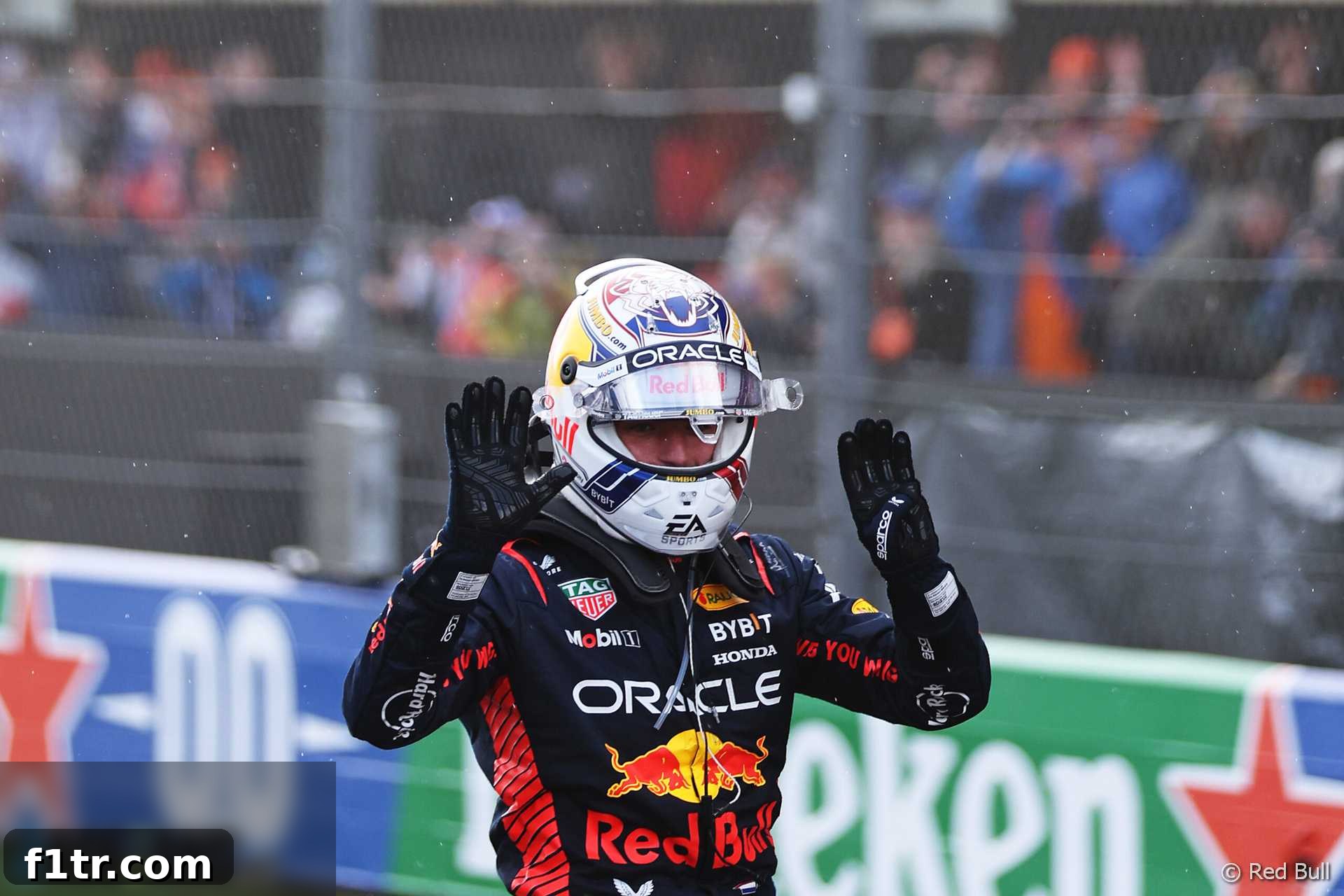
Max Verstappen Masters Zandvoort Chaos to Claim Record-Equalling Dutch Grand Prix Victory
In a thrilling spectacle that will be etched into Formula 1 history, Max Verstappen delivered an unforgettable performance to win a dramatic Dutch Grand Prix at his home circuit in Zandvoort. Battling through an onslaught of ever-changing weather conditions, a late red flag, and intense strategic pressure, the Red Bull Racing driver secured his ninth consecutive victory, equalling Sebastian Vettel’s long-standing record for the most consecutive F1 wins. The tumultuous race saw Fernando Alonso pilot his Aston Martin to an impressive second place, demonstrating masterful car control, while Pierre Gasly was elevated to a surprising third position after a time penalty was applied to Sergio Perez.
A Torrential Start: Rain Transforms Zandvoort into a Strategic Minefield
Even before the formation lap began, a palpable tension hung over the Zandvoort circuit as drivers reported unsettling spots of rain on their visors. This initial drizzle quickly escalated into a heavy downpour as the lights went out, catching many teams and drivers by surprise. Verstappen made a clean getaway from pole, maintaining his lead into Turn 1, with Lando Norris holding onto second ahead of a determined Alonso, who snatched third from George Russell. However, the track conditions rapidly deteriorated, particularly on the south side of the circuit, where the rain intensified dramatically.
This sudden deluge sparked immediate chaos and a flurry of activity in the pit lane. As the field completed the opening lap, a significant number of drivers, including Sergio Perez, Zhou Guanyu, and Pierre Gasly, opted for a brave and immediate switch to intermediate tyres. This audacious early gamble paid dividends almost instantly. Verstappen, Norris, and Russell, who initially stayed out on slick tyres, found themselves rapidly losing ground to those on intermediates. Perez, having made the inspired call, began scything through the field, showcasing the devastating advantage of the intermediate tyres on the slick-shod competitors.
Verstappen eventually responded by pitting at the end of the second lap for intermediates. However, by this point, Perez’s aggressive strategy had propelled him into a commanding lead, a testament to his decisive pit call. Zhou and Gasly also benefited from their early switches, holding strong positions. Verstappen, now on the correct tyres, immediately commenced his relentless charge to recover positions, quickly dispatching Gasly and setting his sights on Perez, who held a healthy lead.
Verstappen’s Masterclass: Regaining Control as the Track Dries
As the race progressed into its early stages, the capricious Zandvoort weather took another turn; the heavy rain began to subside, and a clear drying line emerged on the circuit. This transition presented another critical strategic challenge: when to switch back to slick tyres. Verstappen, ever alert to the evolving conditions and displaying the acute racecraft of a champion, made the bold decision to pit for soft tyres at the end of lap 11. This timely call proved to be a masterstroke.
Perez, still leading, faced a difficult choice. His team, Red Bull, chose to keep him out for a few more laps, hoping to extend the life of his intermediates or perhaps gain an advantage if the track didn’t dry as quickly. However, this delay proved costly. By the time Perez made his own pit stop for soft tyres, Verstappen, whose earlier stop had given him several crucial laps on the faster slicks, was comfortably back in the lead. This strategic triumph effectively cemented Verstappen’s position at the front, demonstrating Red Bull’s ability to adapt and execute flawlessly under pressure.
Safety Car Interruption: Sargeant’s Setback and a Race Reset
Just moments after Verstappen had re-established his lead, the race was neutralized by a Safety Car. Rookie Logan Sargeant, driving his Williams, suffered an apparent mechanical failure after clipping the apex kerb at Turn 8, sending his car into the barriers. The incident brought out the Safety Car, bunching up the field and erasing any gaps that had been painstakingly built. This offered a potential lifeline to competitors who had lost ground or were on differing strategies.
The marshals worked efficiently to clear Sargeant’s car, and the race restarted on lap 22. Verstappen led the pack, with Perez, Alonso, Gasly, and Carlos Sainz Jnr completing the top five. The restart saw no significant changes in the leading order, as Verstappen quickly re-established his dominance, pulling out of DRS range of his teammate Perez by the time the drag reduction system was activated. The track conditions had stabilized for a period, allowing the leaders to settle into a rhythm, with Verstappen gradually extending his advantage over the chasing pack.
Mid-Race Chess: Tyre Management and Strategic Pit Stops
As the Grand Prix entered its middle phase, Verstappen continued to extend his lead, demonstrating the potent combination of his driving skill and the raw pace of the Red Bull RB19. The gaps between the top contenders began to stretch out once more, allowing teams to consider their second round of pit stops and tyre management strategies. Perez, running in second, eventually pitted for a fresh set of soft tyres at the end of lap 45, rejoining the track in fourth place behind Gasly. The Alpine driver followed suit shortly after, completing his own pit stop.
Fernando Alonso, who had been running a consistent and strong race, suffered a minor setback during his pit stop. A slightly slower stop meant he dropped to fifth place behind Yuki Tsunoda momentarily. However, Alonso’s racecraft was on full display. After Tsunoda made his subsequent stop, Alonso seized the opportunity, catching and passing Carlos Sainz with a magnificent move in the opening sector to reclaim a well-deserved third position, showcasing his enduring talent and race pace.
The Return of the Rain God: Zandvoort Unleashes Another Deluge
With just 15 laps remaining, the ominous grey skies above Zandvoort once again began to threaten, and teams braced themselves for another heavy rain shower. On lap 61, the forecast proved accurate, as a fierce downpour engulfed the circuit, particularly the final sector, turning it into a treacherous, waterlogged expanse within seconds. This sudden change triggered yet another frantic dash to the pit lane. Many drivers, including Perez, Gasly, Sainz, and both Mercedes drivers Lewis Hamilton and George Russell, immediately opted for intermediate tyres.
Verstappen and Alonso, both leading the race, responded on the following lap, pitting for intermediates as the rain intensified into a full deluge. The conditions were so severe that some drivers considered full wet weather tyres; Esteban Ocon notably made the switch. The challenging conditions were underscored when Sergio Perez spun at the first corner, prompting both Red Bull drivers to follow Ocon’s lead and switch to full wet weather tyres, anticipating a further deterioration of the track.
Red Flag Drama: Zhou’s Crash and a Race Suspension
The escalating intensity of the rain soon led to the ultimate disruption: a red flag. Zhou Guanyu, still battling on intermediate tyres in the abysmal conditions, tragically aquaplaned off the track at Tarzan corner, slamming into the barriers. The incident initially brought out a Virtual Safety Car, but as the conditions continued to worsen, race control made the decisive call to red flag the race, suspending proceedings entirely. This occurred just as Perez was exiting the pit lane after his switch to wet tyres, adding another layer of complexity to the unfolding drama.
With the race red-flagged, drivers lined up in the pit lane, and the order was reset to the positions held on the lap prior to the red flag. This meant Verstappen held the lead, Alonso was in a strong second place, and Perez was provisionally third, ahead of Gasly, Sainz, and Hamilton. Crucially, race control mandated that all drivers must use intermediate tyres for the resumption of the race, which would recommence with a rolling start after two laps behind the Safety Car, giving teams time to prepare and ensure driver safety.
Tense Finale: Restart, Penalties, and a Victorious Homecoming
After a significant delay, the Dutch Grand Prix roared back to life on lap 67 with a rolling start. Verstappen once again showed his composure, pulling away cleanly from Alonso and his Red Bull teammate Perez in third. However, the drama was far from over. Sergio Perez was hit with a five-second time penalty for speeding in the pit lane during the red flag period, immediately putting his hard-fought podium position in jeopardy. Further back, Lando Norris and George Russell made contact at Turn 11, resulting in a puncture for Russell that forced him to pit and relegated him to the rear of the field, compounding Mercedes’ challenging weekend.
With the track remaining wet but manageable on intermediates, Verstappen methodically pulled a small but critical gap over Alonso. The Dutchman then crossed the finish line to secure a magnificent home victory, igniting rapturous celebrations from the orange army in the stands. This win not only marked a triumph on home soil but also etched his name into the record books with an incredible ninth successive Formula 1 victory. Fernando Alonso, four seconds behind, secured a richly deserved second place, showcasing his enduring class and ability to perform in demanding conditions.
Perez crossed the line in third, but his five-second penalty proved decisive, dropping him behind Pierre Gasly, who inherited a hard-earned third place, capping off a remarkable and opportunistic race for the Alpine driver. Carlos Sainz claimed a solid fifth for Ferrari, ahead of Lewis Hamilton in sixth. Lando Norris recovered to finish seventh, with Alexander Albon continuing his strong form for Williams in eighth. Oscar Piastri and Esteban Ocon completed the points-paying positions, while newcomer Liam Lawson, deputizing for Daniel Ricciardo, brought his AlphaTauri home in a respectable 13th place on his F1 debut.
The Legacy of Zandvoort: A Race for the Ages
The 2023 Dutch Grand Prix will be remembered as a true test of skill, strategy, and resilience. Max Verstappen’s ability to navigate the ever-changing conditions, execute flawless pit stops, and maintain his composure under immense pressure underscored his status as a generational talent. His record-equalling nine consecutive wins speak volumes about his current dominance in Formula 1. The race also highlighted the brilliance of veterans like Fernando Alonso and the opportunism of drivers like Pierre Gasly, proving that even in an era of dominance, Formula 1 continues to deliver unpredictable and thrilling spectacles. Zandvoort once again delivered a classic, leaving fans eagerly anticipating the next chapter of the 2023 season.
Further Reading: Insights from the 2023 Dutch Grand Prix
- Azerbaijan GP defeat was key to record-equalling run of wins – Verstappen
- “Too early to say” if podium signals return to form for Aston Martin – Alonso
- Verstappen makes history with unbeaten hat-track in first home races
- Perez is ‘doing his job and will be our driver in 2024’, Horner insists
- Ferrari had the “sixth or seventh fastest car” at Zandvoort – Sainz
Browse all 2023 Dutch Grand Prix articles