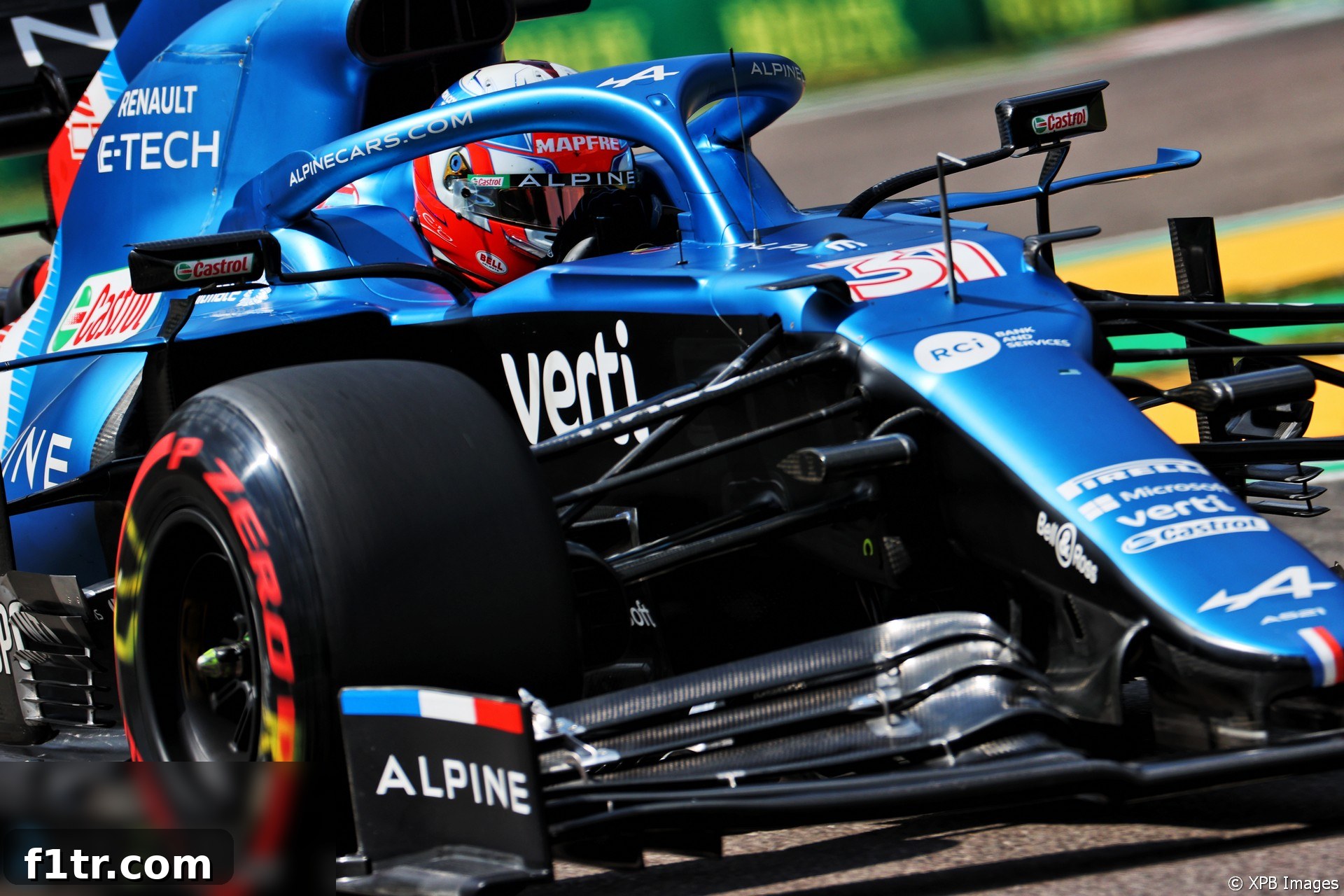
In a qualifying session filled with anticipation for the Emilia-Romagna Grand Prix, Alpine F1 driver Esteban Ocon delivered a remarkably strong performance, adeptly guiding his Alpine-Renault A521 to a commendable ninth-place starting position on the grid. Ocon’s effort, which he confidently described as extracting the absolute maximum potential from his machinery, marked a significant and encouraging turnaround from his earlier struggles at the season-opening Bahrain Grand Prix.
The historic Autodromo Internazionale Enzo e Dino Ferrari, affectionately known as Imola, set the stage for this critical showdown. For Ocon, Saturday’s qualifying unfolded with impressive consistency and precision. After demonstrating promising speed by securing fifth place in the initial Q1 segment, he maintained his momentum, solidifying his presence within the top ten in both Q2 and Q3. While he initially ended the top-ten shootout at the lower end, a track limits violation by Aston Martin’s Lance Stroll led to the deletion of Stroll’s lap times, consequently elevating Ocon one crucial spot higher up the grid. This marginal gain underscored the fine margins that often define success in Formula 1 qualifying.
This impressive display of pace and control represented a substantial improvement for the young French driver, particularly after the disappointment of failing to progress beyond Q1 in Bahrain just a few weeks prior. At Imola, Ocon’s proximity to the leading cars was noteworthy, as he qualified less than eight-tenths of a second away from pole position. This tight margin is a testament to the fiercely competitive nature of Formula 1 and highlights the tangible progress made by both Ocon and the dedicated Alpine team in a short period.
Esteban Ocon’s Triumph: Maximizing Alpine’s A521 Potential
“I think it’s been a very good, straightforward session, which is what we needed looking at Bahrain, which was more tricky with yellow flags and all that,” Ocon remarked, reflecting on his qualifying success with a clear sense of relief and satisfaction. He further praised his team’s operational excellence: “I’m pretty pleased with how the session went and how the guys organised the traffic and how we managed things.” The seamless execution of strategy and efficient traffic management by the Alpine pit wall were clearly pivotal to his performance, ensuring he had clear track to push for optimal lap times without impediment.
Ocon’s conviction in having truly pushed the Alpine A521 to its absolute limit was palpable. “The next thing is that I think we maximised the potential today. I think P9 was the maximum that we could have done, the other ones [in Q3] were a little bit quicker than us and out of reach,” he elaborated. This pragmatic assessment by the French driver reveals a mature understanding of his car’s current capabilities in relation to its highly competitive rivals. In the cutthroat environment of Formula 1, extracting every last hundredth of a second from the machinery is non-negotiable, and Ocon believes he achieved precisely that on the challenging Imola circuit.
A significant factor contributing to Ocon’s enhanced confidence and increased pace at Imola were the upgrades introduced by Alpine specifically for this Grand Prix weekend. “The upgrades that we brought this weekend gave us confidence, the car felt good in all three sessions,” he explained. These technical refinements, likely encompassing aerodynamic tweaks and setup adjustments, appeared to have a positive impact on the car’s overall balance, responsiveness, and stability. Beyond the engineering aspects, Ocon also admitted to a more personal connection with the track itself. “And to be fair, I had a lot of fun out on this track, so that was good.” Imola, renowned for its demanding blend of high-speed corners and intricate technical sections, requires an exceptional degree of driver commitment, and Ocon evidently found his optimal rhythm.
Despite his strong showing, Ocon maintained a realistic perspective regarding the competitive hierarchy. He openly acknowledged that the performance gap to the leading cars remains substantial, which only reinforced his satisfaction with securing a hard-fought P9. “That’s why I’m saying we maximised the potential because I don’t think we could do anything better today,” he reiterated, emphasizing the thoroughness of his and the team’s effort. “It’s really good when you are able to extract the maximum out of the car.” This sentiment encapsulates a professional racing driver’s ultimate objective: to perform flawlessly and achieve the best possible result with the available tools, a feat Ocon undoubtedly accomplished during the Emilia-Romagna Grand Prix qualifying.
Fernando Alonso’s Imola Challenge: A Quest for Car Confidence and Pace
In stark contrast to his teammate’s upbeat assessment, Fernando Alonso endured a considerably more challenging qualifying session at Imola, ultimately placing 15th on the grid. For the two-time Formula 1 world champion, this marked a rare and notable occasion: his first qualifying defeat to a teammate since the 2017 Malaysian Grand Prix, an unexpected benchmark in his otherwise stellar career. The veteran Spaniard, in the midst of his highly anticipated return to the pinnacle of motorsport after a two-year sabbatical, openly conceded his struggles with characteristic honesty.
“I was not fast,” Alonso admitted, delivering a straightforward and unvarnished appraisal of his performance. Despite his personal sensations behind the wheel, the stopwatch undeniably told a different story. “The car felt good, balance was good, and every time I finished the lap, I was quite happy with how I felt. But I definitely was too slow to be higher on the classification. So nothing we can do now, unfortunately. Just try to understand it, improve it for next time.” This perplexing disconnect between a driver’s subjective feel and the objective lap time is a common yet frustrating hurdle, particularly when readapting to the extreme demands of modern F1 cars and the unique characteristics of specific circuits.
Imola, with its unforgiving old-school charm and challenging layout, inherently presents a unique set of demands that significantly amplify the need for absolute driver confidence. Alonso elaborated on this crucial aspect, highlighting the circuit’s impact on his adaptation process: “I need to understand better what is the limit of the car. In difficult tracks or in demanding circuits like this one you need to have a minimum trust level in the car. Because these old-school tracks require some trust in the car and confidence to push the limit while qualifying arrives.” Unlike more contemporary circuits with expansive run-off areas and greater margin for error, Imola mercilessly punishes even the slightest miscalculation, necessitating surgical precision and an intimate understanding of the car’s dynamic limits. This requirement for inherent trust in the machine, especially when pushing for those critical tenths in qualifying, appears to be an area where Alonso is still assiduously building his comfort.
“Maybe I’m not into that level yet. I will try to improve for the next one,” he concluded, his statement underscoring the ongoing and intensive adaptation process. Alonso’s return to Formula 1 is not merely about raw speed, which he still possesses in abundance, but about recalibrating his instincts and fully integrating with a new generation of F1 machinery and the continually evolving technical regulations. The demanding characteristics of circuits like Imola serve as a rigorous crucible, testing a driver’s confidence and their ability to extract peak performance under immense pressure. It’s a journey that even a legend must undertake.
Looking ahead to the race, Alonso maintained a pragmatic outlook regarding his starting position. “It’s going to be a tough race starting at the back, Imola is not well known for overtaking opportunities.” The narrow circuit and limited straights traditionally make overtakes a rare commodity, meaning a strategic, disciplined, and opportunistic drive will be absolutely essential for any points haul from his 15th-place grid slot. His vast experience, however, suggests he will be ready to seize any opportunity that arises during the race.
Alpine’s Dual Fortunes: Development, Adaptation, and Race Day Outlook
The qualifying results at Imola painted a clear and insightful picture of Alpine’s current standing in the competitive Formula 1 landscape. It highlighted a team showing promising signs of developmental progress, yet still navigating the complex interplay of driver adaptation and meticulous car optimization. Esteban Ocon’s stellar performance was a significant morale booster, not only for his individual confidence but also for the team’s collective belief in their ongoing development program. It provided concrete evidence that the Alpine A521 possesses the inherent potential for solid midfield results when expertly handled and meticulously configured.
Fernando Alonso’s qualifying struggles, while undoubtedly a setback for the veteran champion, can perhaps be viewed as an expected part of his extensive reintegration journey into Formula 1. His candid reflections on the imperative need for greater trust and confidence in the car underscore the profound mental and physical demands of Grand Prix racing at its highest echelon. Alonso’s unparalleled experience means he will undoubtedly work tirelessly alongside the team to bridge this performance gap, but it distinctly highlights that even a motorsport legend of his stature requires time to become truly at one with his new environment and the evolving technicalities of the sport.
The Emilia-Romagna Grand Prix promises an intriguing and potentially challenging race day for the Alpine F1 team. Esteban Ocon, starting from an advantageous ninth position, will be acutely focused on consolidating his track position and strategically challenging for higher points, leveraging the A521’s improved stability and his newfound confidence. Fernando Alonso, from his 15th-place grid slot, will face the monumental task of climbing through the tightly packed field on a circuit notoriously difficult for executing overtakes. However, his race craft and strategic acumen are legendary, and if opportunities present themselves, he remains one of the very best at capitalizing on them with precision and tenacity.
Ultimately, the Imola qualifying session provided invaluable data and crucial insights for Alpine. It unequivocally reinforced the positive impact of their recent technical upgrades and Esteban Ocon’s growing maturity and confidence as a front-line driver. Simultaneously, it clearly highlighted the specific areas where Fernando Alonso and the team still need to focus their concerted efforts to fully unlock his boundless potential within the current machinery. The journey for the Alpine F1 team in the 2021 season continues to be one defined by continuous development, strategic adaptation, and the relentless pursuit of peak performance on every race weekend.
Explore More on the 2021 Emilia-Romagna Grand Prix
- Valtteri Bottas on Imola Pace: “100% Tyres”
- Bottas Considers Imola Crash “History” After Russell’s Apology
- George Russell After Wolff Talks: “Lewis and Valtteri Are Teammates to Me as Nicholas Is”
- Debate: Hamilton’s Reversal at Imola “Shouldn’t Be a Story”
- Highlighting the Star Performers of the 2021 Emilia-Romagna Grand Prix
View All 2021 Emilia-Romagna Grand Prix Articles