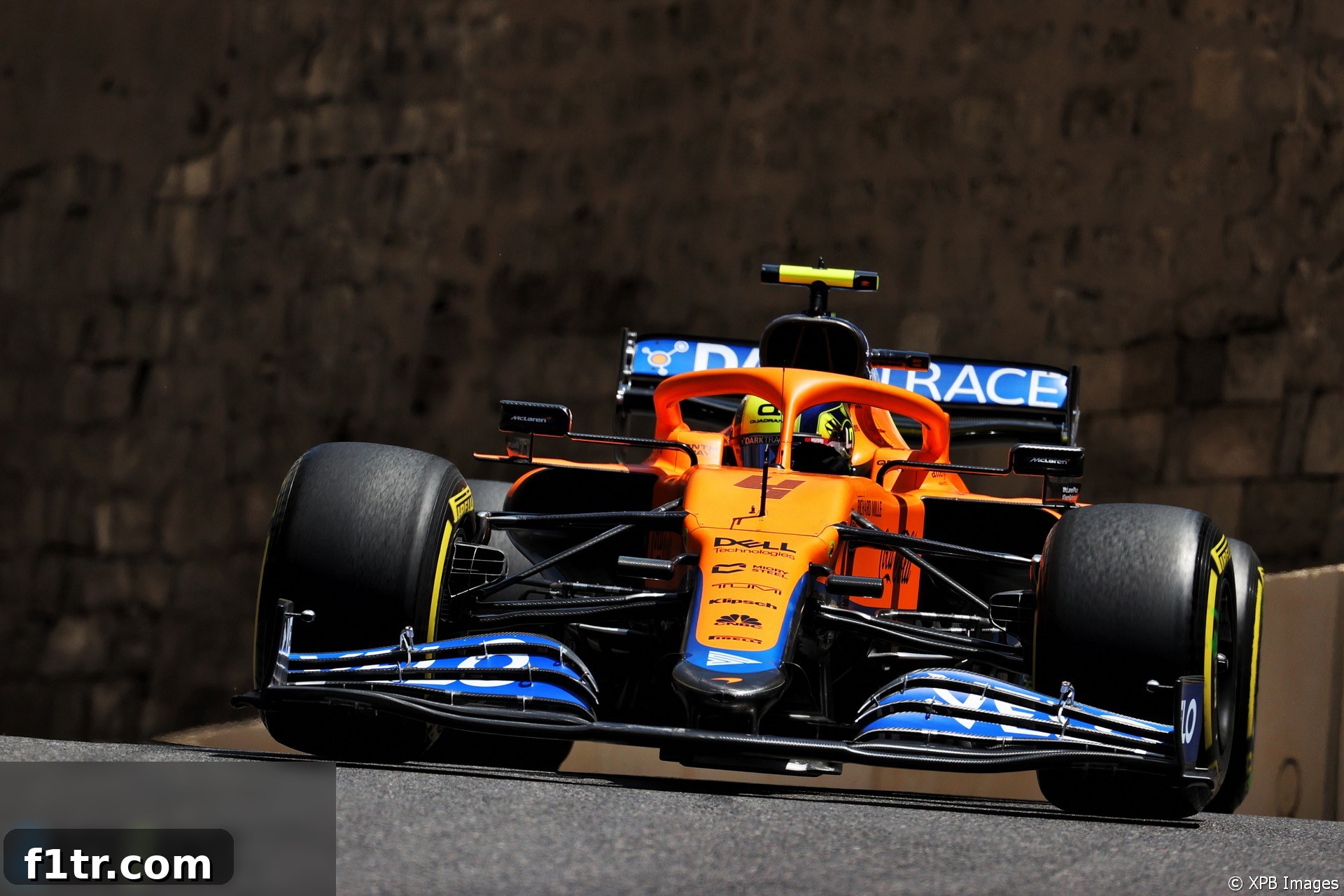
Lando Norris Hit with Grid Penalty Following Red Flag Incident at Azerbaijan Grand Prix Qualifying
In a significant decision that has altered the starting order for the Azerbaijan Grand Prix, McLaren’s star driver, Lando Norris, has been issued a three-place grid penalty. The stewards’ ruling came after a thorough investigation into an incident during the highly eventful Q1 session, where Norris was found to have failed to comply with regulations requiring immediate pit entry under a red flag.
This penalty is a notable setback for Norris, who had impressively qualified in sixth position. As a result, he will now start Sunday’s race from ninth on the grid. Beyond the immediate impact on his starting advantage, the stewards also levied three penalty points against his Super Licence. This brings his current total to eight points, placing him just four points away from incurring an automatic one-race ban – a critical threshold all Formula 1 drivers strive to avoid.
The Incident Unfolds: A High-Stakes Dilemma in Baku
The controversy stems from the opening qualifying session (Q1), which was punctuated by two separate red flag periods. The specific incident involving Norris occurred when Antonio Giovinazzi crashed, necessitating the immediate deployment of red flags by race control. Red flags are a paramount safety measure in Formula 1, signaling to all competitors to reduce speed drastically and proceed directly to the pit lane, or to their designated garage, in a safe and controlled manner.
Norris’s situation was particularly complex. He was navigating the challenging Baku City Circuit, approaching the pit lane entrance at high speed, when the red flags were displayed. Onboard telemetry and footage indicated a clear moment of indecision. He appeared to hesitate, straddling the white dotted line that marks the beginning of the pit lane entry, seemingly caught between committing to the pit lane or continuing his lap.
His radio communication with the McLaren pit wall further underscored the pressure of the moment. “Should I box or continue?” Norris urgently queried. His team’s swift response was decisive: “If you can, box.” However, Norris had already passed the point of no return for a safe and immediate entry. “I can’t, I’m too late,” he responded, indicating that he had inadvertently committed to completing the lap rather than entering the pits as required by the regulations.
Stewards’ Verdict: Balancing Regulations with Reality
The stewards launched an investigation immediately after qualifying, focusing on Norris’s adherence to the FIA’s stringent regulations concerning red flags. The FIA International Sporting Code explicitly states that upon the deployment of red flags, “all cars must immediately and safely proceed to the pit lane.” Any deviation from this rule is considered a serious breach, often carrying severe consequences due to its potential impact on safety.
In their official communique, the stewards confirmed that Norris had indeed committed an infraction by failing to enter the pit lane promptly. However, their decision was not made without considering the extenuating circumstances. They meticulously factored in the extremely limited time Norris had to react to the red flags, especially given his high speed and precise track position at the moment of the signal. This mitigating element proved crucial in determining the final penalty.
While a typical failure to respect a red flag during qualifying might result in a more severe five-place grid penalty, the stewards opted for a reduced three-place sanction. They explained their reasoning, highlighting the tight window for reaction: “[Norris] was just on the long start-finish-straight when red flags were displayed. Consequently, red lights were flashing on a panel on the left guardrail and on the car’s dashboard.” They further noted Norris’s candid admission during the hearing: “During the hearing the driver admitted that he lifted the throttle, braked and was committed to and able to enter the pit lane. At that moment he was not sure what to do and asked his team over the radio.” The stewards concluded that despite the team’s immediate instruction, “Although the team ordered him immediately to enter the pits, it was too late and Norris crossed the finish line one more time,” confirming the delayed reaction and subsequent infringement.
Lando Norris’s Perspective: A Driver’s Honest Account
Before the official verdict was publicized, Lando Norris shared his immediate thoughts on the incident, offering a glimpse into the challenging mental calculus drivers face at top speed. He described the moment of confusion: “I was in the middle, I was continuing my lap but then I didn’t really know at one point I could turn left or go right.” This statement underscores the split-second nature of decisions in Formula 1, where clarity can be obscured by speed and the intense focus required to navigate the circuit.
Norris also emphasized his immediate safety response: “I slowed down straight away, I don’t feel like I was doing anything wrong. And I was going at quite a high speed, going into that pit at that time.” His comments highlighted his belief that he acted responsibly by reducing speed, and questioned the practicality of entering the pits immediately given his velocity and position. “So I don’t know, I need to speak to the team, but I don’t think I’ve done anything wrong,” he concluded, reflecting a common sentiment among drivers who often feel their actions are justifiable within the chaotic context of racing, even if they technically fall foul of a specific rule.
Impact on Grid Position and the Penalty Points System
The three-place grid penalty is a direct strategic blow for Lando Norris and McLaren. Starting from ninth instead of sixth will place him deeper in the midfield pack, increasing his exposure to potential first-lap incidents and making it harder to establish track position. On a street circuit like Baku, where overtaking can be challenging in certain sectors, a lower starting spot requires a flawless race and potentially a different strategic approach to secure a strong points haul.
Equally significant are the three penalty points added to Norris’s Super Licence. The FIA’s penalty points system is a disciplinary tool designed to deter dangerous driving and repeated rule infringements throughout a season. Accumulating 12 penalty points within a 12-month period leads to an automatic suspension for one Grand Prix. With eight points now on his record, Norris is in a precarious position, putting increased pressure on him to maintain a clean sheet for the remainder of the racing calendar. This system ensures that drivers are consistently reminded of their responsibility to race safely and within the rules.
The Unpredictable Nature of Baku and F1 Demands
The Baku City Circuit is renowned for its high-speed sections intertwined with incredibly narrow, technical turns, making it one of the most demanding tracks on the calendar. This unique characteristic often leads to incidents, particularly during the cut-throat environment of qualifying where drivers push their cars to their absolute limits. Red flags are a relatively common occurrence at this venue, reinforcing the constant need for drivers to be exceptionally vigilant and capable of instantaneous reactions to changing track conditions or directives from race control.
This incident vividly illustrates the fine margins that define Formula 1. Drivers are tasked with making split-second, safety-critical decisions at speeds exceeding 300 km/h, often with incomplete information and under immense psychological pressure. While regulations are meticulously defined, their real-time application in the heat of competition, where safety is paramount but competitive instincts are also at play, can present complex dilemmas for even the most experienced drivers.
Looking Ahead: McLaren’s Strategy for Race Day
Despite the grid penalty, McLaren will undoubtedly be working tirelessly on strategies to help Lando Norris recover positions during the Azerbaijan Grand Prix. Starting from ninth, a strong opening lap will be crucial, as will a well-executed race strategy. The notoriously unpredictable nature of the Baku race, with its high probability of Safety Car periods and even further red flags, could also present opportunities for Norris to regain lost ground. His proven talent and McLaren’s competitive car package will be vital in navigating this challenge and aiming for a strong points finish for the team.
The focus for Norris will now fully shift to race day, where he will strive to showcase his resilience and driving skill to secure valuable points for McLaren, despite the disciplinary action. This incident serves as a poignant reminder of the relentless demands placed upon Formula 1 drivers and the unyielding nature of the sport’s regulations, where every fraction of a second and every decision carries significant weight.
Advert | Become a Supporter & go ad-free
Advert | Become a RaceFans supporter andgo ad-free
Further Reading: 2021 Azerbaijan Grand Prix Insights
- Aston Martin Also Confirms Following Pirelli’s Tyre Restrictions Before Crash
- Pirelli Confirms Teams Not to Blame for Baku Tyre Failures Following Investigation
- “Tyres Should Not Explode Like That,” Says Villeneuve as Pirelli Prepares to Reveal Findings
- Why Alonso is Able to Enjoy F1 More Now Than When He Left
- Penalty for Safety Car Error Was Just One of Latifi’s Frustrations in Baku
Browse all 2021 Azerbaijan Grand Prix articles