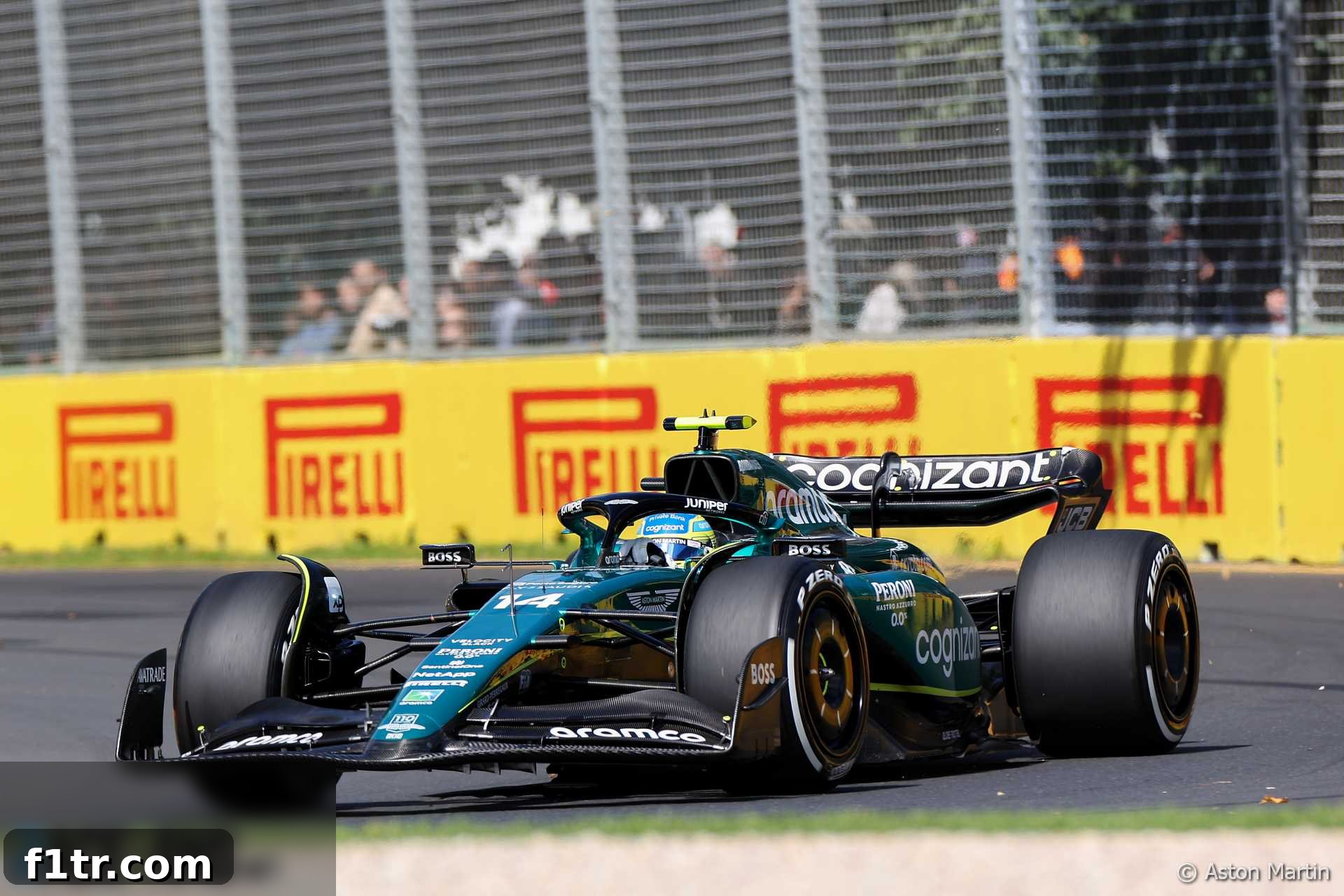
Fernando Alonso Dominates Rain-Hit Australian GP FP2 Amidst Shifting Conditions
Fernando Alonso showcased his formidable skill and the robust performance of his Aston Martin, clocking the fastest time in a tumultuous, rain-interrupted second free practice session for the Australian Grand Prix in Melbourne. His impressive lap placed him ahead of Charles Leclerc and Max Verstappen, setting a compelling tone for the weekend.
Advert | Become a Supporter & go ad-free
The veteran Aston Martin driver laid down his blistering 1’18.887 lap early in the session. This crucial timing proved instrumental, as just around the 15-minute mark, the heavens opened over Albert Park, dramatically altering track conditions and effectively halting any further improvements on the timing screens. Alonso’s benchmark was nearly half a second quicker than Charles Leclerc’s best effort in the Ferrari, underscoring both his pace and his strategic timing.
Anticipation was palpable as clouds, heavy with the threat of rain, had been hovering over Albert Park even before the session commenced. This led to a noticeable drop in ambient and track temperatures compared to the initial hour of practice. With a 40% risk of rain looming large, teams and drivers were acutely aware of the rapidly changing conditions. As the green light signaled the start of FP2, there was an immediate rush of cars onto the circuit. Drivers jostled for track position through the initial two sectors, eager to secure a clear patch of asphalt to commence their crucial qualifying simulation runs before the inevitable downpour.
Carlos Sainz Jnr of Ferrari was the first to successfully complete a flying lap, establishing the initial benchmark with a 1’20.378. Fernando Alonso quickly followed, slotting into second just half a tenth adrift of the Spaniard. The times continued to tumble rapidly as more drivers found their rhythm. Sainz was soon displaced by his Ferrari teammate Charles Leclerc, who demonstrated strong pace. However, it was Max Verstappen in the Red Bull who truly raised the bar, becoming the first driver to dip into the 1’19s, momentarily seizing the top spot.
Alonso, not one to rest on his laurels, pushed hard on his second flying lap on the medium compound tyres. He found well over a second of extra pace, vaulting himself back to the top of the leaderboard and establishing a significant eight-tenths advantage over Carlos Sainz, who also managed to improve on his subsequent effort. Meanwhile, Max Verstappen’s next push lap was prematurely abandoned after a rare mistake saw him run wide across the grass at the first corner, a moment that highlighted the fine margins at play even in practice.
Traffic management proved to be a persistent challenge throughout the session, mirroring issues observed in the earlier practice. The airwaves were once again filled with frustrated radio messages from drivers whose laps were compromised by slower rivals. Carlos Sainz, for instance, arrived at Turn 11 to find a cluster of cars struggling to clear the racing line, forcing him to abort his run. Similarly, Sergio Perez voiced his displeasure, reporting that two of his flying laps had been significantly hindered by the presence of Lance Stroll and Zhou Guanyu, respectively. These incidents underscored the tight nature of the Albert Park circuit and the difficulty of finding clear air during practice sessions, especially when drivers are on different programs or tyre compounds.
Barely ten minutes into the session, the first reports of light rain began to trickle in from various sections of the circuit. This prompted a flurry of activity in the pit lane as most of the field retreated to their garages. Some teams, in a gamble that conditions might not worsen immediately, opted to send their cars back out on soft dry tyres, hoping to extract one last performance lap. Both Fernando Alonso and Lando Norris embarked on flying laps with this strategy, but their efforts were quickly curtailed. Both drivers ran wide at the first corner due to the rapidly deteriorating grip levels, signaling that the dry tyre window had firmly closed.
As the grip levels clearly diminished with the increasing dampness on track, an eerie silence descended over the circuit. The majority of drivers returned to the relative safety of their garages, awaiting developments. After a lull of nearly ten minutes, Ferrari decided to test the waters again, sending both Sainz and Leclerc back out onto the circuit, once more fitted with soft dry tyres. Concurrently, George Russell of Mercedes also ventured out, this time equipped with intermediate tyres. Russell’s run was short-lived, as he quickly deemed the track too dry for the intermediate compound. Ferrari’s soft tyre gamble also yielded little success, as both cars promptly returned to the garage, their tyres struggling for purchase.
Lewis Hamilton and the two Alpine drivers, Esteban Ocon and Pierre Gasly, subsequently took to the track on intermediate tyres. However, their exploratory laps confirmed the mixed conditions, and they too returned to the pits after just a single tour. Max Verstappen, never one to shy away from testing the limits, was next to brave the conditions on his own. His radio message confirmed the obvious: the track was indeed wet. With his curiosity satisfied and data gathered, he also returned to his garage, having provided valuable feedback to his Red Bull engineers.
The rain then intensified further, with visible standing water beginning to accumulate on certain parts of the track. This prompted a more concerted effort from a group of teams, who sent their drivers out on intermediate tyres specifically to gather crucial data on how their cars would perform in proper wet weather conditions. The treacherous nature of the conditions was starkly demonstrated when Lance Stroll ran wide off the circuit at Turn 3, a stark reminder of the reduced grip. Both Lewis Hamilton and Nico Hulkenberg reported over team radio that the white road markings, common on street circuits, were proving particularly slippery under the wet conditions, posing an additional challenge to drivers.
Towards the final quarter of the session, the rain began to ease, and the track gradually started its slow process of drying. However, large patches of the circuit remained far too wet to even contemplate a switch back to slick tyres. The final minutes ticked by until the chequered flag, with the majority of the field making one last appearance on track. This allowed drivers to take advantage of the opportunity to perform valuable practice starts on the newly modified grid markings for this weekend, a critical exercise ahead of Sunday’s main event.
As the second practice session concluded, Fernando Alonso stood proudly at the top of the timings board with his 1’18.887. It was a significant achievement, though it’s worth noting that his fastest time was still slightly slower than Max Verstappen’s best effort from the earlier, fully dry FP1 session on soft tyres. Charles Leclerc secured the second-fastest time, approximately four-tenths adrift of the Aston Martin driver, indicating strong pace from Ferrari. Max Verstappen finished third, with George Russell impressing in fourth for Mercedes. Carlos Sainz rounded out the top five in the second Ferrari, followed by Esteban Ocon and Sergio Perez in sixth and seventh, respectively. Lando Norris, Nico Hulkenberg, and Pierre Gasly completed a diverse top ten, showcasing the competitive nature of the midfield in these challenging conditions.
Meanwhile, Williams driver Logan Sargeant did not participate in the second practice session. His car had stopped on track at the very end of FP1, and his team continued working tirelessly on it, prioritizing thorough checks and repairs rather than risking further issues in the complex FP2 conditions. This absence meant Sargeant lost valuable track time, a significant disadvantage for a rookie driver adapting to a new circuit and the demands of Formula 1.
2023 Australian Grand Prix Second Practice Result
| Position | Number | Driver | Team | Model | Time | Gap | Laps |
|---|---|---|---|---|---|---|---|
| 1 | 14 | Fernando Alonso | Aston Martin-Mercedes | AMR23 | 1’18.887 | 13 | |
| 2 | 16 | Charles Leclerc | Ferrari | SF-23 | 1’19.332 | 0.445 | 10 |
| 3 | 1 | Max Verstappen | Red Bull | RB19 | 1’19.502 | 0.615 | 12 |
| 4 | 63 | George Russell | Mercedes | W14 | 1’19.672 | 0.785 | 20 |
| 5 | 55 | Carlos Sainz Jnr | Ferrari | SF-23 | 1’19.695 | 0.808 | 12 |
| 6 | 31 | Esteban Ocon | Alpine-Renault | A523 | 1’19.725 | 0.838 | 12 |
| 7 | 11 | Sergio Perez | Red Bull | RB19 | 1’20.083 | 1.196 | 15 |
| 8 | 4 | Lando Norris | McLaren-Mercedes | MCL60 | 1’20.176 | 1.289 | 20 |
| 9 | 27 | Nico Hulkenberg | Haas-Ferrari | VF-23 | 1’20.194 | 1.307 | 19 |
| 10 | 10 | Pierre Gasly | Alpine-Renault | A523 | 1’20.206 | 1.319 | 12 |
| 11 | 22 | Yuki Tsunoda | AlphaTauri-Red Bull | AT04 | 1’20.220 | 1.333 | 18 |
| 12 | 77 | Valtteri Bottas | Alfa Romeo-Ferrari | C43 | 1’20.312 | 1.425 | 22 |
| 13 | 44 | Lewis Hamilton | Mercedes | W14 | 1’20.323 | 1.436 | 17 |
| 14 | 81 | Oscar Piastri | McLaren-Mercedes | MCL60 | 1’20.380 | 1.493 | 24 |
| 15 | 24 | Zhou Guanyu | Alfa Romeo-Ferrari | C43 | 1’20.470 | 1.583 | 22 |
| 16 | 18 | Lance Stroll | Aston Martin-Mercedes | AMR23 | 1’20.579 | 1.692 | 15 |
| 17 | 21 | Nyck de Vries | AlphaTauri-Red Bull | AT04 | 1’20.600 | 1.713 | 8 |
| 18 | 23 | Alexander Albon | Williams-Mercedes | FW45 | 1’21.182 | 2.295 | 18 |
| 19 | 20 | Kevin Magnussen | Haas-Ferrari | VF-23 | 1’21.266 | 2.379 | 18 |
| 20 | 2 | Logan Sargeant | Williams-Mercedes | FW45 | No time |
Advert | Become a RaceFans supporter andgo ad-free
2023 Australian Grand Prix
- Australian GP to forbid fans from entering track at end of this year’s race
- I only missed one chance to score points this year – Albon
- Formula 1’s stewards should listen to drivers less, not more
- Mercedes unsure whether gains seen in Melbourne were ‘track-specific’
- Why Ferrari saw a ‘real step forward in pure performance’ in point-less Australian GP
Browse all 2023 Australian Grand Prix articles