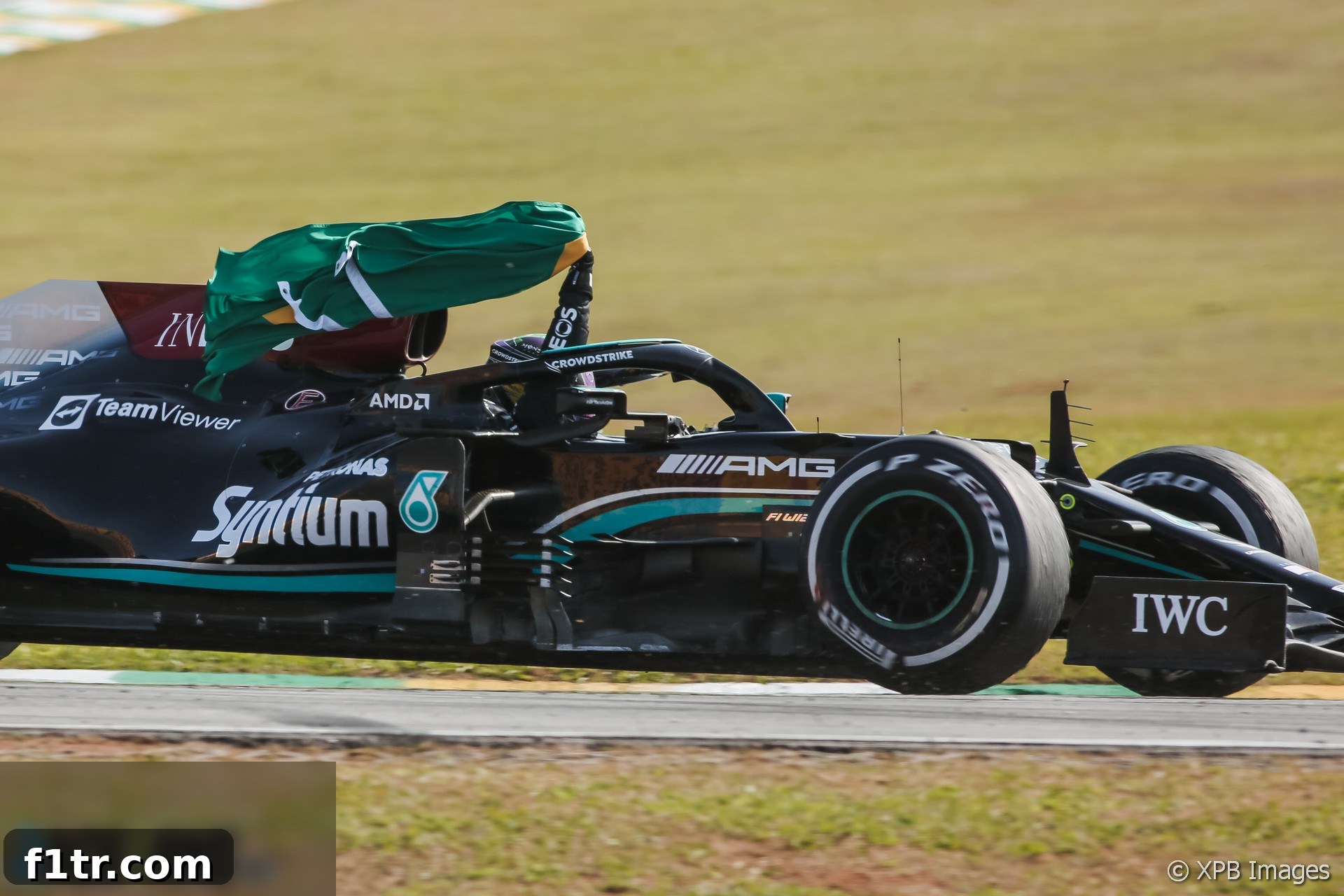
The 2021 Formula 1 season delivered one of its most captivating races at the Sao Paulo Grand Prix, an event that will undoubtedly be etched into the annals of motorsport history. Mercedes-AMG Petronas driver Lewis Hamilton showcased a performance of sheer brilliance, clinching the 101st victory of his illustrious career. This monumental achievement at Interlagos was made all the more remarkable by his starting position: a challenging 10th on the grid. His triumphant charge not only added another win to his formidable tally but also brought his number of career victories precisely level with his pole positions – a testament to his versatility and racecraft.
Enhance your reading experience. Become a Supporter & go ad-free.
Hamilton’s victory from P10 was far from a common occurrence, even for a driver of his caliber. This marked only the fifth occasion in his career where he has managed to win a Grand Prix after starting outside the front two rows of the grid. It stands as the second-lowest starting position from which he has tasted victory in a Grand Prix, surpassed only by his incredible triumph at the 2018 German Grand Prix, where he started from 14th place at Hockenheim. These exceptional comeback drives underscore Hamilton’s ability to navigate complex race scenarios, manage tire degradation, and execute decisive overtakes under immense pressure, consistently demonstrating why he is regarded as one of the greatest drivers in the sport’s history.
The groundwork for this heroic Sunday performance was laid during Saturday’s sprint qualifying race, where Hamilton executed an equally breathtaking ascent through the field. Despite starting from 20th place due to a technical infringement, he clawed his way up an astonishing 15 positions to finish fifth. While an incredible feat, this particular sprint race climb falls just short of his personal best for position gain in a single race session. That record remains his remarkable 19-place surge to third at the 2014 Hungarian Grand Prix, a season when Formula 1 grids still comprised 22 cars, making such a monumental gain even more challenging. These instances not only highlight his raw speed but also his unerring determination and strategic brilliance in adverse conditions.
The impact of this victory on the high-stakes championship battle was immediate and profound. Hamilton’s win significantly narrowed the points deficit to his primary rival, Max Verstappen, reducing it to a mere 14 points with only three races remaining in the season. To truly appreciate the intensity of this championship fight, one only needs to look back at the previous year. In 2020, Hamilton had already secured the drivers’ title with three races still to run, holding an overwhelming 110-point lead over his then-teammate Valtteri Bottas. The stark contrast between these two seasons underscores the fierce competition and dramatic twists that characterized the 2021 campaign.
Indeed, the 2021 championship race stood as the closest battle with three races left since the thrilling 2012 season. That year, Red Bull Racing’s Sebastian Vettel held a slender 13-point advantage over Ferrari’s Fernando Alonso. Vettel ultimately clinched the title by just three points in a nail-biting finale at the very same Interlagos circuit. This historical parallel offers a fascinating perspective and perhaps an encouraging sign for Verstappen and his Red Bull team. The circuit’s history of delivering dramatic, championship-deciding races only heightened the anticipation for the concluding rounds of the season, promising more edge-of-the-seat action for fans worldwide. The mental fortitude required to navigate such a close championship, balancing aggression with consistency, becomes paramount for both drivers and their respective teams.
The Sao Paulo Grand Prix also marked the third and final sprint qualifying race of the 2021 season, an experimental format designed to inject more excitement into the race weekend structure. Consistent with the trend established in the previous sprint weekends, the driver who topped the regular qualifying session on Friday did not ultimately start the Grand Prix from pole position. This pattern was partly influenced by various penalties, as seen with Hamilton’s grid drop. Instead, it was Valtteri Bottas who skillfully secured the 20th pole position of his career, a significant milestone that saw him draw level with the 1996 Formula 1 World Champion, Damon Hill. Bottas’s consistent qualifying speed throughout his career has been a standout feature, proving his ability to extract maximum performance from the car over a single lap, even under the new sprint format pressures.
In a strategic move characteristic of modern Formula 1, Red Bull opted to pit Sergio Perez in the closing stages of the main race. The objective was clear: to secure the crucial bonus point for setting the fastest lap, denying it to their championship rivals, Mercedes. Perez successfully executed this mandate, recording the sixth fastest lap of his career. This achievement placed him in an exclusive group of drivers, now on par with legends such as Jose Froilan Gonzalez, Mike Hawthorn, Phil Hill, Dan Gurney, Emerson Fittipaldi, Carlos Reutemann, and Heinz-Harald Frentzen. Such strategic plays for an additional point often prove vital in tightly contested constructors’ and drivers’ championships, showcasing the intricate balance between individual performance and team objectives.
Beyond the headline battle for the drivers’ championship, the fight for third place in the constructors’ standings provided its own compelling narrative. Ferrari demonstrated a remarkable resurgence, consistently out-scoring McLaren for the fourth consecutive race weekend. This impressive run of form saw a dramatic swing in their fortunes: from trailing McLaren by a noticeable 17.5 points just a few races prior, they now found themselves leading their British rivals by a significant margin of 31.5 points. While the fight for third place was not entirely over, McLaren faced an uphill battle, needing a sudden and substantial change in performance and luck to regain their competitive edge and challenge Ferrari in the remaining races. The financial and prestige implications of securing third place are immense, fueling the intensity of this particular constructors’ championship battle.
Further down the grid, another tight contest unfolded between Alpine and AlphaTauri for fifth place in the constructors’ championship. Entering the Sao Paulo Grand Prix level on points, both teams managed to score valuable points with three of their four cars participating in the race (each team having two cars, implying one from each team scored). Remarkably, despite their efforts, they left Interlagos still tied, each accumulating 112 points. This deadlock highlighted the incredibly even performance between the two midfield contenders and underlined the consistent efforts of their drivers and technical teams throughout the season. Every point in such a close fight becomes critical, influencing team morale, future investment, and standing within the sport’s competitive hierarchy.
Ultimately, Lewis Hamilton’s 101st Grand Prix victory marks a symbolic entry into his “second century” of wins. This milestone not only adds to his already legendary status but also sets a new benchmark for future generations of drivers. While achieving another hundred victories might seem an astronomical task, given the demanding nature of the sport and the increasing competition, his continued drive and passion for Formula 1 suggest that further records are certainly within reach. The Sao Paulo Grand Prix will be remembered not just for Hamilton’s individual brilliance, but for its profound implications across all facets of the 2021 Formula 1 season.
The Sao Paulo Grand Prix truly delivered on all fronts, providing countless talking points, dramatic moments, and crucial shifts in the championship narratives. Have you spotted any other interesting statistics, fascinating facts, or key insights from this memorable race weekend? Share your thoughts and observations in the comments section below, and join the discussion with fellow Formula 1 enthusiasts.
Support independent Formula 1 journalism. Become a RaceFans supporter and enjoy an ad-free experience.
More on the 2021 Sao Paulo Grand Prix
- Red Bull and Mercedes summoned to FIA hearing on review of Sao Paulo incident
- McLaren must “get back to scoring the results that are on the table” – Seidl
- Hamilton makes his second-biggest climb to victory from 10th on the grid
- F1 releases missing video footage from Verstappen’s car of Hamilton incident
- How Alonso and Ocon “pushed team tactics to the ultimate limit” to delay Gasly
Browse all 2021 Sao Paulo Grand Prix articles