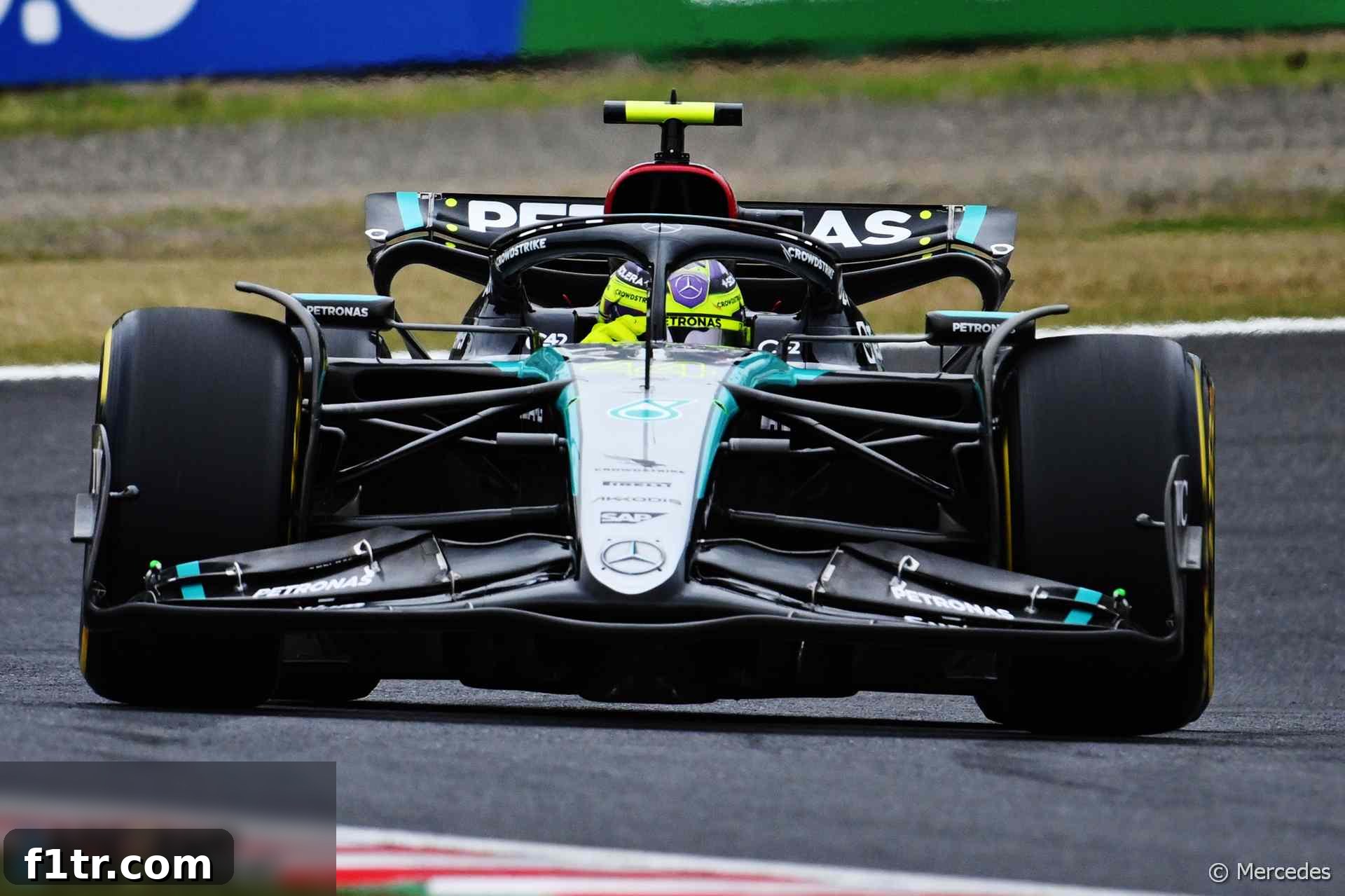
Mercedes Eyes Chinese Grand Prix Payoff: Hamilton and Russell Confident in Suzuka Learnings
As the Formula 1 circus arrives in Shanghai for the highly anticipated Chinese Grand Prix, Mercedes-AMG Petronas F1 Team drivers Lewis Hamilton and George Russell are expressing cautious yet palpable optimism. Despite the team not introducing any significant car upgrades for this weekend’s event – a particular challenge given the unique sprint race format with limited practice – both drivers believe the foundational knowledge gained from the previous race in Suzuka, Japan, will be instrumental in unlocking the W15’s potential.
The journey to understanding the intricacies of their 2024 challenger, the W15, has been a significant undertaking for Mercedes. Following a somewhat turbulent start to the season, the team has been relentless in its pursuit of performance. Hamilton highlighted this ongoing process, stating, “Nothing’s changed with that car, so it’s going to be the same car this weekend. But we understand it a little bit more than the last weekend.” This deeper understanding, rather than new hardware, is the cornerstone of their strategy for the Chinese Grand Prix.
Translating Suzuka Insights into Shanghai Performance
The Japanese Grand Prix offered crucial lessons for the Brackley-based squad. Hamilton elaborated on the team’s developmental progress: “We did make improvements and so [we’re] bringing some of those learnings into this weekend and then on top of that some new direction again. I think if we could go back, we would have done things differently, that’s the benefit of hindsight and experience.” This reflective approach indicates that Mercedes has been meticulously analyzing data and driver feedback from Suzuka to identify areas where setup or operational strategies could have been optimized.
The ability to translate these theoretical “learnings” into practical on-track performance will be critical in Shanghai. “So we’ll try and bring that here this weekend and see if we can implement some of those changes we would have perhaps done, perhaps further in Suzuka and hopefully that can find us a bit of performance,” Hamilton added. This suggests that certain setup philosophies or operational adjustments that might have been considered post-race in Japan will now be applied proactively in China, aiming to extract more pace from the W15 within its existing specifications. The team’s technical director and engineering staff will be working closely with both drivers to implement these changes effectively during the sole free practice session.
The Sprint Race Format: A Double-Edged Sword for Development
The return of the sprint race format at the Chinese Grand Prix adds another layer of complexity to Mercedes’ mission. With only a single 60-minute practice session before qualifying for the sprint race, the window for experimentation and setup optimization is incredibly narrow. This limited track time means that the insights gleaned from Suzuka are even more valuable, as there will be less opportunity for trial-and-error in Shanghai. Teams must arrive with a highly refined baseline setup and a clear understanding of their car’s characteristics. For Mercedes, leveraging their newfound knowledge of the W15 effectively will be paramount to navigate this demanding schedule and avoid being caught out by suboptimal configurations.
George Russell’s Circuit-Specific Analysis
Adding another dimension to the team’s outlook, Hamilton’s teammate George Russell provided a nuanced analysis of Mercedes’ season thus far, suggesting that the characteristics of recent circuits may have masked their true potential. “The last three races have all been largely very similar circuits, very high speed nature in Jeddah, in Melbourne, in Suzuka,” Russell explained. These tracks typically demand a car that is aerodynamically efficient and stable through fast corners, an area where the W15 has shown some inconsistencies.
Russell contrasted this with their performance in Bahrain, the season’s opening race: “We saw it was much more competitive in Bahrain, qualifying third and probably should have finished on the podium if it wasn’t for the [power unit] problem.” The Bahrain International Circuit features more heavy braking zones and a mix of corner speeds, which seemed to suit the W15’s characteristics better. This observation fuels the belief within the team that their car has a broader operating window than recent results suggest, and that finding the right balance for different track layouts is key.
The Impact of Track Characteristics on W15 Performance
The W15, like many modern F1 cars, operates within a very narrow performance window. Mercedes has openly discussed the challenges they face in consistently getting the car into this optimal zone. Russell’s comments underscore the sensitivity of the W15 to specific track characteristics. High-speed, sweeping circuits like Suzuka and Jeddah demand a particular aero balance and suspension setup that might have proven elusive for Mercedes. Conversely, circuits with more varied corner types and heavy braking, such as Bahrain, seem to allow the W15 to express more of its inherent potential.
The Chinese Grand Prix circuit presents its own unique challenges, with its iconic Turn 1-2-3 complex, long back straight, and tight hairpins. This diverse layout could potentially play into the W15’s strengths if the team can effectively apply their Suzuka learnings to optimize the car’s performance across different speed ranges. Managing tire degradation will also be a key factor, and Mercedes will hope their improved understanding of the W15 translates into better tire management over long stints.
Hindsight and the Path Forward
Russell echoed Hamilton’s sentiments regarding the benefit of hindsight from Suzuka: “with the benefit of hindsight, we would have done things differently.” This collective acknowledgment highlights the team’s transparent and analytical approach to problem-solving. While past opportunities cannot be recaptured, the insights gained are invaluable for future races. Russell’s pragmatic outlook reinforces the team’s focus: “But we can only focus on the here and now and focus on the improvements. It has only been four races.”
Indeed, with only four races completed in the 2024 Formula 1 season, the championship picture is far from settled. Mercedes currently sits fourth in the constructors’ championship, a single position ahead of Aston Martin, reflecting the tight competition in the midfield. This position is not where a team of Mercedes’ pedigree aims to be, and the pressure to climb up the standings is mounting. The Chinese Grand Prix, therefore, is not just another race; it’s a crucial opportunity for Mercedes to demonstrate that their development path is yielding tangible results.
The trust within the team remains strong, with Russell affirming, “We have things we need to improve and I trust the team is working their socks off to achieve that.” This commitment from every member of the Mercedes-AMG Petronas F1 Team, from the strategists to the engineers and mechanics, is vital. The iterative nature of Formula 1 car development means that every piece of data, every driver comment, and every setup change contributes to the overall puzzle. The goal is clear: to consistently unlock the W15’s maximum performance and challenge at the front of the grid.
As the lights prepare to go out in Shanghai, all eyes will be on Mercedes to see if their deep dive into the W15’s characteristics, fueled by the lessons from Suzuka, can indeed translate into a significant step forward. A strong showing in China would not only boost morale but also provide concrete evidence that their intensive analytical efforts are beginning to bear fruit, setting a positive trajectory for the remainder of the demanding Formula 1 season.
Formula 1 Insights & Analysis
- “Overtaking is overtaking”: Domenicali denies F1’s yo-yo racing is “artificial”
- The crashes F1 is trying to prevent may be rare – but the danger is obvious
- F1 returning to India soon after 2027 sounds like wishful thinking
- Verstappen loathes F1’s new generation of cars – but what do his rivals reckon?
- The ‘throwback weekend’ is back in fashion. But it’s a flawed concept – especially for F1
Browse all Formula 1 articles