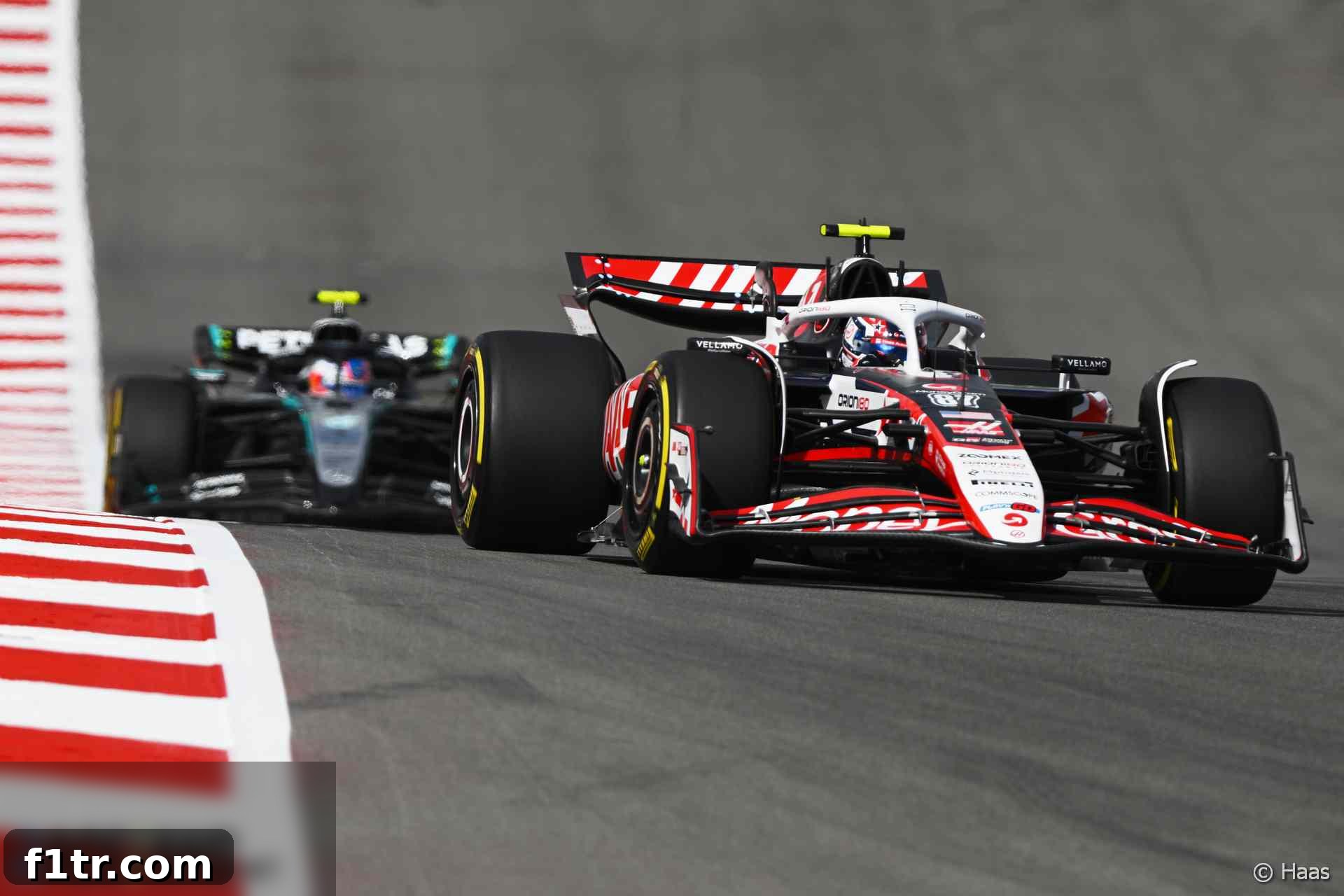
The intense world of Formula 1 often boils down to split-second decisions and the fine margins that separate glory from despair. A recent incident involving rising star Oliver Bearman and fellow prodigy Andrea Kimi Antonelli has ignited fresh debate, casting a spotlight on the sport’s controversial track limits regulations and the consistency of steward decisions. Bearman, driving for Haas, found himself at the center of this storm, vehemently criticizing the stewards’ call to penalize him for allegedly leaving the track while locked in a fierce wheel-to-wheel battle with Antonelli.
The incident, which occurred during a highly anticipated sprint race, ultimately cost the young Haas driver a valuable points-scoring position. Following an intense on-track skirmish, the race stewards handed Bearman a 10-second time penalty. Their reasoning was clear: he had left the track and, in doing so, gained an unfair advantage. This decision reverberated through the paddock and among fans, sparking immediate discussions about the fairness of the ruling and the subjective nature of racing interpretations.
The crucial moment unfolded at Turn 15, a challenging corner where Antonelli, a promising Mercedes junior driver, attempted an audacious inside pass on Bearman. As the two cars hurtled into the apex, Bearman ran wide, momentarily exceeding the white lines that define the track’s edge. The stewards, after reviewing the replays and telemetry, concluded that Antonelli had brought his car sufficiently alongside Bearman’s for his overtaking maneuver to be deemed legitimate. This assessment was pivotal in their subsequent penalty decision.
In their official notes, the stewards provided a detailed explanation of their ruling. They stated: “Car 12 [Antonelli] was attempting an overtake on car 87 [Bearman] on the inside into turn 12 [sic, presumably Turn 15] and had its front axle ahead of the mirrors of car 87 prior to and at the apex.” This specific detail is crucial in Formula 1 regulations, as it often establishes whether an attacking driver has “earned the right to the racing line.” The stewards continued, “Therefore car 12 had the right to use the full width of the track. Car 87 left the track on the outside while defending and rejoined the track in front of car 12.” Their analysis underscored that Antonelli had established a legitimate claim to the corner, necessitating Bearman to either yield or navigate the turn without gaining an advantage from running off track.
The final part of the stewards’ justification emphasized the outcome of Bearman’s action: “The stewards determine that Car 12 attempted a legitimate overtake, earned the right to the racing line according to the Driving Standard Guidelines and did not deliberately force car 87 off track, whereas car 12 gained a lasting advantage from leaving the track by maintaining its position.” This particular phrase, “gained a lasting advantage,” is frequently at the core of track limits penalties. It implies that by not losing time or position despite going off track, Bearman benefited unfairly from his excursion, thus warranting the time penalty.
However, Bearman himself presented a starkly contrasting perspective. Clearly frustrated and feeling unjustly treated, he immediately disagreed with the stewards’ interpretation of events. He strongly accused Antonelli of being the aggressor, suggesting he was deliberately forced off the racing surface rather than voluntarily leaving it to gain an advantage. “From my point of view, I felt like that was not a punishable offence,” Bearman asserted, highlighting his conviction that his actions were a natural consequence of the racing situation.
He elaborated on his reasoning, stating, “What happened there was simply getting pushed off the track and holding position. I don’t think I was in the wrong by staying where I was there.” Bearman’s comments underline a fundamental disagreement in how the incident was perceived: the stewards saw a driver gaining an advantage, while Bearman saw himself as a victim of aggressive driving, reacting to maintain his position after being pushed wide. This dichotomy often fuels the most heated debates in motorsport, where the line between hard racing and illicit maneuvering can appear incredibly thin.
The tension surrounding the incident was palpable even during the race. Bearman’s immediate reaction on the team radio provided a raw glimpse into his frustration. He queried his team, “is there any investigation for what happened with me and Antonelli?” When the dreaded news of a 10-second time penalty was relayed back to him, his exasperation was evident. Bearman’s incredulous response – “What the hell? That is incredible.” – perfectly captured his disbelief and strong disagreement with the stewards’ judgment. This unfiltered moment highlighted not just his personal disappointment, but also the broader challenges drivers face in adhering to strict track limits rules while engaging in high-stakes competition.
Such incidents are not isolated occurrences in Formula 1; they are a recurring theme that often sparks intense discussion among fans, experts, and former drivers. The debate over track limits and the interpretation of “gaining an advantage” has been ongoing for years, with various circuits and corners presenting unique challenges for enforcement. The consistency of steward decisions across different races and even different incidents remains a point of contention, with some arguing for stricter, more black-and-white rules, while others advocate for more nuanced, situational assessments.
Penalty Box: The Stewards’ Verdict Under Scrutiny
The penalty handed to Oliver Bearman against Andrea Kimi Antonelli has ignited a passionate debate across the Formula 1 community. Was it a fair application of the rules, or an overly harsh judgment on a young driver fighting hard for position? Share your perspective and join the discussion in the comments section below. Your insights help shape the ongoing conversation about racing standards and officiating in motorsport.
A RaceFans account is required to participate in discussions. If you do not have one, register an account here or read more about registering here.
2025 United States Grand Prix Related Articles
- Tsunoda apologised to Racing Bulls for “very unnecessary” comments on Lawson
- Sainz brands Mexican GP grid penalty “completely disproportionate”
- No more ‘repercussions’ for Norris: McLaren change stance after Austin collision
- Bearman feared he’d triggered ban with Antonelli incident in sprint race
- Every team except Sauber to run rookie driver during first practice in Mexico
Browse all 2025 United States Grand Prix articles