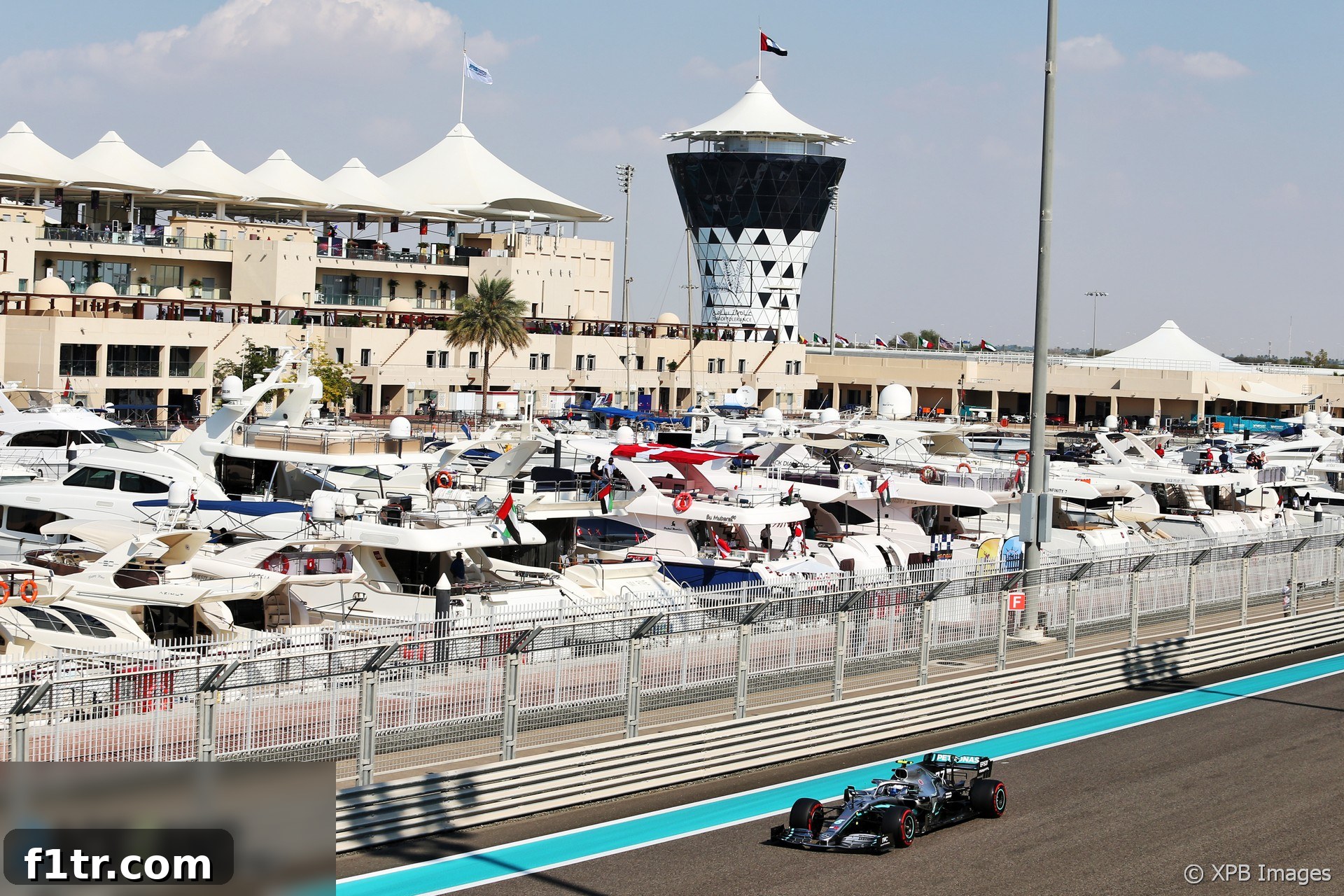
Valtteri Bottas Sets Blistering Pace in Abu Dhabi Grand Prix First Practice
The Valtteri Bottas show began with commanding authority in the opening practice session for the Abu Dhabi Grand Prix. Despite facing a significant grid penalty for Sunday’s race, the Mercedes driver comfortably topped the timings, demonstrating the raw power of a brand-new power unit in his W10.
Advert | Become a Supporter & go ad-free
Bottas’s Dominant Performance and Strategic Penalty
The FIA officially confirmed during the session that Bottas would start from the very back of the grid on Sunday. This penalty came as Mercedes opted to fit a completely new engine, turbocharger, and MGU-H (Motor Generator Unit – Heat) for the season finale. Despite this looming disadvantage, Bottas wasted no time showcasing the fresh power, setting a blistering pace in the opening 90 minutes of running at the Yas Marina Circuit.
His fastest lap placed him a formidable half-second clear of Max Verstappen’s Red Bull. What made Bottas’s performance even more impressive was that he achieved this advantage on the medium compound tyres, while his closest rival, Verstappen, was running on the softer, theoretically faster, Pirelli compound. This disparity in tyre choice and outright pace underscored Bottas’s strong start to the weekend, signaling his intent to fight through the field on Sunday despite the penalty. Mercedes’ decision to introduce a new power unit, knowing a penalty was inevitable, suggests a focus on gathering performance data and potentially preparing for the next season, or simply maximizing their chances for a strong points finish from Bottas by providing him with the most robust and powerful engine available.
The Unique Challenges of Yas Marina’s FP1 Conditions
The initial practice session at Yas Marina presents a unique challenge for teams and drivers. Held earlier in the day, the track experiences significantly hotter ambient and track temperatures compared to the crucial qualifying session and the race itself, both of which take place as dusk falls and under floodlights. These considerably hotter conditions often lead to notable shifts in the competitive order as the weekend progresses.
The elevated temperatures impact tyre performance, causing greater degradation and making it harder for drivers to extract optimal grip. Furthermore, engine cooling becomes more critical, and aerodynamic balance can be affected. Therefore, while Bottas’s raw pace was undeniable, teams understand that the true pecking order will only emerge once the sun sets and the track cools, bringing conditions closer to those expected for qualifying and the Grand Prix. Teams use FP1 primarily for basic setup work, verifying new components, and understanding tyre behavior under less representative conditions, before fine-tuning their cars in the cooler, more relevant sessions.
Session Disruptions: Red Flags for Vettel and Ricciardo
The first practice session was not without its drama, being interrupted by two separate red flag incidents, underscoring the demanding nature of the Yas Marina track. The session came to a premature halt in its closing stages when Sebastian Vettel, pushing hard in his Ferrari, spun spectacularly into the barrier at Turn 19. The Ferrari SF90 snapped away from him as he bounced over the apex kerb, losing control before making impact.
Vettel narrowly avoided the end of the TecPro barrier, but the left-rear wheel and suspension of his car crunched against the unforgiving Armco barrier, resulting in significant damage. The incident brought the session to an early conclusion, denying drivers valuable track time in the dying minutes. This was a frustrating start for Vettel, who was looking to end a challenging season on a high note, and the Ferrari mechanics faced a considerable repair job ahead of FP2.
Earlier, approximately half an hour into the session, the first red flag was deployed when Daniel Ricciardo’s Renault engine blew in a plume of smoke at the end of the lap. Fortunately for the Australian, his power unit was an older, high-mileage component that was scheduled for replacement anyway. As he was running an older engine that was already beyond its allocated life, replacing it for the remainder of the weekend would not incur an additional grid penalty, providing a small silver lining to an otherwise costly mechanical failure.
Hamilton’s Early Pace and the Competitive Landscape
As has become a tradition in recent years, Lewis Hamilton briefly sported the prestigious number one on the front of his Mercedes-AMG F1 W10 at the start of the first practice session at Yas Marina, a nod to his constructors’ championship triumph. His usual race number, 44, remained visible at the back of his car. Hamilton ended the session with the third-quickest time, a solid but not spectacular start to his weekend.
His session was somewhat hampered by his engine briefly entering ‘limp home’ mode earlier in the running. This precautionary setting typically reduces engine power and can be triggered by various sensor readings or potential issues, preventing further damage. While he recovered to set competitive lap times, it might have prevented him from challenging Bottas’s ultimate pace. Nevertheless, a third-place finish indicated that Mercedes still held a significant advantage over the field.
Behind the Mercedes duo and Verstappen, Alexander Albon continued his development at Red Bull, securing the fourth-fastest time, showcasing consistent form. He finished ahead of the unfortunate Sebastian Vettel, whose crash cost him valuable track time and a higher finishing position. Notably, Romain Grosjean had a strong outing in his Haas, claiming the sixth-quickest time after experimenting with a new setup on his VF-19. His performance narrowly out-paced Charles Leclerc in the other Ferrari, highlighting the potential improvements Haas had found.
Kevin Magnussen ensured both VF-19s featured prominently in the top eight, securing the eighth position, a rare strong showing for the American team. Antonio Giovinazzi continued his impressive late-season form, guiding his Alfa Romeo to ninth. Rounding out the top ten was Nico Hulkenberg, who began his final Formula 1 race weekend in a respectable tenth place, hoping to secure a strong farewell performance.
Midfield Scramble and Final Preparations
The midfield battle, as always, remained fiercely competitive. Lando Norris placed 11th for McLaren, followed by Lance Stroll in 12th for Racing Point. Kimi Raikkonen and Sergio Perez were hot on their heels, indicating how tightly packed the timesheets were outside the top few contenders. The Toro Rosso pair of Daniil Kvyat and Pierre Gasly ended up 15th and 16th respectively, while Carlos Sainz Jnr was a somewhat surprising 17th, suggesting McLaren still had work to do to dial in their car for the specific demands of Yas Marina.
At the very back, the Williams cars of Robert Kubica and George Russell continued their season-long struggle for pace, finishing 18th and 20th. Daniel Ricciardo, despite his engine failure, managed 19th after his limited running. The session provided crucial data for all teams, especially regarding tyre compounds and setup adjustments for the changing conditions that define the Abu Dhabi Grand Prix weekend.
Advert | Become a RaceFans supporter andgo ad-free
Abu Dhabi Grand Prix FP1 Results: A Snapshot of Speed
Here’s a detailed breakdown of the lap times from the first practice session at Yas Marina, showcasing the initial pecking order before significant track evolution and temperature changes take effect:
| Pos. | No. | Driver | Car | Best lap | Gap | Laps |
|---|---|---|---|---|---|---|
| 1 | 77 | Valtteri Bottas | Mercedes | 1’36.957 | 23 | |
| 2 | 33 | Max Verstappen | Red Bull-Honda | 1’37.492 | 0.535 | 22 |
| 3 | 44 | Lewis Hamilton | Mercedes | 1’37.591 | 0.634 | 20 |
| 4 | 23 | Alexander Albon | Red Bull-Honda | 1’38.084 | 1.127 | 23 |
| 5 | 5 | Sebastian Vettel | Ferrari | 1’38.906 | 1.949 | 19 |
| 6 | 8 | Romain Grosjean | Haas-Ferrari | 1’39.146 | 2.189 | 18 |
| 7 | 16 | Charles Leclerc | Ferrari | 1’39.249 | 2.292 | 18 |
| 8 | 20 | Kevin Magnussen | Haas-Ferrari | 1’39.350 | 2.393 | 19 |
| 9 | 99 | Antonio Giovinazzi | Alfa Romeo-Ferrari | 1’39.423 | 2.466 | 20 |
| 10 | 27 | Nico Hulkenberg | Renault | 1’39.505 | 2.548 | 22 |
| 11 | 4 | Lando Norris | McLaren-Renault | 1’39.628 | 2.671 | 18 |
| 12 | 18 | Lance Stroll | Racing Point-Mercedes | 1’39.864 | 2.907 | 23 |
| 13 | 7 | Kimi Raikkonen | Alfa Romeo-Ferrari | 1’39.888 | 2.931 | 17 |
| 14 | 11 | Sergio Perez | Racing Point-Mercedes | 1’39.901 | 2.944 | 17 |
| 15 | 26 | Daniil Kvyat | Toro Rosso-Honda | 1’39.969 | 3.012 | 20 |
| 16 | 10 | Pierre Gasly | Toro Rosso-Honda | 1’40.401 | 3.444 | 17 |
| 17 | 55 | Carlos Sainz Jnr | McLaren-Renault | 1’40.687 | 3.730 | 23 |
| 18 | 88 | Robert Kubica | Williams-Mercedes | 1’40.792 | 3.835 | 21 |
| 19 | 3 | Daniel Ricciardo | Renault | 1’40.850 | 3.893 | 12 |
| 20 | 63 | George Russell | Williams-Mercedes | 1’41.362 | 4.405 | 24 |
First practice visual gaps: A Closer Look at Lap Time Differences
This visual representation highlights the time difference between drivers, illustrating the competitive margins across the grid during the first practice session.
Valtteri Bottas – 1’36.957
+0.535 Max Verstappen – 1’37.492
+0.634 Lewis Hamilton – 1’37.591
+1.127 Alexander Albon – 1’38.084
+1.949 Sebastian Vettel – 1’38.906
+2.189 Romain Grosjean – 1’39.146
+2.292 Charles Leclerc – 1’39.249
+2.393 Kevin Magnussen – 1’39.350
+2.466 Antonio Giovinazzi – 1’39.423
+2.548 Nico Hulkenberg – 1’39.505
+2.671 Lando Norris – 1’39.628
+2.907 Lance Stroll – 1’39.864
+2.931 Kimi Raikkonen – 1’39.888
+2.944 Sergio Perez – 1’39.901
+3.012 Daniil Kvyat – 1’39.969
+3.444 Pierre Gasly – 1’40.401
+3.730 Carlos Sainz Jnr – 1’40.687
+3.835 Robert Kubica – 1’40.792
+3.893 Daniel Ricciardo – 1’40.850
+4.405 George Russell – 1’41.362
Drivers more than ten seconds off the pace omitted from the visual gap graph.
Looking Ahead: The Road to the Race
With First Practice concluded, teams will now meticulously analyze the data gathered, adjusting their setups in anticipation of the cooler, more representative conditions of FP2 and FP3 later in the weekend. Valtteri Bottas’s dominant display, despite his impending grid penalty, sets an intriguing tone for the final race of the season. His ability to extract such pace on medium tyres suggests Mercedes’ strong baseline performance and his personal determination.
The Red Bulls and Ferraris will be working hard to close the gap as track conditions evolve, while the midfield teams will continue their relentless battle for every tenth of a second. The red flags served as a reminder of Yas Marina’s challenges, especially with drivers pushing the limits. All eyes will now turn to the qualifying session, where the true grid positions will be decided, setting the stage for an exciting season finale at the Abu Dhabi Grand Prix.
Advert | Become a RaceFans supporter andgo ad-free
More on the 2019 Abu Dhabi Grand Prix
For further insights and analyses from this exciting race weekend, explore our related articles:
- 2019 Abu Dhabi Grand Prix Star Performers
- Leclerc would welcome Hamilton as Ferrari team mate
- Vettel aiming for small improvements and fewer mistakes in 2020
- Perez praises Norris’s driving after last-lap pass
- Dominant Hamilton shows F1’s new generation the way in 2019 finale
Browse all 2019 Abu Dhabi Grand Prix articles