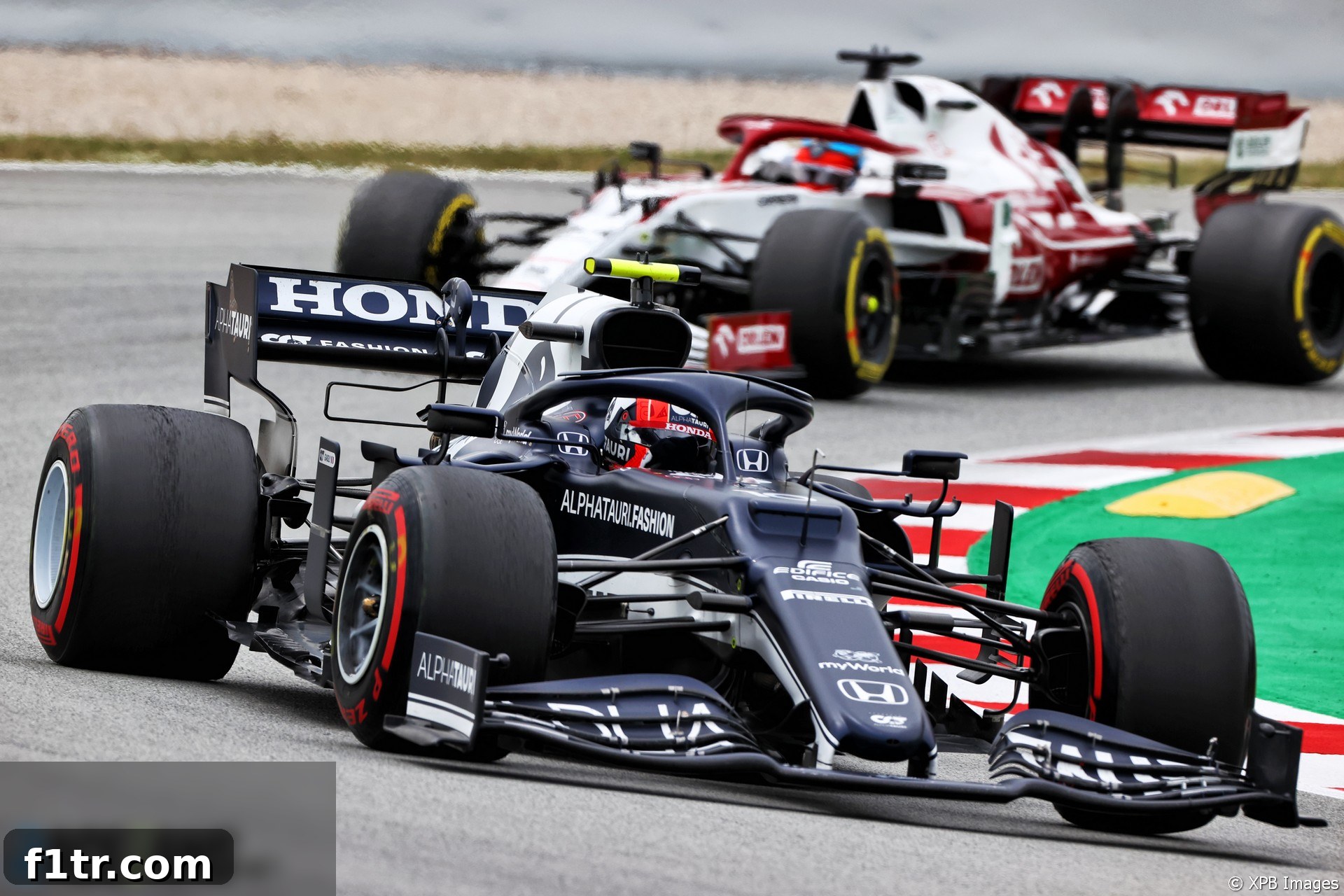
In the high-stakes world of Formula 1, precision is paramount, and every millimeter on the track can determine success or failure. This was starkly evident for AlphaTauri driver Pierre Gasly at the 2021 Spanish Grand Prix, where a seemingly minor misjudgment on the starting grid led to significant repercussions. Gasly was assessed a five-second time penalty during the race and, more notably, received a penalty point on his Super Licence for failing to position his car correctly on the grid ahead of the race start.
The incident, captured clearly by his onboard camera, revealed that Gasly’s AlphaTauri AT02 was positioned slightly ahead of the designated grid hatchings when the lights went out for the start of the race from his 12th-place grid slot. This infringement, though small, violates stringent regulations designed to ensure fair play and safety at the outset of a Grand Prix. The stewards, after reviewing the evidence, swiftly applied the penalties, highlighting Formula 1’s zero-tolerance policy for such errors.
Understanding Grid Infringements and F1 Penalties
The regulations governing starting grid positions are meticulously enforced in Formula 1. Each driver is assigned a specific grid box, marked by white lines, and must ensure their car is entirely contained within these boundaries. The front wheels, in particular, must not cross the forward-most line before the start signal is given. This rule is crucial to prevent any driver from gaining an unfair advantage, even by a fraction of a second, which can have a ripple effect throughout the field in a sport where milliseconds matter.
Stewards utilize advanced telemetry and high-definition onboard camera footage to monitor every car’s position with absolute accuracy. When an infringement like Gasly’s occurs, a standard procedure involves a time penalty applied during the race – typically five or ten seconds – and a penalty point on the driver’s Super Licence. The time penalty directly impacts the driver’s immediate race result, forcing them to push harder or drop positions after a pit stop, while the penalty points contribute to a cumulative total that could lead to a race ban if a driver accrues 12 points within a 12-month period.
For Gasly, the five-second penalty was a significant setback early in the race. Starting from the middle of the pack on the Circuit de Barcelona-Catalunya, a track notoriously difficult for overtaking, he faced an uphill battle. Despite this challenge, the French driver showcased remarkable resilience and skill, executing a strong recovery drive. He managed to overcome the time penalty and fight his way through the highly competitive midfield, ultimately securing the final championship point by finishing in tenth place. This performance underlined his ability to adapt under pressure and extract maximum performance from his car, even when adverse circumstances are stacked against him.
Gasly’s Reaction: A Candid Apology and Mixed Feelings
Following the chequered flag, a visibly contrite Gasly took to the team radio to offer a heartfelt apology to his AlphaTauri crew. “I’m sorry for the penalty,” he stated, adding, “I thought I was fine but that’s very silly.” This candid admission reflected his immediate disappointment in himself for making what he perceived as an avoidable error. Such a mistake, especially at the start of a race, can derail an entire strategy and waste the meticulous preparation put in by both driver and team. His self-reproach highlighted the immense pressure F1 drivers operate under, where even the slightest lapse in concentration can have significant consequences.
Reflecting on the Spanish Grand Prix as a whole, Gasly expressed “mixed feelings.” While proud of his impressive recovery drive that saw him salvage a point, he couldn’t hide his frustration with the team’s overall pace compared to the season’s opening rounds. “I think in the race I made a good recovery but we’re really lacking pace compared to the first two rounds, which is frustrating,” he commented. This candid assessment pointed to deeper performance issues that AlphaTauri needed to address, suggesting that the AT02 was not performing to its full potential at Catalunya, a circuit known for exposing car weaknesses.
The Significance of Penalty Points in Formula 1
The penalty point received by Pierre Gasly is his first within the current 12-month period of the Super Licence system. While a single point is far from the critical threshold, it serves as a stark reminder of the continuous scrutiny and disciplinary framework within Formula 1. The Super Licence penalty points system was implemented to curb dangerous driving and repeat infringements, ensuring drivers maintain a high standard of conduct and safety on track. Accumulating 12 penalty points within a rolling 12-month period results in an automatic one-race ban, a severe consequence that can significantly impact a driver’s championship aspirations and a team’s performance.
For a driver of Gasly’s caliber, who has demonstrated his speed and maturity over several seasons, this first penalty point serves as a minor blot on an otherwise strong disciplinary record. It underscores the razor-thin margins and the absolute necessity for perfection required at every stage of a Grand Prix weekend, from qualifying to the final lap. Drivers are constantly balancing aggressive driving with adherence to the rules, and a simple grid alignment error highlights how even seasoned professionals can fall victim to human error under immense pressure.
AlphaTauri’s Performance Trajectory and Future Ambitions
Gasly’s comments about the car’s pace shed light on AlphaTauri’s ongoing development challenges in the intensely competitive midfield. “I’m upset with myself for making the mistake on the grid, it’s a very silly penalty to get and it made my life harder. That being said, I had some good battles in the race and managed to pass a few cars to make it into 10th place,” he elaborated. This shows his personal accountability combined with an objective assessment of the car. While the AT02 has shown flashes of brilliance, particularly in qualifying, achieving consistent race pace across different circuit characteristics remains a key area for improvement. The Circuit de Barcelona-Catalunya, with its demanding mix of high-speed corners and technical sections, often serves as a true test of a car’s aerodynamic efficiency and balance.
Despite the frustrations, Gasly remains optimistic about the team’s potential. “The car definitely has potential, we just haven’t made it work consistently in all corners around the lap yet,” he affirmed. This perspective is crucial for team morale and development. Identifying specific areas where the car struggles, rather than a general lack of pace, allows engineers to focus their efforts more effectively. The AlphaTauri team, known for its agile development capabilities and close ties with Red Bull Racing, will be working tirelessly to unlock this potential.
Looking ahead, Gasly’s focus immediately shifted to the next iconic challenge on the F1 calendar: the Monaco Grand Prix. “We’re going to work hard now ahead of Monaco and I trust in the team to make some steps forward in the next few races,” he stated. Monaco, with its unique street circuit demands, requires a completely different car setup, emphasizing maximum downforce and precise handling. A strong performance there could reset the narrative for both Gasly and AlphaTauri, proving their ability to adapt and compete at the highest level. The team’s commitment to continuous improvement and Gasly’s unwavering determination will be critical as they navigate the remainder of the 2021 Formula 1 season, striving to convert their car’s inherent potential into consistent point-scoring finishes.
2021 Spanish Grand Prix Insights and Analysis
- Two reasons why Catalunya may not predict the championship – at least this year
- McLaren to keep “drip-feeding” updates onto 2021 car
- Working group tackling F1’s track limits problem
- ‘We’ll discuss what went wrong’: Hamilton and Verstappen team radio transcript analysis
- 2021 Spanish Grand Prix Star Performers
Browse all 2021 Spanish Grand Prix articles